

GCC Expanded Polystyrene (EPS) Market Research Report: Forecast (2026-2032)
By Product Type (White Expanded Polystyrene, Grey Expanded Polystyrene, Black Expanded Polystyrene, High-Density Expanded Polystyrene), By Price Range (Low Price, Mid-Price, High P ... rice, Others), By End-User (Building & Construction, Packaging Food & Beverage, Electronics, Healthcare / Pharmaceutical, Transportation & Automotive, Agriculture, Appliances), By Distribution Channel (Direct Sales, Distributors/Dealers, Online Sales, Retail Outlets, Others, Others), and others Read more
- Chemicals
- Mar 2026
- Pages 280
- Report Format: PDF, Excel, PPT
GCC Expanded Polystyrene (EPS) Market
Projected 7.72% CAGR from 2026 to 2032
Study Period
2026-2032
Market Size (2026)
USD 320 Million
Market Size (2032)
USD 500 Million
Base Year
2025
Projected CAGR
7.72%
Leading Segments
By End-User: Building & Construction
GCC Expanded Polystyrene (EPS) Market Report Key Takeaways:
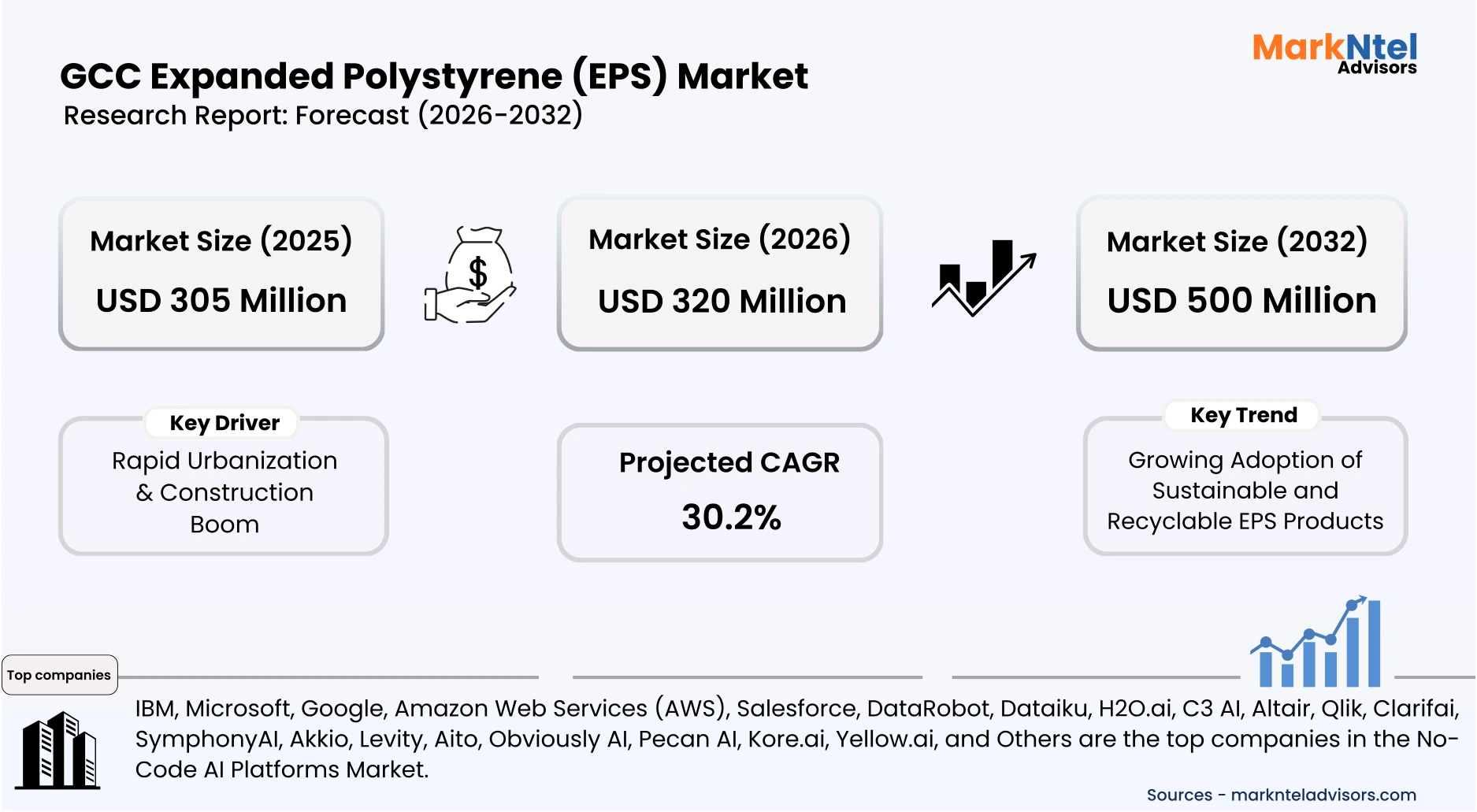
- The GCC Expanded Polystyrene (EPS) Market size was valued at USD 305 million in 2025 and is projected to grow from USD 320 million in 2026 to USD 500 million by 2032, exhibiting a CAGR of 7.72% during the forecast period.
- Saudi Arabia holds the largest market share of about 36% in the GCC Expanded Polystyrene (EPS) Market in 2026.
- By product type, the white expanded polystyrene segment represented a significant share of about 58% in the GCC Expanded Polystyrene Market in 2026.
- By end-user, the building & construction segment seized a significant share of about 64% in the GCC Expanded Polystyrene Market in 2026.
- Leading expanded polystyrene companies in the GCC region are BASF, TotalEnergies, SABIC, Ravago Manufacturing, Kuwait Styrene Company (TKSC), STYROQ, Kaneka Corporation, Al Muhaidib Polystyrene Production Co., National Polystyrene Packaging Factory (NPPF), SUNPOR, and Others.
Market Insights & Analysis: GCC Expanded Polystyrene Market (2026-32):
The GCC Expanded Polystyrene Market size was valued at USD 305 million in 2025 and is projected to grow from USD 320 million in 2026 to USD 500 million by 2032. Along with this, the market is estimated to grow at a CAGR of around 7.72% during the forecast period, i.e., 2026-32.
The GCC Expanded Polystyrene Market is witnessing significant growth, primarily driven by rapid urbanization and large-scale construction projects. The demand for lightweight, thermally efficient, and versatile building materials has surged as governments in the region invest heavily in residential, commercial, and infrastructure developments. High-end projects such as the One&Only One Za’abeel mixed-use development in Dubai have leveraged EPS for thermal insulation and structural performance. The material’s lightweight nature and high R-value contributed to reducing energy consumption and improving building envelope efficiency, demonstrating EPS’s critical role in modern construction .
Beyond building applications, EPS geofoam blocks have been applied in civil engineering projects, such as the Al Khaleej Street Tunnel in Dubai, for lightweight embankment and void filling. These applications improve soil stabilization, reduce settlement pressures under road infrastructure, and accelerate project timelines, highlighting EPS’s value in both structural and geotechnical solutions .
A notable trend shaping the market is the growing adoption of sustainable and recyclable EPS products, driven by government regulations and circular economy initiatives. Under the Single-Use Plastics Policy, Abu Dhabi banned non-recyclable EPS food containers starting June 2024, compelling foodservice providers and manufacturers to shift toward recyclable EPS alternatives or biodegradable foams. This regulation has stimulated the EPS market to produce eco-friendly, recyclable products, particularly for food and beverage packaging, and is expected to encourage broader adoption of sustainable EPS across the GCC.
Looking ahead, the GCC EPS market is poised to grow further as urban expansion, mega infrastructure projects, and sustainability mandates converge. High-density EPS applications in construction, civil engineering, and industrial packaging will continue to drive demand, while regulatory support for recyclable and sustainable EPS solutions will reinforce the market’s long-term resilience. Manufacturers who can innovate in eco-friendly EPS products and provide solutions that meet both performance and environmental requirements are expected to capture a larger share of this evolving market.
Overall, the GCC EPS market combines the drivers of urbanization, construction growth, and regulatory support for sustainability, ensuring robust demand across building, infrastructure, and packaging sectors. The push toward eco-friendly, high-performance EPS is likely to sustain market growth while aligning with regional environmental goals.
GCC Expanded Polystyrene Market Scope:
| Category | Segments |
|---|---|
| By Product Type | (White Expanded Polystyrene, Grey Expanded Polystyrene, Black Expanded Polystyrene, High-Density Expanded Polystyrene), |
| By Price Range | (Low Price, Mid-Price, High Price, Others), |
| By End-User | (Building & Construction, Packaging Food & Beverage, Electronics, Healthcare / Pharmaceutical, Transportation & Automotive, Agriculture, Appliances), |
| By Distribution Channel | (Direct Sales, Distributors/Dealers, Online Sales, Retail Outlets, Others, Others), |
GCC Expanded Polystyrene Market Driver:
Rapid Urbanization & Construction Boom
The UAE’s ongoing urbanization and large-scale infrastructure development are significant drivers for the Expanded Polystyrene (EPS) market in the GCC. Major cultural and infrastructure projects, such as the National History Museum in Abu Dhabi, have employed EPS extensively for void filling, floor raising, and lightweight fill applications. These applications help reduce structural loads, accelerate construction schedules, and optimize building efficiency. The use of EPS geofoam blocks in landscaping and podium construction demonstrates the material’s versatility in supporting complex architectural designs while maintaining cost-effectiveness and energy efficiency.
Similarly, projects on Yas Island have leveraged EPS blocks for landscaping and podium fill, where their lightweight nature and high thermal performance are critical for both exterior infrastructure and environmental management . These applications highlight EPS’s role in enhancing project sustainability by improving thermal insulation, reducing material use, and simplifying installation processes.
The rapid pace of construction, coupled with government-backed urbanization initiatives across the UAE and broader GCC, continues to fuel EPS consumption in large-scale projects. With ongoing and planned developments, including residential, commercial, and mixed-use infrastructure, the demand for EPS as a lightweight, thermally efficient, and versatile construction material is expected to grow steadily in the coming years.
Overall, Urban expansion and infrastructure projects are central to GCC economies, making EPS indispensable for construction and landscaping applications. Its functional advantages ensure it remains a critical material, driving consistent market growth.
GCC Expanded Polystyrene Market Trend:
Growing Adoption of Sustainable and Recyclable EPS Products
A significant trend shaping the GCC Expanded Polystyrene (EPS) market is the shift toward sustainable and recyclable EPS solutions, driven by regulatory mandates and circular economy initiatives. In Abu Dhabi, the Single-Use Plastics Policy, effective June 2024, banned non-recyclable EPS food containers. This move forced foodservice providers and manufacturers to transition to recyclable EPS alternatives or biodegradable foams, directly stimulating the demand for eco-friendly EPS products in the food and beverage packaging segment. By promoting recyclable materials, the policy encourages manufacturers to innovate while supporting environmental sustainability.
Similarly, in Saudi Arabia, the Saudi Investment Recycling Company (SIRC) partnered with the Alliance to End Plastic Waste (AEPW) in 2024 to establish large-scale EPS recycling infrastructure. The program focuses on converting post-consumer and post-construction EPS into reusable pellets suitable for new construction and packaging materials. This initiative strengthens the circular economy in the Kingdom, providing manufacturers with access to recycled raw materials and promoting eco-friendly EPS adoption in both industrial and commercial applications.
Together, these initiatives highlight how government policies and collaborative sustainability programs are driving the GCC EPS market toward environmentally responsible products. As regulatory pressure and recycling infrastructure expand, manufacturers are increasingly producing recyclable EPS for packaging and construction, ensuring the market grows sustainably while meeting environmental compliance standards.
GCC Expanded Polystyrene Market Opportunity:
Increasing Demand for High-Density EPS Products
A key opportunity for the GCC Expanded Polystyrene (EPS) market is the rising need for high‑density EPS products, which offer superior mechanical strength, compressive performance, and long‑term stability compared with standard grades. High‑density EPS (typically >0.06 g/cm³) is especially valuable in demanding structural and environmental conditions, including insulated concrete forms (ICFs), civil engineering geofoam, and heavy‑load installations such as road embankments, foundations, and industrial flooring. These applications require materials that can support weight without deformation and provide robust insulation in challenging construction environments.
In the construction and infrastructure sectors across the GCC, governments are prioritizing projects that emphasize durability and lifecycle performance. EPS grades with high compressive strength help meet stringent building codes and energy efficiency goals in new developments and retrofits. Their use in infrastructure like embankments and retaining walls offers substantial advantages over traditional fill materials by minimizing settlement issues and reducing installation time.
Beyond construction, high‑density EPS serves cold storage facilities and industrial insulation where stable temperature control is essential, helping companies comply with regulatory requirements for pharmaceuticals and food logistics.
Overall, the shift toward structural and performance‑focused EPS applications represents a clear opportunity for manufacturers and suppliers to expand their high‑density EPS portfolios, aligning with GCC infrastructure growth and sustainability objectives.
GCC Expanded Polystyrene Market Challenge:
Increasing Cost Due to Complex Environmental & Regulatory Framework
A significant challenge for the GCC Expanded Polystyrene (EPS) market is the increasing environmental and regulatory pressure on non-recyclable EPS products. In the United Arab Emirates, the Environment Agency, Abu Dhabi (EAD) implemented a key part of its Single‑Use Plastic Policy, which became effective from June 2024. This regulation bans several single-use EPS products, including cups, lids, plates, and takeaway containers, targeting consumer items that are easily discarded and contribute to plastic pollution. The policy aims to reduce environmental contamination, particularly microplastics, and encourages the use of reusable or recyclable alternatives.
This regulatory move presents a challenge for EPS manufacturers and suppliers who have traditionally relied on non-recyclable EPS grades for packaging applications. Companies must now restructure production lines, invest in recyclable EPS formulations, and redesign packaging solutions to comply with the new law. These adaptations can increase operational costs and require additional capital, particularly for smaller manufacturers who may lack advanced recycling technology.
While the policy promotes sustainability, it also underscores the necessity for EPS producers to innovate quickly. Failure to comply risks losing market access and customer trust, particularly in environmentally conscious markets within the UAE and the broader GCC region.
Overall, the EAD ban highlights the regulatory and environmental pressures confronting non-recyclable EPS products, compelling manufacturers to adopt sustainable alternatives or face compliance and financial challenges.
GCC Expanded Polystyrene Market (2026-32) Segmentation Analysis:
The GCC Expanded Polystyrene Market study of MarkNtel Advisors evaluates & highlights the major trends and influencing factors in each segment. It includes predictions for the period 2026–32 at the regional level. Based on the analysis, the market has been further classified as;
Based on Product Type:
-
- White Expanded Polystyrene
- Grey Expanded Polystyrene
- Black Expanded Polystyrene
- High-Density Expanded Polystyrene
White Expanded Polystyrene dominates the GCC market, accounting for approximately 58% of total consumption. Its widespread adoption is primarily due to its exceptional thermal insulation properties, lightweight nature, and cost-effectiveness, making it ideal for both residential and commercial applications. White EPS is extensively used in construction for wall insulation, roofing, and prefabricated panels, where energy efficiency and temperature regulation are critical, particularly in the GCC’s hot climate.
Additionally, its versatility extends to packaging, where it protects sensitive goods during transportation. Manufacturers prefer white EPS because it allows easier customization, cutting, and molding compared to high-density or colored variants. Environmental considerations, such as recyclability and reduced material usage, further enhance its preference over black, grey, or high-density EPS. Overall, the combination of thermal performance, affordability, and adaptability drives the strong market share of white EPS in the region.
Based on End-User:
-
- Building & Construction
- Packaging Food & Beverage
- Electronics
- Healthcare / Pharmaceutical
- Transportation & Automotive
- Agriculture
- Appliances
The Building & Construction sector is the largest end-user of EPS in the GCC, representing around 64% of the market. The region’s booming real estate and infrastructure projects, coupled with the demand for energy-efficient buildings, have significantly driven EPS consumption. White EPS is particularly favored for insulating walls, roofs, and floors, reducing cooling costs in the region’s predominantly hot climate.
Moreover, EPS is lightweight, easy to transport, and simple to install, which aligns well with large-scale construction projects. Government regulations promoting green buildings and sustainable construction further boost its use. EPS also contributes to structural strength in prefabricated construction panels while ensuring sound insulation. Consequently, the synergy between high demand for energy-efficient, cost-effective, and lightweight building materials ensures that the Building & Construction sector continues to lead EPS consumption in the GCC.
GCC Expanded Polystyrene Market (2026-32): Regional Projection
The GCC Expanded Polystyrene (EPS) Market is dominated by Saudi Arabia, accounting for 36% of the market size. The country leads due to its rapid urbanization, large-scale infrastructure projects, and government-backed construction initiatives, including residential, commercial, and industrial developments. High adoption of EPS in building insulation, lightweight fill, and industrial packaging drives demand across sectors.
Saudi Arabia’s dominance is further supported by significant investment in mega projects such as NEOM, the Red Sea Project, and Qiddiya, which require large volumes of high-density EPS for construction, landscaping, and insulation applications. Additionally, government policies promoting energy-efficient and sustainable construction have encouraged the use of EPS for thermal insulation and lightweight structural solutions.
These factors, combined with well-established manufacturing and distribution networks, make Saudi Arabia the largest regional consumer of EPS in the GCC. The country’s ongoing focus on modern urban development and construction efficiency is expected to maintain its leading position in the market over the coming years.
Gain a Competitive Edge with Our GCC Expanded Polystyrene Market Report:
- GCC Expanded Polystyrene Market Report by MarkNtel Advisors provides a detailed & thorough analysis of market size & share, growth rate, competitive landscape, and key players. This comprehensive analysis helps businesses gain a holistic understanding of the market dynamics & make informed decisions.
- This report also highlights current market trends & future projections, allowing businesses to identify emerging opportunities & potential challenges. By understanding market forecasts, companies can align their strategies & stay ahead of the competition.
- GCC Expanded Polystyrene Market Report aids in assessing & mitigating risks associated with entering or operating in the market. By understanding market dynamics, regulatory frameworks, and potential challenges, businesses can develop strategies to minimize risks & optimize their operations.
*Reports Delivery Format - Market research studies from MarkNtel Advisors are offered in PDF, Excel and PowerPoint formats. Within 24 hours of the payment being successfully received, the report will be sent to your email address.
Frequently Asked Questions
- Market Segmentation
- Introduction
- Product Definition
- Research Process
- Assumptions
- Executive Summary
- GCC Expanded Polystyrene Market Policies, Regulations, and Product Standards
- GCC Expanded Polystyrene Market Trends & Developments
- GCC Expanded Polystyrene Market Dynamics
- Growth Factors
- Challenges
- GCC Expanded Polystyrene Market Hotspot & Opportunities
- GCC Expanded Polystyrene Market Outlook, 2022-2032F
- Market Size & Outlook
- By Revenues (USD Million)
- By Quantity Sold (Thousand Units)
- Market Share & Analysis
- By Product Type- Market Size & Forecast 2022-2032, USD Million & Thousand Units
- White Expanded Polystyrene
- Grey Expanded Polystyrene
- Black Expanded Polystyrene
- High-Density Expanded Polystyrene
- By Price Range- Market Size & Forecast 2022-2032, USD Million & Thousand Units
- Low Price
- Mid-Price
- High Price
- Others
- By End-User- Market Size & Forecast 2022-2032, USD Million & Thousand Units
- Building & Construction
- Packaging Food & Beverage
- Electronics
- Healthcare / Pharmaceutical
- Transportation & Automotive
- Agriculture
- Appliances
- By Distribution Channel- Market Size & Forecast 2022-2032, USD Million & Thousand Units
- Direct Sales
- Distributors/Dealers
- Online Sales
- Retail Outlets
- Others
- Others
- By Country
- The UAE
- Saudi Arabia
- Oman
- Kuwait
- Bahrain
- Qatar
- Rest of GCC
- By Company
- Competition Characteristics
- Market Share & Analysis
- By Product Type- Market Size & Forecast 2022-2032, USD Million & Thousand Units
- Market Size & Outlook
- The UAE Expanded Polystyrene Market Outlook, 2022-2032F
- Market Size & Outlook
- By Revenues (USD Million)
- By Quantity Sold (Thousand Units)
- Market Share & Analysis
- By Product Type- Market Size & Forecast 2022-2032, USD Million & Thousand Units
- By Price Range- Market Size & Forecast 2022-2032, USD Million & Thousand Units
- By End-User- Market Size & Forecast 2022-2032, USD Million & Thousand Units
- By Distribution Channel- Market Size & Forecast 2022-2032, USD Million & Thousand Units
- Market Size & Outlook
- Saudi Arabia Expanded Polystyrene Market Outlook, 2022-2032F
- Market Size & Outlook
- By Revenues (USD Million)
- By Quantity Sold (Thousand Units)
- Market Share & Analysis
- By Product Type- Market Size & Forecast 2022-2032, USD Million & Thousand Units
- By Price Range- Market Size & Forecast 2022-2032, USD Million & Thousand Units
- By End-User- Market Size & Forecast 2022-2032, USD Million & Thousand Units
- By Distribution Channel- Market Size & Forecast 2022-2032, USD Million & Thousand Units
- Market Size & Outlook
- Oman Expanded Polystyrene Market Outlook, 2022-2032F
- Market Size & Outlook
- By Revenues (USD Million)
- By Quantity Sold (Thousand Units)
- Market Share & Analysis
- By Product Type- Market Size & Forecast 2022-2032, USD Million & Thousand Units
- By Price Range- Market Size & Forecast 2022-2032, USD Million & Thousand Units
- By End-User- Market Size & Forecast 2022-2032, USD Million & Thousand Units
- By Distribution Channel- Market Size & Forecast 2022-2032, USD Million & Thousand Units
- Market Size & Outlook
- Kuwait Expanded Polystyrene Market Outlook, 2022-2032F
- Market Size & Outlook
- By Revenues (USD Million)
- By Quantity Sold (Thousand Units)
- Market Share & Analysis
- By Product Type- Market Size & Forecast 2022-2032, USD Million & Thousand Units
- By Price Range- Market Size & Forecast 2022-2032, USD Million & Thousand Units
- By End-User- Market Size & Forecast 2022-2032, USD Million & Thousand Units
- By Distribution Channel- Market Size & Forecast 2022-2032, USD Million & Thousand Units
- Market Size & Outlook
- Bahrain Expanded Polystyrene Market Outlook, 2022-2032F
- Market Size & Outlook
- By Revenues (USD Million)
- By Quantity Sold (Thousand Units)
- Market Share & Analysis
- By Product Type- Market Size & Forecast 2022-2032, USD Million & Thousand Units
- By Price Range- Market Size & Forecast 2022-2032, USD Million & Thousand Units
- By End-User- Market Size & Forecast 2022-2032, USD Million & Thousand Units
- By Distribution Channel- Market Size & Forecast 2022-2032, USD Million & Thousand Units
- Market Size & Outlook
- Qatar Expanded Polystyrene Market Outlook, 2022-2032F
- Market Size & Outlook
- By Revenues (USD Million)
- By Quantity Sold (Thousand Units)
- Market Share & Analysis
- By Product Type- Market Size & Forecast 2022-2032, USD Million & Thousand Units
- By Price Range- Market Size & Forecast 2022-2032, USD Million & Thousand Units
- By End-User- Market Size & Forecast 2022-2032, USD Million & Thousand Units
- By Distribution Channel- Market Size & Forecast 2022-2032, USD Million & Thousand Units
- Market Size & Outlook
- GCC Expanded Polystyrene Market Key Strategic Imperatives for Success & Growth
- Competitive Outlook
- Company Profiles
- BASF
- Business Description
- Product Portfolio
- Collaborations & Alliances
- Recent Developments
- Financial Details
- Others
- TotalEnergies
- Business Description
- Product Portfolio
- Collaborations & Alliances
- Recent Developments
- Financial Details
- Others
- SABIC
- Business Description
- Product Portfolio
- Collaborations & Alliances
- Recent Developments
- Financial Details
- Others
- Ravago Manufacturing
- Business Description
- Product Portfolio
- Collaborations & Alliances
- Recent Developments
- Financial Details
- Others
- Kuwait Styrene Company (TKSC)
- Business Description
- Product Portfolio
- Collaborations & Alliances
- Recent Developments
- Financial Details
- Others
- STYROQ
- Business Description
- Product Portfolio
- Collaborations & Alliances
- Recent Developments
- Financial Details
- Others
- Kaneka Corporation
- Business Description
- Product Portfolio
- Collaborations & Alliances
- Recent Developments
- Financial Details
- Others
- Al Muhaidib Polystyrene Production Co.
- Business Description
- Product Portfolio
- Collaborations & Alliances
- Recent Developments
- Financial Details
- Others
- National Polystyrene Packaging Factory (NPPF)
- Business Description
- Product Portfolio
- Collaborations & Alliances
- Recent Developments
- Financial Details
- Others
- SUNPOR
- Business Description
- Product Portfolio
- Collaborations & Alliances
- Recent Developments
- Financial Details
- Others
- Others
- Business Description
- Product Portfolio
- Collaborations & Alliances
- Recent Developments
- Financial Details
- Others
- BASF
- Company Profiles
- Disclaimer
MarkNtel Advisors follows a robust and iterative research methodology designed to ensure maximum accuracy and minimize deviation in market estimates and forecasts. Our approach combines both bottom-up and top-down techniques to effectively segment and quantify various aspects of the market. A consistent feature across all our research reports is data triangulation, which examines the market from three distinct perspectives to validate findings. Key components of our research process include:
1. Scope & Research Design At the outset, MarkNtel Advisors define the research objectives and formulate pertinent questions. This phase involves determining the type of research—qualitative or quantitative—and designing a methodology that outlines data collection methods, target demographics, and analytical tools. They also establish timelines and budgets to ensure the research aligns with client goals.
2. Sample Selection and Data Collection In this stage, the firm identifies the target audience and determines the appropriate sample size to ensure representativeness. They employ various sampling methods, such as random or stratified sampling, based on the research objectives. Data collection is carried out using tools like surveys, interviews, and observations, ensuring the gathered data is reliable and relevant.
3. Data Analysis and Validation Once data is collected, MarkNtel Advisors undertake a rigorous analysis process. This includes cleaning the data to remove inconsistencies, employing statistical software for quantitative analysis, and thematic analysis for qualitative data. Validation steps are taken to ensure the accuracy and reliability of the findings, minimizing biases and errors.

4. Data Forecast and FinalizationThe final phase involves forecasting future market trends based on the analyzed data. MarkNtel Advisors utilize predictive modeling and time series analysis to anticipate market behaviors. The insights are then compiled into comprehensive reports, featuring visual aids like charts and graphs, and include strategic recommendations to inform client decision-making
We offer flexible licensing options to cater to varying organizational needs. Choose the pricing pack that best suits your requirements:
Buy Now Inquire Before Buying
 Request Customization
 Talk to our Consultant







