GCC Construction Plastic Market Research Report: Trends, Forecast & Opportunities (2026-2032)
By Plastic Type (Expanded Polystyrene (EPS), Polyethylene (PE), Polypropylene (PP), Polyvinyl Chloride (PVC), Other), By Application (Pipes, Windows and Doors, Insulation Materials ... , Others), By End-User (Residential Construction, Non-Residential Construction), and others Read more
- Buildings, Construction, Metals & Mining
- Feb 2026
- Pages 170
- Report Format: PDF, Excel, PPT
GCC Construction Plastic Market
Projected 7.83% CAGR from 2026 to 2032
Study Period
2026-2032
Market Size (2026)
USD 1.88 Million
Market Size (2032)
USD 2.96 Million
Base Year
2025
Projected CAGR
7.83%
Leading Segments
By End-User: Residential Construction
GCC Construction Plastic Market Report Key Takeaways:
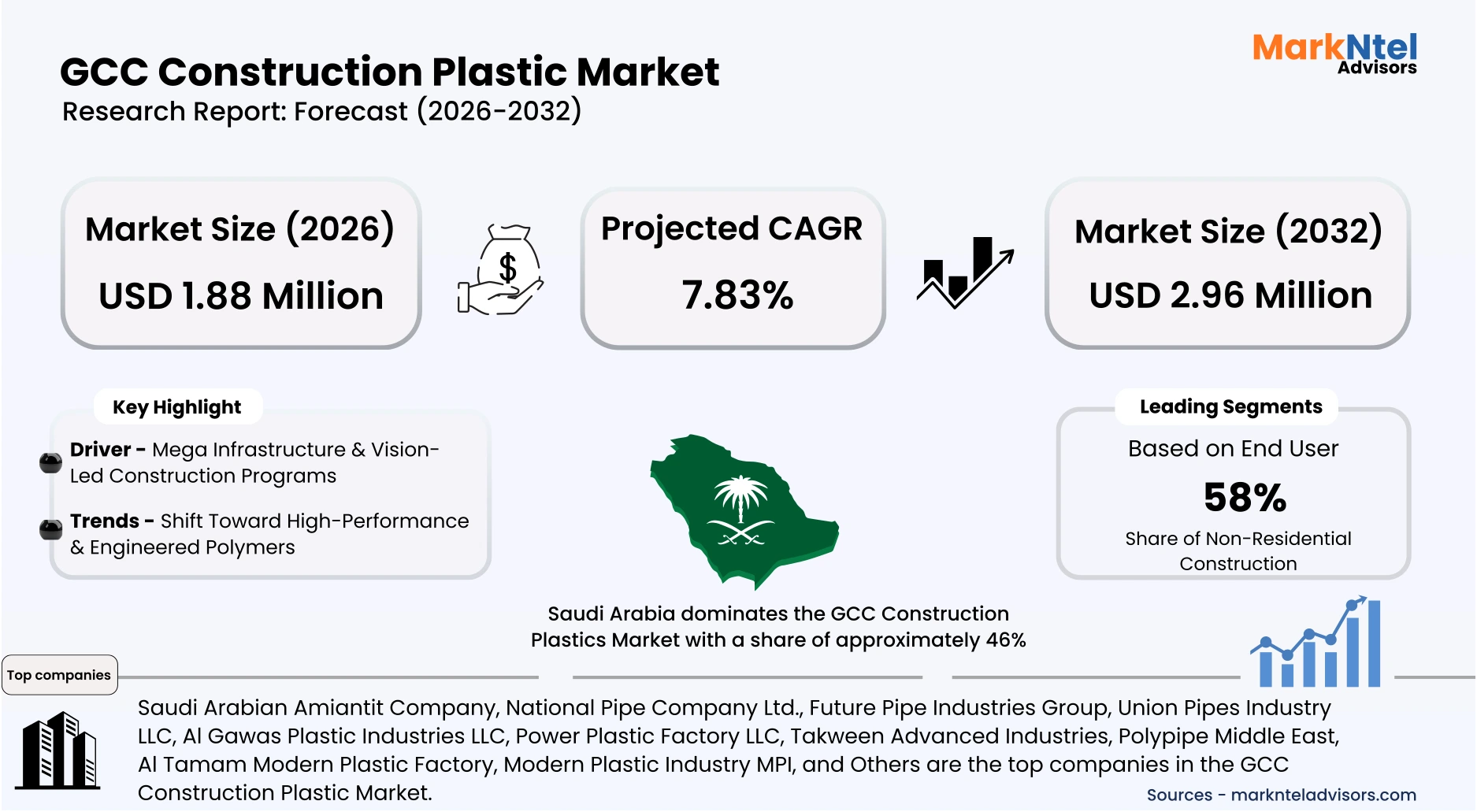
- Market size is estimated at USD 1.88 million in 2026 and is projected to reach USD 2.96 million by 2032. The estimated CAGR from 2026 to 2032 is around 7.83%, indicating strong growth.
- Saudi Arabia is dominating this market by accounting for more than 46% of the market share in 2026.
- By Plastic Type, the Polyvinyl Chloride (PVC) segment represented a significant share of about 39% in the GCC Construction Plastic Market in 2026.
- By End-User, the Non-Residential Construction segment represented a significant share of about 58% in the GCC Construction Plastic Market in 2026.
- Leading Construction Plastic in GCC are Saudi Arabian Amiantit Company, National Pipe Company Ltd., Future Pipe Industries Group, Union Pipes Industry LLC, Al Gawas Plastic Industries LLC, Power Plastic Factory LLC, Takween Advanced Industries, Zamil Plastic Industries Ltd., Saudi Plastic Products Company SAPPCO, Neproplast Industries Co. Ltd., Interplast Co. Ltd., Polyfab Plastic Industry LLC, Cosmoplast Industrial Company LLC, Harwal Group, Polypipe Middle East, Al Tamam Modern Plastic Factory, Arabian Plastic Pipes Company APPCO, Gulf Pipe Engineering Group, Modern Plastic Industry MPI, and Others.
Market Insights & Analysis: GCC Construction Plastic Market (2026-32):
The GCC Construction Plastic Market size is estimated at USD 1.88 billion in 2026 and is projected to reach USD 2.96 billion by 2032. Along with this, the market is estimated to grow at a CAGR of around 7.83% during the forecast period, i.e., 2026-32.
The GCC Construction Plastic Market continues to expand in line with sustained public investment and economic diversification across member states. In 2025, the World Bank projected GCC economic growth of 3.7% in 2025 and 4.1% in 2026, supported primarily by non-oil sector expansion and public capital spending. Saudi Arabia’s Ministry of Finance reported total government expenditures of approximately USD 342 billion in the 2025 budget, prioritizing infrastructure, housing, water systems, and industrial development under Vision 2030. These allocations directly stimulate demand for polymer-based piping, insulation, conduit systems, and building envelope materials used in construction.
Saudi Arabia remains the largest construction market in the GCC, with official Vision 2030 progress updates indicating that the majority of strategic initiatives are either completed or advancing according to schedule. National programs supporting transport corridors, metro networks, desalination facilities, and new economic zones require corrosion-resistant and lightweight materials, reinforcing the role of plastic-based construction solutions . In parallel, the UAE’s 2025 federal budget continues to allocate significant resources toward social development, housing, and infrastructure modernization. These public commitments create structural visibility for manufacturers of PVC, polyethylene, and polypropylene construction products .
End-user demand is broad-based across residential, commercial, industrial, and infrastructure segments, each influencing material volumes differently. Government-backed housing delivery programs increase the consumption of plastic plumbing, window profiles, and insulation systems designed to meet updated building standards. Commercial real estate expansion and tourism-linked developments in Dubai and Riyadh elevate demand for engineered plastics in façade applications and mechanical insulation. Industrial diversification, highlighted by the World Bank as a driver of non-oil growth, further supports the adoption of durable plastic piping and cable protection systems in logistics parks and manufacturing facilities.
Looking forward, regulatory emphasis on energy efficiency and sustainability is expected to reinforce construction plastics adoption across the GCC. The UAE’s Net Zero 2050 Strategy and Saudi Arabia’s climate policy commitments are accelerating the implementation of modern building codes that prioritize thermal efficiency and lifecycle cost performance. Continued fiscal spending under national development frameworks, combined with demographic growth and urban expansion, sustains medium-term construction activity. Supported by infrastructure modernization and industrial localization strategies, the GCC Construction Plastics Market is positioned for stable growth in both volume and value terms through 2026 and beyond.
GCC Construction Plastic Market Recent Developments:
- 2026 Saudi Arabian Amiantit Company has introduced Flowtite Orange, a GRP pipe engineered for high-abrasion and erosion environments. Developed using Flowtite® technology within the Amiblu platform, it features a wear-resistant liner designed to extend service life in stormwater, mining, and high-velocity pipeline applications.
- 2025 : Future Pipe Industries signed an MoU with ARAMCO at MECC 2025 to enhance local composite manufacturing and testing capabilities in Saudi Arabia. The partnership supports Vision 2030 objectives and promotes innovation in corrosion-resistant piping solutions for key industrial and infrastructure sectors.
GCC Construction Plastic Market Scope:
| Category | Segments |
|---|---|
| By Plastic Type | (Expanded Polystyrene (EPS), Polyethylene (PE), Polypropylene (PP), Polyvinyl Chloride (PVC), Other), |
| By Application | (Pipes, Windows and Doors, Insulation Materials, Others), |
| By End-User | (Residential Construction, Non-Residential Construction), |
GCC Construction Plastic Market Driver:
Mega Infrastructure & Vision-Led Construction Programs
Mega infrastructure execution under national transformation agendas has intensified materially across the GCC, creating a structural expansion in construction activity. In 2025, Saudi Arabia’s Public Investment Fund confirmed assets of approximately USD 925 billion and continued strategic deployment across projects, including NEOM, Qiddiya, and Red Sea Global, embedding multi-year capital commitments into urban and industrial development . Concurrently, Dubai’s Roads and Transport Authority approved 72 infrastructure projects over four years to expand road, bridge, and tunnel networks, reinforcing sustained transport corridor construction .
Similarly, in 2025, Qatar’s Public Works Authority (Ashghal) announced a USD 22.2 billion five-year infrastructure plan covering sewage networks, drainage tunnels, government buildings, and residential land development through 2029. The program includes strategic outfalls, wastewater treatment expansion, and infrastructure for more than 5,500 residential plots, further strengthening execution-based construction activity across the GCC. These state-backed programs have shifted from announcement phases to execution, demonstrating measurable on-ground development supported by official government updates.
The demand impact is geographically concentrated in Saudi Arabia and the UAE, where giga-scale mixed-use districts, logistics hubs, and transport systems require large volumes of installed utilities. Industrial ports such as NEOM’s Oxagon and expanding mobility corridors in Dubai necessitate extensive underground service networks, drainage systems, and cable conduits integrated during early construction phases . Unlike speculative private developments, these projects are publicly funded and phased, ensuring continuity of procurement cycles tied to engineering milestones. Each kilometer of corridor, utility trench, or service tunnel increases consumption of polymer-based piping, insulation, and conduit materials across infrastructure and commercial end-user segments.
This driver expands market volume because district-scale infrastructure consumes standardized materials in repeatable quantities throughout multi-stage implementation schedules. Urban transport systems, port expansions, and large residential clusters require thousands of meters of installed pipeline and cable management networks before vertical construction progresses. As national development programs extend through 2026 under formal fiscal frameworks, material procurement aligns with physical construction progress rather than short-term pricing fluctuations. Consequently, vision-led mega infrastructure programs constitute the most decisive and volume-expanding catalyst for the GCC Construction Plastics Market.
GCC Construction Plastic Market Trend:
Shift Toward High-Performance & Engineered Polymers
The shift toward high-performance and engineered polymers in the GCC construction plastics market has accelerated as governments tighten durability and sustainability standards for infrastructure and buildings. The UAE’s Net Zero 2050 Strategy and updated green building regulations emphasize energy efficiency and lifecycle performance, encouraging the adoption of advanced insulation and corrosion-resistant materials. In Saudi Arabia, the Saudi Building Code continues to strengthen thermal insulation and material efficiency requirements for residential and commercial developments. Reflecting this regulatory shift, Gulf-O-Flex inaugurated a state-of-the-art thermal insulation manufacturing facility in Saudi Arabia to localize high-performance insulation solutions aligned with Vision 2030 energy efficiency objectives. These regulatory frameworks are driving preference for engineered polymer solutions over conventional materials .
This trend is structurally reshaping the value chain by increasing demand for composite pipes, high-density polyethylene systems, and advanced insulation products capable of withstanding salinity, high temperatures, and pressure variations. Infrastructure operators in desalination, district cooling, and wastewater treatment increasingly prioritize lifecycle durability and reduced maintenance costs, favoring engineered plastics over traditional steel or concrete. Major regional manufacturers have expanded composite and specialty polymer offerings to meet these performance standards. For instance, Bahrain Pipes announced the launch of high-density polyethylene (HDPE) corrugated pipes for stormwater and wastewater applications, featuring over 100-year lifespan and recyclability to align with modern sustainability benchmarks. The company has also adopted advanced multilayer PVC extrusion technology to enhance product homogeneity, structural performance, and compliance with international standards . As specifications evolve, procurement models increasingly emphasize technical compliance rather than the lowest upfront cost.
The persistence of this trend is reinforced by climate conditions, long asset lifespans, and formal sustainability commitments across GCC economies. Extreme heat, soil salinity, and water scarcity necessitate materials with enhanced structural integrity and corrosion resistance. Public infrastructure investments extending through 2026 embed advanced material standards into project design phases. Consequently, high-performance polymers are becoming a structural component of construction specifications, influencing long-term market evolution rather than temporary substitution patterns.
GCC Construction Plastic Market Opportunity:
Expansion in Water Management & Utility Networks
Expansion of water and wastewater infrastructure across Saudi Arabia and the UAE presents a structurally attractive growth avenue for new construction plastics suppliers. In 2025, Saudi Arabia’s National Water Company continued awarding large-scale contracts to expand sewage treatment capacity and water transmission networks under its national water strategy . In parallel, the UAE is accelerating treated wastewater reuse and advanced desalination-linked distribution upgrades to strengthen long-term water security. These government-backed programs reflect sustained infrastructure prioritization rather than short-term construction cycles .
Heightened policy focus on climate resilience and resource efficiency is translating directly into physical network expansion across urban and industrial zones. Large-diameter sewage pipelines, stormwater drainage systems, pumping stations, and tertiary treatment connections require corrosion-resistant HDPE, PVC, and structural plastic components. In 2026, Kuwait approved a USD 3.3 billion contract to construct the North Kabd sewage treatment plant with a processing capacity of 1 million cubic meters per day, illustrating the scale of wastewater infrastructure deployment across the region . Each kilometer of installed pipeline creates measurable material volume demand due to standardized technical specifications.
Segmented project packaging and public-private partnership frameworks further enhance entry prospects for emerging manufacturers. Water infrastructure tenders are frequently divided into regional or phase-based contracts, enabling mid-sized suppliers to compete without confronting vertically integrated incumbents. Specialized offerings such as prefabricated HDPE manholes, custom jointing systems, and high-stiffness drainage pipes allow technical differentiation. In addition, Ras Al Khaimah’s 2026 public-private partnership agreement for a 60,000 cubic meters per day wastewater treatment plant supported by a 6.3 km gravity pipeline and 26 km recycled water network highlights how PPP models are opening new supply-chain participation opportunities for qualified mid-sized manufacturers . As wastewater reuse targets and urban network upgrades advance through 2026, the water management segment offers a durable and scalable pathway for new entrants in the GCC Construction Plastics Market.
GCC Construction Plastic Market Challenge:
Project Delays & Cyclical Construction Spending
Project delays and cyclical public spending patterns represent a structural constraint on the GCC Construction Plastics Market. In 2025, Saudi Arabia’s Ministry of Finance projected a fiscal deficit of approximately USD 27 billion, reflecting continued capital commitments alongside fluctuating oil revenues. International reporting during 2025–2026 also highlighted recalibration and phased execution of selected mega-project components to manage expenditure pressures. Several major Saudi giga-projects were reported in 2025 to face repeated delays and strategic reprioritization toward near-term returns, reinforcing phased implementation across large-scale developments . NEOM, originally projected to accommodate 9 million residents, has experienced repeated delays alongside a strategic shift by the Public Investment Fund toward projects delivering more immediate economic returns . Such fiscal adjustments contribute to staggered infrastructure timelines rather than uninterrupted construction momentum.
The measurable impact on market participants is visible in extended tender cycles and phased contract awards across infrastructure and urban development projects. Since a significant portion of construction plastics demand originates from government-backed utilities, housing, and transport projects, any slowdown or rescoping directly reduces short-term procurement volumes. Manufacturers supplying pipes, insulation, and profiles often operate under fixed-price or milestone-based contracts, making production planning sensitive to execution delays. Smaller converters, in particular, face working capital strain when project disbursements are postponed.
This challenge materially restricts expansion because capacity investments depend on predictable construction pipelines and stable order visibility. When infrastructure programs are implemented in stages, immediate material offtake declines even if long-term plans remain intact. Uncertain project scheduling discourages aggressive scaling and new market entry, particularly for mid-sized manufacturers. Consequently, cyclical construction spending and execution delays function as a systemic barrier to sustained volume growth within the GCC Construction Plastics Market.
GCC Construction Plastic Market (2026-32) Segmentation Analysis:
The GCC Construction Plastic Market study of MarkNtel Advisors evaluates & highlights the major trends and influencing factors in each segment. It includes predictions for the period 2026–32 at the regional level. Based on the analysis, the market has been further classified as;
Based on Plastic Type:
- Expanded Polystyrene (EPS)
- Polyethylene (PE)
- Polypropylene (PP)
- Polyvinyl Chloride (PVC)
- Other
Polyvinyl Chloride (PVC) dominates the GCC Construction Plastics Market with a share of approximately 39%, primarily due to its extensive application across water supply, drainage, electrical conduit, and window profile systems. PVC offers corrosion resistance, durability, and cost efficiency, making it suitable for high-temperature and high-salinity GCC conditions. Regional water authorities widely specify PVC for potable water and sewage networks because of its long service life and low maintenance needs. Its compatibility with standardized piping systems strengthens adoption across infrastructure and residential projects.
Regulatory and construction frameworks reinforce PVC’s dominance. Building codes in Saudi Arabia and the UAE emphasize material durability, fire performance standards, and thermal efficiency in plumbing and electrical systems, areas where PVC remains technically and economically competitive. In addition, large-scale infrastructure expansions across water and wastewater treatment networks continue to utilize PVC piping due to its compliance with international standards such as ASTM and ISO.
Upstream supply strength is further reinforced by the USD 1.99 billion EPC contract awarded for the development of one of the world’s largest PVC production complexes at TA’ZIZ in the UAE, reflecting substantial regional investment in PVC manufacturing infrastructure. This large-scale petrochemical investment enhances long-term polymer availability for downstream construction applications across the GCC. Additionally, Bahrain Pipes commissioned an advanced extrusion line to produce three-layer PVC pipes at outputs up to 750 kg per hour, enhancing efficiency and high-filler production capability . Major regional manufacturers, including Neproplast, Cosmoplast, and SAPPCO, maintain extensive PVC production lines.
Operational economics further anchor PVC’s leadership position. Compared to alternatives such as HDPE or composites, PVC offers lower installation costs and established contractor familiarity. Its availability and adaptability across pressure and non-pressure systems enable scalable deployment in residential, commercial, and infrastructure segments. Consequently, technical versatility and cost-effectiveness sustain PVC as the dominant plastic type within the GCC Construction Plastics Market.
Based on the End-User:
- Residential Construction
- Non-Residential Construction
Non-Residential Construction dominates the GCC Construction Plastics Market with a share of approximately 58%, primarily due to the scale and technical complexity of commercial, industrial, and infrastructure projects across the region. Large developments such as airports, metro systems, logistics parks, hospitals, and district cooling networks require extensive plastic piping, insulation, cable conduits, and drainage systems. For instance, Saudi Arabia continues to advance large-scale urban and industrial zones under Vision 2030, including NEOM and logistics corridors, which involve substantial underground utility installations and mechanical infrastructure. Such projects consume significantly higher volumes of polymer-based systems compared to individual residential units.
Regulatory and performance standards further reinforce this dominance. Non-residential buildings must comply with stricter fire safety, energy efficiency, and environmental performance codes, increasing the specification of engineered plastic systems in HVAC, electrical containment, and wastewater applications. Industrial facilities and commercial complexes also require corrosion-resistant and high-capacity piping networks capable of handling higher operational loads. This elevates per-project plastic consumption relative to standard housing construction.
Operationally, non-residential developments are executed in large phases with centralized procurement, creating bulk purchasing cycles for PVC, HDPE, and composite systems. Compared to residential housing, which typically uses smaller-diameter and lower-volume installations, infrastructure and commercial projects require extensive mechanical and utility networks. Consequently, higher material intensity, regulatory compliance requirements, and large-scale procurement patterns anchor Non-Residential Construction as the dominant end-user segment in the GCC Construction Plastics Market.
GCC Construction Plastic Market (2026-32): Regional Projection
Saudi Arabia dominates the GCC Construction Plastics Market with a share of approximately 46%, supported by the sheer volume of construction contracts awarded within the Kingdom. In 2025, Saudi Arabia accounted for the largest share of total project awards in the GCC, driven by transport, power, water, and real estate developments across multiple provinces. Major mobility projects such as metro expansions and airport upgrades require extensive plastic piping, insulation systems, and drainage networks. The breadth of concurrent infrastructure execution significantly elevates polymer consumption compared to other GCC states.
Utility-scale infrastructure intensity further reinforces Saudi Arabia’s dominance. The Kingdom continues expanding wastewater treatment, water transmission, and desalination-linked distribution systems under national programs. These installations involve high volumes of PVC and HDPE pipes integrated during early construction stages. In 2025, the Jizan Industrial City project completed installation of a 3.5-meter diameter HDPE submarine pipeline, underscoring the large-scale deployment of polymer pipeline systems in Saudi infrastructure . Unlike smaller GCC markets, Saudi Arabia’s multi-city rollout multiplies material demand across regions.
Industrial expansion also plays a decisive role. Logistics zones, manufacturing hubs, and mining infrastructure require corrosion-resistant plastic utility systems. Saudi Arabia’s larger population base and geographic footprint sustain higher non-residential construction intensity. Consequently, infrastructure scale and diversified project execution position Saudi Arabia as the leading country in the GCC Construction Plastics Market.
Gain a Competitive Edge with Our GCC Construction Plastic Market Report
- GCC Construction Plastic Market Report by MarkNtel Advisors provides a detailed & thorough analysis of market size & share, growth rate, competitive landscape, and key players. This comprehensive analysis helps businesses gain a holistic understanding of the market dynamics & make informed decisions.
- This report also highlights current market trends & future projections, allowing businesses to identify emerging opportunities & potential challenges. By understanding market forecasts, companies can align their strategies & stay ahead of the competition.
- GCC Construction Plastic Market Report aids in assessing & mitigating risks associated with entering or operating in the market. By understanding market dynamics, regulatory frameworks, and potential challenges, businesses can develop strategies to minimize risks & optimize their operations.
*Reports Delivery Format - Market research studies from MarkNtel Advisors are offered in PDF, Excel and PowerPoint formats. Within 24 hours of the payment being successfully received, the report will be sent to your email address.
Frequently Asked Questions
- Market Segmentation
- Introduction
- Product Definition
- Research Process
- Assumptions
- Executive Summary
- GCC Construction Plastic Market Policies, Regulations, and Product Standards
- GCC Construction Plastic Market Supply Chain Analysis
- GCC Construction Plastic Market Trends & Developments
- GCC Construction Plastic Market Dynamics
- Growth Drivers
- Challenges
- GCC Construction Plastic Market Hotspot & Opportunities
- GCC Construction Plastic Market Outlook, 2022–2032
- Market Size & Outlook
- By Revenues (USD Million)
- By Quantity (Thousand Tons)
- Market Share & Outlook
- By Plastic Type– Market Size & Forecast 2022–2032, Thousand Tons
- Expanded Polystyrene (EPS)
- Polyethylene (PE)
- Polypropylene (PP)
- Polyvinyl Chloride (PVC)
- Other
- By Application– Market Size & Forecast 2022–2032, Thousand Tons
- Pipes
- Windows and Doors
- Insulation Materials
- Others
- By End-User– Market Size & Forecast 2022–2032, Thousand Tons
- Residential Construction
- Independent homes
- Row homes
- Large apartment buildings
- Non-Residential Construction
- Commercial
- Industrial
- Infrastructure
- Residential Construction
- By Country
- Saudi Arabia
- United Arab Emirates (UAE)
- Qatar
- Kuwait
- Oman
- Bahrain
- By Plastic Type– Market Size & Forecast 2022–2032, Thousand Tons
- Market Size & Outlook
- Saudi Arabia Construction Plastic Market Outlook, 2022–2032
- Market Size & Outlook
- By Revenues (USD Million)
- By Quantity (Thousand Tons)
- Market Share & Outlook
- By Plastic Type -Market Size & Forecast 2022–2032, Thousand Tons
- By Application -Market Size & Forecast 2022–2032, Thousand Tons
- By End User-Market Size & Forecast 2022–2032, Thousand Tons
- Market Size & Outlook
- UAE Construction Plastic Market Outlook, 2022–2032
- Market Size & Outlook
- By Revenues (USD Million)
- By Quantity (Thousand Tons)
- Market Share & Outlook
- By Plastic Type -Market Size & Forecast 2022–2032, Thousand Tons
- By Application -Market Size & Forecast 2022–2032, Thousand Tons
- By End User-Market Size & Forecast 2022–2032, Thousand Tons
- Market Size & Outlook
- Qatar Construction Plastic Market Outlook, 2022–2032
- Market Size & Outlook
- By Revenues (USD Million)
- By Quantity (Thousand Tons)
- Market Share & Outlook
- By Plastic Type -Market Size & Forecast 2022–2032, Thousand Tons
- By Application -Market Size & Forecast 2022–2032, Thousand Tons
- By End User-Market Size & Forecast 2022–2032, Thousand Tons
- Market Size & Outlook
- Kuwait Construction Plastic Market Outlook, 2022–2032
- Market Size & Outlook
- By Revenues (USD Million)
- By Quantity (Thousand Tons)
- Market Share & Outlook
- By Plastic Type -Market Size & Forecast 2022–2032, Thousand Tons
- By Application -Market Size & Forecast 2022–2032, Thousand Tons
- By End User-Market Size & Forecast 2022–2032, Thousand Tons
- Market Size & Outlook
- Oman Construction Plastic Market Outlook, 2022–2032
- Market Size & Outlook
- By Revenues (USD Million)
- By Quantity (Thousand Tons)
- Market Share & Outlook
- By Plastic Type -Market Size & Forecast 2022–2032, Thousand Tons
- By Application -Market Size & Forecast 2022–2032, Thousand Tons
- By End User-Market Size & Forecast 2022–2032, Thousand Tons
- Market Size & Outlook
- Bahrain Construction Plastic Market Outlook, 2022–2032
- Market Size & Outlook
- By Revenues (USD Million)
- By Quantity (Thousand Tons)
- Market Share & Outlook
- By Plastic Type -Market Size & Forecast 2022–2032, Thousand Tons
- By Application -Market Size & Forecast 2022–2032, Thousand Tons
- By End User-Market Size & Forecast 2022–2032, Thousand Tons
- Market Size & Outlook
- GCC Construction Plastic Market Key Strategic Imperatives for Success & Growth
- Competition Outlook
- Company Profiles
- Saudi Arabian Amiantit Company
- Business Description
- Product Portfolio
- Strategic Alliances or Partnerships
- Recent Developments
- Financial Details
- Others
- National Pipe Company Ltd.
- Business Description
- Product Portfolio
- Strategic Alliances or Partnerships
- Recent Developments
- Financial Details
- Others
- AG Future Pipe Industries
- Business Description
- Product Portfolio
- Strategic Alliances or Partnerships
- Recent Developments
- Financial Details
- Others
- Union Pipes Industry LLC
- Business Description
- Product Portfolio
- Strategic Alliances or Partnerships
- Recent Developments
- Financial Details
- Others
- Al Gawas Plastic Industries LLC
- Business Description
- Product Portfolio
- Strategic Alliances or Partnerships
- Recent Developments
- Financial Details
- Others
- Power Plastic Factory LLC
- Business Description
- Product Portfolio
- Strategic Alliances or Partnerships
- Recent Developments
- Financial Details
- Others
- Takween Advanced Industries
- Business Description
- Product Portfolio
- Strategic Alliances or Partnerships
- Recent Developments
- Financial Details
- Others
- Zamil Plastic Industries Ltd.
- Business Description
- Product Portfolio
- Strategic Alliances or Partnerships
- Recent Developments
- Financial Details
- Others
- Saudi Plastic Products Company SAPPCO
- Business Description
- Product Portfolio
- Strategic Alliances or Partnerships
- Recent Developments
- Financial Details
- Others
- Neproplast Industries Co. Ltd.
- Business Description
- Product Portfolio
- Strategic Alliances or Partnerships
- Recent Developments
- Financial Details
- Others
- Interplast Co. Ltd.
- Business Description
- Product Portfolio
- Strategic Alliances or Partnerships
- Recent Developments
- Financial Details
- Others
- Polyfab Plastic Industry LLC
- Business Description
- Product Portfolio
- Strategic Alliances or Partnerships
- Recent Developments
- Financial Details
- Others
- Cosmoplast Industrial Company LLC
- Business Description
- Product Portfolio
- Strategic Alliances or Partnerships
- Recent Developments
- Financial Details
- Others
- Harwal Group
- Business Description
- Product Portfolio
- Strategic Alliances or Partnerships
- Recent Developments
- Financial Details
- Others
- Polypipe Middle East
- Business Description
- Product Portfolio
- Strategic Alliances or Partnerships
- Recent Developments
- Financial Details
- Others
- Al Tamam Modern Plastic Factory
- Business Description
- Product Portfolio
- Strategic Alliances or Partnerships
- Recent Developments
- Financial Details
- Others
- Arabian Plastic Pipes Company APPCO
- Business Description
- Product Portfolio
- Strategic Alliances or Partnerships
- Recent Developments
- Financial Details
- Others
- Gulf Pipe Engineering Group
- Business Description
- Product Portfolio
- Strategic Alliances or Partnerships
- Recent Developments
- Financial Details
- Others
- Modern Plastic Industry MPI
- Business Description
- Product Portfolio
- Strategic Alliances or Partnerships
- Recent Developments
- Financial Details
- Others
- Others
- Saudi Arabian Amiantit Company
- Company Profiles
- Disclaimer
MarkNtel Advisors follows a robust and iterative research methodology designed to ensure maximum accuracy and minimize deviation in market estimates and forecasts. Our approach combines both bottom-up and top-down techniques to effectively segment and quantify various aspects of the market. A consistent feature across all our research reports is data triangulation, which examines the market from three distinct perspectives to validate findings. Key components of our research process include:
1. Scope & Research Design At the outset, MarkNtel Advisors define the research objectives and formulate pertinent questions. This phase involves determining the type of research—qualitative or quantitative—and designing a methodology that outlines data collection methods, target demographics, and analytical tools. They also establish timelines and budgets to ensure the research aligns with client goals.
2. Sample Selection and Data Collection In this stage, the firm identifies the target audience and determines the appropriate sample size to ensure representativeness. They employ various sampling methods, such as random or stratified sampling, based on the research objectives. Data collection is carried out using tools like surveys, interviews, and observations, ensuring the gathered data is reliable and relevant.
3. Data Analysis and Validation Once data is collected, MarkNtel Advisors undertake a rigorous analysis process. This includes cleaning the data to remove inconsistencies, employing statistical software for quantitative analysis, and thematic analysis for qualitative data. Validation steps are taken to ensure the accuracy and reliability of the findings, minimizing biases and errors.

4. Data Forecast and FinalizationThe final phase involves forecasting future market trends based on the analyzed data. MarkNtel Advisors utilize predictive modeling and time series analysis to anticipate market behaviors. The insights are then compiled into comprehensive reports, featuring visual aids like charts and graphs, and include strategic recommendations to inform client decision-making
We offer flexible licensing options to cater to varying organizational needs. Choose the pricing pack that best suits your requirements:
Buy Now Inquire Before Buying
 Request Customization
 Talk to our Consultant