China Polypropylene Random Copolymer (PPR) Pipes Market Research Report: Trends, Forecast & Opportunities (2026-2032)
By Type (Standard PPR Pipes, Composite / Reinforced PPR Pipes, Hot & Cold Water PPR Pipes, High-Pressure PPR Pipes, Low-Pressure PPR Pipes), By Grade (Single-layer PPR Pipes, Multi ... -layer PPR Pipes), By Pipe Diameter (Small Diameter Pipes (< 50 mm), Medium Diameter Pipes (50–200 mm), Large Diameter Pipes (> 200 mm)), By Pressure Rating (PN10, PN16, PN20, PN25), By Distribution Channel (Direct Sales, Distributors & Wholesalers, Retail Stores / Hardware Suppliers, Online Channels), By Application (Plumbing Systems, Water Supply Systems, HVAC & District Cooling Systems, Irrigation Systems, Chemical & Industrial Fluid Transport, Others), By End User (Residential Buildings, Commercial Buildings, Industrial Facilities, Municipal & Infrastructure Projects, Agriculture), and others Read more
- Buildings, Construction, Metals & Mining
- Mar 2026
- Pages 135
- Report Format: PDF, Excel, PPT
China Polypropylene Random Copolymer (PPR) Pipes Market
Projected 5.33% CAGR from 2026 to 2032
Study Period
2026-2032
Market Size (2026)
USD 2.38 Billion
Market Size (2032)
USD 3.25 Billion
Base Year
2025
Projected CAGR
5.33%
Leading Segments
By Type: Hot & Cold Water PPR Pipes
China Polypropylene Random Copolymer (PPR) Pipes Market Report Key Takeaways:
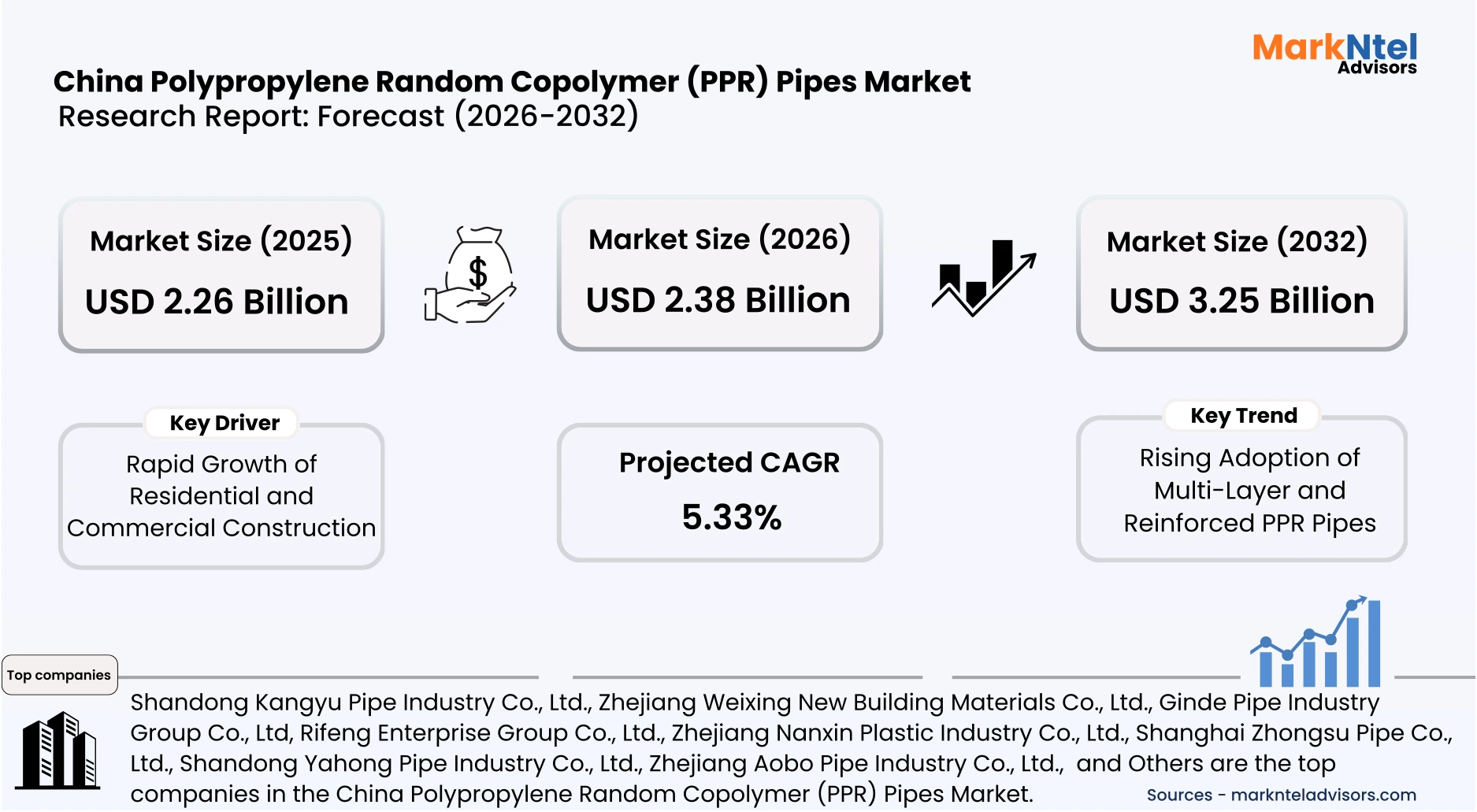
- The China Polypropylene Random Copolymer (PPR) Pipes Market size was valued at around USD 2.26 billion in 2025 and is projected to grow from USD 2.38 billion in 2026 to USD 3.25 billion by 2032, exhibiting a CAGR of 5.33% during the forecast period.
- By type, the hot & cold water PPR pipes captured a significant share of about 37% in the China Polypropylene Random Copolymer (PPR) Pipes Market in 2026.
- By end user, the residential buildings seized a significant share of about 42% in the China Polypropylene Random Copolymer (PPR) Pipes Market in 2026.
- Leading polypropylene random copolymer (PPR) pipes companies in China are Shandong Kangyu Pipe Industry Co., Ltd., Zhejiang Weixing New Building Materials Co., Ltd., Ginde Pipe Industry Group Co., Ltd, Rifeng Enterprise Group Co., Ltd., Zhejiang Nanxin Plastic Industry Co., Ltd., Shanghai Zhongsu Pipe Co., Ltd., Shandong Yahong Pipe Industry Co., Ltd., Zhejiang Aobo Pipe Industry Co., Ltd., Tianjin Junxing Pipe Group Co., Ltd., Zhejiang Xinniu Pipe Co., Ltd., and Others.
Market Insights & Analysis: China Polypropylene Random Copolymer (PPR) Pipes Market (2026-32):
The China Polypropylene Random Copolymer (PPR) Pipes Market size was valued at around USD 2.26 billion in 2025 and is projected to grow from USD 2.38 billion in 2026 to USD 3.25 billion by 2032. Along with this, the market is estimated to grow at a CAGR of around 5.33% during the forecast period, i.e., 2026-32.
The China Polypropylene Random Copolymer (PPR) Pipes Market is projected to expand steadily, driven by expanding residential and commercial construction activities and increasing adoption of advanced multi-layer and reinforced PPR piping solutions.
According to the National Bureau of Statistics (NBS) of China, the country’s total real estate development investment reached approximately USD 1.41 trillion in 2024, with around USD 1.07 trillion directed specifically toward residential construction. Large-scale housing and commercial development projects require extensive plumbing networks, which significantly increases demand for PPR piping systems in modern buildings.
Regionally, East China remains China’s largest construction hub, with provinces such as Jiangsu, Zhejiang, and cities like Shanghai driving development. The region accounts for 26.36% of major construction investments, totaling USD 1.28 billion. Meanwhile, South China, led by Guangdong and Guangxi, recorded USD 887 million in construction allocations, supported by rapid urban expansion in Shenzhen and Guangzhou .
Similarly, Central China recorded USD 1.19 billion in construction investments, accounting for 24.63% of total allocations. Meanwhile, Northwest China received USD 605 million, largely supporting infrastructure and energy projects that require extensive piping systems .
Large infrastructure projects are supporting market expansion. For example, the Medog Hydropower Station on the Yarlung Tsangpo River began construction in 2025 with an investment exceeding USD 137 billion and expected annual generation of 300 billion kWh, driving demand for housing and plumbing systems. Additionally, Jiangsu Province announced 507 projects worth USD 102 billion in 2025, along with USD 11.4 billion in private industrial developments.
Manufacturers are increasingly introducing advanced piping solutions such as multi-layer and reinforced PPR pipes. For instance, Rifeng Enterprise Group Co., Ltd. launched multi-layer PPR heating pipes featuring oxygen-barrier technology, which prevents oxygen diffusion in heating systems and enhances durability for under-floor heating and high-temperature plumbing applications.
Looking ahead, infrastructure investment is expected to remain strong. China’s National Development and Reform Commission (NDRC) announced an early batch of 2026 infrastructure projects worth about USD 42 billion, including more than 280 major national projects focusing on transportation networks, underground pipelines, and ecological urban systems . At the same time, technological advancements are shaping the market.
Future government plans will further support market growth. For instance, China’s 15th Five-Year Plan (2026–2030) emphasizes expansion of affordable housing and the rental housing sector, alongside improvements in residential infrastructure and living standards. Large-scale housing development and building upgrades are expected to increase the installation of modern plumbing networks using polymer piping systems.
Strong construction investments, large infrastructure projects, and government housing initiatives are expected to sustain demand for modern plumbing materials in China. As cities continue to expand and adopt advanced building technologies, the need for durable and efficient PPR piping systems will continue to rise, supporting the steady growth of the China PPR pipes market.
China Polypropylene Random Copolymer (PPR) Pipes Market Scope:
| Category | Segments |
|---|---|
| By Type | (Standard PPR Pipes, Composite / Reinforced PPR Pipes, Hot & Cold Water PPR Pipes, High-Pressure PPR Pipes, Low-Pressure PPR Pipes), |
| By Grade | (Single-layer PPR Pipes, Multi-layer PPR Pipes), |
| By Pipe Diameter | (Small Diameter Pipes (< 50 mm), Medium Diameter Pipes (50–200 mm), Large Diameter Pipes (> 200 mm)), |
| By Pressure Rating | (PN10, PN16, PN20, PN25), |
| By Distribution Channel | (Direct Sales, Distributors & Wholesalers, Retail Stores / Hardware Suppliers, Online Channels), |
| By Application | (Plumbing Systems, Water Supply Systems, HVAC & District Cooling Systems, Irrigation Systems, Chemical & Industrial Fluid Transport, Others), |
| By End User | (Residential Buildings, Commercial Buildings, Industrial Facilities, Municipal & Infrastructure Projects, Agriculture), |
China Polypropylene Random Copolymer (PPR) Pipes Market Driver:
Rapid Growth of Residential and Commercial Construction
China’s expanding residential construction and urban housing modernization programs are key drivers supporting demand for polypropylene random copolymer (PPR) pipes. The large scale of real estate activity continues to create significant requirements for internal plumbing networks used in water supply, heating, and HVAC systems.
According to the National Bureau of Statistics, the floor space of newly built commercial buildings sold in China reached 881.01 million square meters in 2025, reflecting the massive scale of residential and commercial developments that require extensive piping infrastructure within buildings.
In parallel, the Chinese government is actively promoting housing quality improvements and urban renewal programs. In 2025, approximately 1.21 million units of government-subsidized housing were constructed or made available, while 27,000 old urban residential communities were renovated, benefiting nearly 4.99 million households . These initiatives involve large-scale upgrades to building infrastructure, including water distribution systems, sanitation pipelines, and heating networks, which increasingly rely on durable polymer pipes such as PPR due to their corrosion resistance, long lifespan, and thermal stability.
North China is witnessing strong construction growth driven by infrastructure modernization and regional integration initiatives. The Beijing–Tianjin–Hebei development program is accelerating transportation networks, industrial parks, and housing projects. The region received nearly USD 775 million in project investments, increasing the demand for water supply and HVAC piping installations across residential and commercial buildings.
Overall, the combination of large-scale real estate construction, government-supported housing programs, and regional urban integration projects continues to generate strong and sustained demand for PPR piping systems across China’s building infrastructure sector.
China Polypropylene Random Copolymer (PPR) Pipes Market Trend:
Rising Adoption of Multi-Layer and Reinforced PPR Pipes
A key trend in the China polypropylene random copolymer (PPR) pipes market is the rising adoption of multi-layer and reinforced PPR pipes, including fiberglass-reinforced and aluminum-composite variants. These pipes offer higher pressure resistance, better thermal stability, and reduced thermal expansion, making them suitable for high-rise buildings, HVAC systems, and high-temperature plumbing networks.
With China experiencing continuous urbanization and large-scale vertical construction, the demand for piping materials capable of handling higher pressure and temperature conditions has increased significantly. Multi-layer PPR pipes incorporate reinforcement materials such as fiberglass or aluminum between polymer layers, which enhances structural rigidity while maintaining corrosion resistance and lightweight properties associated with polymer piping systems.
Industry manufacturers are actively expanding product portfolios to meet this demand. For example, China Lesso Group Holdings Ltd. offers PPR-aluminum composite pipe systems designed for high-pressure water supply and heating networks. The pipes combine polypropylene random copolymer with an aluminum reinforcement layer, reducing thermal expansion while improving pressure resistance. The systems are available in 20 mm to 110 mm sizes with pressure ratings up to 2.5 MPa, making them suitable for high-rise buildings, HVAC systems, and commercial plumbing applications .
Overall, the increasing preference for reinforced and composite PPR piping solutions reflects the broader transition toward high-performance plumbing materials capable of supporting China’s expanding urban infrastructure and complex building systems.
China Polypropylene Random Copolymer (PPR) Pipes Market Opportunity:
Expanding Smart Plumbing Systems and Modular Construction
The expansion of smart plumbing systems and modular (prefabricated) construction is creating a significant opportunity for the China Polypropylene Random Copolymer (PPR) pipes market.
Modular construction involves manufacturing building components in controlled factory environments before assembling them at construction sites. This approach requires lightweight, corrosion-resistant, and easy-to-install piping materials that can be seamlessly integrated into prefabricated modules. As a result, polymer-based piping systems such as PPR pipes are increasingly preferred because they offer durability, flexibility, and simplified installation compared with traditional metal pipes.
Government policies are accelerating this shift. Under China’s 14th Five-Year Plan for the construction sector, authorities targeted prefabricated buildings to exceed 30% of new residential construction by 2025, promoting industrialized building methods and encouraging developers to adopt standardized piping systems compatible with factory-assembled modules.
The rapid expansion of prefabricated construction reflects this transition. China’s prefabricated housing industry reached about USD 8.2 billion in 2024 and is projected to reach nearly USD 9.5 billion in 2025, supported by USD 5.96 billion allocated to 86 pilot cities for modular housing development.
The increasing adoption of modular construction and smart plumbing systems will significantly expand demand for standardized and durable piping solutions. As prefabricated building techniques grow across China, the use of PPR pipes is expected to rise steadily in residential and commercial construction projects.
China Polypropylene Random Copolymer (PPR) Pipes Market Challenge:
Volatile Raw Material Prices
Volatility in polypropylene (PP) raw-material prices is a major challenge for the China Polypropylene Random Copolymer (PPR) pipes market, as PP resin is the primary input used in manufacturing these pipes.
Fluctuating resin prices directly affect production costs, profit margins, and pricing strategies for pipe manufacturers. In recent years, China’s polypropylene market has experienced noticeable price instability due to supply-demand imbalances, feedstock cost fluctuations, and broader macroeconomic pressures.
For instance, polypropylene prices in the Chinese domestic market averaged about USD 1.0725 per kg in 2024, but declined to approximately USD 1.043 per kg in 2025, reflecting a 2.9% year-on-year decrease and highlighting the ongoing volatility in raw-material costs .
Price fluctuations were also visible in spot markets. In 2025, the spot price of polypropylene dropped to approximately USD 885 per tonne, while the average market price between January and November 2025 stood at about USD 1,030 per tonne. This level represented one of the lowest average prices recorded in nearly 18 years, indicating significant instability in the resin market.
Unpredictable changes in polypropylene prices create financial uncertainty for PPR pipe manufacturers by raising procurement risks and compressing margins. Continued volatility in raw-material costs may limit production planning and investment, potentially restraining the expansion of the China PPR pipes market.
China Polypropylene Random Copolymer (PPR) Pipes Market (2026-32) Segmentation Analysis:
The China Polypropylene Random Copolymer (PPR) Pipes Market study of MarkNtel Advisors evaluates & highlights the major trends and influencing factors in each segment. It includes predictions for the period 2026–32 at the country level. Based on the analysis, the market has been further classified as;
Based on Type:
- Standard PPR Pipes
- Composite / Reinforced PPR Pipes
- Hot & Cold Water PPR Pipes
- High-Pressure PPR Pipes
- Low-Pressure PPR Pipes
The hot & cold water PPR pipes segment dominates the China Polypropylene Random Copolymer (PPR) Pipes Market with 37% market share, owing to their critical role in building plumbing systems that require reliable distribution of both heated and non-heated water.
These pipes are specifically engineered to maintain structural integrity under varying temperature conditions, enabling them to transport hot water for domestic use while simultaneously supporting cold-water supply networks. Their balanced performance characteristics make them a versatile solution for integrated plumbing infrastructure in modern buildings.
From a material perspective, PPR pipes designed for hot and cold water applications offer high thermal resistance, stable pressure-bearing capacity, and long operational life. The polymer structure of polypropylene random copolymer provides strong resistance to scaling, corrosion, and chemical reactions, which helps preserve water purity and ensures durability in long-term service conditions.
The widespread use of centralized heating systems, water circulation networks, and modern sanitary infrastructure in residential apartments, hotels, hospitals, and commercial complexes further supports the dominance of this segment.
In addition, their lightweight structure and heat-fusion joining technology enable seamless installation and leak-proof connections, which simplifies plumbing design and reduces installation complexity. These functional advantages collectively position hot and cold water PPR pipes as the most widely utilized category within the PPR piping industry.
Based on End User:
- Residential Buildings
- Commercial Buildings
- Industrial Facilities
- Municipal & Infrastructure Projects
- Agriculture
The residential buildings dominate the China Polypropylene Random Copolymer (PPR) Pipes Market with 42% market share, primarily due to the extensive need for dependable plumbing systems in modern housing infrastructure.
Residential properties require comprehensive piping networks for potable water distribution, hot water circulation, heating applications, and sanitation systems. PPR pipes are widely utilized in these applications because of their excellent chemical resistance, long operational life, and ability to maintain water quality without corrosion or scaling.
A key factor supporting the dominance of this segment is the structural complexity of contemporary residential developments, particularly high-rise apartment complexes and large housing communities. Such buildings require piping systems capable of maintaining stable water pressure and temperature across multiple floors while ensuring durability and minimal maintenance. PPR pipes are well-suited for these conditions because they possess strong pressure resistance, low thermal conductivity, and smooth internal surfaces that support efficient water flow and reduce energy losses.
In addition, the material’s lightweight structure and ease of installation simplify plumbing integration during construction, making it highly suitable for large-scale residential projects. These functional and performance advantages collectively reinforce the leading role of residential buildings in driving demand for PPR pipes in the market.
Gain a Competitive Edge with Our China Polypropylene Random Copolymer (PPR) Pipes Market Report:
- China Polypropylene Random Copolymer (PPR) Pipes Market Report by MarkNtel Advisors provides a detailed & thorough analysis of market size & share, growth rate, competitive landscape, and key players. This comprehensive analysis helps businesses gain a holistic understanding of the market dynamics & make informed decisions.
- This report also highlights current market trends & future projections, allowing businesses to identify emerging opportunities & potential challenges. By understanding market forecasts, companies can align their strategies & stay ahead of the competition.
- China Polypropylene Random Copolymer (PPR) Pipes Market Report aids in assessing & mitigating risks associated with entering or operating in the market. By understanding market dynamics, regulatory frameworks, and potential challenges, businesses can develop strategies to minimize risks & optimize their operations.
*Reports Delivery Format - Market research studies from MarkNtel Advisors are offered in PDF, Excel and PowerPoint formats. Within 24 hours of the payment being successfully received, the report will be sent to your email address.
Frequently Asked Questions
- Market Segmentation
- Introduction
- Product Definition
- Research Process
- Assumptions
- Executive Summary
- China Polypropylene Random Copolymer (PPR) Pipes Market Policies, Regulations, and Product Standards
- China Polypropylene Random Copolymer (PPR) Pipes Market Trends & Developments
- China Polypropylene Random Copolymer (PPR) Pipes Market Dynamics
- Growth Factors
- Challenges
- China Polypropylene Random Copolymer (PPR) Pipes Market Hotspot & Opportunities
- China Polypropylene Random Copolymer (PPR) Pipes Market Outlook, 2022-2032F
- Market Size & Outlook
- By Revenues (USD Million)
- Market Share & Outlook
- By Type- Market Size & Forecast 2022-2032, USD Million
- Standard PPR Pipes
- Composite / Reinforced PPR Pipes
- Hot & Cold Water PPR Pipes
- High-Pressure PPR Pipes
- Low-Pressure PPR Pipes
- By Grade- Market Size & Forecast 2022-2032, USD Million
- Single-layer PPR Pipes
- Multi-layer PPR Pipes
- PPR-AL-PPR Pipes
- PPR-GF-PPR Pipes
- PPR-PE-AL-PPR Pipes
- PPR-PA-AL-PPR Pipes
- By Pipe Diameter- Market Size & Forecast 2022-2032, USD Million
- Small Diameter Pipes (< 50 mm)
- Medium Diameter Pipes (50–200 mm)
- Large Diameter Pipes (> 200 mm)
- By Pressure Rating- Market Size & Forecast 2022-2032, USD Million
- PN10
- PN16
- PN20
- PN25
- By Distribution Channel- Market Size & Forecast 2022-2032, USD Million
- Direct Sales
- Distributors & Wholesalers
- Retail Stores / Hardware Suppliers
- Online Channels
- By Application- Market Size & Forecast 2022-2032, USD Million
- Plumbing Systems
- Water Supply Systems
- HVAC & District Cooling Systems
- Irrigation Systems
- Chemical & Industrial Fluid Transport
- Others
- By End User- Market Size & Forecast 2022-2032, USD Million
- Residential Buildings
- Commercial Buildings
- Industrial Facilities
- Municipal & Infrastructure Projects
- Agriculture
- By Region- Market Size & Forecast 2022-2032, USD Million
- East China
- North China
- South China
- Central China
- Southwest China
- Northwest China
- Northeast China
- By Company
- Competition Characteristics
- Market Share & Analysis
- By Type- Market Size & Forecast 2022-2032, USD Million
- Market Size & Outlook
- China Standard PPR Pipes Market Outlook, 2022-2032
- Market Size & Outlook
- By Revenues (USD Million)
- Market Share & Outlook
- By Grade- Market Size & Forecast 2022-2032, USD Million
- By Pipe Diameter- Market Size & Forecast 2022-2032, USD Million
- By Pressure Rating- Market Size & Forecast 2022-2032, USD Million
- By Distribution Channel- Market Size & Forecast 2022-2032, USD Million
- By Application- Market Size & Forecast 2022-2032, USD Million
- By End User- Market Size & Forecast 2022-2032, USD Million
- By Region- Market Size & Forecast 2022-2032, USD Million
- Market Size & Outlook
- China Composite / Reinforced PPR Pipes Market Outlook, 2022-2032
- Market Size & Outlook
- By Revenues (USD Million)
- Market Share & Outlook
- By Grade- Market Size & Forecast 2022-2032, USD Million
- By Pipe Diameter- Market Size & Forecast 2022-2032, USD Million
- By Pressure Rating- Market Size & Forecast 2022-2032, USD Million
- By Distribution Channel- Market Size & Forecast 2022-2032, USD Million
- By Application- Market Size & Forecast 2022-2032, USD Million
- By End User- Market Size & Forecast 2022-2032, USD Million
- By Region- Market Size & Forecast 2022-2032, USD Million
- Market Size & Outlook
- China Hot & Cold Water PPR Pipes Market Outlook, 2022-2032
- Market Size & Outlook
- By Revenues (USD Million)
- Market Share & Outlook
- By Grade- Market Size & Forecast 2022-2032, USD Million
- By Pipe Diameter- Market Size & Forecast 2022-2032, USD Million
- By Pressure Rating- Market Size & Forecast 2022-2032, USD Million
- By Distribution Channel- Market Size & Forecast 2022-2032, USD Million
- By Application- Market Size & Forecast 2022-2032, USD Million
- By End User- Market Size & Forecast 2022-2032, USD Million
- By Region- Market Size & Forecast 2022-2032, USD Million
- Market Size & Outlook
- China High-Pressure PPR Pipes Market Outlook, 2022-2032
- Market Size & Outlook
- By Revenues (USD Million)
- Market Share & Outlook
- By Grade- Market Size & Forecast 2022-2032, USD Million
- By Pipe Diameter- Market Size & Forecast 2022-2032, USD Million
- By Pressure Rating- Market Size & Forecast 2022-2032, USD Million
- By Distribution Channel- Market Size & Forecast 2022-2032, USD Million
- By Application- Market Size & Forecast 2022-2032, USD Million
- By End User- Market Size & Forecast 2022-2032, USD Million
- By Region- Market Size & Forecast 2022-2032, USD Million
- Market Size & Outlook
- China Low-Pressure PPR Pipes Market Outlook, 2022-2032
- Market Size & Outlook
- By Revenues (USD Million)
- Market Share & Outlook
- By Grade- Market Size & Forecast 2022-2032, USD Million
- By Pipe Diameter- Market Size & Forecast 2022-2032, USD Million
- By Pressure Rating- Market Size & Forecast 2022-2032, USD Million
- By Distribution Channel- Market Size & Forecast 2022-2032, USD Million
- By Application- Market Size & Forecast 2022-2032, USD Million
- By End User- Market Size & Forecast 2022-2032, USD Million
- By Region- Market Size & Forecast 2022-2032, USD Million
- Market Size & Outlook
- China Polypropylene Random Copolymer (PPR) Pipes Market Key Strategic Imperatives for Success & Growth
- Competitive Outlook
- Company Profiles
- Shandong Kangyu Pipe Industry Co., Ltd.
- Business Description
- Product Portfolio
- Collaborations & Alliances
- Recent Developments
- Financial Details
- Others
- Zhejiang Weixing New Building Materials Co., Ltd.
- Business Description
- Product Portfolio
- Collaborations & Alliances
- Recent Developments
- Financial Details
- Others
- Ginde Pipe Industry Group Co., Ltd
- Business Description
- Product Portfolio
- Collaborations & Alliances
- Recent Developments
- Financial Details
- Others
- Rifeng Enterprise Group Co., Ltd.
- Business Description
- Product Portfolio
- Collaborations & Alliances
- Recent Developments
- Financial Details
- Others
- Zhejiang Nanxin Plastic Industry Co., Ltd.
- Business Description
- Product Portfolio
- Collaborations & Alliances
- Recent Developments
- Financial Details
- Others
- Shanghai Zhongsu Pipe Co., Ltd.
- Business Description
- Product Portfolio
- Collaborations & Alliances
- Recent Developments
- Financial Details
- Others
- Shandong Yahong Pipe Industry Co., Ltd.
- Business Description
- Product Portfolio
- Collaborations & Alliances
- Recent Developments
- Financial Details
- Others
- Zhejiang Aobo Pipe Industry Co., Ltd.
- Business Description
- Product Portfolio
- Collaborations & Alliances
- Recent Developments
- Financial Details
- Others
- Tianjin Junxing Pipe Group Co., Ltd.
- Business Description
- Product Portfolio
- Collaborations & Alliances
- Recent Developments
- Financial Details
- Others
- Zhejiang Xinniu Pipe Co., Ltd.
- Business Description
- Product Portfolio
- Collaborations & Alliances
- Recent Developments
- Financial Details
- Others
- Shandong Kangyu Pipe Industry Co., Ltd.
- Company Profiles
- Disclaimer
MarkNtel Advisors follows a robust and iterative research methodology designed to ensure maximum accuracy and minimize deviation in market estimates and forecasts. Our approach combines both bottom-up and top-down techniques to effectively segment and quantify various aspects of the market. A consistent feature across all our research reports is data triangulation, which examines the market from three distinct perspectives to validate findings. Key components of our research process include:
1. Scope & Research Design At the outset, MarkNtel Advisors define the research objectives and formulate pertinent questions. This phase involves determining the type of research—qualitative or quantitative—and designing a methodology that outlines data collection methods, target demographics, and analytical tools. They also establish timelines and budgets to ensure the research aligns with client goals.
2. Sample Selection and Data Collection In this stage, the firm identifies the target audience and determines the appropriate sample size to ensure representativeness. They employ various sampling methods, such as random or stratified sampling, based on the research objectives. Data collection is carried out using tools like surveys, interviews, and observations, ensuring the gathered data is reliable and relevant.
3. Data Analysis and Validation Once data is collected, MarkNtel Advisors undertake a rigorous analysis process. This includes cleaning the data to remove inconsistencies, employing statistical software for quantitative analysis, and thematic analysis for qualitative data. Validation steps are taken to ensure the accuracy and reliability of the findings, minimizing biases and errors.

4. Data Forecast and FinalizationThe final phase involves forecasting future market trends based on the analyzed data. MarkNtel Advisors utilize predictive modeling and time series analysis to anticipate market behaviors. The insights are then compiled into comprehensive reports, featuring visual aids like charts and graphs, and include strategic recommendations to inform client decision-making
We offer flexible licensing options to cater to varying organizational needs. Choose the pricing pack that best suits your requirements:
Buy Now Inquire Before Buying
 Request Customization
 Talk to our Consultant