

China Maritime Cargo Insurance Market Research Report: Size, Share, Trends & Forecast (2026-2032)
By Coverage Type (All Risk Coverage, Named Perils Coverage, Total Loss Only Coverage), By Policy Type (Single Transit Policy, Open Cover Policy, Annual Policy), By Cargo Type (Cont ... ainerized Cargo, Bulk Cargo, Liquid Cargo, Breakbulk Cargo), By Commodity (Industrial Goods, Consumer Goods, Agricultural Product, Oil & Gas, Chemicals & Petrochemicals, Metals & Minerals, Automotive & Machinery, Others), By Trading Lane (China – North America, China – Europe, China – Southeast Asia, China – Middle East, China – Africa, China – Latin America), By Buyers (Traders, Cargo Owners, Ship Owners, Others) Read more
- ICT & Electronics
- Mar 2026
- Pages 135
- Report Format: PDF, Excel, PPT
China Maritime Cargo Insurance Market
Projected 5.51% CAGR from 2026 to 2032
Study Period
2026-2032
Market Size (2026)
USD 4.48 Billion
Market Size (2032)
USD 6.18 Billion
Base Year
2025
Projected CAGR
5.51%
Leading Segments
By Cargo Type: Containerized Cargo
China Maritime Cargo Insurance Market Report Key Takeaways:
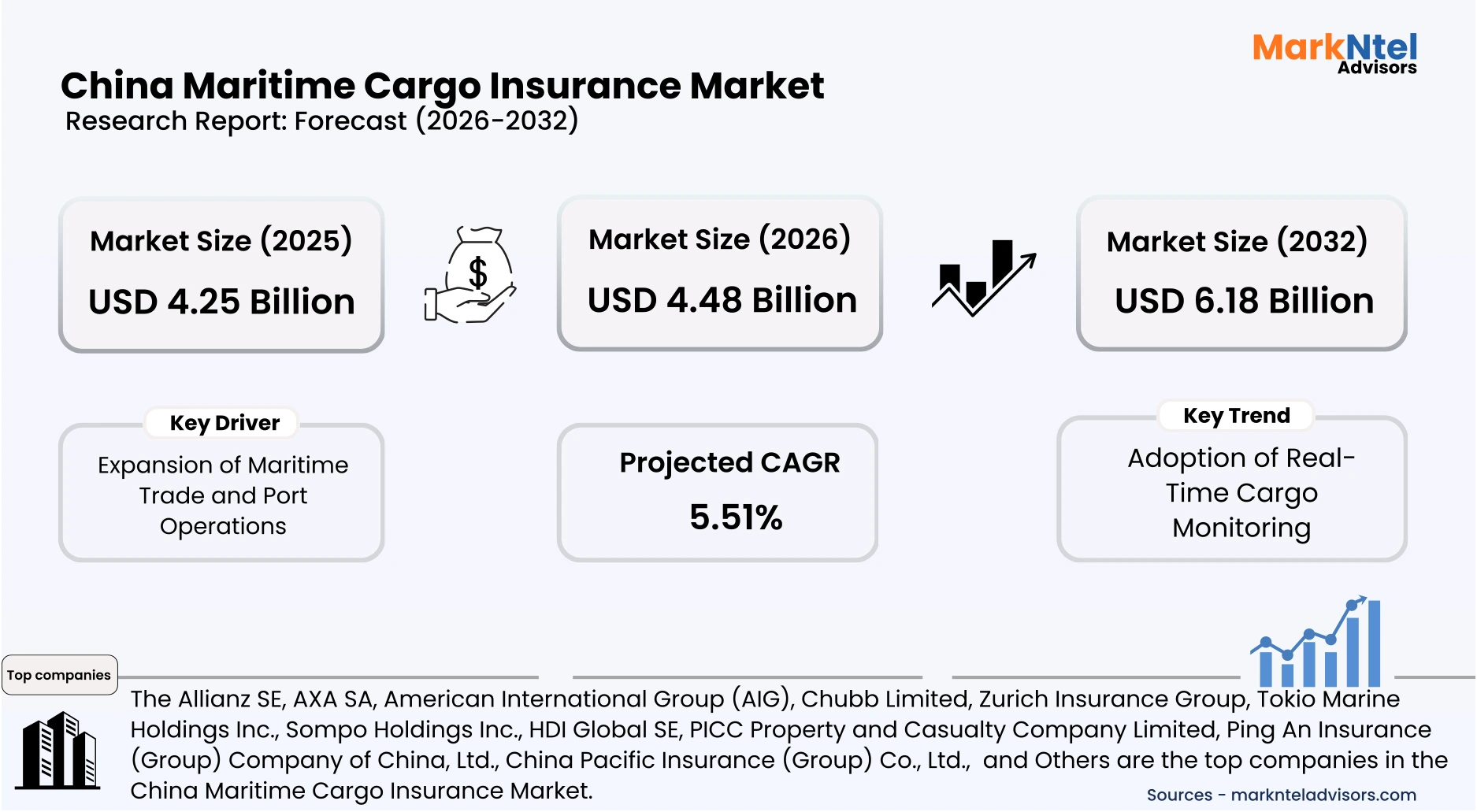
- The China Maritime Cargo Insurance market size was valued at USD 4.25 billion in 2025 and is projected to grow from USD 4.48 billion in 2026 to USD 6.18 billion by 2032, exhibiting a CAGR of 5.51% during the forecast period.
- East China holds the largest market share of about 42% in the China Maritime Cargo Insurance Market in 2026.
- By coverage type, the all-risk coverage segment represented a significant share of about 45% in the China Maritime Cargo Insurance Market in 2026.
- By cargo type, the containerized cargo segment seized a significant share of about 52% in the China Maritime Cargo Insurance Market in 2026.
- Leading maritime cargo insurance companies in the UAE Market are Allianz SE, AXA SA, American International Group (AIG), Chubb Limited, Zurich Insurance Group, Tokio Marine Holdings Inc., Sompo Holdings Inc., HDI Global SE, PICC Property and Casualty Company Limited, Ping An Insurance (Group) Company of China, Ltd., China Pacific Insurance (Group) Co., Ltd., China Shipowners Mutual Assurance Association (China P&I Club), and Others.
Market Insights & Analysis: China Maritime Cargo Insurance Market (2026-32):
The China Maritime Cargo Insurance Market size was valued at approximately USD 4.25 billion in 2025 and is projected to grow from USD 4.48 billion in 2026 to USD 6.18 billion by 2032. Along with this, the market is estimated to grow at a CAGR of around 5.51% during the forecast period, i.e., 2026-32.
The China Maritime Cargo Insurance Market is projected to expand steadily, driven by the expansion of maritime trade and port activities, along with the increasing adoption of real-time cargo monitoring technologies that improve shipment visibility, risk assessment, and insurance coverage efficiency across international shipping routes.
According to data cited by the International Association of Ports and Harbors, approximately 95% of China’s import–export trade volume is transported by sea, demonstrating the critical role of maritime logistics in supporting the country’s global trade flows . This strong reliance on ocean transport directly increases the demand for cargo insurance to protect goods moving through international shipping routes.
China’s expanding port infrastructure and container throughput are strengthening demand for maritime cargo insurance. The Ministry of Transport of the People's Republic of China reported that Chinese ports handled about 350 million TEUs in 2025, up 6.8% year-on-year, while foreign-trade container throughput grew 9.8%.
Similarly, the Port of Shenzhen handled approximately 33.16 million TEUs of foreign-trade containers in 2025, marking a 6.41% increase year-on-year and establishing a new record for the port. The port currently operates 295 global shipping routes connecting more than 300 ports across over 100 countries, demonstrating the scale of China’s maritime logistics network .
Another key hub, the Port of Ningbo‑Zhoushan, handled over 1.4 billion tons of cargo in 2025, maintaining its position as the world’s busiest cargo port for the 17th consecutive year, while container throughput exceeded 43 million TEUs .
Beyond the eastern coastal hubs, maritime connectivity is expanding to inland regions through strategic logistics corridors. The Beibu Gulf Port in southwest China processed 4.3 million TEUs in the first half of 2024, supporting trade links between western China and Southeast Asia and strengthening international maritime logistics flows .
Digitalization is also transforming China’s port operations. The adoption of real-time cargo tracking, blockchain-based documentation, and digital-twin logistics platforms is improving cargo visibility, monitoring shipment conditions, and enabling insurers to assess risk and verify claims more efficiently. These technological advancements support more accurate underwriting and strengthen the overall efficiency of maritime cargo insurance services.
Future infrastructure investments will further reinforce market growth. For example, the Shanghai Xiaoyangshan North Operation Area project is under development with 22 new container berths, significantly increasing the port’s capacity to accommodate ultra-large container vessels .
Likewise, the Fudu Terminal expansion at Ningbo-Zhoushan Port includes two 200,000-ton-class berths scheduled for completion around 2027, allowing the port to handle larger cargo volumes and strengthen global shipping connectivity.
The continued expansion of China’s maritime trade network, combined with large-scale port infrastructure investments and digital logistics technologies, will significantly increase cargo movement through seaborne routes. As trade volumes grow and cargo values rise, the demand for maritime cargo insurance coverage is expected to strengthen steadily in the coming years.
Impact of Iran-Israel War on China Maritime Cargo Insurance Market:
The escalation of the Iran–Israel conflict has created notable disruptions in global maritime trade routes, indirectly impacting the China maritime cargo insurance market. China depends heavily on sea transport for international trade, with many shipping routes connecting Asia to Europe and the Middle East passing through the Strait of Hormuz, one of the world’s most critical energy and shipping corridors. Nearly 20% of global oil shipments transit through this route, making the region strategically important for global trade flows . Security risks and maritime attacks in the region have increased uncertainty for shipping companies transporting cargo linked to Chinese exports and energy imports.
The conflict has also triggered a sharp rise in maritime war-risk insurance premiums. Industry reports indicate that insurance costs for vessels operating in the Gulf region increased significantly, with war-risk premiums rising from about 0.25% to nearly 3% of vessel value in some cases. Higher vessel insurance costs typically translate into increased cargo insurance premiums for exporters, including Chinese manufacturers shipping goods to Europe and the Middle East. In addition, some shipping companies have begun rerouting vessels to avoid high-risk zones, which increases voyage distance, fuel consumption, and transit time.
Overall, geopolitical tensions in the Middle East are increasing operational uncertainty for global shipping. For China, this results in higher cargo risk exposure, increased insurance costs, and more complex underwriting conditions for maritime cargo insurers supporting international trade routes.
China Maritime Cargo Insurance Market Recent Developments:
- 2025: Hong Kong launched a marine war-risk insurance pool backed by five insurers to support Chinese shipowners operating in the Gulf region. The facility provides up to USD 130 million in coverage for 10 mainland-owned vessels, offering lower-cost protection against war and emergency risks compared with traditional London insurance markets .
China Maritime Cargo Insurance Market Scope:
| Category | Segments |
|---|---|
| By Coverage Type | (All Risk Coverage, Named Perils Coverage, Total Loss Only Coverage), |
| By Policy Type | (Single Transit Policy, Open Cover Policy, Annual Policy), |
| By Cargo Type | (Containerized Cargo, Bulk Cargo, Liquid Cargo, Breakbulk Cargo), |
| By Commodity | (Industrial Goods, Consumer Goods, Agricultural Product, Oil & Gas, Chemicals & Petrochemicals, Metals & Minerals, Automotive & Machinery, Others), |
| By Trading Lane | (China – North America, China – Europe, China – Southeast Asia, China – Middle East, China – Africa, China – Latin America), |
| By Buyers | (Traders, Cargo Owners, Ship Owners, Others) |
China Maritime Cargo Insurance Market Driver:
Expansion of Maritime Trade and Port Operations
The steady expansion of maritime trade and port operations in China is a key factor supporting the growth of the maritime cargo insurance market. As one of the world’s largest exporting nations, China depends extensively on maritime logistics networks to transport manufactured goods, industrial inputs, and energy commodities to global markets.
Strong growth in seaborne trade has significantly increased the value and volume of cargo transported through Chinese ports. According to China Daily, Chinese coastal ports handled approximately 4.96 billion tons of foreign-trade cargo in 2023, reflecting a 9.6% year-on-year increase and indicating rising movement of containerized goods, raw materials, and bulk commodities.
Major regional port clusters play a critical role in facilitating this trade activity. In North China, the Bohai Rim port cluster, including Tianjin, Qingdao, and ports across Hebei and Shandong, serves as a key export hub. Tianjin Port processed about 23.3 million TEUs in 2024, highlighting the scale of maritime cargo flows in northern trade routes .
In South China, the Guangdong–Hong Kong–Macao Greater Bay Area shipping cluster forms another major export hub. Shenzhen Port processed around 33.4 million TEUs in 2024, supporting large volumes of electronics, machinery, and consumer goods shipped to international markets.
As maritime cargo volumes increase across these major port clusters, the value of goods transported by sea continues to rise, strengthening the need for comprehensive cargo insurance coverage to manage risks associated with global shipping operations.
The ongoing expansion of China’s maritime trade and port infrastructure increases cargo movement and exposure to transit risks. As a result, demand for maritime cargo insurance services is expected to grow steadily alongside the country’s expanding global shipping network.
China Maritime Cargo Insurance Market Trend:
Adoption of Real-Time Cargo Monitoring
The adoption of real-time cargo tracking, blockchain documentation, and digital-twin logistics platforms is emerging as a key technological trend in China’s maritime cargo insurance market. China is developing digital port ecosystems to improve supply-chain transparency and risk monitoring.
In Shanghai, authorities launched an integrated container information platform enabling exporters, shipping lines, and regulators to track vessel schedules and container status in real time. According to the Shanghai Municipal Government, the system monitors 18 export nodes and 14 import nodes, providing end-to-end visibility across the container shipping process .
The platform further incorporates digital-twin technology, enabling authorities to simulate port operations and analyze container flows in real time. By aggregating operational data from port terminals, trucking networks, and multimodal transport systems, the digital twin allows more accurate monitoring of cargo movements and logistical bottlenecks. Such technologies provide valuable datasets that can be utilized by insurers to validate shipment timelines, evaluate cargo handling conditions, and accelerate claims verification in the event of cargo loss or damage.
As real-time cargo monitoring and digital logistics ecosystems expand, insurers gain improved visibility into shipping risks and cargo conditions. These technological capabilities are expected to enhance underwriting precision and claims management efficiency, thereby supporting long-term growth in China’s maritime cargo insurance market.
China Maritime Cargo Insurance Market Opportunity:
Expansion of Cross-Border E-Commerce Logistics
The rapid growth of cross-border e-commerce exports represents a significant opportunity for the China maritime cargo insurance market, as increasing international shipments require risk protection during maritime transportation.
According to the General Administration of Customs of the People's Republic of China, China’s cross-border e-commerce imports and exports reached approximately USD 370 billion in 2024, reflecting strong expansion in digital trade and international parcel shipments .
In addition, exports through cross-border e-commerce channels surpassed around USD 278.6 billion in 2024, increasing 16.9% year-on-year, demonstrating the accelerating scale of China’s online export logistics. These shipments include electronics, consumer goods, apparel, and small industrial products, many of which are transported through maritime logistics networks connecting Chinese ports with markets in Europe, Southeast Asia, and North America.
As cross-border e-commerce exports continue to expand, the number of international shipments moving through maritime logistics channels will increase substantially. This growth will raise exposure to cargo damage, theft, and transit disruptions, creating strong opportunities for insurers to expand maritime cargo insurance coverage in China.
China Maritime Cargo Insurance Market Challenge:
Geopolitical Disruptions and Maritime Route Volatility
Disruptions in global maritime trade routes challenge China’s maritime cargo insurance market because the country relies heavily on sea transport for exports. According to the United Nations Conference on Trade and Development, maritime shipping carries over 80% of global merchandise trade, making China’s trade routes through the Red Sea and Suez Canal vulnerable to geopolitical and logistical disruptions.
Security tensions in the Red Sea in 2024 disrupted global shipping, causing container transits through the Suez Canal to decline by about 42%, according to UN trade assessments. Many vessels were rerouted via the Cape of Good Hope, increasing voyage distance, fuel consumption, and transit time.
For China’s exporters and logistics operators, these disruptions raise the probability of cargo delays, damage, and operational losses during long-distance maritime transport. Insurers must reassess risk exposure and adjust underwriting conditions for shipments moving through high-risk waters. This leads to higher insurance costs and more complex policy structures for maritime cargo coverage.
As China depends heavily on maritime trade routes linking Asia with Europe and other global markets, disruptions along key corridors directly affect cargo movement. Increased uncertainty in shipping routes, therefore, poses a persistent challenge for risk pricing and stability in the China maritime cargo insurance market.
China Maritime Cargo Insurance Market (2026-32) Segmentation Analysis:
The China Maritime Cargo Insurance Market study of MarkNtel Advisors evaluates & highlights the major trends and influencing factors in each segment. It includes predictions for the period 2026–32 at the country level. Based on the analysis, the market has been further classified as;
Based on Coverage Type:
- All Risk Coverage
- Named Perils Coverage
- Total Loss Only Coverage
The all-risk coverage segment dominates the China Maritime Cargo Insurance market, accounting for approximately 45% of the market size, due to its comprehensive protection against a broad spectrum of transit-related risks.
This policy structure typically covers physical loss or damage to cargo arising from most unforeseen events during transportation, except for specific exclusions such as war, deliberate misconduct, or inherent product defects.
As China remains one of the world’s largest exporters of manufactured goods, including electronics, machinery, automotive components, and consumer products, exporters and logistics providers increasingly prioritize comprehensive insurance protection to safeguard high-value shipments moving through international maritime routes.
China’s extensive global shipping network further strengthens the preference for all-risk policies. Large volumes of containerized cargo pass through major international ports such as the Port of Shanghai and the Port of Shenzhen, with shipments often traveling across long and complex supply chains before reaching destination markets.
Furthermore, international trade agreements and financing arrangements frequently require comprehensive cargo insurance to secure the value of goods in transit. Financial institutions and trading partners typically favor broader insurance coverage as a risk mitigation mechanism within global supply chains.
Overall, the strong demand for comprehensive protection against diverse shipping risks positions all risk coverage as the most widely adopted policy type within China’s maritime cargo insurance market.
Based on Cargo Type:
- Containerized Cargo
- Bulk Cargo
- Liquid Cargo
- Breakbulk Cargo
The containerized cargo segment dominates the China Maritime Cargo Insurance market, accounting for about 52% of total market value, due to the country’s extensive export-oriented manufacturing sector and the widespread adoption of containerized shipping in global trade.
China exports a broad range of manufactured goods and automotive components, which are primarily transported in standardized shipping containers. The large volume and high value of these goods significantly increase the demand for comprehensive cargo insurance coverage to mitigate financial risks associated with maritime transportation.
The prominence of containerized cargo is further supported by the scale and efficiency of China’s port infrastructure. Major international container hubs such as the Port of Shanghai and the Port of Shenzhen process substantial volumes of container traffic annually, serving as critical gateways for trade between China and key markets in North America, Europe, and the Asia-Pacific. The continuous expansion of container shipping capacity across these ports reflects the growing reliance on containerized logistics for international trade.
Consequently, the central role of container shipping in China’s global trade network reinforces containerized cargo as the leading segment within the country’s maritime cargo insurance market.
China Maritime Cargo Insurance Market (2026-32): Regional Projection
East China dominates the China Maritime Cargo Insurance market with an estimated 42% share, due to its concentration of world-class ports, extensive export-oriented industries, and highly developed maritime logistics infrastructure. The region hosts the Yangtze River Delta port cluster, one of the most significant global shipping hubs, facilitating large volumes of containerized cargo transported between China and major international markets.
Major ports in East China handle some of the highest container throughput levels worldwide. The Port of Shanghai handled approximately 51.5 million TEUs in 2024, maintaining its position as the world’s busiest container port. Meanwhile, the Port of Ningbo-Zhoushan processed about 39.3 million TEUs, reinforcing the region’s status as a global maritime logistics center.
Continuous growth in cargo movement is also reflected in operational statistics, indicating that Shanghai processed around 25.5 million TEUs in the first half of 2024, highlighting strong and sustained maritime trade activity .
East China is a major industrial and export hub for electronics, automotive manufacturing, machinery, and chemicals. These sectors generate large volumes of high-value cargo transported by sea, increasing reliance on maritime logistics and driving stronger demand for comprehensive maritime cargo insurance to manage international shipping risks.
Consequently, the region’s high port throughput, strong industrial export base, and extensive international shipping connectivity firmly establish East China as the leading regional market within China’s maritime cargo insurance industry.
Gain a Competitive Edge with Our China Maritime Cargo Insurance Market Report:
- China Maritime Cargo Insurance Market Report by MarkNtel Advisors provides a detailed & thorough analysis of market size & share, growth rate, competitive landscape, and key players. This comprehensive analysis helps businesses gain a holistic understanding of the market dynamics & make informed decisions.
- This report also highlights current market trends & future projections, allowing businesses to identify emerging opportunities & potential challenges. By understanding market forecasts, companies can align their strategies & stay ahead of the competition.
- China Maritime Cargo Insurance Market Report aids in assessing & mitigating risks associated with entering or operating in the market. By understanding market dynamics, regulatory frameworks, and potential challenges, businesses can develop strategies to minimize risks & optimize their operations.
*Reports Delivery Format - Market research studies from MarkNtel Advisors are offered in PDF, Excel and PowerPoint formats. Within 24 hours of the payment being successfully received, the report will be sent to your email address.
Frequently Asked Questions
- Market Segmentation
- Introduction
- Product Definition
- Research Process
- Assumptions
- Executive Summary
- China Maritime Cargo Insurance Market Policies, Regulations, and Product Standards
- China Maritime Cargo Insurance Market Trends & Developments
- China Maritime Cargo Insurance Market Dynamics
- Growth Factors
- Challenges
- China Maritime Cargo Insurance Market Hotspot & Opportunities
- China Maritime Cargo Insurance Market Outlook, 2022-2032F
- Market Size & Outlook
- By Revenues (USD Million)
- Market Share & Outlook
- By Coverage Type- Market Size & Forecast 2022-2032, USD Million
- All Risk Coverage
- Named Perils Coverage
- Total Loss Only Coverage
- By Policy Type- Market Size & Forecast 2022-2032, USD Million
- Single Transit Policy
- Open Cover Policy
- Annual Policy
- By Cargo Type- Market Size & Forecast 2022-2032, USD Million
- Containerized Cargo
- Bulk Cargo
- Liquid Cargo
- Breakbulk Cargo
- By Commodity- Market Size & Forecast 2022-2032, USD Million
- Industrial Goods
- Consumer Goods
- Agricultural Product
- Oil & Gas
- Chemicals & Petrochemicals
- Metals & Minerals
- Automotive & Machinery
- Others
- By Trading Lane- Market Size & Forecast 2022-2032, USD Million
- China – North America
- China – Europe
- China – Southeast Asia
- China – Middle East
- China – Africa
- China – Latin America
- By Buyers- Market Size & Forecast 2022-2032, USD Million
- Traders
- Cargo Owners
- Ship Owners
- Others
- By Company
- Competition Characteristics
- Market Share & Analysis
- By Coverage Type- Market Size & Forecast 2022-2032, USD Million
- Market Size & Outlook
- China Containerized Cargo Market Outlook, 2022-2032
- Market Size & Outlook
- By Revenues (USD Million)
- Market Share & Outlook
- By Policy Type- Market Size & Forecast 2022-2032, USD Million
- By Coverage Type- Market Size & Forecast 2022-2032, USD Million
- By Commodity- Market Size & Forecast 2022-2032, USD Million
- By Trading Lane- Market Size & Forecast 2022-2032, USD Million
- By Buyers- Market Size & Forecast 2022-2032, USD Million
- Market Size & Outlook
- China Bulk Cargo Market Outlook, 2022-2032
- Market Size & Outlook
- By Revenues (USD Million)
- Market Share & Outlook
- By Policy Type- Market Size & Forecast 2022-2032, USD Million
- By Coverage Type- Market Size & Forecast 2022-2032, USD Million
- By Commodity- Market Size & Forecast 2022-2032, USD Million
- By Trading Lane- Market Size & Forecast 2022-2032, USD Million
- By Buyers- Market Size & Forecast 2022-2032, USD Million
- Market Size & Outlook
- China Liquid Cargo Market Outlook, 2022-2032
- Market Size & Outlook
- By Revenues (USD Million)
- Market Share & Outlook
- By Policy Type- Market Size & Forecast 2022-2032, USD Million
- By Coverage Type- Market Size & Forecast 2022-2032, USD Million
- By Commodity- Market Size & Forecast 2022-2032, USD Million
- By Trading Lane- Market Size & Forecast 2022-2032, USD Million
- By Buyers- Market Size & Forecast 2022-2032, USD Million
- Market Size & Outlook
- China Breakbulk Cargo Market Outlook, 2022-2032
- Market Size & Outlook
- By Revenues (USD Million)
- Market Share & Outlook
- By Policy Type- Market Size & Forecast 2022-2032, USD Million
- By Coverage Type- Market Size & Forecast 2022-2032, USD Million
- By Commodity- Market Size & Forecast 2022-2032, USD Million
- By Trading Lane- Market Size & Forecast 2022-2032, USD Million
- By Buyers- Market Size & Forecast 2022-2032, USD Million
- Market Size & Outlook
- China Maritime Cargo Insurance Market Key Strategic Imperatives for Success & Growth
- Competitive Outlook
- Company Profiles
- Allianz SE
- Business Description
- Product Portfolio
- Collaborations & Alliances
- Recent Developments
- Financial Details
- Others
- AXA SA
- Business Description
- Product Portfolio
- Collaborations & Alliances
- Recent Developments
- Financial Details
- Others
- American International Group (AIG)
- Business Description
- Product Portfolio
- Collaborations & Alliances
- Recent Developments
- Financial Details
- Others
- Chubb Limited
- Business Description
- Product Portfolio
- Collaborations & Alliances
- Recent Developments
- Financial Details
- Others
- Zurich Insurance Group
- Business Description
- Product Portfolio
- Collaborations & Alliances
- Recent Developments
- Financial Details
- Others
- Tokio Marine Holdings Inc.
- Business Description
- Product Portfolio
- Collaborations & Alliances
- Recent Developments
- Financial Details
- Others
- Sompo Holdings Inc.
- Business Description
- Product Portfolio
- Collaborations & Alliances
- Recent Developments
- Financial Details
- Others
- HDI Global SE
- Business Description
- Product Portfolio
- Collaborations & Alliances
- Recent Developments
- Financial Details
- Others
- PICC Property and Casualty Company Limited
- Business Description
- Product Portfolio
- Collaborations & Alliances
- Recent Developments
- Financial Details
- Others
- Ping An Insurance (Group) Company of China, Ltd.
- Business Description
- Product Portfolio
- Collaborations & Alliances
- Recent Developments
- Financial Details
- Others
- China Pacific Insurance (Group) Co., Ltd.
- Business Description
- Product Portfolio
- Collaborations & Alliances
- Recent Developments
- Financial Details
- Others
- China Shipowners Mutual Assurance Association (China P&I Club)
- Business Description
- Product Portfolio
- Collaborations & Alliances
- Recent Developments
- Financial Details
- Others
- Allianz SE
- Company Profiles
- Disclaimer
MarkNtel Advisors follows a robust and iterative research methodology designed to ensure maximum accuracy and minimize deviation in market estimates and forecasts. Our approach combines both bottom-up and top-down techniques to effectively segment and quantify various aspects of the market. A consistent feature across all our research reports is data triangulation, which examines the market from three distinct perspectives to validate findings. Key components of our research process include:
1. Scope & Research Design At the outset, MarkNtel Advisors define the research objectives and formulate pertinent questions. This phase involves determining the type of research—qualitative or quantitative—and designing a methodology that outlines data collection methods, target demographics, and analytical tools. They also establish timelines and budgets to ensure the research aligns with client goals.
2. Sample Selection and Data Collection In this stage, the firm identifies the target audience and determines the appropriate sample size to ensure representativeness. They employ various sampling methods, such as random or stratified sampling, based on the research objectives. Data collection is carried out using tools like surveys, interviews, and observations, ensuring the gathered data is reliable and relevant.
3. Data Analysis and Validation Once data is collected, MarkNtel Advisors undertake a rigorous analysis process. This includes cleaning the data to remove inconsistencies, employing statistical software for quantitative analysis, and thematic analysis for qualitative data. Validation steps are taken to ensure the accuracy and reliability of the findings, minimizing biases and errors.

4. Data Forecast and FinalizationThe final phase involves forecasting future market trends based on the analyzed data. MarkNtel Advisors utilize predictive modeling and time series analysis to anticipate market behaviors. The insights are then compiled into comprehensive reports, featuring visual aids like charts and graphs, and include strategic recommendations to inform client decision-making
We offer flexible licensing options to cater to varying organizational needs. Choose the pricing pack that best suits your requirements:
Buy Now Inquire Before Buying
 Request Customization
 Talk to our Consultant







