

Brazil Enzymes Market Research Report: Trends & Forecast (2026-2032)
By Type (Carbohydrases, Proteases, Lipases, Polymerases & Nucleases, Phytases, Other Enzymes), By Source (Microbial, Plant, Animal), By Application (Industrial Enzymes, Food Enzyme ... s, Feed Enzymes, Healthcare & Diagnostics), and others Read more
- Chemicals
- Mar 2026
- Pages 120
- Report Format: PDF, Excel, PPT
Brazil Enzymes Market
Projected 5.64% CAGR from 2026 to 2032
Study Period
2026-2032
Market Size (2026)
USD 346 Million
Market Size (2032)
USD 481 Million
Base Year
2025
Projected CAGR
5.64%
Leading Segments
By Application: Industrial Enzymes
Brazil Enzymes Market Report Key Takeaways:
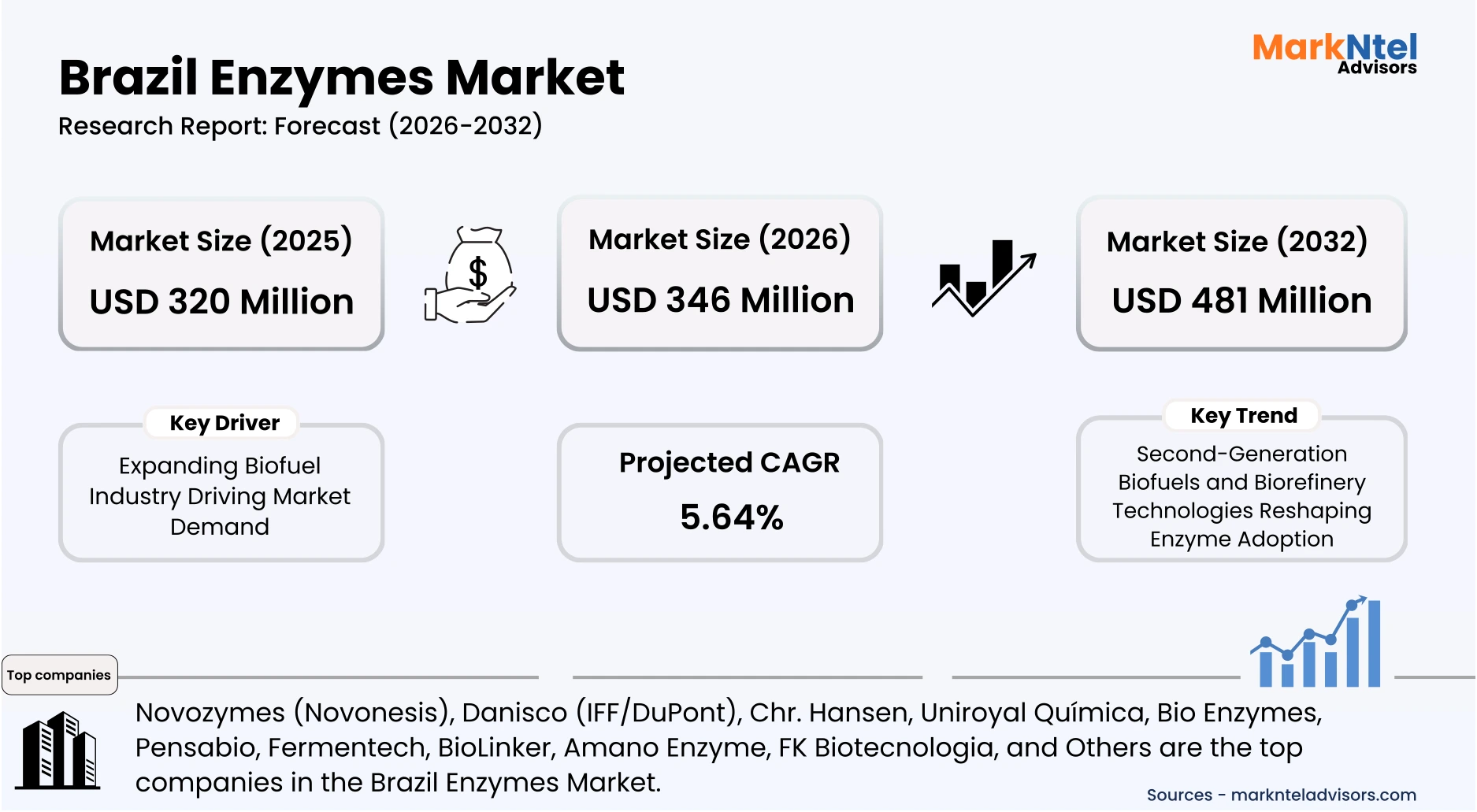
- The Brazil Enzymes Market size was valued at around USD 320 million in 2025 and is projected to grow from USD 346 million in 2026 to USD 481 million by 2032, exhibiting a CAGR of 5.64% during the forecast period.
- The Southeast region is the leading region with a significant share of 40% in 2026.
- By Type, the Carbohydrases segment captured a significant share of about 40% in the Brazil Enzyme Market in 2026.
- By Application, the industrial enzymes seized a significant share of about 50% in the Brazil Enzymes Market in 2026.
- Leading companies in Brazil are Novozymes (Novonesis), Danisco (IFF/DuPont), Chr. Hansen, Uniroyal Química, Bio Enzymes, Pensabio, Fermentech, BioLinker, Amano Enzyme, FK Biotecnologia, and Others.
Market Insights & Analysis: Brazil Enzymes Market (2026-32):
The Brazil Enzymes Market size was valued at around USD 320 million in 2025 and is projected to grow from USD 346 million in 2026 to USD 481 million by 2032, exhibiting a CAGR of 5.64% during the forecast period. i.e., 2026-32.
Brazil’s enzymes industry has demonstrated a strong historical growth trajectory underpinned by the country’s expanding industrial base, rising demand for bio‐based products, and increasing integration of biotechnological processes across key end‑user segments . Industrial deployment spans food & beverage manufacturing, textiles, detergents, and bioenergy applications, stimulating demand from both commercial processors and institutional buyers in agribusiness and manufacturing. These segments’ contributions have positioned Brazil as an emerging leader within Latin America’s bio-industrial landscape, supported by expanding enzyme applications and process innovation.
The market’s current conditions are shaped by economic and demographic drivers that support enzyme adoption across diverse sectors. Brazil’s vast agricultural operations and integrated supply chains sustain strong demand for feed and processing enzymes, particularly in poultry and livestock applications where enzyme additives improve nutrient uptake and production efficiency. In the food and beverage sector, urbanization and shifting consumption patterns toward convenient, high‑quality processed foods have accelerated enzyme use to enhance product consistency and shelf life. Moreover, the domestic rise of enzyme engineering firms experimenting with advanced production methods, including AI‑assisted strain optimization and enzyme immobilization techniques, has contributed to lower production costs and broadened the technology’s applicability.
Brazil’s policy environment increasingly supports bio‑innovation and industrial biotechnology, creating regulatory and institutional frameworks that indirectly bolster enzyme market prospects. The government is advancing its National Bioeconomy Strategy (ENBIO) and drafting a National Bioeconomy Development Plan (PNDBio) to coordinate investments, governance, and financing mechanisms aimed at strengthening domestic biotechnology and bioproduct sectors through 2035. This initiative, part of the broader ecological transformation and industrial modernization agenda under the Nova Indústria Brazil program, seeks to expand local capacity for bioinputs, sustainable biomaterials, and biological manufacturing, all of which can stimulate enzyme research, scale‑up, and commercialization.
Looking forward, the Brazilian enzymes market is expected to sustain demand as industrial decarbonization, circular economy objectives, and green manufacturing priorities gain prominence. Expansion of domestic production capabilities, including technology transfer efforts aimed at reducing dependence on imported enzymes, is anticipated to enhance cost competitiveness and supply chain resilience. Combined with targeted efforts to cultivate skilled workforce capacity and align regulatory systems with innovation pathways, these factors position Brazil’s enzymes sector for continued growth across key industrial and institutional end‑user segments over the coming decade.
Brazil Enzymes Market Scope:
| Category | Segments |
|---|---|
| By Type | (Carbohydrases, Proteases, Lipases, Polymerases & Nucleases, Phytases, Other Enzymes), |
| By Source | (Microbial, Plant, Animal), |
| By Application | (Industrial Enzymes, Food Enzymes, Feed Enzymes, Healthcare & Diagnostics), |
Brazil Enzymes Market Driver:
Expanding Biofuel Industry Driving Market Demand
Brazil’s rapidly expanding biofuel sector has become the most influential structural driver of demand for industrial enzymes, particularly in bioethanol production. Brazil produced 36.83 billion liters of ethanol in 2024, a 4.4% increase from 2023, reaching a historic record. Brazil is the second-largest ethanol producer globally, reinforcing the scale of the biofuel sector . Enzymes such as cellulases and amylases are essential for converting sugarcane biomass and corn starch into fermentable sugars. As production volumes rise, enzyme consumption increases proportionally because every additional liter of ethanol requires enzymatic processing during saccharification and fermentation.
This driver has intensified in recent years due to national decarbonization policies that directly incentivize ethanol output. Under the RenovaBio program administered by the National Agency of Petroleum, Natural Gas and Biofuels, Brazil raised its carbon-intensity reduction targets for fuel distributors through 2030, stimulating biofuel demand . Corn ethanol already represents about 20% of Brazil’s ethanol production, with output projected to continue expanding due to new plants and capacity investments and is projected to expand further as distributors purchase decarbonization credits (CBIOs). Higher mandated blending and carbon targets therefore, translate directly into increased feedstock processing and enzyme usage.
The structural nature of this driver is reinforced by continued investment in ethanol capacity and second-generation biofuels. According to the Brazilian Sugarcane Industry and Bioenergy Association, Brazil processed more than 621 million tons of sugarcane in the 2024–2025 harvest , with a growing share directed toward ethanol rather than sugar. New cellulosic ethanol plants rely heavily on advanced enzyme systems to convert agricultural residues such as bagasse and straw. As production volumes expand across major sugarcane regions, including São Paulo and Goiás, enzyme demand grows in tandem with processing capacity rather than fluctuating with short-term pricing cycles.
Brazil Enzymes Market Trend:
Second-Generation Biofuels and Biorefinery Technologies Reshaping Enzyme Adoption
The rapid expansion of second-generation (2G) biofuels and integrated biorefineries is emerging as a defining trend transforming Brazil’s enzymes market. Unlike conventional ethanol derived from sugarcane juice, 2G biofuels convert agricultural residues such as bagasse and straw using specialized enzyme systems. A Brazilian second-generation ethanol plant uses specially formulated enzymes to extract the sugars present in the cellulose of sugarcane bagasse before fermentation. According to the International Energy Agency, Brazil remains one of the few countries operating commercial-scale cellulosic ethanol plants, highlighting growing industrial deployment.
This trend has accelerated as bioenergy producers invest in biorefinery infrastructure that maximizes biomass utilization. Brazil’s biofuel producer Raízen operates industrial-scale cellulosic ethanol plants and continues expanding facilities with annual capacities around 82 million liters each. Such facilities rely heavily on cellulases and hemicellulases to break down lignocellulosic biomass, fundamentally increasing enzyme intensity across biofuel value chains.
The structural impact extends beyond ethanol production, influencing research, supply chains, and technology partnerships. Brazil’s Brazilian Agricultural Research Corporation and industry participants are developing improved enzyme technologies tailored to tropical biomass feedstocks. Continued decarbonization targets and rising global demand for sustainable fuels ensure long-term investment in advanced biofuel infrastructure. As a result, enzyme applications are shifting toward high-efficiency bioconversion systems, embedding biotechnology more deeply into Brazil’s evolving bioindustrial economy.
Brazil Enzymes Market Opportunity:
Research & Development Catalyzing Efficiency and Cost-Effectiveness
High investment potential exists in R&D to enhance enzyme efficiency and reduce production costs, driven by Brazil’s growing demand for advanced biofuel and bioproduct applications. Enzymes such as cellulases and amylases are critical for converting sugarcane biomass and other agricultural residues into fermentable sugars, yet current processes remain energy- and time-intensive. Partnerships with local biotechnology firms and research institutes enable the development of tailored enzyme formulations optimized for Brazil’s tropical feedstocks, providing measurable gains in conversion rates and reducing overall operational costs.
The Brazilian Agricultural Research Corporation (Embrapa Agroenergia) actively opens its enzyme research infrastructure and collaborates with private companies to develop microbial and enzymatic technologies for biomass processing. Their platform includes a large microorganism collection, pilot plant capabilities, and cooperation models for the co-development of enzyme products. Specifically, Embrapa offers innovation‑open calls and co-development frameworks where industry partners can leverage its R&D teams to develop enzymes for bioenergy, bioproducts, and other applications, lowering barriers for smaller firms to access advanced biological capabilities.
Brazil’s National Bioeconomy Strategy (ENBio) and the forthcoming PNDBio plan actively promote biotechnology innovation, providing both regulatory support and potential funding incentives for domestic R&D. Scientists at CNPEM’s Biorenewables National Laboratory advanced understanding of fungi-derived enzymes essential for degrading sugarcane bagasse, with the aim of improving efficiency in second-generation ethanol production. This confirms research focus on enzyme efficiency improvements, aligning with R&D opportunity themes.
Investment in R&D thus represents a structurally favorable opportunity: by improving enzyme efficiency, companies can reduce per-liter ethanol production costs, increase yield from biomass, and differentiate products in a competitive market. Smaller and emerging biotechnology players are particularly positioned to innovate rapidly, forming niche partnerships and delivering customized solutions that large incumbents may adopt only gradually. This makes R&D a key driver of both market growth and long-term technological leadership in Brazil’s enzyme sector.
Brazil Enzymes Market Challenge:
Regulatory Complexities and High Production Costs
A critical challenge in Brazil’s Enzymes Market is the complex regulatory framework and high operational costs, which create structural barriers for manufacturers and importers. Enzyme products are subject to multiple regulatory agencies, including ANVISA for food and pharma applications, MAPA for agricultural uses, and IBAMA for environmental compliance. Compliance requires extensive documentation, lengthy approval timelines, and adherence to biosafety and labeling standards, which increase time-to-market and limit entry for smaller players.
Brazil issued a joint ordinance to modernize procedures for registering biological products microbiological, bioquímicos, semioquímicos, etc., explicitly involving all three regulatory agencies in the process. This reflects the multi‑agency coordination needed for biological/biotech product approvals and underscores the documentation and evaluation requirements across health, agricultural, and environmental domains.
High production and formulation costs further constrain market growth. Local enzyme manufacturing relies on specialized fermentation facilities and purified proteins, which require significant capital investment and operational expertise. Importing enzymes incurs tariffs and currency risk, making products expensive for downstream users in detergents, food processing, and textiles. Brazil still depends heavily on imported high-performance enzymes for sectors like brewing, starch processing, and pulp & paper. This reliance reduces competitiveness, creates supply vulnerabilities, and prevents smaller firms from quickly adapting products for local industrial needs, restricting overall market expansion.
Brazil Enzymes Market (2026-32) Segmentation Analysis:
The Brazil Enzymes Market study of MarkNtel Advisors evaluates & highlights the major trends and influencing factors in each segment. It includes predictions for the period 2026–32 at the country level. Based on the analysis, the market has been further classified as:
Based on Type:
- Carbohydrases
- Proteases
- Lipases
- Polymerases & Nucleases
- Phytases
- Other Enzymes
Carbohydrases dominate Brazil’s enzyme industry with a market share of 40% due to their versatility across industrial, food, and biofuel applications, particularly in starch processing, brewing, and bioethanol production. Rising demand for efficient biocatalysts that directly convert polysaccharides into fermentable sugars is driving segment growth. Government support under ENBio and PNDBio incentivizes local biotechnology development and investment in enzyme innovation.
Investment flows favor enhanced amylases, cellulases, and glucoamylases with improved activity and stability, enabling manufacturers to meet industrial efficiency and cost requirements. Biofuel producers, food processors, and beverage companies increasingly adopt these enzymes to reduce energy usage, increase yield, and maintain product consistency, expanding segment volume. Brazilian research institutions develop carbohydrate-degrading enzyme systems for converting biomass into fuels and bioproducts, reflecting local innovation capacity.
Brazil’s abundant starch-rich feedstocks, such as sugarcane, corn, and cassava, provide low-cost raw materials for enzyme production. Combined with favorable tax policies, R&D incentives, and partnerships with local biotech firms, these factors secure Carbohydrases sustained leadership in the domestic market and facilitate scalable manufacturing for export.
Based on Application:
- Industrial Enzymes
- Food Enzymes
- Feed Enzymes
- Healthcare & Diagnostics
The Industrial Enzymes lead with a market share of 50% due to broad adoption across food & beverage, biofuel, textile, detergent, and pulp & paper sectors. Industrial players prioritise enzymes like carbohydrases, proteases, and lipases to improve process efficiency, reduce operational costs, and enhance product quality, driving sustained demand.
Investment in local enzyme production, including partnerships with biotech companies, allows tailored formulations for industrial applications, reducing reliance on imported enzymes. Policies under PNDBio and the National Bioeconomy Strategy further encourage innovation and scale-up of industrial enzyme manufacturing.
Sustained dominance is reinforced by Brazil’s diverse industrial base and export-oriented production, which demands consistent enzyme performance. The combination of regulatory support, R&D investment, and growing industrial adoption ensures that Industrial Enzymes maintains market leadership throughout the 2026–2032 forecast period.
Brazil Enzymes Market (2026-32) Regional Analysis:
The Southeast region of Brazil, notably São Paulo, Minas Gerais, and Rio de Janeiro, stands as the largest and most dominant hub in the country’s enzymes market with a market share of 40% due to its industrial concentration and demand intensity. It hosts the most advanced and diversified food processing, biofuel, chemical, and biotechnology sectors, which are heavy users of enzymes across applications such as food & beverage processing and bioethanol production. São Paulo’s strong industrial base, linked to high urbanization and consumer purchasing power, drives sustained demand for enzyme solutions that improve productivity and product quality. The region’s robust food processing sector is a key catalyst for enzyme utilization, particularly for bakery, dairy, and beverage products, stimulating enzyme consumption more than other regions.
Structural and economic factors further reinforce Southeast dominance: the area benefits from developed infrastructure, including logistics networks and proximity to ports, which reduces distribution costs and enhances supply chain efficiency for enzyme suppliers. It also has an extensive agricultural output of sugar, corn, and soy, underpinning enzyme demand in both food and biofuel applications. According to Embrapa, the Southeast accounts for about 434.5 million tonnes of sugarcane on approximately 5.4 million hectares of planted area. This is substantially larger than other regions, highlighting its agricultural output scale. This vast sugarcane production in the Southeast directly supports sustained enzyme demand, especially for fermentative processes in bioethanol and downstream industrial processing, where enzymes reduce hydrolysis costs and improve yields.
Regulatory and business environment advantages also support market leadership. Southeast Brazil is the center of biotechnology and industrial enzyme innovation, with a high concentration of biotech firms and R&D activities. Cellco Biotec, headquartered in São Carlos, São Paulo state, developed and commercially produces DNA polymerases and other enzymes used in molecular biology applications such as DNA amplification, sequencing, and diagnostics. This is a clear example of a locally produced enzyme product with export activity and efficient commercialization of enzyme technologies. These conditions, paired with concentrated end-user demand and strong trade activity, create a clear cause-and-effect relationship between regional conditions and sustained dominance in the Brazilian enzymes market.
Gain a Competitive Edge with Our Brazil Enzymes Market Report:
- The Brazil Enzymes Market Report by MarkNtel Advisors provides a detailed & thorough analysis of market size & share, growth rate, competitive landscape, and key players. This comprehensive analysis helps businesses gain a holistic understanding of the market dynamics & make informed decisions.
- This report also highlights current market trends & future projections, allowing businesses to identify emerging opportunities & potential challenges. By understanding market forecasts, companies can align their strategies & stay ahead of the competition.
- The Brazil Enzymes Market Report aids in assessing & mitigating risks associated with entering or operating in the market. By understanding market dynamics, regulatory frameworks, and potential challenges, businesses can develop strategies to minimize risks & optimize their operations.
*Reports Delivery Format - Market research studies from MarkNtel Advisors are offered in PDF, Excel and PowerPoint formats. Within 24 hours of the payment being successfully received, the report will be sent to your email address.
Frequently Asked Questions
- Market Segmentation
- Introduction
- Product Definition
- Research Process
- Assumptions
- Executive Summary
- Brazil Enzymes Market Policies, Regulations, and Product Standards
- Brazil Enzymes Market Trends & Developments
- Brazil Enzymes Market Dynamics
- Growth Factors
- Challenges
- Brazil Enzymes Market Hotspot & Opportunities
- Brazil Enzymes Market Outlook, 2022-2032F
- Market Size & Outlook
- By Revenues (USD Million)
- By Volume (Million Tons)
- Market Share & Outlook
- Market Size & Outlook
- 8.2.1. By Type - Market Size & Forecast 2022-2032, USD Million & Million Tons
- Carbohydrases
- Proteases
- Lipases
- Polymerases & Nucleases
- Phytases
- Other Enzymes
- By Source- Market Size & Forecast 2022-2032, USD Million & Million Tons
- Microbial
- Plant
- Animal
- By Application- Market Size & Forecast 2022-2032, USD Million & Million Tons
- Industrial Enzymes
- Food & Beverage
- Biofuel
- Detergents
- Textile & Leather
- Paper & Pulp
- Wastewater Treatment
- Food Enzymes
- Bakery
- Dairy
- Beverages
- Meat Processing
- Confectionery
- Feed Enzymes
- Poultry
- Swine
- Ruminants
- Aquaculture
- Healthcare & Diagnostics
- In-vitro Diagnostics
- Therapeutic Enzymes
- Enzyme Replacement Therapy
- Industrial Enzymes
- By Region- Market Size & Forecast 2022-2032, USD Million & Million Tons
- North
- Northeast
- Central-West
- Southeast
- South
- By Company
- Competition Characteristics
- Market Share & Analysis
- Brazil Carbohydrases Market Outlook, 2022-2032
- Market Size & Outlook
- By Revenues (USD Million)
- By Volume (Million Tons)
- Market Share & Outlook
- By Source- Market Size & Forecast 2022-2032, USD Million & Million Tons
- By Application- Market Size & Forecast 2022-2032, USD Million & Million Tons
- By Region- Market Size & Forecast 2022-2032, USD Million & Million Tons
- Market Size & Outlook
- Brazil Proteases Market Outlook, 2022-2032
- Market Size & Outlook
- By Revenues (USD Million)
- By Volume (Million Tons)
- Market Share & Outlook
- By Source- Market Size & Forecast 2022-2032, USD Million & Million Tons
- By Application- Market Size & Forecast 2022-2032, USD Million & Million Tons
- By Region- Market Size & Forecast 2022-2032, USD Million & Million Tons
- Market Size & Outlook
- Brazil Lipases Market Outlook, 2022-2032
- Market Size & Outlook
- By Revenues (USD Million)
- By Volume (Million Tons)
- Market Share & Outlook
- By Source- Market Size & Forecast 2022-2032, USD Million & Million Tons
- By Application- Market Size & Forecast 2022-2032, USD Million & Million Tons
- By Region- Market Size & Forecast 2022-2032, USD Million & Million Tons
- Market Size & Outlook
- Brazil Polymerases & Nucleases Market Outlook, 2022-2032
- Market Size & Outlook
- By Revenues (USD Million)
- By Volume (Million Tons)
- Market Share & Outlook
- By Source- Market Size & Forecast 2022-2032, USD Million & Million Tons
- By Application- Market Size & Forecast 2022-2032, USD Million & Million Tons
- By Region- Market Size & Forecast 2022-2032, USD Million & Million Tons
- Market Size & Outlook
- Brazil Phytases Market Outlook, 2022-2032
- Market Size & Outlook
- By Revenues (USD Million)
- By Volume (Million Tons)
- Market Share & Outlook
- By Source- Market Size & Forecast 2022-2032, USD Million & Million Tons
- By Application- Market Size & Forecast 2022-2032, USD Million & Million Tons
- By Region- Market Size & Forecast 2022-2032, USD Million & Million Tons
- Market Size & Outlook
- Brazil Enzymes Market Key Strategic Imperatives for Success & Growth
- Competitive Outlook
- Company Profiles
- Novozymes (Novonesis)
- Business Description
- Product Portfolio
- Collaborations & Alliances
- Recent Developments
- Financial Details
- Others
- Danisco (IFF/DuPont)
- Business Description
- Product Portfolio
- Collaborations & Alliances
- Recent Developments
- Financial Details
- Others
- Chr. Hansen
- Business Description
- Product Portfolio
- Collaborations & Alliances
- Recent Developments
- Financial Details
- Others
- Uniroyal Química
- Business Description
- Product Portfolio
- Collaborations & Alliances
- Recent Developments
- Financial Details
- Others
- Bio Enzymes
- Business Description
- Product Portfolio
- Collaborations & Alliances
- Recent Developments
- Financial Details
- Others
- Pensabio
- Business Description
- Product Portfolio
- Collaborations & Alliances
- Recent Developments
- Financial Details
- Others
- Fermentech
- Business Description
- Product Portfolio
- Collaborations & Alliances
- Recent Developments
- Financial Details
- Others
- BioLinker
- Business Description
- Product Portfolio
- Collaborations & Alliances
- Recent Developments
- Financial Details
- Others
- Amano Enzyme
- Business Description
- Product Portfolio
- Collaborations & Alliances
- Recent Developments
- Financial Details
- Others
- FK Biotecnologia
- Business Description
- Product Portfolio
- Collaborations & Alliances
- Recent Developments
- Financial Details
- Others
- Novozymes (Novonesis)
- Company Profiles
- Disclaimer
MarkNtel Advisors follows a robust and iterative research methodology designed to ensure maximum accuracy and minimize deviation in market estimates and forecasts. Our approach combines both bottom-up and top-down techniques to effectively segment and quantify various aspects of the market. A consistent feature across all our research reports is data triangulation, which examines the market from three distinct perspectives to validate findings. Key components of our research process include:
1. Scope & Research Design At the outset, MarkNtel Advisors define the research objectives and formulate pertinent questions. This phase involves determining the type of research—qualitative or quantitative—and designing a methodology that outlines data collection methods, target demographics, and analytical tools. They also establish timelines and budgets to ensure the research aligns with client goals.
2. Sample Selection and Data Collection In this stage, the firm identifies the target audience and determines the appropriate sample size to ensure representativeness. They employ various sampling methods, such as random or stratified sampling, based on the research objectives. Data collection is carried out using tools like surveys, interviews, and observations, ensuring the gathered data is reliable and relevant.
3. Data Analysis and Validation Once data is collected, MarkNtel Advisors undertake a rigorous analysis process. This includes cleaning the data to remove inconsistencies, employing statistical software for quantitative analysis, and thematic analysis for qualitative data. Validation steps are taken to ensure the accuracy and reliability of the findings, minimizing biases and errors.

4. Data Forecast and FinalizationThe final phase involves forecasting future market trends based on the analyzed data. MarkNtel Advisors utilize predictive modeling and time series analysis to anticipate market behaviors. The insights are then compiled into comprehensive reports, featuring visual aids like charts and graphs, and include strategic recommendations to inform client decision-making
We offer flexible licensing options to cater to varying organizational needs. Choose the pricing pack that best suits your requirements:
Buy Now Inquire Before Buying
 Request Customization
 Talk to our Consultant







