

Brazil Bags & Luggage Market Research Report: Growth Drivers & Forecast (2026-2032)
By Product Type (Bags, Luggage), By Price Range (Economy (Below USD50), Mid-Range (USD50-150), Premium (Above USD150)), By Material (Hard-Shell Materials, Soft-Shell Textile Materi ... als, Leather & Synthetic Leather, Hybrid Construction), By Application (Travel, Business, Others), By Sales Channel (Supermarkets/Hypermarkets, Specialty Stores, Online), and others Read more
- FMCG
- Feb 2026
- Pages 170
- Report Format: PDF, Excel, PPT
Brazil Bags & Luggage Market
Projected 5.23% CAGR from 2026 to 2032
Study Period
2026-2032
Market Size (2026)
USD 1.27 Billion
Market Size (2032)
USD 1.64 Billion
Base Year
2025
Projected CAGR
5.23%
Leading Segments
By Material: Soft-Shell Textile Materials
Brazil Bags & Luggage Market Report Key Takeaways:
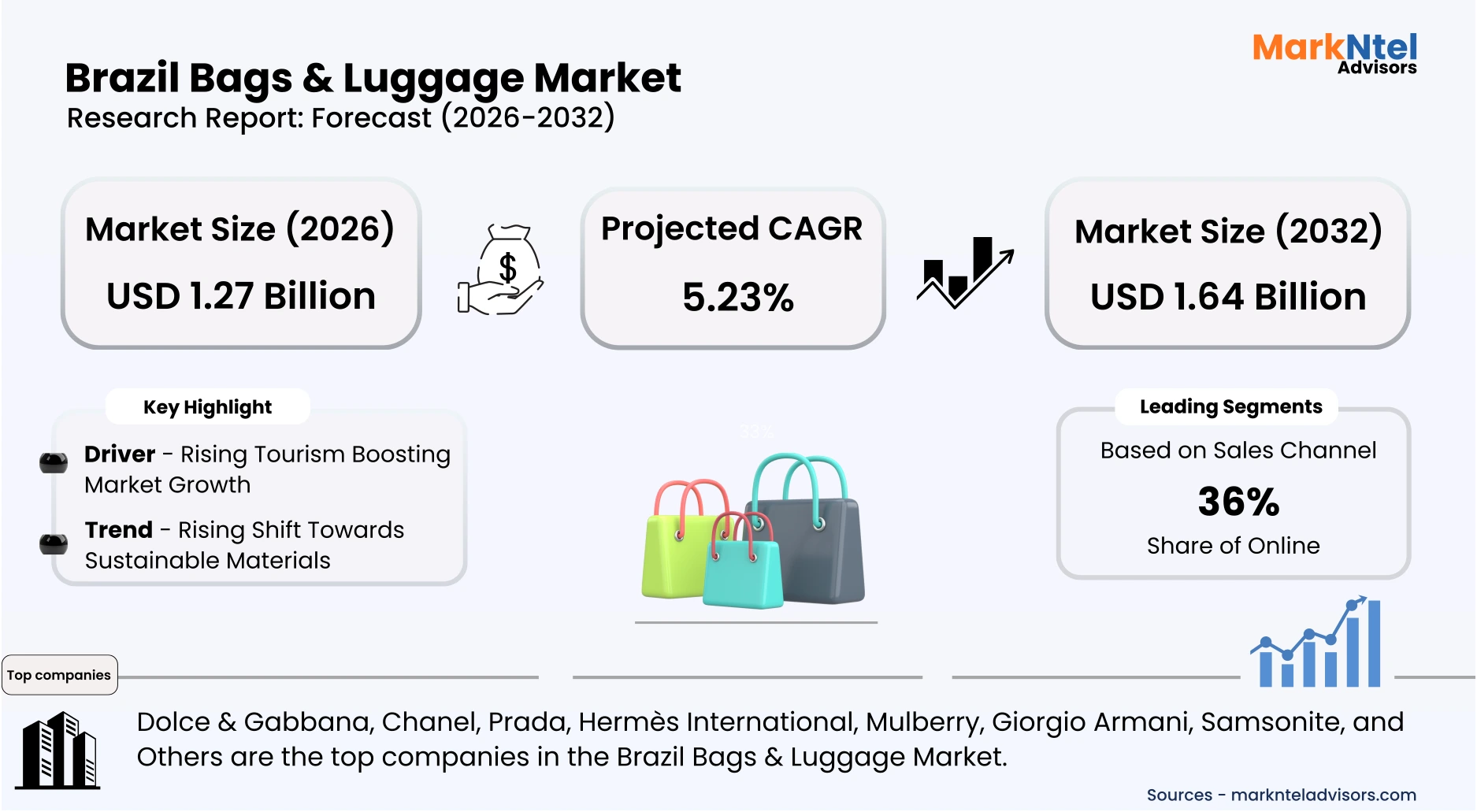
- Market size was valued at around USD 1.21 billion in 2025 and is projected to grow from USD 1.27 billion in 2026 to USD 1.64 billion by 2032, exhibiting a CAGR of 5.23% during the forecast period.
- By Material Type, the Soft-Shell Textile Materials segment represented a significant share of about 48% in the Brazil Bags & Luggage Market in 2026.
- By Sales Channel, the online segment presented a significant share of about 36% in the Brazil Bags & Luggage Market in 2026.
- Leading Bags & Luggage Companies in the Brazil Market are Dolce & Gabbana, Chanel, Prada, Hermès International, Mulberry, Giorgio Armani, Samsonite, and others.
Market Insights & Analysis: Brazil Bags & Luggage Market (2026-32):
The Brazil Bags & Luggage Market size was valued at approximately USD 1.21 billion in 2025 and is projected to grow from USD 1.27 billion in 2026 to USD 1.64 billion by 2032. Along with this, the market is estimated to grow at a CAGR of around 5.23% during the forecast period, i.e., 2026-32.
The steady expansion of the Brail Bags & Luggage Market is supported by tourism normalization, rising urban disposable income, and structural improvements in retail logistics. According to Brazil’s Ministry of Tourism, the country recorded 6.6 million international arrivals in 2024, the highest in its history, reinforcing demand for travel luggage and accessories. Additionally, domestic aviation passenger traffic across São Paulo and Rio hubs strengthened replacement cycles for cabin and mid-range luggage.
Additionally, retail performance further validates consumption resilience. For instance, MercadoLibre announced around USD 5 billion investment in Brazil in 2025 , expanding fulfillment centers, technology systems, and workforce capacity. This digital infrastructure enhances online channel penetration, reduces delivery lead times, and allows brands to scale omnichannel distribution efficiently.
Moreover, the material dominance reflects cost structure and supply ecosystem realities. Soft-Shell Textile Materials hold 48% share, supported by Brazil’s well-established textile clusters in Santa Catarina and São Paulo. For instance, Brazil remains among Latin America’s largest textile producers, ensuring the availability of polyester and nylon fabrics at competitive cost structures. For instance, Brazil produces 9.8 billion clothing articles a year. Conversely, premium leather goods remain more exposed to imported raw inputs, increasing currency sensitivity and pricing volatility.
Furthermore, corporate performance mirrors macro momentum. For instance, Samsonite reported a 31.3% increase in Brazil's net sales in Q3 2025 versus Q3 2024 , driven by wholesale and e-commerce growth. Also, luxury players, including Dolce & Gabbana, Chanel, Prada, Hermès International, Mulberry, and Giorgio Armani, continue boutique operations in premium retail corridors, supporting high-margin segments. These interconnected demand, supply, and retail investments justify the sustainable growth of this market.
Brazil Bags & Luggage Market Recent Developments:
- 2025 : Prada expanded its Brazil ION Orchard boutique with a refreshed layout and more space for bags and luggage, enhancing the shopping experience and strengthening Brazil’s position as a key luxury bags and travel goods market in Southeast Asia.
Brazil Bags & Luggage Market Scope:
| Category | Segments |
|---|---|
| By Product Type | (Bags, Luggage), |
| By Price Range | (Economy (Below USD50), Mid-Range (USD50-150), Premium (Above USD150)), |
| By Material | (Hard-Shell Materials, Soft-Shell Textile Materials, Leather & Synthetic Leather, Hybrid Construction), |
| By Application | (Travel, Business, Others), |
| By Sales Channel | (Supermarkets/Hypermarkets, Specialty Stores, Online), |
Brazil Bags & Luggage Market Driver:
Rising Tourism Boosting Market Growth
Rapid recovery and sustained expansion in international travel are significantly accelerating demand in Brazil’s bags and luggage market, as rising tourist inflows and outbound travel stimulate purchases of new, replacement, and premium travel gear. For instance, according to Brazil’s Ministry of Tourism, the country recorded 6.6 million international tourist arrivals in 2024, the highest level in its history, reflecting a strong post-pandemic rebound. Additionally, Brazil’s civil aviation authority (ANAC) reported continued passenger traffic growth in 2025, reinforcing travel frequency and luggage replacement cycles.
Additionally, stronger arrivals from key markets such as Argentina, the United States, and European countries have extended peak travel cycles beyond traditional holiday seasons. Similarly, globally recognized events, including the Formula 1 São Paulo Grand Prix, international music festivals, and major exhibitions in São Paulo, are driving incremental visitor inflows. Together, sustained tourism momentum is reinforcing travel-driven consumption patterns and structurally supporting growth in Brazil’s Bags and Luggage Market through 2032.
Brazil Bags & Luggage Market Trend:
Rising Shift Towards Sustainable Materials
Sustainability-led premiumization is rapidly emerging as a high-margin revenue driver in Brazil’s Bags and Luggage Market, driven by evolving consumer preferences for durability, recycled content, and lifecycle transparency. According to Brazil’s National Solid Waste Policy (PNRS), manufacturers are incentivized to adopt reverse logistics and recycling systems, which lends structural support to brands offering eco-certified products. Soft-shell textile materials allow easier integration of recycled polyester (rPET) and regenerated nylon without expensive line restructuring, compared to rigid shells.
Several major players are already aligning with these shifts. Samsonite has rolled out circular collections and digital product passports globally, featuring recycled fabrics and traceability tech that reduce lifecycle impact. Similarly, Prada is expanding its Re-Nylon sustainable bags made from ECONYL® regenerated nylon , which can be introduced into Brazil through e-commerce and boutique channels. Chanel and Hermès International have also increased emphasis on material transparency and long-lifecycle goods, efforts that support premium sustainability credentials.
Brazil Bags & Luggage Market Opportunity:
Smart & High-Tech Luggage Features Offering Lucrative Growth Opportunities
Smart luggage represents a growing revenue opportunity in Brazil as traveler volumes, mobile technology adoption, and logistics digitization intersect. Brazil’s civil-aviation sector is the largest in Latin America and among the world’s top ten in passenger numbers, reflecting a substantial pool of frequent and leisure travelers who value enhanced luggage functionality. As digital payments and smartphones become ubiquitous, tech-enabled luggage features, such as Bluetooth tracking, GPS locators, USB charging hubs, and digital locks, are increasingly relevant for technology-savvy consumers.
The emergence of connected luggage aligns with logistics modernization. For instance, research on Brazil’s luggage market highlights that smart luggage with GPS, USB charging, and biometric locks is gaining traction among frequent travelers and premium shoppers. These features not only enhance user convenience but also reduce common travel frustrations such as bag loss, thus offering potential market growth.
Brazil Bags & Luggage Market Challenge:
Import Dependence Constraining Margin Stability
Import dependence remains a structural profitability challenge in the Brazil bags and luggage market, particularly across premium handbags and hard-shell travel categories. For instance, as per the World Bank WITS, Brazil imported handbags under valued at approximately USD 5.96 million in 2024, with China accounting for about USD 4.87 million of that total. This concentration highlights reliance on foreign finished goods supply. Additionally, Brazil imported luggage products at approximately millions of dollars during 2025, indicating substantial exposure to imported travel goods.
Moreover, currency volatility amplifies this risk. For reference, Brazil’s Central Bank data shows exchange-rate fluctuations between 2023 and 2025, directly affecting landed import costs since most trade transactions are denominated in US Dollars. When the Brazilian Real depreciates, distributors face immediate cost inflation, compressing retailer margins in price-sensitive supermarket and specialty store channels.
Brazil Bags & Luggage Market (2026-32) Segmentation Analysis:
The Brazil Bags & Luggage Market study of MarkNtel Advisors evaluates & highlights the major trends and influencing factors in each segment. It includes predictions for the period 2026–32 at the country level. Based on the analysis, the market has been further classified as;
Based on Sales Channel:
- Supermarkets/Hypermarkets
- Specialty Stores
- Online
Online channel demonstrates structural dominance with a market share of about 36% due to logistics modernization and digital payment adoption. Brazil’s rapid Pix payment adoption reduces transaction friction, encouraging direct-to-consumer purchases. Marketplace infrastructure investments exceeding USD 5 billion equivalent in 2025 enable scalable SKU distribution nationwide. Additionally, online retail allows dynamic pricing, flash promotions, and targeted advertising during peak travel seasons. Specialty and supermarket channels remain relevant for impulse and price-sensitive buyers, but online platforms provide broader assortment access and faster product discovery.
Moreover, omnichannel integration further strengthens dominance. Click-and-collect models and marketplace integrations reduce operational risk and improve inventory turnover. These structural advantages position online retail as the most scalable and growth-oriented sales channel through 2032.
Based on Material:
- Hard-Shell Materials
- Soft-Shell Textile Materials
- Leather & Synthetic Leather
- Hybrid Construction
Soft-Shell Textile Materials dominate with a market share of about 48% due to affordability, lightweight properties, and compatibility with domestic textile production. Brazil’s established textile clusters provide competitive polyester and nylon supply chains, reducing procurement volatility compared to imported leather. Additionally, textile-based construction supports modular engineering and hybrid enhancements, increasing product versatility.
Manufacturers can scale backpack, duffel, and soft-luggage lines using similar input materials, improving economies of scale. Sustainability integration further reinforces dominance. Recycled polyester and regenerated textile technologies are more adaptable within soft-shell production lines than rigid composites. This flexibility positions soft-shell materials as the volume engine of the Brazil Bags & Luggage Market through 2032.
Gain a Competitive Edge with Our Brazil Bags & Luggage Market Report:
- Brazil Bags & Luggage Market Report by MarkNtel Advisors provides a detailed & thorough analysis of market size & share, growth rate, competitive landscape, and key players. This comprehensive analysis helps businesses gain a holistic understanding of the market dynamics & make informed decisions.
- This report also highlights current market trends & future projections, allowing businesses to identify emerging opportunities & potential challenges. By understanding market forecasts, companies can align their strategies & stay ahead of the competition.
- Brazil Bags & Luggage Market Report aids in assessing & mitigating risks associated with entering or operating in the market. By understanding market dynamics, regulatory frameworks, and potential challenges, businesses can develop strategies to minimize risks & optimize their operations.
*Reports Delivery Format - Market research studies from MarkNtel Advisors are offered in PDF, Excel and PowerPoint formats. Within 24 hours of the payment being successfully received, the report will be sent to your email address.
Frequently Asked Questions
- Market Segmentation
- Introduction
- Product Definition
- Research Process
- Assumptions
- Executive Summary
- Brazil Bags & Luggage Market Policies, Regulations, and Product Standards
- Brazil Bags & Luggage Market Trends & Developments
- Brazil Bags & Luggage Market Dynamics
- Growth Factors
- Challenges
- Brazil Bags & Luggage Market Hotspot & Opportunities
- Brazil Bags & Luggage Market Outlook, 2022-2032F
- Market Size & Outlook
- By Revenues (USD Million)
- By Units Sold (Thousand Units)
- Market Share & Outlook
- By Product Type- Market Size & Forecast 2022-2032, USD Million & Thousand Units
- Bags
- Cross Body Bags
- Bags and Backpacks
- Business Bags
- Duffle Bags
- Clutches
- Others (Tote Bags, Wallet & Coin Pouches, Other Small Bags, etc.)
- Luggage
- Soft Luggage
- Hard Luggage
- Wheeled Luggage
- Non-Wheeled Luggage
- Bags
- By Price Range- Market Size & Forecast 2022-2032, USD Million & Thousand Units
- Economy (Below USD50)
- Mid-Range (USD50-150)
- Premium (Above USD150)
- By Material- Market Size & Forecast 2022-2032, USD Million & Thousand Units
- Hard-Shell Materials
- Soft-Shell Textile Materials
- Leather & Synthetic Leather
- Hybrid Construction
- By Application- Market Size & Forecast 2022-2032, USD Million & Thousand Units
- Travel
- Business
- Others
- By Sales Channel- Market Size & Forecast 2022-2032, USD Million & Thousand Units
- Supermarkets/Hypermarkets
- Specialty Stores
- Online
- By Region - Market Size & Forecast 2022-2032, USD Million & Thousand Units
- São Paulo
- Rio de Janeiro
- Brasília
- Northeast
- North
- South
- Central-West
- By Company
- Competition Characteristics
- Market Share & Analysis
- By Product Type- Market Size & Forecast 2022-2032, USD Million & Thousand Units
- Market Size & Outlook
- Brazil Travel Bags & Luggage Market Outlook, 2022-2032
- Market Size & Outlook
- By Revenues (USD Million)
- By Units Sold (Thousand Units)
- Market Share & Outlook
- By Price Range- Market Size & Forecast 2022-2032, USD Million & Thousand Units
- By Material- Market Size & Forecast 2022-2032, USD Million & Thousand Units
- By Application- Market Size & Forecast 2022-2032, USD Million & Thousand Units
- By Sales Channel- Market Size & Forecast 2022-2032, USD Million & Thousand Units
- By Region - Market Size & Forecast 2022-2032, USD Million & Thousand Units
- Market Size & Outlook
- Brazil Business Bags & Luggage Market Outlook, 2022-2032
- Market Size & Outlook
- By Revenues (USD Million)
- By Units Sold (Thousand Units)
- Market Share & Outlook
- By Price Range- Market Size & Forecast 2022-2032, USD Million & Thousand Units
- By Material- Market Size & Forecast 2022-2032, USD Million & Thousand Units
- By Application- Market Size & Forecast 2022-2032, USD Million & Thousand Units
- By Sales Channel- Market Size & Forecast 2022-2032, USD Million & Thousand Units
- By Region - Market Size & Forecast 2022-2032, USD Million & Thousand Units
- Market Size & Outlook
- Brazil Bags & Luggage Market Key Strategic Imperatives for Success & Growth
- Competitive Outlook
- Company Profiles
- Dolce & Gabbana
- Business Description
- Product Portfolio
- Collaborations & Alliances
- Recent Developments
- Financial Details
- Others
- Chanel
- Business Description
- Product Portfolio
- Collaborations & Alliances
- Recent Developments
- Financial Details
- Others
- Prada
- Business Description
- Product Portfolio
- Collaborations & Alliances
- Recent Developments
- Financial Details
- Others
- Hermès International
- Business Description
- Product Portfolio
- Collaborations & Alliances
- Recent Developments
- Financial Details
- Others
- Mulberry
- Business Description
- Product Portfolio
- Collaborations & Alliances
- Recent Developments
- Financial Details
- Others
- Giorgio Armani
- Business Description
- Product Portfolio
- Collaborations & Alliances
- Recent Developments
- Financial Details
- Others
- Samsonite
- Business Description
- Product Portfolio
- Collaborations & Alliances
- Recent Developments
- Financial Details
- Others
- Others
- Business Description
- Product Portfolio
- Collaborations & Alliances
- Recent Developments
- Financial Details
- Others
- Dolce & Gabbana
- Company Profiles
- Disclaimer
MarkNtel Advisors follows a robust and iterative research methodology designed to ensure maximum accuracy and minimize deviation in market estimates and forecasts. Our approach combines both bottom-up and top-down techniques to effectively segment and quantify various aspects of the market. A consistent feature across all our research reports is data triangulation, which examines the market from three distinct perspectives to validate findings. Key components of our research process include:
1. Scope & Research Design At the outset, MarkNtel Advisors define the research objectives and formulate pertinent questions. This phase involves determining the type of research—qualitative or quantitative—and designing a methodology that outlines data collection methods, target demographics, and analytical tools. They also establish timelines and budgets to ensure the research aligns with client goals.
2. Sample Selection and Data Collection In this stage, the firm identifies the target audience and determines the appropriate sample size to ensure representativeness. They employ various sampling methods, such as random or stratified sampling, based on the research objectives. Data collection is carried out using tools like surveys, interviews, and observations, ensuring the gathered data is reliable and relevant.
3. Data Analysis and Validation Once data is collected, MarkNtel Advisors undertake a rigorous analysis process. This includes cleaning the data to remove inconsistencies, employing statistical software for quantitative analysis, and thematic analysis for qualitative data. Validation steps are taken to ensure the accuracy and reliability of the findings, minimizing biases and errors.

4. Data Forecast and FinalizationThe final phase involves forecasting future market trends based on the analyzed data. MarkNtel Advisors utilize predictive modeling and time series analysis to anticipate market behaviors. The insights are then compiled into comprehensive reports, featuring visual aids like charts and graphs, and include strategic recommendations to inform client decision-making
We offer flexible licensing options to cater to varying organizational needs. Choose the pricing pack that best suits your requirements:
Buy Now Inquire Before Buying
 Request Customization
 Talk to our Consultant







