

By Base Oil (Mineral Oil, Semi-Synthetic Oil, Synthetic Oil, Bio-based Compressor Oil), By Compressor Type (Positive Displacement Compressors, Dynamic Compressors), By End User (General Manufacturing,... ... neral Manufacturing, Automotive, Oil & Gas, Power Generation, Mining & Metals, Food & Beverage, Pharmaceuticals, Chemicals & Petrochemicals, Construction, HVAC & Refrigeration, Textile, Others), and others Read more
- Chemicals
- Jul 2026
- 140
- PDF, Excel, PPT
US Compressor Oil Market Key Takeaways
- The United States compressor oil market was valued at USD 1.22 billion in 2025 and is projected to grow from USD 1.27 billion in 2026 to USD 1.62 billion by 2032.
- The industry is projected to witness steady growth at a 4.14% CAGR during 2026–2032.
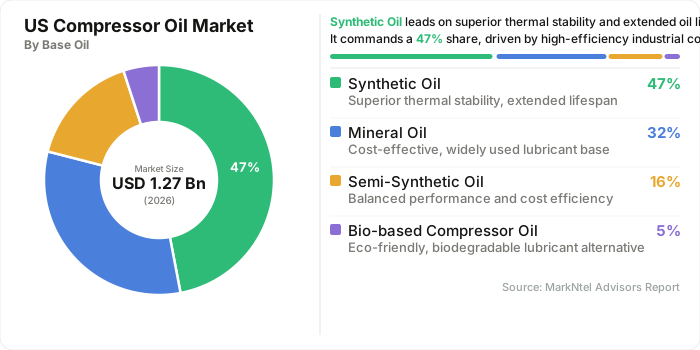
- The synthetic oil led the base oil segment, capturing approximately 47% of the market share.
- General manufacturing remained the largest end-user segment, accounting for approximately 32% of the market in 2026.
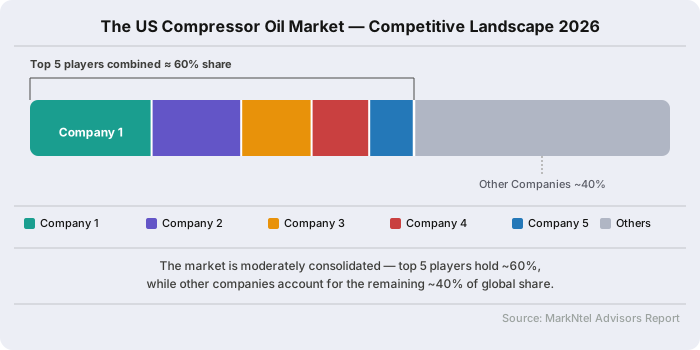
- The landscape is moderately consolidated, with the top five companies collectively holding nearly 60% of the overall market share.
US Compressor Oil Market Size and Outlook
The compressor oil market size in the United States was valued at USD 1.22 billion in 2025 and is projected to grow from USD 1.27 billion in 2026 to USD 1.62 billion by 2032, registering a CAGR of 4.14% during the forecast period, 2026–2032. Market expansion is supported by surging U.S. LNG export capacity and growing industrial energy-efficiency programs. Rising investments in air compression systems across manufacturing and energy industries are expected to strengthen lubricant demand and support sustained market growth.
Industrial manufacturing continues to provide a strong foundation for lubricant consumption. The Federal Reserve reported that U.S. manufacturing capacity utilization stood at 76.3% in December 2025, while total industrial production was 2.0% above its year-earlier level despite remaining below the long-run historical average. Facilities operating at this level rely heavily on reciprocating compressors for pneumatic tools, conveyors, and packaging lines, increasing compressor maintenance activities and recurring lubricant replacement across industrial operations.
Power sector investments are further reinforcing long-term growth prospects. The U.S. Energy Information Administration recorded 53 gigawatts of new utility-scale electricity generating capacity added in 2025, with another 86 gigawatts planned for 2026. Natural gas-fired generating units depend on turbine air compressors for combustion and fuel-handling functions, while increasing industrial automation across power infrastructure is expected to sustain compressor utilization and lubricant demand throughout the forecast period.
The US compressor oil industry is also benefiting from expanding domestic semiconductor innovation. In June 2026, the U.S. Department of Commerce announced a USD 250 million CHIPS R&D award to I-Pulse to advance next-generation silicon carbide semiconductor technology. The investment strengthens high-temperature manufacturing capabilities requiring reliable compressed air systems and supporting utility infrastructure. As fabrication and pilot production facilities expand, demand for premium compressor oils is expected to increase steadily across advanced industrial applications.
US Compressor Oil Market Key Indicators
- According to the U.S. Energy Information Administration, natural gas pipeline projects completed in 2025 added roughly 6.3 billion cubic feet per day of transport capacity nationwide, with 85% of that new capacity serving Gulf Coast delivery points tied to rising liquefied natural gas exports. Every mile of new transmission and gathering pipeline brings additional compressor stations online, each requiring specialized lubrication to withstand continuous high-pressure gas-handling duty across the expanding network.
- Bureau of Economic Analysis data show total U.S. vehicle sales reached a seasonally adjusted annual rate of 16.3 million units in December 2025, up 1.7% from the prior month. Assembly plants supporting this volume operate pneumatic assembly tools and paint-shop air systems around the clock, and sustained vehicle output keeps compressor duty cycles high across the automotive supply chain and its component and parts suppliers.
- The U.S. Census Bureau reported construction spending at a seasonally adjusted annual rate of USD 2,210.2 billion in May 2026, continuing a multi-year pattern of elevated activity nationwide. Job sites at this scale rely heavily on portable air compressors for pneumatic nailing, drilling, and concrete work, and elevated spending levels translate directly into higher rental-fleet and equipment lubricant consumption across residential and nonresidential construction projects alike.
- The U.S. Geological Survey valued domestic nonfuel mineral production at USD 112 billion in 2025, a 5.6% increase over 2024 driven largely by higher precious-metals prices and steady industrial-minerals output. Extraction and processing operations depend on rotary screw compressors for drilling, ventilation, and material handling equipment, so rising mineral output value directly supports lubricant demand across the domestic mining and metals sector.
US Compressor Oil Market Scope
| Category | Segments |
|---|---|
| By Base Oil | Mineral Oil, Semi-Synthetic Oil, Synthetic Oil, Bio-based Compressor Oil |
| By Compressor Type | Positive Displacement Compressors, Dynamic Compressors |
| By End User | General Manufacturing, Automotive, Oil & Gas, Power Generation, Mining & Metals, Food & Beverage, Pharmaceuticals, Chemicals & Petrochemicals, Construction, HVAC & Refrigeration, Textile, Others |
US Compressor Oil Market Growth Drivers
Surging U.S. LNG Export Capacity Expanding Demand for Large-Scale Gas Compression
Liquefied natural gas (LNG) export expansion is a major growth driver for the US compressor oil industry as rising export volumes increase demand for continuously operating gas compression equipment. As per the U.S. Energy Information Administration, U.S. LNG exports reached 15.0 billion cubic feet per day in 2025, making the country the first to export more than 100 million metric tons of LNG in a single year. This sustained expansion significantly boosts demand for industrial compressor lubricants used in liquefaction facilities.
The infrastructure expansion is concentrated along the Gulf Coast, where eight LNG export terminals are currently operational. The EIA projects U.S. LNG export capacity will nearly double compared with December 2025 levels by 2031 as Golden Pass, Port Arthur, and Rio Grande LNG projects become operational. Furthermore, LNG exports are forecast to exceed 18.1 billion cubic feet per day by 2027, creating additional demand for oxidation resistance solutions that support continuously operating compressor systems.
This long-term infrastructure development creates significant opportunities for lubricant suppliers with strategically located blending and distribution facilities across the Gulf Coast. Every newly commissioned liquefaction train increases compressor assets requiring scheduled lubrication and maintenance, strengthening demand across the US compressor oil industry. Manufacturers offering high-temperature, synthetic formulations capable of supporting extended service intervals are expected to gain a competitive advantage by helping operators minimize costly equipment downtime and improve operational reliability.
Recent Trends
Growing Industrial Energy-Efficiency Programs Extending Compressor Oil Service Intervals
Industrial energy-efficiency initiatives are transforming lubrication practices across the US compressor oil industry. The U.S. Department of Energy's Better Buildings & Better Plants Initiative reported that more than 650 public and private organizations participate in the program, collectively achieving over USD 24 billion in cumulative energy savings as of its 2025 Progress Update. These efforts are accelerating adoption of synthetic compressor oil to improve equipment efficiency and operational reliability.
Manufacturers are increasingly replacing calendar-based lubricant changes with condition-based maintenance strategies that continuously monitor compressor performance and oil health. Since compressed air systems are often among a facility's largest electricity consumers, organizations integrate condition monitoring with energy management programs to optimize lubricant performance. This approach supports extended service intervals, enhances equipment reliability, lowers maintenance frequency, and improves overall operating efficiency across industrial facilities.
The trend is expected to strengthen as more industrial facilities adopt structured energy-management programs to improve operational efficiency and reduce energy consumption. Because compressed air generation represents a substantial share of industrial electricity use, companies increasingly standardize premium lubricants that minimize friction losses and sustain compressor performance. This ongoing transition continues reinforcing long-term demand across the US compressor oil market.
US Compressor Oil Market Opportunities and Challenges
EPA PFAS Reporting Requirements Driving Fluorine-Free Compressor Oil Innovation
The U.S. Environmental Protection Agency's Toxic Substances Control Act Section 8(a)(7) rule presents a significant compliance challenge for the US compressor oil industry. Manufacturers and importers that commercially used per- and polyfluoroalkyl substances (PFAS) must submit detailed reports between April 13, 2026, and October 13, 2026. Compliance requires reformulating products, auditing supply chains, and advancing lubricant additive technology to meet evolving regulatory requirements.
Manufacturers supplying high-temperature reciprocating and rotary screw compressor applications across manufacturing, oil & gas, and power generation industries face increased research, documentation, and formulation costs. PFAS additives have historically delivered extreme-pressure resistance, water repellency, and thermal stability, making replacement technically challenging. Maintaining product performance while achieving regulatory compliance also requires extensive testing to secure OEM-approved lubricants for demanding industrial operations.
The regulatory shift simultaneously creates attractive growth opportunities for the US compressor oil market. The Organization for Economic Co-operation and Development's June 2025 report highlights increasing commercial availability of non-fluorinated extreme-pressure additive packages matching legacy lubricant performance. Suppliers completing fluorine-free reformulations before the October 2026 reporting deadline can strengthen OEM partnerships, enhance procurement competitiveness, and expand adoption across manufacturing, energy, and chemical processing industries.
Segmentation Insights
Fully Synthetic Oil Dominates Due to Superior Oxidation Stability and Extended Service Life
Fully synthetic oil accounted for approximately 47% of the US compressor oil industry by value in 2025, making it the leading base oil segment. Its dominance is attributed to superior oxidation stability, extended service life, and consistent performance under demanding operating conditions. Growing adoption of energy-efficient operations across industrial facilities has further accelerated demand for synthetic formulations that improve lubrication efficiency while reducing maintenance requirements.
Synthetic formulations are specifically designed to withstand the elevated discharge temperatures generated by rotary screw compressors and reciprocating compressor systems operating continuously across manufacturing, energy, and heavy industrial applications. Their enhanced thermal performance minimizes varnish formation, reduces internal component wear, and extends oil-change intervals, enabling industrial operators to improve equipment reliability while lowering lifecycle operating and maintenance costs.
Supply-side developments further support the segment's long-term expansion. According to the U.S. Energy Information Administration, domestic refineries held lubricant base oil production capacity of 285,545 barrels per stream day as of January 1, 2026, representing an 8.6% increase from 262,895 barrels per stream day a year earlier. Expanding domestic production capacity strengthens supply availability for premium synthetic formulations. Based on base oil, the scope has been classified into:
- Mineral Oil
- Semi-Synthetic Oil
- Synthetic Oil
- Bio-based Compressor Oil
General Manufacturing Leads Due to Continuous Use of Compressed Air Across Production Facilities
General anufacturing accounted for approximately 32% of the United States compressor oil industry, making it the largest end-user segment. Its leadership is driven by the widespread use of compressed air for pneumatic tools, conveyors, packaging lines, welding equipment, and material handling systems. Rising adoption of industrial machinery maintenance practices has further strengthened demand for premium compressor lubricants that ensure uninterrupted production and operational efficiency.
The Institute for Supply Management reported that its Manufacturing PMI registered 53.3% in June 2026, marking the sixth consecutive month of sector expansion. Sustained factory activity keeps plant air compressors operating near continuous duty cycles, increasing lubricant consumption across production facilities. This operating environment encourages the use of wear protection additives that enhance compressor durability, reduce friction, and improve equipment performance under demanding industrial conditions.
Consistent manufacturing expansion continues to support recurring compressor oil replacement demand across both small and large industrial facilities nationwide. Continuous operation of compressed air systems accelerates lubricant degradation, requiring scheduled oil replacement to maintain equipment efficiency and reduce unplanned downtime. As production output remains resilient across diverse manufacturing industries, the segment is expected to retain its dominant position. The study analyzes the following key end-user segments:
- General Manufacturing
- Automotive
- Oil & Gas
- Power Generation
- Mining & Metals
- Food & Beverage
- Pharmaceuticals
- Chemicals & Petrochemicals
- Construction
- HVAC & Refrigeration
- Textile
- Others
US Compressor Oil Market Competitive Analysis
The US compressor oil market is moderately consolidated, with the top five players Exxon Mobil Corporation, Shell USA Inc., Chevron Corporation, BP Lubricants USA Inc. (Castrol), and Phillips 66 Lubricants collectively accounting for an estimated 60% of total market revenue. These companies benefit from extensive distribution networks, strong OEM approvals, broad industrial lubricant portfolios, and continuous investments in synthetic lubricant technologies. Meanwhile, companies such as TotalEnergies Marketing USA, FUCHS Lubricants Co., Valvoline Global Operations, AMSOIL Inc., and PETRO-CANADA Lubricants Inc. strengthen competition by targeting specialized industrial applications and premium lubricant segments, fostering steady innovation.
Prominent Companies in the US Compressor Oil Industry
- Exxon Mobil Corporation
- Shell USA Inc.
- Chevron Corporation
- BP Lubricants USA Inc. (Castrol)
- Phillips 66 Lubricants
- TotalEnergies Marketing USA, Inc.
- FUCHS Lubricants Co.
- Valvoline Global Operations
- AMSOIL Inc.
- PETRO-CANADA Lubricants Inc. (HF Sinclair)
- Others
US Compressor Oil Industry News and Recent Developments
January 2026: HF Sinclair Completes Acquisition of Industrial Oils Unlimited
HF Sinclair Corporation completed the acquisition of Industrial Oils Unlimited (IOU) through its Lubricants & Specialties business. IOU, a Tulsa, Oklahoma-based manufacturer of industrial lubricants and specialty fluids, strengthens HF Sinclair's regional manufacturing capabilities and expands its industrial lubricant portfolio. The acquisition also broadens the company's distribution network and enhances its ability to serve manufacturing, energy, and heavy-duty industrial customers across the United States.
Impact Analysis: The acquisition reinforces HF Sinclair's competitive position in the U.S. industrial lubricants sector by expanding production capacity, improving regional supply chain efficiency, and strengthening customer reach. The integration of IOU's manufacturing assets and DX product portfolio enables the company to better address growing demand for premium industrial lubricants, including compressor oils. The transaction also supports product portfolio diversification and positions HF Sinclair to capitalize on increasing lubricant requirements from manufacturing, energy, and industrial infrastructure projects across the United States.
- Market Segmentation
- Introduction
- Product Definition
- Research Process
- Assumptions
- Executive Summary
- US Compressor Oil Market Supply Chain Analysis
- US Compressor Oil Market Raw Material & Feedstock Analysis
- US Compressor Oil Market Import & Export Analysis
- US Compressor Oil Market Policies, Regulations, and Product Standards
- US Compressor Oil Production Trend 2022-2032
- US Compressor Oil Trend by Type of Base Oil
- Mineral Oil
- Semi-Synthetic Oil
- Fully Synthetic Oil
- Bio-based Compressor Oil
- Company Wise Production Plants and Statistics
- Installed Production Capacity
- Actual Production
- Planned Production Target
- US Compressor Oil Trend by Type of Base Oil
- US Compressor Oil Pricing Analysis 2022-2032
- US Compressor Oil Pricing Trend 2022-2032
- US Compressor Oil Pricing Trend by Base Oil 2022-2032
- Mineral Oil
- Semi-Synthetic Oil
- Fully Synthetic Oil
- Bio-based Compressor Oil
- US Compressor Oil Market Dynamics
- Growth Factors
- Challenges
- US Compressor Oil Market Hotspot & Opportunities
- US Compressor Oil Market Outlook, 2022-2032
- Market Size & Outlook
- By Revenues (USD Million)
- Market Segmentation & Outlook
- By Base Oil- Market Size & Forecast 2022-2032, USD Million
- Mineral Oil
- Semi-Synthetic Oil
- Synthetic Oil
- Bio-based Compressor Oil
- By Compressor Type- Market Size & Forecast 2022-2032, USD Million
- Positive Displacement Compressors
- Reciprocating
- Rotary Screw
- Rotary Vane
- Scroll
- Others
- Dynamic Compressors
- Centrifugal
- Axial
- Positive Displacement Compressors
- By End User - Market Size & Forecast 2022-2032, USD Million
- General Manufacturing
- Automotive
- Oil & Gas
- Power Generation
- Mining & Metals
- Food & Beverage
- Pharmaceuticals
- Chemicals & Petrochemicals
- Construction
- HVAC & Refrigeration
- Textile
- Others
- By Region- Market Size & Forecast 2022-2032, USD Million
- Northeast
- Midwest
- South
- West
- By Company
- Competition Characteristics
- Market Share & Analysis
- By Base Oil- Market Size & Forecast 2022-2032, USD Million
- Market Size & Outlook
- US Mineral Compressor Oil Market Outlook, 2022-2032
- Market Size & Outlook
- By Revenues (USD Million)
- Market Segmentation & Outlook
- By Compressor Type- Market Size & Forecast 2022-2032, USD Million
- By End User - Market Size & Forecast 2022-2032, USD Million
- By Region- Market Size & Forecast 2022-2032, USD Million
- Market Size & Outlook
- US Semi-Synthetic Compressor Oil Market Outlook, 2022-2032
- Market Size & Outlook
- By Revenues (USD Million)
- Market Segmentation & Outlook
- By Compressor Type- Market Size & Forecast 2022-2032, USD Million
- By End User - Market Size & Forecast 2022-2032, USD Million
- By Region- Market Size & Forecast 2022-2032, USD Million
- Market Size & Outlook
- US Synthetic Compressor Oil Market Outlook, 2022-2032
- Market Size & Outlook
- By Revenues (USD Million)
- Market Segmentation & Outlook
- By Compressor Type- Market Size & Forecast 2022-2032, USD Million
- By End User - Market Size & Forecast 2022-2032, USD Million
- By Region- Market Size & Forecast 2022-2032, USD Million
- Market Size & Outlook
- US Bio-based Compressor Oil Market Outlook, 2022-2032
- Market Size & Outlook
- By Revenues (USD Million)
- Market Segmentation & Outlook
- By Compressor Type- Market Size & Forecast 2022-2032, USD Million
- By End User - Market Size & Forecast 2022-2032, USD Million
- By Region- Market Size & Forecast 2022-2032, USD Million
- Market Size & Outlook
- US Compressor Oil Market Key Strategic Imperatives for Success & Growth
- Competitive Outlook
- Company Profiles
- Exxon Mobil Corporation
- Business Description
- Product Portfolio
- Collaborations & Alliances
- Recent Developments
- Financial Details
- Others
- Shell USA Inc.
- Business Description
- Product Portfolio
- Collaborations & Alliances
- Recent Developments
- Financial Details
- Others
- Chevron Corporation
- Business Description
- Product Portfolio
- Collaborations & Alliances
- Recent Developments
- Financial Details
- Others
- BP Lubricants USA Inc. (Castrol)
- Business Description
- Product Portfolio
- Collaborations & Alliances
- Recent Developments
- Financial Details
- Others
- Phillips 66 Lubricants
- Business Description
- Product Portfolio
- Collaborations & Alliances
- Recent Developments
- Financial Details
- Others
- TotalEnergies Marketing USA, Inc.
- Business Description
- Product Portfolio
- Collaborations & Alliances
- Recent Developments
- Financial Details
- Others
- FUCHS Lubricants Co.
- Business Description
- Product Portfolio
- Collaborations & Alliances
- Recent Developments
- Financial Details
- Others
- Valvoline Global Operations
- Business Description
- Product Portfolio
- Collaborations & Alliances
- Recent Developments
- Financial Details
- Others
- AMSOIL Inc.
- Business Description
- Product Portfolio
- Collaborations & Alliances
- Recent Developments
- Financial Details
- Others
- PETRO-CANADA Lubricants Inc. (HF Sinclair)
- Business Description
- Product Portfolio
- Collaborations & Alliances
- Recent Developments
- Financial Details
- Others
- Others
- Exxon Mobil Corporation
- Company Profiles
- Disclaimer

MarkNtel Advisors follows a robust and iterative research methodology designed to ensure maximum accuracy and minimize deviation in market estimates and forecasts. Our approach combines both bottom-up and top-down techniques to effectively segment and quantify various aspects of the market. A consistent feature across all our research reports is data triangulation, which examines the market from three distinct perspectives to validate findings. Key components of our research process include:
1. Scope & Research Design At the outset, MarkNtel Advisors define the research objectives and formulate pertinent questions. This phase involves determining the type of research—qualitative or quantitative—and designing a methodology that outlines data collection methods, target demographics, and analytical tools. They also establish timelines and budgets to ensure the research aligns with client goals.
2. Sample Selection and Data Collection In this stage, the firm identifies the target audience and determines the appropriate sample size to ensure representativeness. They employ various sampling methods, such as random or stratified sampling, based on the research objectives. Data collection is carried out using tools like surveys, interviews, and observations, ensuring the gathered data is reliable and relevant.
3. Data Analysis and Validation Once data is collected, MarkNtel Advisors undertake a rigorous analysis process. This includes cleaning the data to remove inconsistencies, employing statistical software for quantitative analysis, and thematic analysis for qualitative data. Validation steps are taken to ensure the accuracy and reliability of the findings, minimizing biases and errors.

4. Data Forecast and FinalizationThe final phase involves forecasting future market trends based on the analyzed data. MarkNtel Advisors utilize predictive modeling and time series analysis to anticipate market behaviors. The insights are then compiled into comprehensive reports, featuring visual aids like charts and graphs, and include strategic recommendations to inform client decision-making
We offer flexible licensing options to cater to varying organizational needs. Choose the pricing pack that best suits your requirements:
Buy Now Inquire Before Buying
 Request Customization