

By Product Type (Standalone Laser Systems, Combination/Multi-Wavelength Systems, Portable/Handheld Units), By Technology (Diode Lasers, Nd:YAG Lasers, Er:YAG / Er,Cr:YSGG Lasers, CO₂ Lasers), By Appli... ... O₂ Lasers), By Application (Conservative/Restorative Dentistry, Endodontic Treatment, Oral & Maxillofacial Surgery, Periodontics, Implantology), By End User (Dental Clinics & DSOs, Hospitals, Academic & Research Institutions) Read more
- Healthcare
- Sep 2026
- 160
- PDF, Excel, PPT
UK Dental Lasers Market Key Takeaways
- The UK dental lasers market was valued at USD 25.1 million in 2025 and is projected to reach USD 27.2 million in 2026 to USD 43.3 million in 2032, registering a CAGR of 8.1% during 2026–2032.
- Standalone laser systems dominate the market, accounting for an estimated 54.2% of product-type revenue in 2026
- By technology, diode lasers lead the market with an estimated 34.6% share in 2026.
- The market is moderately consolidated, with the top five players collectively accounting for 50% share in 2026.
UK Dental Lasers Market Size and Outlook
The UK dental lasers market is estimated at USD 25.1 million in 2025 and reaches USD 27.2 million in 2026. The market is projected to reach USD 43.3 million by 2032, registering an estimated 8.1% CAGR during 2026–2032.
The market scope includes revenue generated from dental laser systems and excludes distributors, general dental equipment, standalone services, training, and unrelated consumables.
UK dental-care policy is strengthening the underlying clinical capacity and treatment demand base. The Department of Health and Social Care’s 2025 NHS dentistry reforms target 700,000 additional urgent dental appointments annually, while the 2026 contract reforms introduce complex-care pathways and additional payments for participating dental contractors. These measures support practice modernization and investment in technologies that can expand treatment capabilities and workflow efficiency.
The professional base further supports growing oral care habits with dental technology adoption and equipment replacement demand. According to the General Dental Council, 131,680 dental professionals are registered in the UK at the end of 2025, including 47,916 dentists. Consequently, the market outlook reflects increasing practice modernization, expanding clinical capacity, replacement of conventional soft-tissue equipment, and wider availability of multi-application laser platforms across UK dental practices.
UK Dental Lasers Market Key Indicators
- According to the NHS Business Services Authority, NHS dental activity in England reached 37.6 million courses of treatment in 2025/26, up 6.2%, while 76.8 million units of dental activity were delivered. The higher treatment throughput supports demand for efficient clinical technologies, including laser systems used across periodontal, endodontic, surgical, and minimally invasive procedures.
- As per the Office for National Statistics, UK healthcare expenditure reaches approximately USD 467 billion in 2025, equivalent to 11.4% of GDP and representing a 7.7% nominal increase from 2024. Rising healthcare expenditure provides a supportive macroeconomic environment for capital equipment investment across dental practices.
- By NHS England data, NHS dental services deliver 69.82 million units of dental activity in 2024/25, representing a 1% increase from 2023/24. Sustained treatment volumes demonstrate continued utilization of dental-care infrastructure and support investment in technologies designed to improve procedural efficiency and treatment capacity.
- As reported by the Office for National Statistics, people aged 65 years and over account for 19.1% of England’s population at mid-2025. The growing older population supports longer-term demand for restorative, periodontal, endodontic, and complex dental procedures, creating a favorable clinical-demand environment for advanced dental technologies.
UK Dental Care Infrastructure Analysis: Practice Capacity and Workforce Expansion Supporting Laser Adoption
England’s dental-care infrastructure is handling a growing volume of clinical activity, strengthening the utilization base for advanced treatment equipment. NHS dental providers delivered 37.6 million Courses of Treatment (COTs) in 2025/26, representing a 6.2% year-on-year increase, while dental activity reached 76.8 million UDAs, up 5.1%. This higher clinical throughput increases pressure on practices to improve treatment efficiency and manage greater patient volumes, supporting the business case for laser systems that can be deployed across multiple procedures.
The infrastructure is also supported by an expanding clinical workforce and broader delegation of dental activity. 25,419 dentists generated NHS dental activity in 2025/26, while registered Dental Care Professionals (DCPs) reached 83,764, up 5.5% year-on-year. DCPs delivered 1.83 million Band 1 COTs, almost 1 million more than the previous year, indicating greater utilization of the wider dental workforce. This creates opportunities for appropriately trained clinicians and hygiene teams to incorporate compact diode laser systems into periodontal and soft-tissue workflows, while larger practices can justify multi-application platforms through higher equipment utilization.
Consequently, rising treatment throughput, expanding clinical capacity, and greater utilization of the wider dental workforce are increasing the addressable base for dental laser adoption. Practices managing high patient volumes can achieve stronger equipment utilization, while group practices and DSOs can further support adoption through standardized procurement, training, and technology deployment across multiple locations.
UK Dental Lasers Market Scope
| Category | Segments |
|---|---|
| By Product Type | Standalone Laser Systems, Combination/Multi-Wavelength Systems, Portable/Handheld Units |
| By Technology | Diode Lasers, Nd:YAG Lasers, Er:YAG / Er,Cr:YSGG Lasers, CO₂ Lasers |
| By Application | Conservative/Restorative Dentistry, Endodontic Treatment, Oral & Maxillofacial Surgery, Periodontics, Implantology |
| By End User | Dental Clinics & DSOs, Hospitals, Academic & Research Institutions |
UK Dental Lasers Market Growth Driver
Rising Prevalence of Periodontal & Peri-Implant Diseases
The growing burden of periodontal and peri-implant diseases is expanding the clinical need for advanced dental treatment technologies, supporting demand for dental laser systems across UK practices. According to the World Health Organization, severe periodontal disease affects more than 1 billion people globally, with prevalence peaking around age 55 and remaining high into older age. This persistent disease burden creates a substantial patient base requiring periodontal interventions and supports demand for technologies that enable targeted soft-tissue management and minimally invasive treatment.
The UK provides an additional indication of this demand, with the Adult Oral Health Survey reporting that 93% of dentate adults in England had at least one observed periodontal condition, including bleeding, calculus, periodontal pocketing, furcation defects, recession, or mobility. The survey also finds that 9% of adults had indicators of very severe periodontal disease, demonstrating a meaningful requirement for advanced periodontal treatment. Laser-based approaches, including Er: YAG systems for periodontal and peri-implant debridement and diode systems for soft-tissue management, can support targeted clinical intervention. Consequently, the high prevalence of periodontal conditions and growing treatment complexity are expected to encourage dental practices to expand laser-based capabilities.
Recent Trend
Shift Toward Multi-Wavelength Platforms for Broader Clinical Workflows
A prominent technology trend in the UK dental market is the shift from single-wavelength systems toward multi-wavelength dental laser platforms that support a broader range of clinical procedures. Manufacturers are increasingly combining complementary wavelengths within one system to address different tissue interactions. For example, Dentsply Sirona’s SiroLaser Blue integrates 445 nm, 970 nm, and 660 nm wavelengths for soft-tissue surgery, endodontics, periodontology, implantology, and photobiomodulation. At the same time, Fotona’s LightWalker platform combines Er:YAG and Nd:YAG wavelengths for hard- and soft-tissue applications.
The trend is also reflected in recent product development focused on greater portability and multi-wavelength functionality. In August 2026, Ultradent Products introduced the Gemini Nova cordless diode laser, incorporating dual 810 nm and 980 nm wavelengths, Bluetooth-connected controls, and preset procedures spanning surgical, hygiene, and orthodontic applications. The system allows clinicians to use either wavelength independently or together, indicating a broader industry shift toward compact platforms that combine multiple treatment capabilities with simplified chairside operation. Consequently, UK dental practices can increasingly access versatile laser platforms that support broader utilization without requiring multiple dedicated systems.
UK Dental Lasers Market Opportunities and Challenges
Regulatory Compliance Burden Creating Service Opportunities
Dental laser manufacturers and importers supplying the UK face additional regulatory and post-market obligations under the country’s evolving medical-device framework. The MHRA requires medical devices placed on the Great Britain market to be registered, while manufacturers using the UKCA route must meet applicable conformity-assessment and post-market surveillance requirements. The post-market surveillance regime that came into force on 16 June 2025 further strengthens obligations around incident monitoring and reporting. These requirements can increase compliance costs and administrative complexity, particularly for smaller manufacturers and importers introducing specialized or lower-volume laser systems into the UK.
The regulatory burden is simultaneously creating an opportunity for vendors that integrate laser safety, regulatory support, clinical training, and upgrade flexibility into their commercial offerings. The Care Quality Commission (CQC) identifies Class 3B and Class 4 lasers as commonly used in dental practice and highlights requirements covering risk assessment, controlled areas, staff training, eye protection, maintenance, quality assurance, and incident reporting. In February 2024, BIOLASE launched the Waterlase iPlus Premier Edition with modular software, allowing practices to add procedure-specific capabilities and upgrades over time. This model supports phased technology adoption and creates opportunities for vendors offering flexible, service-integrated laser platforms.
Segmentation Insight
Standalone Systems Capture Revenue Through Cost-Efficient, Practice-Level Adoption
Standalone laser systems account for an estimated 54.2% of UK dental lasers industry product-type revenue in 2026. Their dominance is primarily supported by the ability to match equipment investment with a practice’s specific clinical requirements. Current systems such as Dentsply Sirona’s SiroLaser Advance Plus operate at 970 nm and 660 nm, while its SiroLaser Blue adds a 445 nm wavelength and supports more than 20 indications. This enables practices to select dedicated platforms according to their treatment mix while avoiding the higher acquisition complexity of broader all-tissue configurations.
Standalone systems also benefit from simpler deployment and focused clinical workflows. A dedicated diode platform can cover periodontal soft-tissue procedures, endodontic applications, implant-related treatments, and photobiomodulation without requiring the broader hard-tissue functionality of an all-tissue laser. This focused architecture can reduce operator learning requirements, simplify maintenance, and allow practices to concentrate investment on procedures generating the highest utilization. Consequently, the combination of targeted functionality, multiple wavelength options within dedicated platforms, and lower implementation complexity supports standalone systems as the leading product-type revenue segment. Based on Product Type, the industry is segmented into:
- Standalone Laser Systems
- Combination/Multi-Wavelength Systems
- Portable/Handheld Units
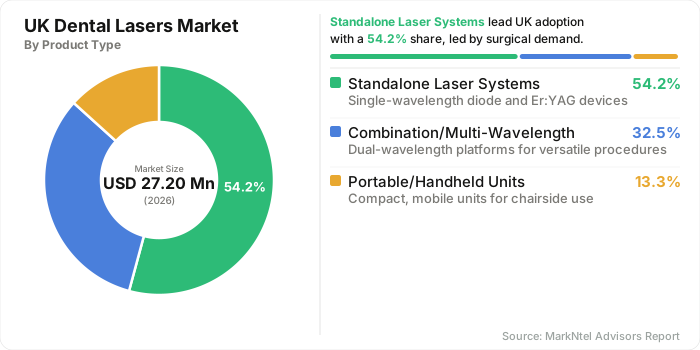
Diode Lasers Lead Through Broad Clinical Applicability and Wavelength Innovation
Diode Lasers account for an estimated 34.6% of UK dental lasers industry technology-based revenue in 2026. Their leading position is supported by broad clinical applicability and continuing wavelength innovation. A peer-reviewed review identified 47 eligible studies from 519 PubMed results, covering eight dental application areas, including disinfection, surgery, photobiomodulation, orthodontics, periodontics, endodontics, bleaching, and resin curing. This breadth enables diode platforms to address multiple clinical requirements within general dental practice.
The segment is gaining further momentum from the integration of 450 nm blue diode technology, which provides higher absorption in hemoglobin and melanin and supports precise soft-tissue cutting with reduced thermal damage. The reviewed evidence also covers 405 nm and 450 nm diode lasers, highlighting their expanding role across surgical and therapeutic applications. This wavelength diversification enables manufacturers to develop more application-specific systems while maintaining the compact architecture and broad utility associated with diode platforms. Consequently, clinical versatility and blue-diode innovation reinforce diode lasers as the leading technology segment. Based on Technology, the industry is segmented into:
- Diode Lasers
- Nd:YAG Lasers
- Er:YAG / Er,Cr:YSGG Lasers
- CO2 Lasers
UK Dental Lasers Market Competitive Analysis
The UK dental lasers industry is moderately consolidated, with the top five companies estimated to account for approximately 50% of 2026 market revenue. The leading five companies are Dentsply Sirona, Inc., Fotona d.o.o., Ultradent Products, Inc., Convergent Dental, Inc., and MegaGen Implant Co., Ltd. (BIOLASE business).
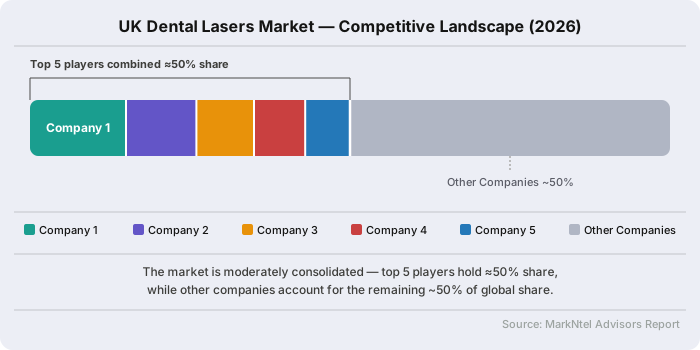
Top Companies in the UK Dental Lasers Industry:
- Dentsply Sirona, Inc.
- Fotona d.o.o.
- Convergent Dental, Inc.
- Ultradent Products, Inc.
- MegaGen Implant Co., Ltd. (BIOLASE business)
- J. MORITA CORP.
- AMD Lasers, Inc.
- elexxion AG
- LightScalpel, LLC
- The Yoshida Dental Mfg. Co., Ltd.
UK Dental Lasers Industry News and Recent Developments
August 2026: Ultradent Introduces Gemini Nova Cordless Diode Laser
Ultradent introduced the Gemini Nova cordless diode laser in August 2026. The system uses 810 nm and 980 nm wavelengths and provides three wavelength modes, with up to 20 W of peak super-pulsed power. The system incorporates a cordless handpiece, Bluetooth-connected base and foot pedal and preset procedures covering surgical, hygiene and orthodontic workflows.
Impact Analysis: The launch strengthens the portability segment and lowers workflow restrictions associated with corded systems. It also expands the commercial proposition of diode lasers beyond conventional soft-tissue surgery into hygiene and photobiomodulation.
June 2026: Ultradent Acquires Azena Medical
Ultradent announced the acquisition of Azena Medical in June 2026, bringing Azena's laser engineering, design, manufacturing and clinical-development capabilities into Ultradent. Azena developed the Gemini family of soft-tissue diode lasers and had maintained a long-standing technology relationship with Ultradent.
Impact Analysis: The transaction vertically integrates laser engineering into a major dental manufacturer and strengthens Ultradent's ability to control product development, manufacturing and clinical innovation. It also increases competitive pressure in the diode-laser segment.
June 2025: Convergent Dental Expands Dental-Laser Education Through Ohio State Collaboration
Convergent Dental announced a collaboration with Ohio State University's College of Dentistry in June 2025 to integrate Solea laser technology into fourth-year clinical simulation training and the university's faculty practice. Solea uses a 9.3-micron CO₂ wavelength and is positioned for both hard- and soft-tissue procedures.
Impact Analysis: Incorporating laser technology into dental education increases clinician familiarity before graduation and creates an institutional pathway for future adoption. The development strengthens the all-tissue segment by embedding laser-based procedures into clinical training.
- Market Segmentation
- Introduction
- Product Definition
- Research Process
- Assumptions
- Executive Summary
- UK Dental Lasers Market Policies, Regulations, and Product Standards
- UK Dental Lasers Market Trends & Developments
- UK Dental Lasers Market Dynamics
- Growth Factors
- Challenges
- UK Dental Lasers Market Hotspot & Opportunities
- UK Dental Lasers Market Outlook, 2022-2032F
- Market Size & Outlook
- By Revenues (USD Million)
- Market Segmentation & Outlook
- By Product Type- Market Size & Forecast 2022-2032, USD Million
- Standalone Laser Systems
- Combination/Multi-Wavelength Systems
- Portable/Handheld Units
- By Technology- Market Size & Forecast 2022-2032, USD Million
- Diode Lasers
- Nd:YAG Lasers
- Er:YAG / Er,Cr:YSGG Lasers
- CO₂ Lasers
- By Application- Market Size & Forecast 2022-2032, USD Million
- Conservative/Restorative Dentistry
- Endodontic Treatment
- Oral & Maxillofacial Surgery
- Periodontics
- Implantology
- By End User- Market Size & Forecast 2022-2032, USD Million
- Dental Clinics & DSOs
- Hospitals
- Academic & Research Institutions
- By Company
- Competition Characteristics
- Market Share & Analysis
- By Product Type- Market Size & Forecast 2022-2032, USD Million
- Market Size & Outlook
- UK Standalone Dental Laser Systems Market Outlook, 2022-2032
- Market Size & Outlook
- By Revenues (USD Million)
- Market Segmentation & Outlook
- By Technology- Market Size & Forecast 2022-2032, USD Million
- By Application- Market Size & Forecast 2022-2032, USD Million
- By End User- Market Size & Forecast 2022-2032, USD Million
- Market Size & Outlook
- UK Combination/Multi-Wavelength Dental Laser Systems Market Outlook, 2022-2032
- Market Size & Outlook
- By Revenues (USD Million)
- Market Segmentation & Outlook
- By Technology- Market Size & Forecast 2022-2032, USD Million
- By Application- Market Size & Forecast 2022-2032, USD Million
- By End User- Market Size & Forecast 2022-2032, USD Million
- Market Size & Outlook
- UK Portable/Handheld Dental Laser Units Market Outlook, 2022-2032
- Market Size & Outlook
- By Revenues (USD Million)
- Market Segmentation & Outlook
- By Technology- Market Size & Forecast 2022-2032, USD Million
- By Application- Market Size & Forecast 2022-2032, USD Million
- By End User- Market Size & Forecast 2022-2032, USD Million
- Market Size & Outlook
- UK Dental Lasers Market Key Strategic Imperatives for Success & Growth
- Competitive Outlook
- Company Profiles
- Dentsply Sirona, Inc.
- Business Description
- Product Portfolio
- Collaborations & Alliances
- Recent Developments
- Financial Details
- Others
- Fotona d.o.o.
- Business Description
- Product Portfolio
- Collaborations & Alliances
- Recent Developments
- Financial Details
- Others
- Convergent Dental, Inc.
- Business Description
- Product Portfolio
- Collaborations & Alliances
- Recent Developments
- Financial Details
- Others
- Ultradent Products, Inc.
- Business Description
- Product Portfolio
- Collaborations & Alliances
- Recent Developments
- Financial Details
- Others
- MegaGen Implant Co., Ltd. (BIOLASE business)
- Business Description
- Product Portfolio
- Collaborations & Alliances
- Recent Developments
- Financial Details
- Others
- J. MORITA CORP.
- Business Description
- Product Portfolio
- Collaborations & Alliances
- Recent Developments
- Financial Details
- Others
- AMD Lasers, Inc.
- Business Description
- Product Portfolio
- Collaborations & Alliances
- Recent Developments
- Financial Details
- Others
- elexxion AG
- Business Description
- Product Portfolio
- Collaborations & Alliances
- Recent Developments
- Financial Details
- Others
- LightScalpel, LLC
- Business Description
- Product Portfolio
- Collaborations & Alliances
- Recent Developments
- Financial Details
- Others
- The Yoshida Dental Mfg. Co., Ltd.
- Business Description
- Product Portfolio
- Collaborations & Alliances
- Recent Developments
- Financial Details
- Others
- Dentsply Sirona, Inc.
- Company Profiles
- Disclaimer

MarkNtel Advisors follows a robust and iterative research methodology designed to ensure maximum accuracy and minimize deviation in market estimates and forecasts. Our approach combines both bottom-up and top-down techniques to effectively segment and quantify various aspects of the market. A consistent feature across all our research reports is data triangulation, which examines the market from three distinct perspectives to validate findings. Key components of our research process include:
1. Scope & Research Design At the outset, MarkNtel Advisors define the research objectives and formulate pertinent questions. This phase involves determining the type of research—qualitative or quantitative—and designing a methodology that outlines data collection methods, target demographics, and analytical tools. They also establish timelines and budgets to ensure the research aligns with client goals.
2. Sample Selection and Data Collection In this stage, the firm identifies the target audience and determines the appropriate sample size to ensure representativeness. They employ various sampling methods, such as random or stratified sampling, based on the research objectives. Data collection is carried out using tools like surveys, interviews, and observations, ensuring the gathered data is reliable and relevant.
3. Data Analysis and Validation Once data is collected, MarkNtel Advisors undertake a rigorous analysis process. This includes cleaning the data to remove inconsistencies, employing statistical software for quantitative analysis, and thematic analysis for qualitative data. Validation steps are taken to ensure the accuracy and reliability of the findings, minimizing biases and errors.

4. Data Forecast and FinalizationThe final phase involves forecasting future market trends based on the analyzed data. MarkNtel Advisors utilize predictive modeling and time series analysis to anticipate market behaviors. The insights are then compiled into comprehensive reports, featuring visual aids like charts and graphs, and include strategic recommendations to inform client decision-making
We offer flexible licensing options to cater to varying organizational needs. Choose the pricing pack that best suits your requirements:
Buy Now Inquire Before Buying
 Request Customization