

By Product Type (Coils, Liquid Vaporizers, Aerosol Sprays, Topical Repellents, Repellent Mats, Wearable Repellents, Others), By Active Ingredient Type (Chemical-based, Plant-based), By Distribution Ch... ... , By Distribution Channel (Offline Retail, Online Retail), By Application (Indoor Use, Outdoor Use), By End User (Adults, Children), and others Read more
- Chemicals
- May 2026
- 235
- PDF, Excel, PPT
Southeast Asia Mosquito Repellent Market Key Takeaways
- The Southeast Asia Mosquito Repellent Market was valued at USD 712 million in 2025 and is anticipated to grow from USD 739 million in 2026 to USD 865 million by 2032.
- The industry is projected to grow at a CAGR of 2.66% during the forecast period, i.e., 2026–2032.
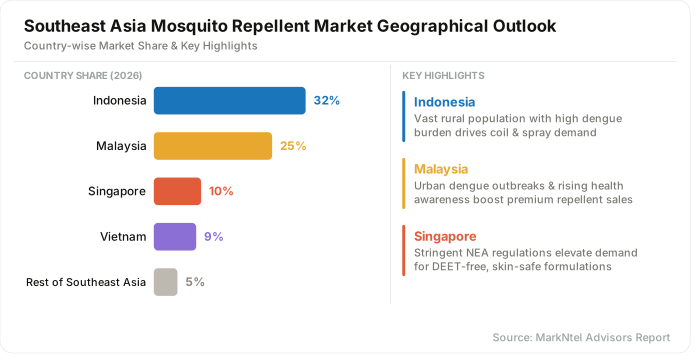
- Indonesia represents the leading regional market, contributing approximately 32% of the overall demand in 2026.
- In terms of product type, coils dominate the segment, accounting for nearly 35% of total revenue in 2026.
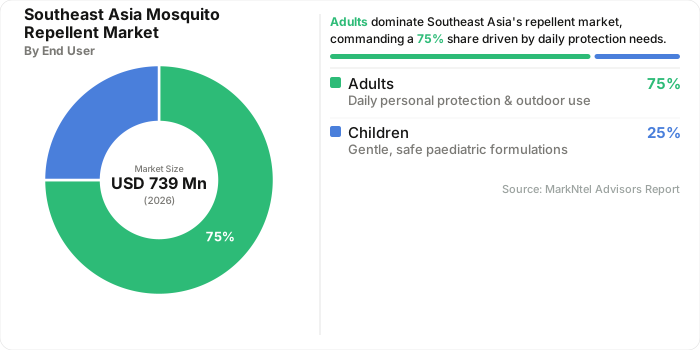
- Based on end users, adults hold the largest share at around 75% in 2026, driven by higher usage frequency and purchasing power.
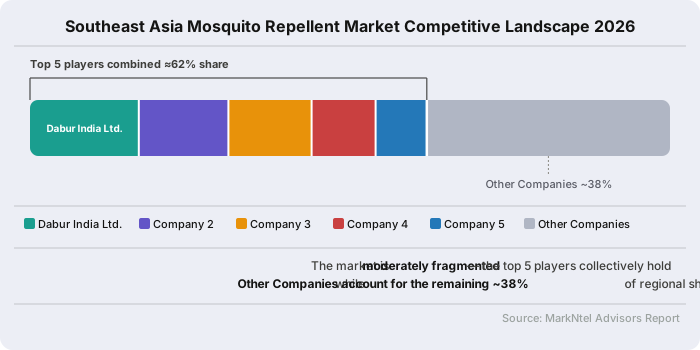
- The competitive structure remains moderately fragmented, with the top five companies collectively capturing close to 62% of the total market share.
Southeast Asia Mosquito Repellent Market Size and Outlook
The Southeast Asia Mosquito Repellent Market is estimated to witness sustained growth at a CAGR of 2.66% during 2026–2032, supported by the dual impact of rising vector-borne disease prevalence and the increasing adoption of advanced mosquito control technologies. Additionally, the growing burden of dengue and chikungunya across multiple countries continues to reinforce the importance of preventive healthcare, driving consistent demand for repellents across households and institutions.
The Philippines exemplifies this trend, with the Department of Health reporting 123,431 dengue cases and 437 deaths as of August 2025. The presence of parallel chikungunya surveillance and continued travel advisories into early 2026 highlights the persistent multi-disease risk environment. This has significantly increased demand for mosquito control solutions, not only at the household level but also across schools, local government units, and community health centers, expanding the role of institutional procurement within the vector control products market.
At the policy level, governments are strengthening long-term disease mitigation strategies. In Indonesia, the Ministry of Health, in collaboration with the World Health Organization and academic institutions, is advancing the “Rencana Aksi Nasional Pengendalian Dengue 2026–2029,” aimed at addressing surveillance gaps and improving case management . Such structured initiatives are expected to enhance nationwide awareness and promote sustained adoption of repellents as part of integrated disease prevention frameworks.
Simultaneously, technological interventions are reshaping the regional landscape. Singapore’s National Environment Agency is expanding Project Wolbachia to cover nearly 50% of households, targeting around 800,000 residences by 2026. This large-scale mosquito suppression program is not only reducing transmission risks but also strengthening public engagement with preventive measures, indirectly boosting demand for mosquito control devices.
From a product innovation perspective, the market is undergoing a structural transition toward advanced delivery systems and safer formulations. Increasing penetration of electric vaporizers, automated sprays, and spatial repellents reflects a shift toward continuous, indoor, and community-level protection. At the same time, rising health awareness is encouraging the adoption of low-toxicity and child-safe products, supporting premiumization and diversification across the region.
The market outlook remains stable and growth-oriented, with the Southeast Asia mosquito repellent Industry projected to grow from USD 739 million in 2026 to USD 865 million by 2032, underpinned by strong epidemiological drivers, government-led interventions, and ongoing product innovation. Collectively, these factors are expected to sustain long-term demand and gradually elevate the industry toward higher-value, technology-driven mosquito repellent products.
Southeast Asia Mosquito Repellent Market Key Indicators
- Vietnam’s epidemiological profile continues to reinforce demand for mosquito prevention solutions, with 184,903 dengue cases and 43 deaths reported in 2025. Early 2026 spikes in Ho Chi Minh City further highlight persistent transmission volatility. Authorities classify outbreaks as unpredictable, prompting continuous public advisories, thereby embedding mosquito repellent usage as a routine preventive behavior rather than a seasonal response.
- Southeast Asia accounts for a disproportionately high share of global dengue exposure, with 1.3 million people living in endemic zones out of 3.5 million globally . This large at-risk population accelerates demand within the anti-mosquito solutions industry, as governments intensify awareness campaigns and households increasingly adopt repellents as a primary line of defense against vector-borne infections.
- A multi-country burden analysis across 12 Southeast Asian nations estimates approximately 2.9 million dengue cases annually, resulting in 5,906 deaths. The scale of infections significantly expands the public health vector control solutions landscape, as policymakers prioritize investments in prevention infrastructure, including mosquito repellents, to reduce disease incidence and associated healthcare system strain.
- The economic burden of dengue in Southeast Asia is estimated at nearly USD 950 million annually, reflecting both direct healthcare costs and productivity losses. This financial impact strengthens the mosquito control solutions ecosystem, as governments and consumers alike shift toward preventive spending, recognizing mosquito repellents as cost-effective tools to mitigate long-term economic and public health risks.
Southeast Asia Mosquito Repellent Market Scope
| Category | Segments |
|---|---|
| By Product Type | Coils, Liquid Vaporizers, Aerosol Sprays, Topical Repellents, Repellent Mats, Wearable Repellents, Others |
| By Active Ingredient Type | Chemical-based, Plant-based |
| By Distribution Channel | Offline Retail, Online Retail |
| By Application | Indoor Use, Outdoor Use |
| By End User | Adults, Children |
Southeast Asia Mosquito Repellent Market Growth Drivers
Escalating Vector-Borne Diseases
The Southeast Asia Mosquito Repellent Industry Market is being strongly driven by the escalating prevalence of vector-borne diseases, particularly dengue and malaria, which continue to intensify across the region.
According to the World Health Organization, dengue cases in Southeast Asia rose sharply from 451,432 cases to 658,301 cases, marking a significant 46% increase. This consistent rise in infection rates has heightened consumer awareness and accelerated the adoption of insect bite protection products such as vaporizers, coils, sprays, and topical repellents across both urban and rural households.
In parallel, malaria resurgence is further strengthening demand for household pest control products. The Asia Pacific Leaders Malaria Alliance reported that Indonesia recorded approximately 540,000 malaria cases in 2024, the highest level in a decade. Notably, Papua province alone contributed nearly 93% of the country’s total cases , indicating concentrated high-risk zones that necessitate continuous preventive interventions. This sustained disease burden is pushing governments and health organizations to promote mosquito repellents as a first-line defense mechanism.
The growing epidemiological pressure is transforming mosquito repellents from discretionary purchases into essential daily-use products. As a result, the industry is expected to witness stable long-term growth, supported by increasing health awareness, government-backed campaigns, and the urgent need for effective mosquito protection solutions.
Recent Trends
Rising Adoption of Long-Lasting Spatial Mosquito Control Technologies
A key trend shaping the mosquito repellent demand is the increasing shift toward advanced, community-level protection systems that go beyond conventional household applications.
The growing preference for spatial repellent devices reflects a transition toward passive, long-lasting solutions capable of delivering area-wide mosquito control, particularly in high-risk regions with persistent dengue and malaria transmission. These innovations are gaining traction as governments and public health agencies prioritize scalable interventions that reduce reliance on frequent consumer reapplication.
A notable development reinforcing this trend, when S. C. Johnson & Son, Inc. initiated high-speed manufacturing of its Guardian™ spatial repellent. This controlled-release system is specifically designed for malaria and dengue prevention, offering continuous protection for up to 12 months per unit. The company further stated that its Nairobi facility has the capacity to produce approximately 20 million units annually , enabling large-scale deployment across endemic regions. Such advancements highlight the growing role of controlled-release repellent technology in strengthening long-term vector control strategies.
The integration of durable, large-scale mosquito protection tools is redefining the landscape, supporting both public health initiatives and consumer demand for convenience. As innovation accelerates, the adoption of long-lasting insect repellent formulations is expected to play a crucial role in sustaining expansion across the Southeast Asia mosquito repellent Industry.
Southeast Asia Mosquito Repellent Market Opportunities and Challenges
Rising Compliance Costs Driving Sustainable Southeast Asia Mosquito Repellent Innovation
Consumer apprehension surrounding the safety of synthetic ingredients is emerging as a structural constraint for the Southeast Asia mosquito repellent industry. Concerns linked to chemical-based formulations, particularly DEET and pyrethroid compounds, are influencing purchasing behavior, especially among families with children.
The World Health Organization recommends cautious application of DEET, advising limited frequency and controlled concentrations in tropical environments, which restricts widespread usage and creates perception barriers within the chemical-based mosquito repellents segment.
At the same time, these safety-related concerns are unlocking significant growth avenues for alternative solutions. The rising preference for plant-based and skin-friendly products is accelerating demand within the eco-friendly insect repellent demand landscape, as consumers actively seek safer and low-toxicity formulations.
This shift is further reinforced by product innovation strategies among key players. For instance, in 2024, Kao Corporation introduced Bioré GUARD Mos Block Serum in Malaysia, using natural citronella oil and proprietary “anti-landing technology.” designed to prevent mosquito contact while maintaining skin compatibility. Such developments highlight the emergence of differentiated offerings within the insect bite prevention products category, combining efficacy with enhanced safety positioning.
The regulatory caution and consumer skepticism toward synthetic repellents pose a challenge; thereby simultaneously reshaping the competitive landscape by encouraging innovation in safer alternatives.
Segmentation Insights
Widespread adoption of Coils due to Strong Consumer Penetration
Coils account for nearly 35% of total revenue in the Southeast Asia mosquito repellent industry, maintaining a strong foothold due to their affordability, accessibility, and long-established consumer acceptance.
The widespread use of coils is particularly evident across price-sensitive and rural populations, where cost-effective household pest control products remain a primary purchasing criterion. Their ability to provide extended protection for several hours at a low price point makes them a preferred solution for daily use in densely populated regions.
Additionally, coils are deeply embedded in traditional consumption patterns, especially in countries such as Indonesia, Vietnam, and the Philippines, where outdoor and semi-open living environments increase mosquito exposure. Compared to advanced formats like vaporizers or wearable devices, coils require minimal infrastructure, supporting their strong penetration within the broader mosquito repellent coils market.
Moreover, coils play a significant role within the evolving mosquito control devices market, particularly in areas with limited electricity access, where alternatives such as liquid vaporizers are less feasible.
In conclusion, despite the emergence of premium and technologically advanced products, coils are expected to retain their dominance due to their cost efficiency, ease of use, and strong regional adaptability. Based on product categorization, the market includes the following segments:
- Coils
- Liquid Vaporizers
- Aerosol Sprays
- Topical Repellents
- Repellent Mats
- Wearable Repellents
- Others
Adults Segment Dominates End-Use Landscape
The adult segment holds approximately 75% share in the Southeast Asia mosquito repellent industry, emerging as the largest contributor due to higher usage frequency, purchasing power, and broader exposure to mosquito-prone environments.
Adults represent the primary consumer base for personal insect protection products, as they are more likely to engage in outdoor activities, commuting, and occupational exposure, increasing the need for consistent mosquito protection.
Additionally, adults play a central role in household purchasing decisions, particularly for travel mosquito protection products and daily-use repellents such as coils, vaporizers, and sprays. This demographic is more inclined toward preventive healthcare spending, driven by rising awareness of vector-borne diseases such as dengue and malaria across Southeast Asia. Their preference for convenient and effective solutions further supports strong product adoption rates.
Moreover, the working population in urban centers significantly contributes to the growth of outdoor mosquito repellent demand, especially in countries like Thailand, Indonesia, and Vietnam, where climatic conditions favor year-round mosquito activity. In contrast, the children segment, while important, is relatively smaller due to cautious product usage and parental concerns regarding chemical exposure.
The dominance of the adult segment is expected to persist, supported by higher consumption intensity, decision-making authority, and increasing awareness of mosquito-borne disease prevention across the region. The report identifies the following major end-user segments:
- Adults
- Children
Southeast Asia Mosquito Repellent Market Geographical Outlook
Indonesia accounts for approximately 32% of the total demand in the Southeast Asia mosquito repellent industry, positioning it as the leading country within the region. This dominance is primarily driven by the country’s high incidence of vector-borne diseases, particularly dengue, which continues to exert significant public health pressure.
In 2024 alone, Indonesia reported over 257,000 dengue cases and more than 1,400 deaths, with infections spanning nearly all provinces. This widespread disease burden has accelerated the adoption of mosquito prevention solutions across both urban and rural populations.
The country’s tropical climate, characterized by high humidity and consistent rainfall, further supports year-round mosquito breeding, sustaining continuous demand within the pest repellent market. Additionally, Indonesia’s large population base and increasing urbanization contribute to dense living conditions, amplifying mosquito exposure and reinforcing the need for daily protection measures. Government-led awareness campaigns and vector control initiatives have also played a crucial role in promoting Repellent usage as a preventive strategy.
Furthermore, strong retail penetration and the availability of affordable products such as coils and sprays support widespread accessibility, particularly among middle- and lower-income households. In conclusion, Indonesia’s combination of high disease prevalence, favorable climatic conditions, and large consumer base is driving long-term demand for effective anti-mosquito products.
Southeast Asia Mosquito Repellent Market Competitive Analysis
The Southeast Asia mosquito repellent market is moderately fragmented, with a mix of global FMCG leaders and strong regional manufacturers operating across diverse product formats, including coils, liquid vaporizers, aerosol sprays, and topical Repellents. The top five companies, including S. C. Johnson & Son, Inc., Reckitt Benckiser Group plc, Godrej Consumer Products Limited, PT. Enesis Group and Spectrum Brands Holdings, Inc., collectively account for approximately 62% of the total market share.
Major Companies in Southeast Asia Mosquito Repellent Market
- PT. Enesis Group
- S. C. Johnson & Son, Inc.
- Reckitt Benckiser Group plc
- Godrej Consumer Products Limited
- Spectrum Brands Holdings, Inc.
- Earth Corporation
- Haw Par Corporation Limited
- Dabur India Limited
- Jyothy Labs Limited
- Sumitomo Chemical Co., Ltd.
- Others
Southeast Asia Mosquito Repellent Industry News and Recent Developments
October 2025: LANXESS Showcases Saltidin® Mosquito Repellent Technology at in-cosmetics Asia 2025 in Bangkok
Specialty chemicals company LANXESS presented its Saltidin® insect repellent technology at the in-cosmetics Asia 2025 exhibition held in Bangkok, Thailand. The company highlighted the ingredient’s suitability for creams, gels, and spray formulations, emphasizing its skin-friendly properties and WHO-recommended profile. The showcase targeted growing Southeast Asian demand for advanced personal protection products amid rising mosquito-borne disease concerns.
Impact Analysis: The development highlights increasing innovation toward premium and dermatologically compatible mosquito repellent formulations across Southeast Asia. LANXESS’s focus on multifunctional and safer active ingredients reflects the market’s gradual transition away from traditional chemical-heavy repellents toward consumer-friendly solutions. The expansion of advanced repellent technologies is expected to support premiumization trends, encourage product differentiation, and intensify competition among mosquito repellent manufacturers operating within tropical Asian markets.
May 2025: Dragkooler Launches New 3-in-1 Mosquito Repellent Cooling Spray in Thailand
Thai wellness brand Dragkooler introduced its new “Mosquito Repellent Spray” featuring a 3-in-1 formulation that combines mosquito protection, cooling sensation, and baby-powder fragrance. The product is positioned within the premium-mass segment and uses natural citronella extracts without DEET or parabens. The launch aims to expand the company’s reach from mother-and-child care products to broader family-oriented consumer segments in Thailand.
Impact Analysis: The launch reflects the growing consumer preference for multifunctional and skin-friendly mosquito repellent solutions across Southeast Asia. By combining comfort, fragrance, and protection within a single product, Dragkooler is targeting premium urban consumers seeking safer and more convenient alternatives to traditional repellents. The introduction also highlights rising innovation intensity within the regional mosquito repellent market, particularly toward natural ingredient-based formulations and premiumized personal protection products.
- Market Segmentation
- Introduction
- Product Definition
- Research Process
- Assumptions
- Executive Summary
- South East Asia Mosquito Repellant Market Policies, Regulations, and Product Standards
- South East Asia Mosquito Repellant Production Trend 2022-2032
- South East Asia Mosquito Repellant Trend by Type of Product Type
- Coils
- Liquid Vaporizers
- Aerosol Sprays
- Topical Repellents
- Repellent Mats
- Wearable Repellents
- Others
- Company Wise Production Plants and Statistics
- Installed Production Capacity
- Actual Production
- Planned Production Target
- South East Asia Mosquito Repellant Trend by Type of Product Type
- South East Asia Mosquito Repellant Pricing Analysis 2022-2032
- South East Asia Mosquito Repellant Pricing Trend 2022-2032
- South East Asia Mosquito Repellant Pricing Trend by Product Type 2022-2032
- Coils
- Liquid Vaporizers
- Aerosol Sprays
- Topical Repellents
- Repellent Mats
- Wearable Repellents
- Others
- South East Asia Mosquito Repellant Market Dynamics
- Growth Factors
- Challenges
- South East Asia Mosquito Repellant Market Hotspot & Opportunities
- South East Asia Mosquito Repellant Market Outlook, 2022-2032F
- Market Size & Outlook
- By Revenues (USD Million)
- Market Share & Analysis
- By Product Type - Market Size & Forecast 2022-2032, USD Million
- Coils
- Liquid Vaporizers
- Aerosol Sprays
- Topical Repellents
- Repellent Mats
- Wearable Repellents
- Others
- By Active Ingredient Type- Market Size & Forecast 2022-2032, USD Million
- Chemical-based
- Plant-based
- By Distribution Channel- Market Size & Forecast 2022-2032, USD Million
- Offline Retail
- Online Retail
- By Application - Market Size & Forecast 2022-2032, USD Million
- Indoor Use
- Outdoor Use
- By End User- Market Size & Forecast 2022-2032, USD Million
- Adults
- Children
- By Country
- Malaysia
- Indonesia
- Singapore
- Cambodia
- Vietnam
- Thailand
- Philippines
- Others
- By Company
- Competition Characteristics
- Market Share & Analysis
- By Product Type - Market Size & Forecast 2022-2032, USD Million
- Market Size & Outlook
- Malaysia Mosquito Repellant Market Outlook, 2022-2032F
- Market Size & Outlook
- By Revenues (USD Million)
- Market Share & Analysis
- By Product Type - Market Size & Forecast 2022-2032, USD Million
- By Active Ingredient Type- Market Size & Forecast 2022-2032, USD Million
- By Distribution Channel- Market Size & Forecast 2022-2032, USD Million
- By Application - Market Size & Forecast 2022-2032, USD Million
- By End User- Market Size & Forecast 2022-2032, USD Million
- Market Size & Outlook
- Indonesia Mosquito Repellant Market Outlook, 2022-2032F
- Market Size & Outlook
- By Revenues (USD Million)
- Market Share & Analysis
- By Product Type - Market Size & Forecast 2022-2032, USD Million
- By Active Ingredient Type- Market Size & Forecast 2022-2032, USD Million
- By Distribution Channel- Market Size & Forecast 2022-2032, USD Million
- By Application - Market Size & Forecast 2022-2032, USD Million
- By End User- Market Size & Forecast 2022-2032, USD Million
- Market Size & Outlook
- Singapore Mosquito Repellant Market Outlook, 2022-2032F
- Market Size & Outlook
- By Revenues (USD Million)
- Market Share & Analysis
- By Product Type - Market Size & Forecast 2022-2032, USD Million
- By Active Ingredient Type- Market Size & Forecast 2022-2032, USD Million
- By Distribution Channel- Market Size & Forecast 2022-2032, USD Million
- By Application - Market Size & Forecast 2022-2032, USD Million
- By End User- Market Size & Forecast 2022-2032, USD Million
- Market Size & Outlook
- Cambodia Mosquito Repellant Market Outlook, 2022-2032F
- Market Size & Outlook
- By Revenues (USD Million)
- Market Share & Analysis
- By Product Type - Market Size & Forecast 2022-2032, USD Million
- By Active Ingredient Type- Market Size & Forecast 2022-2032, USD Million
- By Distribution Channel- Market Size & Forecast 2022-2032, USD Million
- By Application - Market Size & Forecast 2022-2032, USD Million
- By End User- Market Size & Forecast 2022-2032, USD Million
- Market Size & Outlook
- Vietnam Mosquito Repellant Market Outlook, 2022-2032F
- Market Size & Outlook
- By Revenues (USD Million)
- Market Share & Analysis
- By Product Type - Market Size & Forecast 2022-2032, USD Million
- By Active Ingredient Type- Market Size & Forecast 2022-2032, USD Million
- By Distribution Channel- Market Size & Forecast 2022-2032, USD Million
- By Application - Market Size & Forecast 2022-2032, USD Million
- By End User- Market Size & Forecast 2022-2032, USD Million
- Market Size & Outlook
- Thailand Mosquito Repellant Market Outlook, 2022-2032F
- Market Size & Outlook
- By Revenues (USD Million)
- Market Share & Analysis
- By Product Type - Market Size & Forecast 2022-2032, USD Million
- By Active Ingredient Type- Market Size & Forecast 2022-2032, USD Million
- By Distribution Channel- Market Size & Forecast 2022-2032, USD Million
- By Application - Market Size & Forecast 2022-2032, USD Million
- By End User- Market Size & Forecast 2022-2032, USD Million
- Market Size & Outlook
- Philippines Mosquito Repellant Market Outlook, 2022-2032F
- Market Size & Outlook
- By Revenues (USD Million)
- Market Share & Analysis
- By Product Type - Market Size & Forecast 2022-2032, USD Million
- By Active Ingredient Type- Market Size & Forecast 2022-2032, USD Million
- By Distribution Channel- Market Size & Forecast 2022-2032, USD Million
- By Application - Market Size & Forecast 2022-2032, USD Million
- By End User- Market Size & Forecast 2022-2032, USD Million
- Market Size & Outlook
- South East Asia Mosquito Repellant Market Key Strategic Imperatives for Success & Growth
- Competitive Outlook
- Company Profiles
- PT. Enesis Group
- Business Description
- Product Portfolio
- Collaborations & Alliances
- Recent Developments
- Financial Details
- Others
- S. C. Johnson & Son, Inc.
- Business Description
- Product Portfolio
- Collaborations & Alliances
- Recent Developments
- Financial Details
- Others
- Reckitt Benckiser Group plc
- Business Description
- Product Portfolio
- Collaborations & Alliances
- Recent Developments
- Financial Details
- Others
- Godrej Consumer Products Limited
- Business Description
- Product Portfolio
- Collaborations & Alliances
- Recent Developments
- Financial Details
- Others
- Spectrum Brands Holdings, Inc.
- Business Description
- Product Portfolio
- Collaborations & Alliances
- Recent Developments
- Financial Details
- Others
- Earth Corporation
- Business Description
- Product Portfolio
- Collaborations & Alliances
- Recent Developments
- Financial Details
- Others
- Haw Par Corporation Limited
- Business Description
- Product Portfolio
- Collaborations & Alliances
- Recent Developments
- Financial Details
- Others
- Dabur India Limited
- Business Description
- Product Portfolio
- Collaborations & Alliances
- Recent Developments
- Financial Details
- Others
- Jyothy Labs Limited
- Business Description
- Product Portfolio
- Collaborations & Alliances
- Recent Developments
- Financial Details
- Others
- Sumitomo Chemical Co., Ltd.
- Business Description
- Product Portfolio
- Collaborations & Alliances
- Recent Developments
- Financial Details
- Others
- Others
- PT. Enesis Group
- Company Profiles
- Disclaimer

MarkNtel Advisors follows a robust and iterative research methodology designed to ensure maximum accuracy and minimize deviation in market estimates and forecasts. Our approach combines both bottom-up and top-down techniques to effectively segment and quantify various aspects of the market. A consistent feature across all our research reports is data triangulation, which examines the market from three distinct perspectives to validate findings. Key components of our research process include:
1. Scope & Research Design At the outset, MarkNtel Advisors define the research objectives and formulate pertinent questions. This phase involves determining the type of research—qualitative or quantitative—and designing a methodology that outlines data collection methods, target demographics, and analytical tools. They also establish timelines and budgets to ensure the research aligns with client goals.
2. Sample Selection and Data Collection In this stage, the firm identifies the target audience and determines the appropriate sample size to ensure representativeness. They employ various sampling methods, such as random or stratified sampling, based on the research objectives. Data collection is carried out using tools like surveys, interviews, and observations, ensuring the gathered data is reliable and relevant.
3. Data Analysis and Validation Once data is collected, MarkNtel Advisors undertake a rigorous analysis process. This includes cleaning the data to remove inconsistencies, employing statistical software for quantitative analysis, and thematic analysis for qualitative data. Validation steps are taken to ensure the accuracy and reliability of the findings, minimizing biases and errors.

4. Data Forecast and FinalizationThe final phase involves forecasting future market trends based on the analyzed data. MarkNtel Advisors utilize predictive modeling and time series analysis to anticipate market behaviors. The insights are then compiled into comprehensive reports, featuring visual aids like charts and graphs, and include strategic recommendations to inform client decision-making
We offer flexible licensing options to cater to varying organizational needs. Choose the pricing pack that best suits your requirements:
Buy Now Inquire Before Buying
 Request Customization