

By Revenues (USD Million) (Quantity Sold in Tons), By Cable Type (Control Cables, Power Cables, Instrumentation Cables, Engineered Cables, Drag Chain Cables, Data & Communication Cables), By Voltage (... ... ables), By Voltage (Low Voltage Cable (Up to 1 kV), Medium Voltage Cable (1 kV – 35 kV), High Voltage Cable (>35 kV)), By Installation Type (Fixed Installation, Flexible Installation), By Application (Power Transmission & Distribution, Control & Automation Systems, Data & Signal Transmission, Process Industries (chemical, oil & gas), Others), By End User (Manufacturing, Energy and Power, Oil & Gas, Telecommunications, Construction, Automotive, Mining & Metals, Food & Beverage, Others), and others Read more
- Energy
- Apr 2026
- 205
- PDF, Excel, PPT
South East Asia Industrial Cable Market Key Takeaways
- The Southeast Asia industrial cable market is expected to grow at a CAGR of around 8.2% during 2026–2032, with its value rising from about USD 2.1 billion in 2025 to USD 2.27 billion in 2026, and reaching approximately USD 3.64 billion by 2032.
- In 2026, Indonesia emerged as the leading market, accounting for approximately 25.84% of the total share.
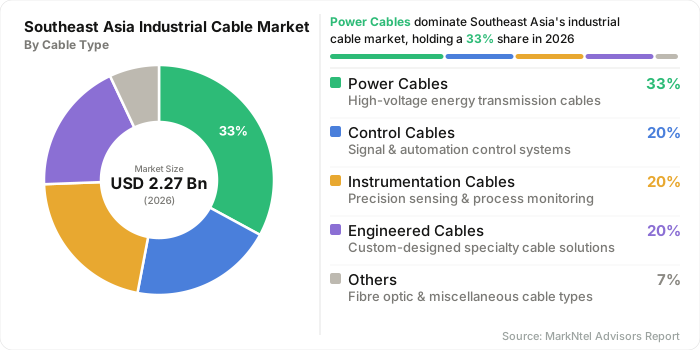
- Based on cable type, power cables represented a notable share of around 33% in 2026.
- With approximately 37% share, the manufacturing segment emerged as the dominant end-user segment in 2026.
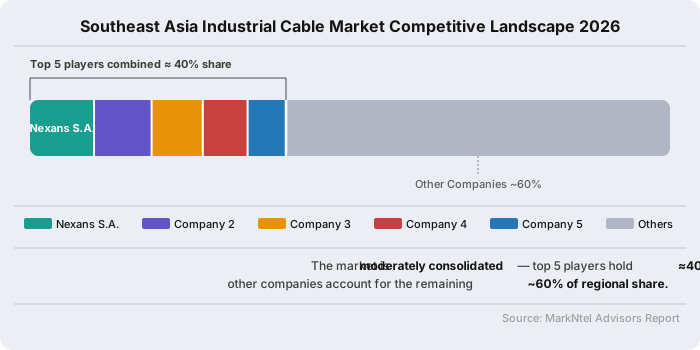
- The industry in Southeast Asia reflects a moderately consolidated structure, comprising approximately 80–120 manufacturers across global and regional levels. However, the top five leading companies collectively account for approximately 40% of the regional market share.
South East Asia Industrial Cable Market Size and Outlook
The Southeast Asia industrial cable market was valued at approximately USD 2.1 billion in 2025 and is expected to reach around USD 3.64 billion by 2032, growing from USD 2.27 billion in 2026, at a CAGR of nearly 8.2% during 2026–2032.
Rapid expansion of manufacturing and infrastructure activities across Southeast Asia, particularly in Indonesia and Vietnam, continues to strengthen demand for industrial cable systems. Manufacturing remains a key growth engine, with Vietnam’s manufacturing value-added growing by nearly 9.97% in 2025, reflecting sustained industrial momentum . This ongoing expansion is increasing the need for power, control, and instrumentation cables across industrial facilities. At the same time, rising electricity consumption and grid expansion, with demand growing by over 7% in 2024 according to the International Energy Agency, further reinforce the requirement for reliable cable infrastructure.
Amid these developments, industrial wire and cable market conditions are supported by policy initiatives and continued industrial investments across the region. Indonesia’s “Making Indonesia 4.0” roadmap and Vietnam’s industrial development strategy are advancing automation and modern manufacturing capabilities, thereby expanding cable demand . Concurrently, the Asian Development Bank committed around USD 6.2 billion in Southeast Asia in 2024 for infrastructure and energy projects, strengthening industrial connectivity . In addition, the expansion of industrial parks in Thailand and Malaysia continues to drive demand for fixed installation and low-voltage cable systems.
Demand patterns across end-user industries are primarily driven by industrial activity, with manufacturing accounting for the largest share due to its high cable intensity. Electronics production growth in Vietnam and automotive manufacturing in Thailand are supporting the adoption of control and data cables for automation systems. Meanwhile, oil & gas industrial cable Southeast Asia demand remains strong in Indonesia and Malaysia, requiring durable instrumentation and medium-voltage cables. In response, industry participants are introducing energy-efficient and fire-resistant cable solutions aligned with evolving industrial standards.
In the coming years, the industrial cable market is expected to maintain its growth trajectory, supported by continued electrification, renewable energy integration, and digital infrastructure expansion across Southeast Asia. Government-led renewable energy targets and grid modernization programs are strengthening industrial power systems and increasing cable deployment. Alongside this, investments in industrial corridors and smart manufacturing facilities are accelerating the adoption of advanced electrical and automation systems. As a result, the growing implementation of Industry 4.0 technologies is expected to sustain demand for specialized data and flexible cables, reinforcing long-term industrial cable market growth.
South East Asia Industrial Cable Market Key Indicators
- ASEAN’s total trade exceeded approximately USD 3.8 trillion in 2024, reflecting strong industrial and manufacturing activity across the region. The continued expansion of trade volumes is driving the development of industrial facilities, logistics hubs, and production units, thereby increasing the deployment of industrial cable systems and supporting overall market growth .
- As per the Organisation for Economic Co-operation and Development, Indonesia’s infrastructure investment needs are estimated at over USD 1.7 trillion through 2040, highlighting large-scale development of transport, energy, and industrial infrastructure. Such expansion requires significant electrical connectivity and industrial wiring systems, directly supporting cable demand across construction and industrial sectors.
- Thailand’s Eastern Economic Corridor (EEC) continues to attract significant investments in advanced industries such as automotive, electronics, and aerospace, supported by over USD 45 billion in infrastructure development. The expansion of industrial zones and transport networks requires extensive electrical and automation systems, thereby increasing the consumption of industrial cables across manufacturing and processing facilities .
- ASEAN foreign direct investment inflows reached approximately USD 226 billion in 2025, despite a global slowdown. This continued investment in industrial and infrastructure sectors is expanding production capacity and driving demand for industrial cable systems.
South East Asia Industrial Cable Market Scope
| Category | Segments |
|---|---|
| By Revenues | Quantity Sold in Tons |
| By Cable Type | Control Cables, Power Cables, Instrumentation Cables, Engineered Cables, Drag Chain Cables, Data & Communication Cables |
| By Voltage | Low Voltage Cable (Up to 1 kV), Medium Voltage Cable (1 kV – 35 kV), High Voltage Cable (>35 kV |
| By Installation Type | Fixed Installation, Flexible Installation |
| By Application | Power Transmission & Distribution, Control & Automation Systems, Data & Signal Transmission, Process Industries (chemical, oil & gas), Others |
| By End User | Manufacturing, Energy and Power, Oil & Gas, Telecommunications, Construction, Automotive, Mining & Metals, Food & Beverage, Others |
South East Asia Industrial Cable Market Growth Drivers
Rapid Industrialization Across ASEAN
Rapid industrialization across Southeast Asia has accelerated in recent years, driven by expanding manufacturing ecosystems and shifting global supply chains. Countries such as Vietnam are benefiting from supply-chain diversification and rising investment in export-oriented industries, reinforcing their position as major production hubs. At the same time, Indonesia is strengthening industrial capacity through large-scale investments, including EV manufacturing expansion projects such as a USD 1 billion plan by VinFast . Together, these developments are significantly increasing manufacturing-driven demand for industrial cable systems across the region.
As industrial activity expands, the impact is directly reflected in rising demand for industrial cable systems across manufacturing and processing facilities. Vietnam’s export performance, with total exports reaching approximately USD 475 billion in 2025, highlights the scale of production and the growing intensity of industrial operations . In parallel, Indonesia’s development of major hubs such as the Morowali Industrial Park, one of the world’s largest integrated nickel processing clusters, demonstrates the depth of downstream industrialization . These large-scale facilities require extensive deployment of power, control, and instrumentation cables for energy distribution, machinery connectivity, and automation systems.
This sustained industrial expansion acts as a structural driver by continuously increasing the installed base of industrial infrastructure rather than generating short-term demand spikes. Each new manufacturing unit, processing facility, or industrial hub requires permanent electrical systems, ensuring consistent cable consumption over time. Government-backed industrial policies and infrastructure investments further reinforce this long-term trend across Southeast Asia. As industrial capacity continues to scale, the broader industrial wire and cable market in Southeast Asia is expected to maintain steady growth.
Recent Trends
Shift Toward High-Performance & Specialty Cables
The increasing adoption of high-performance and specialty cables across Southeast Asia reflects a broader shift driven by industrial automation and evolving safety standards. This transition is reinforced by large-scale investments such as Indonesia’s USD 4 billion petrochemical complex, where highly automated and safety-critical operations necessitate advanced cable systems . At the same time, governments are promoting Industry 4.0 initiatives in Indonesia and Vietnam, emphasizing smart factories and digital production. Together, these developments are increasing the need for advanced cable solutions across modern industrial systems.
As industrial systems become more advanced, demand patterns are shifting toward cables capable of supporting automation, high-load operations, and enhanced safety. Sectors such as electronics, automotive, and process industries increasingly rely on durable and reliable cabling solutions for continuous operations. In response, manufacturers are expanding portfolios to include flame-retardant industrial cables and halogen-free industrial cables, supported by innovations such as, in 2025, Nexans launch of a high-performance, halogen-free solution. This shift is further reflected in adoption trends, with Southeast Asia’s electronics sector importing nearly 30% of halogen-free cable materials, up from 12% in 2020 .
This transition is expected to remain a sustained feature of the market as industrial ecosystems continue to evolve. Regulatory emphasis on safety standards and environmental compliance is reinforcing the adoption of advanced cable technologies. At the same time, the expansion of renewable energy systems and smart infrastructure is creating additional demand for specialized cabling solutions. As a result, high-performance and specialty cables will continue to play a central role in shaping long-term trends across the industrial cable market in Southeast Asia.
South East Asia Industrial Cable Market Opportunities and Challenges
Compliance Requirements Creating Opportunities for Smart Monitoring and Digital Cable Management Solutions
Increasing regulatory scrutiny on industrial safety and operational reliability is emerging as a key challenge for conventional cable systems across Southeast Asia. Governments are strengthening compliance frameworks to reduce risks in manufacturing and process industries. For instance, industrial safety regulations in Singapore mandate stricter monitoring and inspections under the Workplace Safety and Health framework , while Malaysia’s Occupational Safety and Health Master Plan 2026–2030 emphasizes enhanced safety systems. These requirements are increasing compliance costs and exposing limitations in traditional cable infrastructure lacking real-time monitoring capabilities.
In response, a significant opportunity is emerging for smart monitoring and digital cable management solutions. Industrial operators are increasingly adopting sensor-enabled cables, predictive maintenance systems, and digital monitoring platforms to improve system visibility and ensure compliance. This is evident in Indonesia, where Telkom is deploying fiber-optic subsea cables with sensing technology for real-time monitoring . Similarly, utilities across Southeast Asia are adopting AI- and IoT-based cable monitoring systems to predict failures and optimize maintenance . Consequently, cables are evolving into data-driven assets, improving reliability, reducing downtime, and reflecting the growing digitalization impact on industrial cable demand.
Segmentation Insights
Power Cables Hold the Leading Position in the Cable Type Segment
Power cables account for approximately 33% of the total market share in Southeast Asia, making them the leading segment by cable type. This dominance is primarily attributed to their essential role in transmitting and distributing electricity across industrial facilities, infrastructure projects, and energy systems. Unlike control or instrumentation cables, power cables are required across all stages of industrial operations, from primary power supply to internal distribution networks. Their extensive use in sectors such as manufacturing, construction, and oil & gas further reinforces their position as the most widely deployed cable type.
The expansion of industrial and infrastructure activities across the region is increasing the requirement for extensive power cable installations. Countries such as Indonesia and Vietnam are witnessing rapid development of industrial parks, manufacturing hubs, and energy-intensive facilities, all of which require robust power distribution systems. This trend is further reinforced by large-scale energy transmission projects, including initiatives to export offshore wind energy from Vietnam to Singapore through subsea power cable networks. Such projects highlight the growing reliance on high-capacity power infrastructure, while the continued need for both new installations and system upgrades ensures sustained demand , reinforcing the segment’s dominant position in the industrial power cable market across Southeast Asia. Based on cable type, the market is segmented into:
- Control Cables
- Power Cables
- Instrumentation Cables
- Engineered Cables
- Drag Chain Cables
- Data & Communication Cables
Manufacturing Represents the Largest Revenue-Contributing End-User Segment
With a share of nearly 37%, manufacturing stands as the largest end-user segment in the Southeast Asia industrial cable industry. This dominance is driven by the high cable intensity within manufacturing facilities, where continuous power supply, automation systems, and machinery connectivity are essential for smooth operations. Industries such as electronics, automotive, and metals rely extensively on power, control, and instrumentation cables to support production efficiency. In addition, the growing adoption of Industry 4.0 technologies, including robotics and digital systems, is further increasing the need for advanced cable infrastructure.
As high-tech manufacturing capabilities expand across the region, the requirement for industrial cable systems is steadily increasing. Countries such as Thailand are witnessing strong investments in electronics and automation, reinforcing industrial growth. For instance, over 180 PCB investment applications worth more than USD 5 billion, along with a robotics cluster in the Eastern Economic Corridor, highlight rapid expansion in advanced manufacturing . The development of such facilities requires extensive electrical and connectivity infrastructure, thereby ensuring sustained demand for industrial cables and reinforcing the segment’s leading position, supported by strong manufacturing sector cable demand across ASEAN. Based on end user, the market is segmented into:
- Manufacturing
- Energy and Power
- Oil & Gas
- Telecommunications
- Construction
- Automotive
- Mining & Metals
- Food & Beverage
- Others
South East Asia Industrial Cable Market Geographical Outlook
Accounting for approximately 25.84% of the regional market, Indonesia holds the largest share in the Southeast Asia industrial cable market. This dominance is supported by its extensive industrial base spanning mining, metals, and manufacturing sectors. As the world’s leading nickel producer, Indonesia has accelerated downstream processing through government-backed policies and investments in smelting and refining facilities. This momentum is further reflected in large-scale industrial developments, including an USD 8.3 billion nickel processing hub aimed at strengthening EV battery supply chains . Such energy-intensive operations require continuous power and advanced electrical infrastructure, thereby driving strong demand for industrial cable systems.
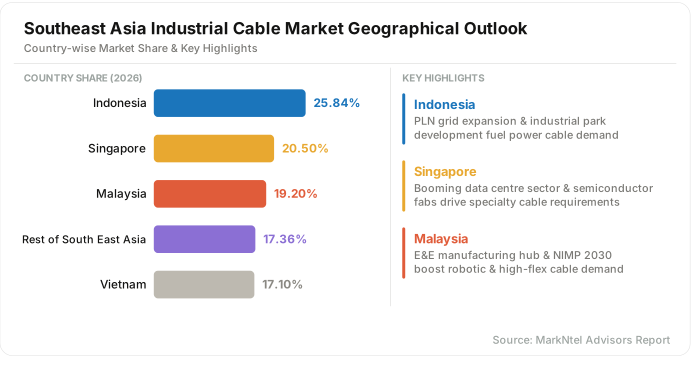
At the same time, ongoing infrastructure and industrial expansion continues to reinforce Indonesia’s leadership position. The development of industrial parks, along with large-scale projects such as petrochemical complexes and EV manufacturing facilities, is steadily increasing the need for reliable power distribution and automation systems. While Vietnam is emerging as one of the fastest-growing manufacturing economies in Southeast Asia, Indonesia’s scale of resource-based industrial activity and large project pipeline provide a stronger demand base. Consequently, Indonesia’s integrated industrial ecosystem and continuous investment momentum collectively strengthen its leading position in the Indonesia industrial cable market within the broader Southeast Asia region.
South East Asia Industrial Cable Market Competitive Analysis
The Southeast Asia industrial cable industry exhibits a moderately consolidated structure, comprising approximately 80–120 manufacturers, including a combination of global corporations and regional suppliers. The top five leading companies Prysmian Group, Nexans, Sumitomo Electric Industries, Furukawa Electric, and LS Cable & System collectively contribute around 40% of the total regional revenue, reflecting a balanced competitive landscape with both global dominance and regional participation.
Major Companies Industrial Cable Companies in Southeast Asia
- Prysmian Group
- Nexans
- Sumitomo Electric Industries
- Furukawa Electric
- LS Cable & System
- Belden Inc.
- Leoni AG
- NKT A/S
- Tai Sin Electric
- Bangkok Cable
- Others
South East Asia Industrial Cable Industry News and Recent Developments
March 2026: Taihan Cable & Solution Begins Construction of Vietnam’s First 400 kV Cable Plant
Taihan Cable & Solution commenced construction of Vietnam’s first 400 kV extra-high-voltage cable manufacturing facility, with an investment of around USD 50 million. The plant is designed to enhance local production capacity and support rising electricity demand and grid expansion across Southeast Asia.
Impact Analysis: This development underscores the increasing focus on localizing high-voltage cable manufacturing within Southeast Asia to support large-scale power transmission and grid modernization projects. It is expected to enhance regional supply chain resilience, reduce reliance on imports, and facilitate faster deployment of EHV cable systems across infrastructure and utility applications.
March 2025: Prysmian Group Introduces Advanced Cable Solutions for APAC Data Centres
Prysmian launched next-generation power cable solutions across Asia-Pacific, including Southeast Asia, to support the rapid growth of AI-driven data centres. The cables are designed to improve energy efficiency, reduce copper usage, and enhance performance for high-demand digital infrastructure.
Impact Analysis: This development highlights the growing influence of data centre expansion in driving demand for high-performance industrial cables across Asia-Pacific. It is expected to accelerate adoption of energy-efficient and high-capacity cable systems, particularly in Southeast Asia, where digital infrastructure investments are rising rapidly.
- Market Segmentation
- Introduction
- Market Definition
- Research Process
- Assumptions
- Executive Summary
- Southeast Asia Cable Production Analysis
- By Country
- By Cable Type
- Southeast Asia Industrial Cable Market Pricing Analysis
- Country Wise Vs Cable Type Wise Prices Per Ton, 2022-2026
- Malaysia
- Control Cables
- Power Cables
- Instrumentation Cables
- Engineered Cables
- Drag Chain Cables
- Data & Communication Cables
- Indonesia
- Control Cables
- Power Cables
- Instrumentation Cables
- Engineered Cables
- Drag Chain Cables
- Data & Communication Cables
- Singapore
- Control Cables
- Power Cables
- Instrumentation Cables
- Engineered Cables
- Drag Chain Cables
- Data & Communication Cables
- Vietnam
- Control Cables
- Power Cables
- Instrumentation Cables
- Engineered Cables
- Drag Chain Cables
- Data & Communication Cables
- Thailand
- Control Cables
- Power Cables
- Instrumentation Cables
- Engineered Cables
- Drag Chain Cables
- Data & Communication Cables
- Philippines
- Control Cables
- Power Cables
- Instrumentation Cables
- Engineered Cables
- Drag Chain Cables
- Data & Communication Cables
- Malaysia
- Country Wise Vs Cable Type Wise Prices Per Ton, 2022-2026
- Southeast Asia Industrial Cable Raw Material Analysis & Pricing Trends, 2022-2032
- Copper
- Aluminum
- PVC
- Polyolefins
- Rubber
- Others
- Southeast Asia Industrial Cable Market Trends & Development
- Southeast Asia Industrial Cable Market Dynamics
- Growth Drivers
- Challenges
- Southeast Asia Industrial Cable Market Regulations, Policies & Standards
- Southeast Asia Industrial Cable Market Hotspots & Opportunities
- Southeast Asia Industrial Cable Market Outlook, 2022-2032F
- Market Size & Analysis
- By Revenues (USD Million)
- Quantity Sold in Tons
- Market Share & Analysis
- By Cable Type- (USD Million)
- Control Cables
- Power Cables
- Instrumentation Cables
- Engineered Cables
- Drag Chain Cables
- Data & Communication Cables
- By Voltage- (USD Million)
- Low Voltage Cable (Up to 1 kV)
- Medium Voltage Cable (1 kV – 35 kV)
- High Voltage Cable (>35 kV)
- By Installation Type- (USD Million)
- Fixed Installation
- Flexible Installation
- By Application- (USD Million)
- Power Transmission & Distribution
- Control & Automation Systems
- Data & Signal Transmission
- Process Industries (chemical, oil & gas)
- Others
- By End User- (USD Million)
- Manufacturing
- Energy and Power
- Oil & Gas
- Telecommunications
- Construction
- Automotive
- Mining & Metals
- Food & Beverage
- Others
- By Country
- Malaysia
- Indonesia
- Singapore
- Vietnam
- Thailand
- Philippines
- Rest of Southeast Asia
- By Company
- Competition Characteristics
- Market Share of Leading Companies
- By Cable Type- (USD Million)
- Market Size & Analysis
- Malaysia Industrial Cable Market Outlook, 2022-2032F
- Market Size & Analysis
- By Revenues (USD Million)
- Quantity Sold in Tons
- Market Share & Analysis
- By Cable Type- (USD Million)
- By Voltage- (USD Million)
- By Installation Type- (USD Million)
- By Application- (USD Million)
- By End User - (USD Million)
- Market Size & Analysis
- Indonesia Industrial Cable Market Outlook, 2022-2032F
- Market Size & Analysis
- By Revenues (USD Million)
- Quantity Sold in Tons
- Market Share & Analysis
- By Cable Type- (USD Million)
- By Voltage- (USD Million)
- By Installation Type- (USD Million)
- By Application- (USD Million)
- By End User - (USD Million)
- Market Size & Analysis
- Singapore Industrial Cable Market Outlook, 2022-2032F
- Market Size & Analysis
- By Revenues (USD Million)
- Quantity Sold in Tons
- Market Share & Analysis
- By Cable Type- (USD Million)
- By Voltage- (USD Million)
- By Installation Type- (USD Million)
- By Application- (USD Million)
- By End User - (USD Million)
- Market Size & Analysis
- Vietnam Industrial Cable Market Outlook, 2022-2032F
- Market Size & Analysis
- By Revenues (USD Million)
- Quantity Sold in Tons
- Market Share & Analysis
- By Cable Type- (USD Million)
- By Voltage- (USD Million)
- By Installation Type- (USD Million)
- By Application- (USD Million)
- By End User - (USD Million)
- Market Size & Analysis
- Thailand Industrial Cable Market Outlook, 2022-2032F
- Market Size & Analysis
- By Revenues (USD Million)
- Quantity Sold in Tons
- Market Share & Analysis
- By Cable Type- (USD Million)
- By Voltage- (USD Million)
- By Installation Type- (USD Million)
- By Application- (USD Million)
- By End User - (USD Million)
- Market Size & Analysis
- Philippines Industrial Cable Market Outlook, 2022-2032F
- Market Size & Analysis
- By Revenues (USD Million)
- Quantity Sold in Tons
- Market Share & Analysis
- By Cable Type- (USD Million)
- By Voltage- (USD Million)
- By Installation Type- (USD Million)
- By Application- (USD Million)
- By End User - (USD Million)
- Market Size & Analysis
- Southeast Asia Industrial Cable Market Key Strategic Imperatives for Growth & Success
- Competition Outlook
- Company Profiles
- Prysmian Group
- Business Description
- Product Portfolio
- Strategic Alliances or Partnerships
- Recent Developments
- Financial Details
- Others
- Nexans
- Business Description
- Product Portfolio
- Strategic Alliances or Partnerships
- Recent Developments
- Financial Details
- Others
- Sumitomo Electric Industries
- Business Description
- Product Portfolio
- Strategic Alliances or Partnerships
- Recent Developments
- Financial Details
- Others
- Furukawa Electric
- Business Description
- Product Portfolio
- Strategic Alliances or Partnerships
- Recent Developments
- Financial Details
- Others
- LS Cable & System
- Business Description
- Product Portfolio
- Strategic Alliances or Partnerships
- Recent Developments
- Financial Details
- Others
- Belden Inc.
- Business Description
- Product Portfolio
- Strategic Alliances or Partnerships
- Recent Developments
- Financial Details
- Others
- Leoni AG
- Business Description
- Product Portfolio
- Strategic Alliances or Partnerships
- Recent Developments
- Financial Details
- Others
- NKT A/S
- Business Description
- Product Portfolio
- Strategic Alliances or Partnerships
- Recent Developments
- Financial Details
- Others
- Tai Sin Electric
- Business Description
- Product Portfolio
- Strategic Alliances or Partnerships
- Recent Developments
- Financial Details
- Others
- Bangkok Cable
- Business Description
- Product Portfolio
- Strategic Alliances or Partnerships
- Recent Developments
- Financial Details
- Others
- Others
- Prysmian Group
- Company Profiles
- Disclaimer

MarkNtel Advisors follows a robust and iterative research methodology designed to ensure maximum accuracy and minimize deviation in market estimates and forecasts. Our approach combines both bottom-up and top-down techniques to effectively segment and quantify various aspects of the market. A consistent feature across all our research reports is data triangulation, which examines the market from three distinct perspectives to validate findings. Key components of our research process include:
1. Scope & Research Design At the outset, MarkNtel Advisors define the research objectives and formulate pertinent questions. This phase involves determining the type of research—qualitative or quantitative—and designing a methodology that outlines data collection methods, target demographics, and analytical tools. They also establish timelines and budgets to ensure the research aligns with client goals.
2. Sample Selection and Data Collection In this stage, the firm identifies the target audience and determines the appropriate sample size to ensure representativeness. They employ various sampling methods, such as random or stratified sampling, based on the research objectives. Data collection is carried out using tools like surveys, interviews, and observations, ensuring the gathered data is reliable and relevant.
3. Data Analysis and Validation Once data is collected, MarkNtel Advisors undertake a rigorous analysis process. This includes cleaning the data to remove inconsistencies, employing statistical software for quantitative analysis, and thematic analysis for qualitative data. Validation steps are taken to ensure the accuracy and reliability of the findings, minimizing biases and errors.

4. Data Forecast and FinalizationThe final phase involves forecasting future market trends based on the analyzed data. MarkNtel Advisors utilize predictive modeling and time series analysis to anticipate market behaviors. The insights are then compiled into comprehensive reports, featuring visual aids like charts and graphs, and include strategic recommendations to inform client decision-making
We offer flexible licensing options to cater to varying organizational needs. Choose the pricing pack that best suits your requirements:
Buy Now Inquire Before Buying
 Request Customization