

By Product Type (Sun Protection Products, After-Sun Products, Self-Tanning Products), By SPF Range (Below SPF 30, SPF 30–50, Above SPF 50), By Form (Lotions & Creams, Sprays, Gels, Sticks, Others), By... ... s, Sticks, Others), By Formulation (Chemical, Mineral, Hybrid), By Distribution Channel (Offline, Supermarkets & Hypermarkets, Pharmacies & Drug Stores, Specialty Stores, Online Retail), and others Read more
- FMCG
- May 2026
- 155
- PDF, Excel, PPT
India Sun Care Market Key Takeaways
- The India Sun Care market reached a valuation of USD 162 million in 2025 and is anticipated to progress from USD 195 million in 2026 to USD 395 million by 2032.
- The market is projected to witness a CAGR of 12.48% over the forecast period.
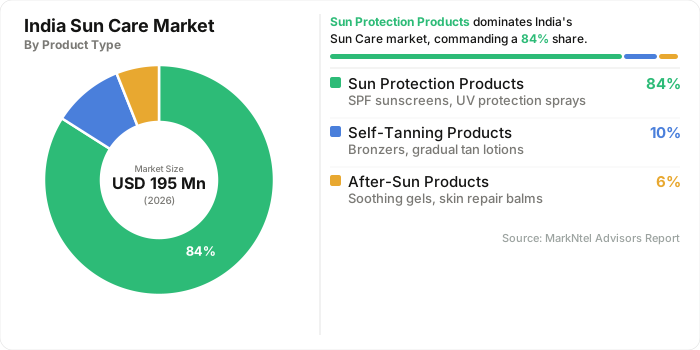
- In terms of product segmentation, sun protection products represent the dominant category, contributing approximately 84% of the overall market revenue.
- Based on product form, lotion and cream-based formulations lead the segment, accounting for nearly 58% share.
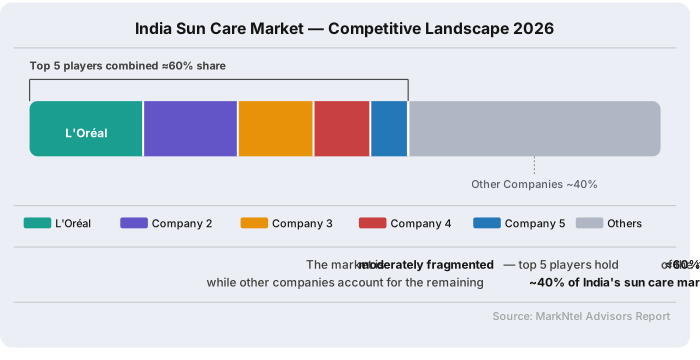
- From a competitive standpoint, the industry exhibits a moderately fragmented structure, with the top five companies collectively capturing close to 60% of the total market share.
India Sun Care Market Size and Outlook
The India sun care market is projected to register a steady CAGR of 12.48% during the forecast period. This growth momentum is increasingly supported by rising awareness of UV protection cosmetics in India, as sunscreen adoption evolves from occasional usage to a daily skincare essential, particularly among younger demographics and working professionals.
A key structural driver shaping emerging trends in sun care industry is the strengthening regulatory framework. The Bureau of Indian Standards introduced IS 17494:2025, marking India’s first standardized in-vivo SPF testing protocol aligned with ISO 24444. The regulation mandates a minimum UVA-to-SPF ratio of one-third along with a critical wavelength benchmark of 370 nanometres, ensuring consistency in broad-spectrum protection claims . This transition toward scientifically validated labeling enhances transparency, compels brands to upgrade formulation standards, and significantly strengthens consumer confidence, thereby improving repeat purchase behavior and long-term category penetration.
In parallel, the rapid expansion of domestic tourism was experienced as the country recorded 2,948.19 million domestic tourist visits in 2024. Government initiatives such as Dekho Apna Desh and SWADESH 2.0, backed by approximately USD 840 million in infrastructure investments , are encouraging travel and outdoor activities. This increased exposure to sunlight is directly supporting water-resistant sunscreen demand, particularly in high-temperature and high-humidity environments.
India's established and emerging players are further strengthening market depth through strategic investments in product development and distribution expansion. This was evident as Hindustan Unilever Limited leverages its extensive nationwide retail network to position sun care products across both mass and premium segments . Similarly, L'Oréal India Private Limited focuses on localized R&D capabilities to develop climate-adaptive formulations suited to Indian skin types and environmental conditions.
Market participants are also advancing innovation-led strategies. Lotus Herbals’ HydroActivated Sunscreen campaign highlighted sweat-activated Hydrosome Technology, offering enhanced UV protection, hydration, and 10-hour water resistance through Edelweiss extract and advanced UV filters. Such advancements underscore the growing demand for hybrid sunscreen formulations, integrating dermatological protection with lifestyle-oriented skincare benefits.
In conclusion, regulatory progress, rising outdoor exposure, and strategic industry investments are collectively reinforcing sustained growth and premiumisation across India’s sun care industry, with the market projected to grow from USD 195 million in 2026 to USD 395 million by 2032.
India Sun Care Market Key Indicators
- India’s rapid urban expansion is reshaping consumption patterns, with the urban population reaching 534.9 million in 2024, accounting for 36.87% of the total population and growing at 2.26% annually. This demographic concentration is significantly influencing sun care demand, as metro consumers increasingly adopt daily SPF usage, particularly in cities like Delhi, Mumbai, and Bengaluru, where skincare awareness is comparatively higher.
- A strong digital shift is redefining purchasing behavior, as beauty e-commerce sales surged by 39% between June and November 2024, compared to just 3% growth in offline retail. This widening gap highlights the growing importance of online channels for sun care products in India, especially among younger consumers who rely on digital platforms for product discovery and skincare education.
- India’s expanding e-commerce ecosystem, valued at USD 125 million in 2024 and projected to reach USD 345 million by 2030 , is unlocking new growth avenues. With rising participation from tier II and III cities, this transformation is accelerating sun care industry growth in India, enabling broader access to premium and niche SPF offerings beyond metropolitan cities.
- The country’s digital user base continues to surge, with internet users reaching 886 million in 2024 and expected to cross 900 million by 2025 . This widespread connectivity is strengthening consumer awareness around UV protection skincare, as increased exposure to online content, influencer recommendations, and dermatological guidance drives informed sun care adoption nationwide.
India Sun Care Market Scope
| Category | Segments |
|---|---|
| By Product Type | Sun Protection Products, After-Sun Products, Self-Tanning Products |
| By SPF Range | Below SPF 30, SPF 30–50, Above SPF 50 |
| By Form | Lotions & Creams, Sprays, Gels, Sticks, Others |
| By Formulation | Chemical, Mineral, Hybrid |
| By Distribution Channel | Offline, Supermarkets & Hypermarkets, Pharmacies & Drug Stores, Specialty Stores, Online Retail |
India Sun Care Market Growth Drivers
Rising Awareness of UV Damage and Skin Health
The intensifying exposure to ultraviolet (UV) radiation is emerging as a critical growth catalyst for the sun care products demand in India, driven by evolving climatic conditions and rising public health awareness.
The UV Index, a globally recognized scale ranging from 0 to 11+, classifies radiation intensity, with values above 6 considered harmful and requiring consistent protective measures . In recent years, multiple regions across India have recorded persistently high to extreme UV levels, indicating a structural shift in environmental exposure patterns rather than isolated seasonal spikes.
This escalation is strongly linked to climate-driven factors such as increasing average temperatures, prolonged summer seasons, and gradual depletion of the ozone layer, all of which contribute to greater penetration of harmful UV rays. Notably, cities like Bengaluru have recorded UV Index levels as high as 13, placing them in the “extreme” risk category globally . Such conditions are significantly influencing consumer behavior, encouraging daily adoption of UV protection skincare products and accelerating demand for high-efficacy formulations within the SPF products market in India.
As awareness of UV-induced skin damage, including premature aging and pigmentation, continues to rise, consumers are increasingly prioritizing preventive skincare. These environmental and behavioral shifts are reinforcing long-term demand fundamentals and positioning sun care as an essential, year-round category within India’s evolving personal care landscape.
Recent Trends
Emergence of Multifunctional Sun Care Products
The India Sun Care Industry is witnessing a notable shift toward multifunctional formulations, reflecting evolving consumer demand for efficiency-driven skincare solutions. Urban consumers, in particular, are increasingly favoring products that combine multiple benefits into a single application, aligning with fast-paced lifestyles and a growing preference for simplified routines. This transition is strengthening the appeal of multifunctional sun care products, where sunscreen is no longer viewed as a standalone product but as an integrated skincare essential.
A key example of this trend is Pilgrim’s launch of its Vitamin C Serum Sunscreen (SPF 50+ PA++++). The product merges photoprotection with antioxidant and brightening benefits, utilizing advanced UV filters such as Uvinul T 150, Uvinul A Plus, and Tinosorb S to deliver broad-spectrum coverage against UVA, UVB, and blue light exposure . This innovation highlights the rising demand for hybrid formulations that address both environmental aggressors and digital exposure, further accelerating the adoption of anti-aging products.
Similarly, NIVEA has expanded its sun care portfolio with targeted solutions such as Shine Control SPF 50 for oil management and Sensitive SPF 50 for delicate skin types . These offerings emphasize customization and dermatological safety, reinforcing the importance of dermatologist-tested sunscreen in building consumer trust.
The convergence of sun protection with advanced skincare benefits is redefining product innovation, positioning multifunctionality as a central trend shaping the future of India’s sun care market.
India Sun Care Market Opportunities and Challenges
Limited Spending Power Creating Demand for Accessible Formats
Affordability constraints continue to pose a structural challenge to the India sun care market, limiting consistent product adoption across a large segment of the population. As per the Ministry of Statistics and Programme Implementation’s Household Consumption Expenditure Survey, the average monthly per capita consumption expenditure remains relatively low at approximately USD 49 in rural areas and USD 84 in urban regions . This relatively modest spending capacity compels households to prioritize essential goods, resulting in irregular adoption patterns for non-essential items such as sunscreen. Consequently, demand is often influenced by seasonal needs rather than consistent daily usage, reinforcing the challenge of price sensitivity among sun care products in India.
Despite this constraint, the market is witnessing the emergence of scalable solutions designed to improve accessibility and affordability. Manufacturers are increasingly introducing low-unit, single-use formats such as SPF 50 zinc-based sachets, which significantly reduce the financial barrier to entry. These compact offerings enable broader participation among cost-conscious consumers while supporting product trial and repeat usage.
Furthermore, sachet-based packaging aligns with on-the-go consumption and outdoor usage scenarios, enhancing product relevance across diverse consumer segments as income limitations continue to restrict widespread penetration, targeted pricing strategies and format innovation are unlocking new demand pockets, thereby strengthening long-term growth potential within India’s evolving sun care landscape.
Segmentation Insights
Widespread Adoption of Sun Protection Products
Sun Protection Products account for approximately 84% of total revenue in the Sun Care industry in India, underscoring their dominant position across the product landscape. This leadership is primarily driven by persistently high UV exposure levels across the country, which have transformed sunscreen usage from a seasonal requirement into a daily necessity. As a result, the category continues to anchor growth within sun protection products, supported by consistent consumer reliance on preventive skincare solutions.
The segment’s strong performance is further reinforced by the rising incidence of sun-induced skin concerns, including tanning, pigmentation, premature ageing, and sunburn. These issues have heightened consumer awareness regarding long-term skin health, encouraging the adoption of regular protection routines.
Consequently, sunscreen is increasingly integrated into everyday grooming practices, rather than being limited to outdoor or occasional usage, thereby strengthening demand within the high SPF sunscreen category.
In parallel, continuous advancements in formulation technologies have significantly enhanced product appeal and usability. Manufacturers are introducing lightweight textures, non-greasy gel formats, and serum-based solutions that cater to diverse skin types and climatic conditions.
Collectively, the dominance of sun protection products is shaped by environmental exposure, increasing skincare awareness, and sustained innovation in product development. These factors firmly position sunscreen as an indispensable component of daily personal care within India sun care industry. The scope of analysis under product type covers:
- Sun Protection Products
- After-Sun Products
- Self-Tanning Products
Lotion and Cream Lead the Consumer Preference
The Lotion & Cream segment accounts for approximately 58% of total revenue within the India sun care industry, reflecting its strong consumer preference and widespread applicability across diverse skin types and climatic conditions.
This dominance is primarily attributed to the familiarity and versatility of lotion-based formulations, which offer balanced hydration, ease of application, and effective UV protection. As a result, these formats continue to anchor demand within sunscreen lotion in India, particularly among consumers seeking reliable, daily-use sun protection solutions.
A key factor reinforcing segment leadership is the ability of creams and lotions to deliver superior skin compatibility, especially in India’s varied weather conditions, ranging from dry to humid environments. These formulations are often enriched with moisturizing agents, making them suitable for prolonged wear while preventing dryness or irritation.
Ongoing product innovation is also reshaping the segment’s value proposition. Developments such as Lakmé Sun Expert Dry Matte Fluid SPF 50++++ highlight the shift toward lightweight, emulsion-based textures that combine sun protection with skincare benefits like oil control, hydration, and enhanced skin comfort. These advancements are driving demand for multifunctional SPF moisturizer in India, particularly among urban consumers seeking non-greasy, cosmetically elegant formulations.
The product familiarity, functional versatility, and continuous innovation are sustaining the dominance of lotion and cream formats in India sun care market. The key segments mapped in the study are based on form:
- Lotions & Cream
- Gels
- Sprays
- Sticks
- Others
India Sun Care Market Competitive Analysis
The India sun care market is moderately fragmented, with a diverse mix of domestic and international players operating across multiple product formats, including lotions, creams, gels, sprays, and sticks. The market features strong participation from FMCG giants, dermatology-led brands, and emerging direct-to-consumer companies. The top five companies, including Hindustan Unilever Limited, L'Oréal India Private Limited, Nivea India Private Limited, Lotus Herbals Private Limited, and Honasa Consumer Limited collectively account for approximately 60% of the total market share.
Key Players in India Sun Care Industry
- Honasa Consumer Limited
- Lotus Herbals Private Limited
- Hindustan Unilever Limited
- VLCC Personal Care Limited
- L'Oréal India Private Limited
- Nivea India Private Limited
- Johnson & Johnson Private Limited
- NAOS Skin Care India Private Limited
- Zydus Wellness Limited
- Amway India Enterprises Private Limited
- Others
India Sun Care Industry News and Recent Developments
March 2026 – Dot & Key Launches Dragon Fruit Bounce Sunscreen SPF 50+
In March 2026, Dot & Key launched its Dragon Fruit Bounce Sunscreen SPF 50+ PA++++ in India. The product features in-vivo tested UV protection, lightweight gel texture, and advanced photostable filters designed for Indian climate conditions and daily use skincare routines.
Impact Analysis: This launch strengthens India’s D2C sunscreen innovation ecosystem by introducing clinically validated UV protection. It increases competition in the premium skincare SPF segment and reinforces the shift toward dermatology-backed, science-driven sunscreen formulations.
February 2026 – Deconstruct Enhances Gel Sunscreen Formula
Deconstruct, an Indian science-led skincare brand, upgraded its Gel Sunscreen by incorporating four new-generation photostable UV filters (Tinosorb S, Tinosorb M, Uvinul A Plus, Uvinul T 150). The reformulation improves broad-spectrum UVA/UVB protection and long-term photostability while retaining a lightweight gel texture suited for Indian weather conditions.
Impact Analysis: This reformulation strengthens India’s growing D2C skincare-led sunscreen segment by introducing advanced photostable UV filters that improve long-lasting protection in harsh Indian climates. It increases competitive pressure on both FMCG and premium dermatology brands by emphasizing science-backed transparency and ingredient innovation.
April 2025 – Supergoop! Launches in India via Nykaa
US-based skincare brand Supergoop! officially entered the Indian market through an exclusive partnership with Nykaa. The brand launched a range of daily-use sunscreens including Unseen Sunscreen, Glowscreen, and Mineral Mattescreen, designed for lightweight, non-greasy, and invisible UV protection suited for everyday use.
Impact Analysis: This launch marked a major shift in India’s sun care market by introducing global “daily sunscreen culture” to Indian consumers. It strengthened the premium SPF segment and increased awareness of sunscreen as an everyday skincare essential rather than seasonal protection.
- Market Segmentation
- Introduction
- Product Definition
- Research Process
- Assumptions
- Executive Summary
- India Sun Care Market Policies, Regulations, and Product Standards
- India Sun Care Production Trend 2022-2032
- India Sun Care Production Trend by Product Type
- Sun Protection Products
- After-Sun Products
- Self-Tanning Products
- Company Wise Production Plants and Statistics
- Installed Production Capacity
- Actual Production
- Planned Production Target
- India Sun Care Production Trend by Product Type
- India Sun Care Pricing Analysis 2022-2032
- India Sun Care Pricing Trend 2022-2032
- India Sun Care Production Trend by Product Type
- Sun Protection Products
- After-Sun Products
- Self-Tanning Products
- India Sun Care Market Dynamics
- Growth Factors
- Challenges
- India Sun Care Market Hotspot & Opportunities
- India Sun Care Market Outlook, 2022-2032F
- Market Size & Outlook
- By Revenues (USD Million)
- Market Share & Outlook
- By Product Type- Market Size & Forecast 2022-2032, USD Million
- Sun Protection Products
- After-Sun Products
- Self-Tanning Products
- By SPF Range- Market Size & Forecast 2022-2032, USD Million
- Below SPF 30
- SPF 30–50
- Above SPF 50
- By Form- Market Size & Forecast 2022-2032, USD Million
- Lotions & Creams
- Sprays
- Gels
- Sticks
- Others
- By Formulation- Market Size & Forecast 2022-2032, USD Million
- Chemical
- Mineral
- Hybrid
- By Distribution Channel- Market Size & Forecast 2022-2032, USD Million
- Offline
- Supermarkets & Hypermarkets
- Pharmacies & Drug Stores
- Specialty Stores
- Online Retail
- By Region- Market Size & Forecast 2022-2032, USD Million
- North
- South
- East
- West
- By Company
- Competition Characteristics
- Market Share & Analysis
- By Product Type- Market Size & Forecast 2022-2032, USD Million
- Market Size & Outlook
- India Sun Protection Products Market Outlook, 2022-2032
- Market Size & Outlook
- By Revenues (USD Million)
- Market Share & Outlook
- By SPF Range- Market Size & Forecast 2022-2032, USD Million
- By Form- Market Size & Forecast 2022-2032, USD Million
- By Formulation- Market Size & Forecast 2022-2032, USD Million
- By Distribution Channel- Market Size & Forecast 2022-2032, USD Million
- By Region- Market Size & Forecast 2022-2032, USD Million
- Market Size & Outlook
- India After-Sun Products Market Outlook, 2022-2032
- Market Size & Outlook
- By Revenues (USD Million)
- Market Share & Outlook
- By SPF Range- Market Size & Forecast 2022-2032, USD Million
- By Form- Market Size & Forecast 2022-2032, USD Million
- By Formulation- Market Size & Forecast 2022-2032, USD Million
- By Distribution Channel- Market Size & Forecast 2022-2032, USD Million
- By Region- Market Size & Forecast 2022-2032, USD Million
- Market Size & Outlook
- India Self-Tanning Products Market Outlook, 2022-2032
- Market Size & Outlook
- By Revenues (USD Million)
- Market Share & Outlook
- By SPF Range- Market Size & Forecast 2022-2032, USD Million
- By Form- Market Size & Forecast 2022-2032, USD Million
- By Formulation- Market Size & Forecast 2022-2032, USD Million
- By Distribution Channel- Market Size & Forecast 2022-2032, USD Million
- By Region- Market Size & Forecast 2022-2032, USD Million
- Market Size & Outlook
- India Sun Care Market Key Strategic Imperatives for Success & Growth
- Competitive Outlook
- Company Profiles
- Honasa Consumer Limited
- Business Description
- Product Portfolio
- Collaborations & Alliances
- Recent Developments
- Financial Details
- Others
- Lotus Herbals Private Limited
- Business Description
- Product Portfolio
- Collaborations & Alliances
- Recent Developments
- Financial Details
- Others
- Hindustan Unilever Limited
- Business Description
- Product Portfolio
- Collaborations & Alliances
- Recent Developments
- Financial Details
- Others
- VLCC Personal Care Limited
- Business Description
- Product Portfolio
- Collaborations & Alliances
- Recent Developments
- Financial Details
- Others
- L'Oréal India Private Limited
- Business Description
- Product Portfolio
- Collaborations & Alliances
- Recent Developments
- Financial Details
- Others
- Nivea India Private Limited
- Business Description
- Product Portfolio
- Collaborations & Alliances
- Recent Developments
- Financial Details
- Others
- Johnson & Johnson Private Limited
- Business Description
- Product Portfolio
- Collaborations & Alliances
- Recent Developments
- Financial Details
- Others
- NAOS Skin Care India Private Limited
- Business Description
- Product Portfolio
- Collaborations & Alliances
- Recent Developments
- Financial Details
- Others
- Zydus Wellness Limited
- Business Description
- Product Portfolio
- Collaborations & Alliances
- Recent Developments
- Financial Details
- Others
- Amway India Enterprises Private Limited
- Business Description
- Product Portfolio
- Collaborations & Alliances
- Recent Developments
- Financial Details
- Others
- Others
- Honasa Consumer Limited
- Company Profiles
- Disclaimer

MarkNtel Advisors follows a robust and iterative research methodology designed to ensure maximum accuracy and minimize deviation in market estimates and forecasts. Our approach combines both bottom-up and top-down techniques to effectively segment and quantify various aspects of the market. A consistent feature across all our research reports is data triangulation, which examines the market from three distinct perspectives to validate findings. Key components of our research process include:
1. Scope & Research Design At the outset, MarkNtel Advisors define the research objectives and formulate pertinent questions. This phase involves determining the type of research—qualitative or quantitative—and designing a methodology that outlines data collection methods, target demographics, and analytical tools. They also establish timelines and budgets to ensure the research aligns with client goals.
2. Sample Selection and Data Collection In this stage, the firm identifies the target audience and determines the appropriate sample size to ensure representativeness. They employ various sampling methods, such as random or stratified sampling, based on the research objectives. Data collection is carried out using tools like surveys, interviews, and observations, ensuring the gathered data is reliable and relevant.
3. Data Analysis and Validation Once data is collected, MarkNtel Advisors undertake a rigorous analysis process. This includes cleaning the data to remove inconsistencies, employing statistical software for quantitative analysis, and thematic analysis for qualitative data. Validation steps are taken to ensure the accuracy and reliability of the findings, minimizing biases and errors.

4. Data Forecast and FinalizationThe final phase involves forecasting future market trends based on the analyzed data. MarkNtel Advisors utilize predictive modeling and time series analysis to anticipate market behaviors. The insights are then compiled into comprehensive reports, featuring visual aids like charts and graphs, and include strategic recommendations to inform client decision-making
We offer flexible licensing options to cater to varying organizational needs. Choose the pricing pack that best suits your requirements:
Buy Now Inquire Before Buying
 Request Customization