

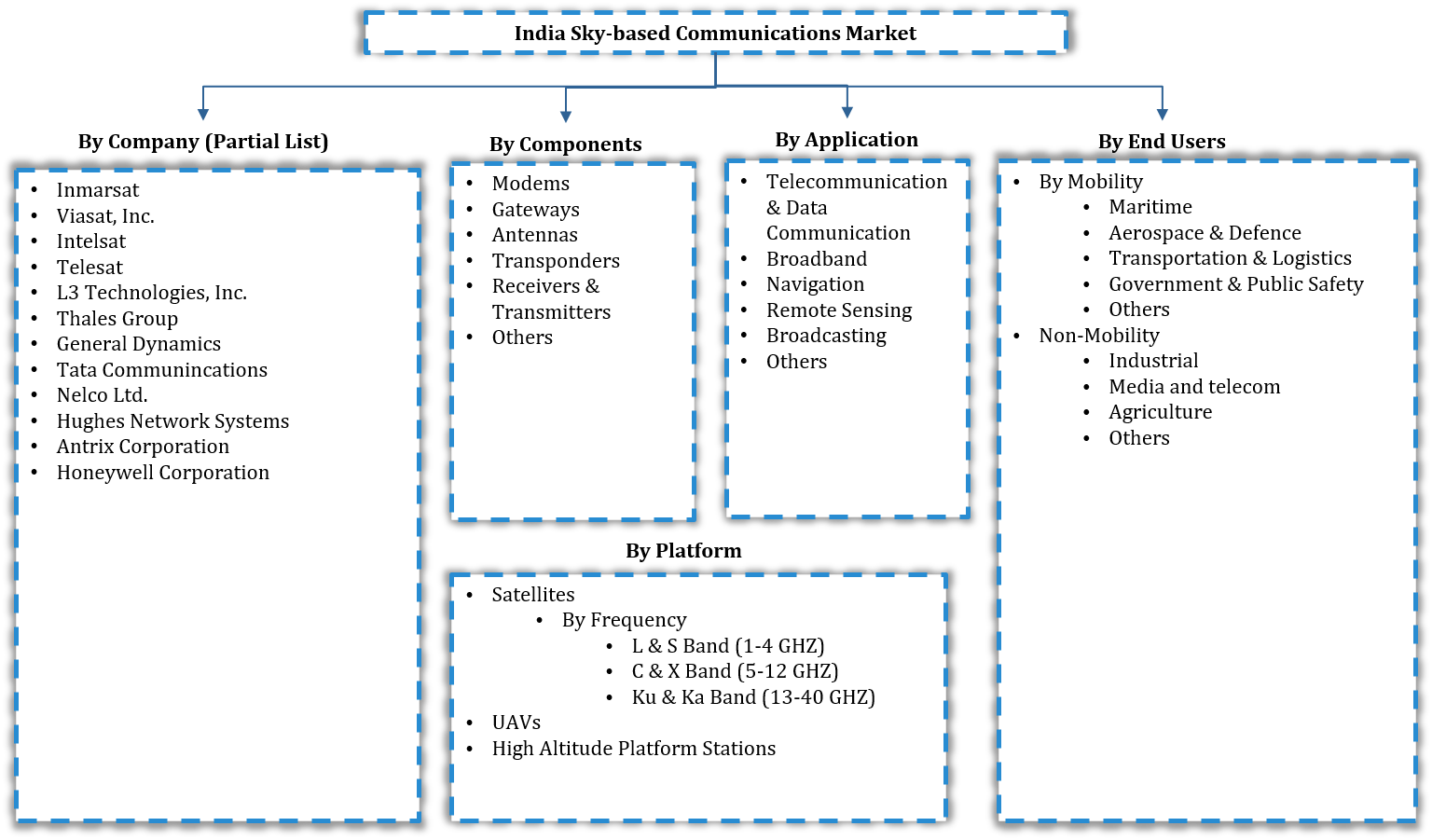
By Component (Modems, Gateways, Antennas, Transponders, Receivers & Transmitters, Others), By Application (Telecommunication & Data Communication, Broadband, Navigation, Remote Sensing, Broadcasting,... ... sing, Broadcasting, Others), By Platform (Satellites (By Frequency (L & S Band (1-4 GHz), C & X Band (5-12 GHz), Ku & Ka-Band (13-40 GHz)), UAVs, High Altitude Platform Stations), By End-User (By Mobility, Maritime, Aerospace & Defense, Transportation & Logistics, Government & Public Safety, Others), Non-Mobility (Media & Telecom, Enterprises (Banks, Petrol Pumps, etc.), Agriculture, Others)), By Competitors (Honeywell Corporation, Inmarsat, Iridium Communications Inc., Viasat, Inc., Intelsat, Telesat, L3 Technologies, Inc., Thales Group, General Dynamics, Dhruva Space, Tata Communications Ltd., Hughes Communications India Pvt. Ltd., Antrix Corporation Ltd.) Read more
- Aerospace & Defense
- Dec 2021
- 101
- PDF, Excel, PPT
Market Overview
Sky-based communication systems & devices have been widespread extensively across India for different applications like navigation, broadcasting, telecommunication, monitoring & surveillance, etc. The technology has matured substantially over the past few decades and has gained traction across commercial use for numerous applications. These systems are used principally for data transfer across various devices through different transmission signals like audio, video, data, telemetry, etc.
According to MarkNtel Advisors, the India Sky Based Communication Market is projected to grow at a CAGR of around 27% during 2021-26. The market is driven primarily by the rapid adoption of technologies like Artificial Intelligence (AI) & the Internet of Things (IoT) in satellite communication, the increasing number of satellite launches for communication, and the escalating demand for services like maritime broadband, inflight connectivity, etc.
Besides, the country's exponentially growing population is indicating a massive consumer base for digital communication services & products and has demonstrated an immense change in terms of the application of sky-based communication systems for real-time data processing & improving scalability across India, further states the research report, “India Sky Based Communication Market Analysis, 2021.”
| Report Coverage | Details |
|---|---|
| Study Period | Historical Data: 2016-19 |
| Base Year: 2020 | |
| Forecast Period: 2021-26 | |
| CAGR(2021-26) | 27% |
| Regions Covered | Middle East & Africa: Saudi Arabia, UAE, Israel, Iran, Egypt, South Africa, Turkey |
| Key Companies Profiled | Inmarsat, Viasat, Inc., Intelsat, Telesat, L3 Technologies, Inc., Thales Group, General Dynamics, Tata Communincations, Nelco Ltd., Hughes Network Systems, Antrix Corporation, Honeywell Corporation |
| Unit Denominations | USD Million/Billion |
Covid-19 had a Two-Fold Impact on the India Sky Based Communication Market
With the emergence of the Covid-19 pandemic, almost all types of industries in India underwent a decelerating effect. However, the India Sky-based Communication market witnesses a dual impact of the crisis. Initially, the government responded to the growing cases of Covid-19 by imposing stringent movement restrictions & lockdowns to curb the virus spread.
Consequently, with industries shut and hampered supply chains, the market witnessed significant financial losses. Besides, since the government restricted public gatherings, research & development activities couldn't happen to bring innovations in the satellite technology, which displayed a temporary halt on the industry.
Moreover, the same aspect also sheds some benefits to the market. While the imposition of lockdown compelled most companies to adopt remote working, the demand for secured communication channels across diverse locations spurred the requirement for sky-based communication services, resulting in market growth amidst the crisis.
- Introduction
- Product Definition
- Research Process
- Assumptions
- Market Segmentation
- Executive Summary
- Impact of COVID-19 on India Sky Based Communication Market Analysis
- Impact of IOT on India Sky Based Communication Market
- India Sky Based Communication Market Outlook, 2016-2026F
- Market Size & Analysis
- By Revenues
- Market Share & Analysis
- Application
- Telecommunication
- Broadband
- Navigation
- Remote Sensing
- Broadcasting
- Data Communication
- Others
- By Platforms
- Satellites
- By Frequency
- L & S Band (1-4 GHZ)
- C & X Band (5-12 GHZ)
- Ku & Ka Band (13-40 GHZ)
- By Frequency
- UAVs
- High Altitude Platform Stations
- Satellites
- By Components
- Modems
- Gateways
- Antennas
- Transponders
- Receivers & Transmitters
- Others
- By End Users
- Mobility
- Maritime
- Aerospace & Defence
- Transportation & Logistics
- Government & Public Safety
- Others
- Non-Mobility
- Industrial
- Media & Telecom
- Agriculture
- Others
- Mobility
- By Competitor
- Competition Characteristics
- Market Share
- Competitor Alignment in Competition Metrix
- Application
- Market Size & Analysis
- India Sky Based Communication Market Analysis Dynamics
- Growth Drivers
- Challenges
- Impact Analysis
- India Sky Based Communication Market Analysis Trends & Insights
- India Sky Based Communication Market Analysis Hotspots & Opportunities
- India Sky Based Communication Market Analysis Regulations
- Competitive Benchmarking
- Competition Matrix
- Product Portfolio
- Target Markets
- Target End Users
- Research & Development
- Strategic Alliances
- Strategic Initiatives
- Company Profiles (Business Description, Product Offering, Target Markets, Assets, Strategic Alliances or Partnerships, etc.)
- Inmarsat
- Viasat, Inc.
- Intelsat
- Telesat
- L3 Technologies, Inc.
- Thales Group
- General Dynamics
- Tata Communincations
- Nelco Ltd.
- Hughes Network Systems
- Antrix Corporation
- Honeywell Corporation
- Disclaimer
- Competition Matrix
MarkNtel Advisors follows a robust and iterative research methodology designed to ensure maximum accuracy and minimize deviation in market estimates and forecasts. Our approach combines both bottom-up and top-down techniques to effectively segment and quantify various aspects of the market. A consistent feature across all our research reports is data triangulation, which examines the market from three distinct perspectives to validate findings. Key components of our research process include:
1. Scope & Research Design At the outset, MarkNtel Advisors define the research objectives and formulate pertinent questions. This phase involves determining the type of research—qualitative or quantitative—and designing a methodology that outlines data collection methods, target demographics, and analytical tools. They also establish timelines and budgets to ensure the research aligns with client goals.
2. Sample Selection and Data Collection In this stage, the firm identifies the target audience and determines the appropriate sample size to ensure representativeness. They employ various sampling methods, such as random or stratified sampling, based on the research objectives. Data collection is carried out using tools like surveys, interviews, and observations, ensuring the gathered data is reliable and relevant.
3. Data Analysis and Validation Once data is collected, MarkNtel Advisors undertake a rigorous analysis process. This includes cleaning the data to remove inconsistencies, employing statistical software for quantitative analysis, and thematic analysis for qualitative data. Validation steps are taken to ensure the accuracy and reliability of the findings, minimizing biases and errors.

4. Data Forecast and FinalizationThe final phase involves forecasting future market trends based on the analyzed data. MarkNtel Advisors utilize predictive modeling and time series analysis to anticipate market behaviors. The insights are then compiled into comprehensive reports, featuring visual aids like charts and graphs, and include strategic recommendations to inform client decision-making
We offer flexible licensing options to cater to varying organizational needs. Choose the pricing pack that best suits your requirements:
Buy Now Inquire Before Buying
 Request Customization