

5G Satellite Communication Market - By Solutions (Backhaul and Tower Feed, Trunking and Head End Feed, Communication-On-the-Move, Hybrid Multiplay), By Orbit ((Geosynchronous Earth Orbit (Large, Heavy... ... Orbit (Large, Heavy, Extra Heavy), Medium Earth Orbit (Medium,Intermediate), Low Earth Orbit (Small, Mini, Pico, Nano, Micro) Others)), By End Users ((Defense & Government, Aviation, Transportation & Logistics, Consumer Electronics, Heavy Industries (Construction & Mining), Energy & Utilities (Oil & Gas, Utilities (Smart Grid)), Others (Smart Cities, Banking & Retail, Healthcare, Media & Entertainment)),and others. Read more
- ICT & Electronics
- Sep 2025
- 196
- PDF, Excel, PPT
Market Insights & Analysis: Global 5G Satellite Communication Market (2025-30):
The Global 5G Satellite Communication Market size is valued at around USD 5.05 billion in 2025 and is projected to reach USD 10.18 billion by 2030. Along with this, the market is estimated to grow at a CAGR of around 15.05% during the forecast period, i.e., 2025-30. The major factor driving market growth is high-speed connectivity, low latency, and seamless connectivity coverage across a wider geographic area. One key driver is the overwhelming growth of data-intensive applications such as autonomous vehicles, smart cities, and IoT ecosystems that require seamless high-speed connectivity in both urban and remote environments. Traditional Terrestrial networks, which often face coverage issues, are thus driving demand for satellite-based 5G solutions to enable greater connectivity.
Moreover, the growing deployment of low Earth orbit (LEO) satellite constellations by companies such as SpaceX and OneWeb provides a way to decrease latency and increase bandwidth, which will be helpful for real-time applications for 5G satellite communications. For instance, SpaceX's Starlink has already demonstrated internet connectivity rates above 100 Mbps in underserved areas, showcasing the transformative nature of the technology.
Furthermore, rising demand for continuous connectivity in the maritime, aviation, and defense sectors. airlines are deploying satellite-supported 5G networks to provide full connectivity during flights, while defense organizations are using this technology for machine-to-machine communications and high-speed communications in rugged environments. This demonstrates a shift towards mission-critical applications needing low-latency, high-reliability networks. In addition, the COVID-19 pandemic further increased the need for connectivity in distant and rural areas. Travel restrictions, social distancing, and the shift to study/work from home all reinforced the urgent move to provide increasingly faster and higher virtual connectivity in the transnational and rural areas of the world.
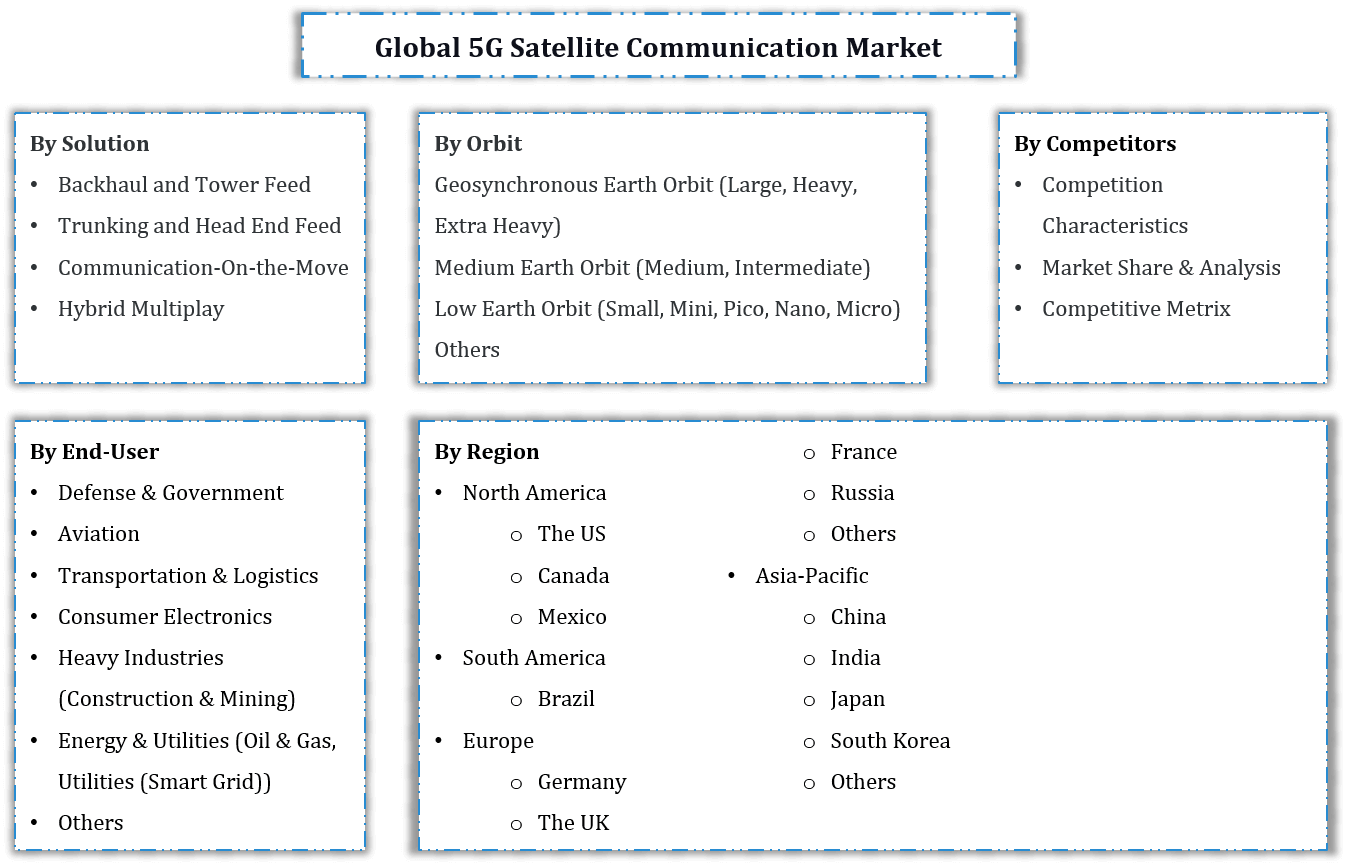
Global 5G Satellite Communication Market Scope:
| Category | Segments |
|---|---|
| By Solutions | Backhaul and Tower Feed, Trunking and Head End Feed, Communication-On-the-Move, Hybrid Multiplay |
| By Orbit | Geosynchronous Earth Orbit (Large, Heavy, Extra Heavy), Medium Earth Orbit (Medium,Intermediate), Low Earth Orbit (Small, Mini, Pico, Nano, Micro) Others |
| By End Users | Defense & Government, Aviation, Transportation & Logistics, Consumer Electronics, Heavy Industries (Construction & Mining), Energy & Utilities (Oil & Gas, Utilities (Smart Grid)), Others (Smart Cities, Banking & Retail, Healthcare, Media & Entertainment |
Global 5G Satellite Communication Market Driver:
Rising Demand for High-Speed & Reliable Global Connectivity – The worldwide 5G satellite communication industry expands because remote areas need fast internet access with minimal delays, while traditional network expansion remains economically unfeasible. The increasing deployment of data-intensive technologies, including autonomous vehicles, telemedicine systems, and IoT-enabled infrastructure, will drive up bandwidth needs and network stability requirements across all areas, including those with poor connectivity. Satellite-based 5G networks serve as the only solution for these applications because they provide both real-time data transmission and continuous network connectivity.
For instance, the aviation and maritime industries rely on satellite-based 5G technology to maintain communication, which extends past the range of traditional terrestrial networks. SpaceX Starlink, along with other companies, continues to launch LEO satellite constellations, which reduces latency and expands network capacity to create worldwide high-speed internet availability. Moreover, Telecom operators together with satellite manufacturers and service providers need to develop satellite-based 5G solutions because these technologies will help them discover new market opportunities and deliver superior services while reaching customers in areas that used to lack network access.
- Introduction
- Product Definition
- Research Process
- Assumptions
- Market Segmentation
- Preface
- Executive Summary
- Impact of COVID-19 on 5G Satellite Communication Market
- Global 5G Satellite Communication Evolution
- Global 5G Satellite Communication Technology Timeline
- Global 5G Satellite Communication Roll out Models & Roll Out Timeline
- Global 5G Satellite Communication Market Dynamics
- Drivers
- Challenges
- Impact Analysis
- Global 5G Satellite Communication Opportunity & Hotspots
- Global 5G Satellite Communication Value Chain Analysis
- Global 5G Satellite Communication Trends & Insights
- Global 5G Satellite Communication Policies and Regulatory Landscape
- Global 5G Satellite Communication Technology Intellectual Property Rights Analysis
- Global 5G Satellite Communication Market, 2020-2030F
- Market Size & Analysis
- By Revenues
- Market Share & Analysis
- By Solutions
- Backhaul and Tower Feed
- Trunking and Head End Feed
- Communication-On-the-Move
- Hybrid Multiplay
- By Orbit
- Geosynchronous Earth Orbit (Large, Heavy, Extra Heavy)
- Medium Earth Orbit (Medium,Intermediate)
- Low Earth Orbit (Small, Mini, Pico, Nano, Micro)
- Others
- By End Users
- Defense & Government
- Aviation
- Transportation & Logistics
- Consumer Electronics
- Heavy Industries (Construction & Mining)
- Energy & Utilities (Oil & Gas, Utilities (Smart Grid))
- Others (Smart Cities, Banking & Retail, Healthcare, Media & Entertainment)
- By Region
- Asia-Pacific
- North America
- Europe
- Rest-of-the-World
- By Competition
- Key Alliances
- By Solutions
- Market Size & Analysis
- North America 5G Satellite Communication Market, 2020-2030F
- Market Size & Analysis
- By Revenues
- Market Share & Analysis
- By Country
- The US
- Canada
- Mexico
- By Country
- Market Size & Analysis
- Europe 5G Satellite Communication Market, 2020-2030F
- Market Size & Analysis
- By Revenues
- Market Share & Analysis
- By Country
- The UK
- Germany
- France
- Russia
- Rest of Europe
- By Country
- Market Size & Analysis
- Asia Pacific 5G Satellite Communication Market, 2020-2030F
- Market Size & Analysis
- By Revenues
- Market Share & Analysis
- By Country
- China
- Japan
- South Korea
- India
- Rest of Asia Pacific
- By Country
- Market Size & Analysis
- Company Profiles
- Airbus SAS
- Avanti Communication Group PLC
- Eutelsat SA
- Gomspace A/S
- Gilat Satellite Networks
- Quortus
- OHB SE
- Space Exploration Technologies Corporation
- The Boeing Company
- Thales Group
- Others
- Disclaimer
MarkNtel Advisors follows a robust and iterative research methodology designed to ensure maximum accuracy and minimize deviation in market estimates and forecasts. Our approach combines both bottom-up and top-down techniques to effectively segment and quantify various aspects of the market. A consistent feature across all our research reports is data triangulation, which examines the market from three distinct perspectives to validate findings. Key components of our research process include:
1. Scope & Research Design At the outset, MarkNtel Advisors define the research objectives and formulate pertinent questions. This phase involves determining the type of research—qualitative or quantitative—and designing a methodology that outlines data collection methods, target demographics, and analytical tools. They also establish timelines and budgets to ensure the research aligns with client goals.
2. Sample Selection and Data Collection In this stage, the firm identifies the target audience and determines the appropriate sample size to ensure representativeness. They employ various sampling methods, such as random or stratified sampling, based on the research objectives. Data collection is carried out using tools like surveys, interviews, and observations, ensuring the gathered data is reliable and relevant.
3. Data Analysis and Validation Once data is collected, MarkNtel Advisors undertake a rigorous analysis process. This includes cleaning the data to remove inconsistencies, employing statistical software for quantitative analysis, and thematic analysis for qualitative data. Validation steps are taken to ensure the accuracy and reliability of the findings, minimizing biases and errors.

4. Data Forecast and FinalizationThe final phase involves forecasting future market trends based on the analyzed data. MarkNtel Advisors utilize predictive modeling and time series analysis to anticipate market behaviors. The insights are then compiled into comprehensive reports, featuring visual aids like charts and graphs, and include strategic recommendations to inform client decision-making
We offer flexible licensing options to cater to varying organizational needs. Choose the pricing pack that best suits your requirements:
Buy Now Inquire Before Buying
 Request Customization