

By Type (Controllers, Gamepads/Joysticks, Headsets, Gaming Keyboards, Gaming Mice, Virtual Reality Equipment, Gaming Chairs, Gaming Monitors), By Platform (PC, Console, Mobile, Virtual Reality, Augmen... ... tual Reality, Augmented Reality), By Usage (Casual Gaming, Professional Gaming, Streaming), By Power Source (Battery-powered, USB-powered, Rechargeable Hybrid), By Connectivity Type (Wired Accessories, Wireless Accessories, Bluetooth-enabled Devices), By Distribution Channel (Online Retail, Offline Retail, Direct Selling, E-commerce Platforms), By End Userc (Individual Consumers, Gaming Cafés / Esports Arenas, Content Creators / Streamers, Educational Institutions), and others Read more
- FMCG
- May 2026
- 240
- PDF, Excel, PPT
Asia Pacific Gaming Accessories Market Report Key Takeaways
- The Asia Pacific gaming accessories market was valued at USD 1.60 billion in 2025 and is projected to grow from USD 1.89 billion in 2026 to USD 3.34 billion by 2032, exhibiting a CAGR of 9.95% during 2026–2032.
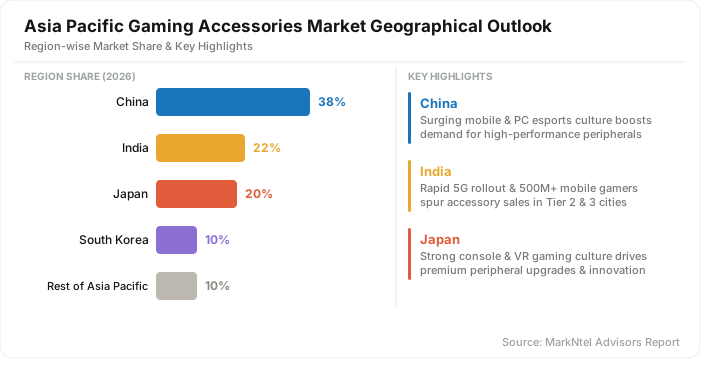
- China leads the market, accounting for approximately 38% of regional revenue, driven by the world’s largest gaming population and a well-established esports ecosystem comprising professional leagues, dedicated arenas, and regulated content frameworks.
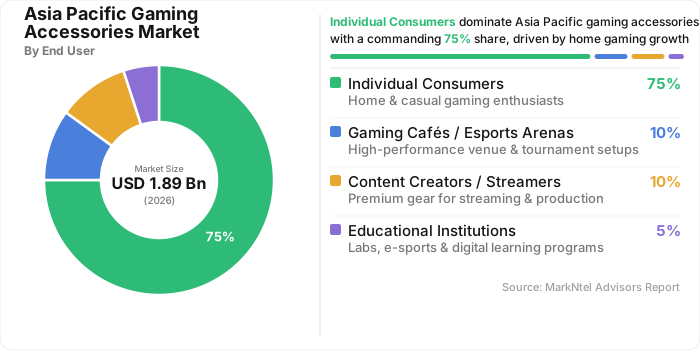
- By end user, individual consumers represent the dominant segment, holding approximately 75% of the market share, reflecting the mass-market demand for gaming accessories across PC, console, and mobile gaming platforms in the region.
- By platform, PC gaming accounts for around 38% share, maintaining its lead over console and mobile segments due to strong esports-driven demand for high-performance peripherals such as mechanical keyboards, high-DPI gaming mice, and precision headsets across key markets including South Korea, China, and Japan.
- The industry is moderately consolidated, with leading players such as ASUSTeK Computer Inc., Razer Inc., Sony Interactive Entertainment, Nintendo Co., Ltd., and Lenovo Group Ltd. competing across performance, pricing, and platform compatibility. Collectively, these companies account for an estimated 70% share of the market.
Asia Pacific Gaming Accessories Market Size and Outlook
The Asia Pacific gaming accessories market is projected to grow at a CAGR of approximately 9.95% during 2026–2032, reflecting sustained expansion driven by the rapid evolution of the region’s gaming ecosystem. This growth is primarily supported by the rising gamer base across countries such as China, India, and South Korea, where increasing internet penetration and mobile accessibility are expanding user participation.
Additionally, the strong development of esports infrastructure and competitive gaming ecosystems is driving demand for high-performance peripherals such as mechanical keyboards, gaming mice, and headsets. Increasing engagement across PC, console, and mobile platforms, coupled with higher spending on immersive gaming experiences, is further accelerating the growth of the gaming accessories market from USD 1.89 billion in 2026 to USD 3.34 billion by 2032.
According to Government of India data released via the Press Information Bureau under the AVGC sector framework the India’s online gaming sector is valued at USD 2.8 billion in 2024 and projected to reach USD 4 billion by 2027. As gaming revenues expand across mobile and PC segments, users increasingly invest in performance-enhancing peripherals such as headsets, controllers, and keyboards, translating content growth directly into accessories demand at the residential level.
A similar policy-driven ecosystem expansion is visible in South Korea, where Ministry of Culture, Sports and Tourism continues to scale institutional support for gaming. The USD 0.046 billion 2024 game industry budget and the USD 1.18 billion 2026 content allocation are not isolated investments but part of a broader strategy to strengthen esports infrastructure, global content exports, and professional gaming ecosystems. This institutional build-out increases high-intensity usage environments such as esports arenas and training facilities, where demand shifts toward premium, high-performance accessories, creating a strong commercial and institutional demand layer alongside consumer spending.
China reinforces the supply-side dimension of this ecosystem, where regulatory normalization is restoring content pipelines at scale. The National Press and Publication Administration approved 1,771 game titles in 2025, an increase over 2024 when 1400 games were approved, signaling a return to steady content flow after earlier restrictions. Each new game release sustains active player engagement cycles, increasing device usage frequency and accelerating replacement cycles for peripherals such as mice, controllers, and VR-compatible equipment. This creates a continuous hardware refresh loop, particularly in the world’s largest gaming user base, reinforcing volume-driven accessories consumption.
India’s regulatory formalization and digital connectivity expansion further complete the demand chain by widening the user funnel. The Promotion and Regulation of Online Gaming Act (August 2025) formally recognized esports as an economic activity, while Telecom Regulatory Authority of India reported 1028.61 million internet subscribers as of June 2025. This simultaneous expansion of regulatory clarity and user connectivity ensures a steady influx of new gamers, where first-time hardware adoption and subsequent accessory upgrades collectively sustain long-term market growth across the Asia Pacific.
Asia Pacific Gaming Accessories Industry Key Indicators
- According to the International Telecommunication Union (ITU), internet use across Asia Pacific reached 77% of the regional population in 2025, up from 71% in 2024, this rapid connectivity expansion extends the active online gaming base across China, India, and Southeast Asia, directly widening the consumer pool for gaming headsets, controllers, keyboards, and other peripherals that require a stable internet connection to deliver full functionality.
- According to the GSMA, mobile operators across the Asia Pacific committed USD 220 billion to 5G network deployments between 2019 and 2024, with an additional USD 254 billion pledged through 2030. This sustained infrastructure investment removes the connectivity barrier to real-time competitive gameplay, expanding the viable addressable market for latency-sensitive gaming peripherals in previously underserved markets across South and Southeast Asia.
- Indonesia’s Presidential Regulation No. 19 of 2024, issued on 12 February 2024, establishes a national roadmap to accelerate the development of the gaming industry, including the formation of an inter-ministerial coordination team to support ecosystem growth and investment. The policy reflects the government’s strategic intent to expand a domestic gaming market.
- According to the United Nations, more than 60% of the world's youth population resides in Asia Pacific as the primary demographic for gaming hardware purchases, this concentrated youth base sustains high-volume and repeat demand cycles for accessories spanning entry-level mobile controllers and earbuds to premium mechanical keyboards and high-refresh gaming monitors.
Asia Pacific Gaming Accessories Market Scope
| Category | Segments |
|---|---|
| By Type | Controllers, Gamepads/Joysticks, Headsets, Gaming Keyboards, Gaming Mice, Virtual Reality Equipment, Gaming Chairs, Gaming Monitors |
| By Platform | PC, Console, Mobile, Virtual Reality, Augmented Reality |
| By Usage | Casual Gaming, Professional Gaming, Streaming |
| By Power Source | Battery-powered, USB-powered, Rechargeable Hybrid |
| By Connectivity Type | Wired Accessories, Wireless Accessories, Bluetooth-enabled Devices |
| By Distribution Channel | Online Retail, Offline Retail, Direct Selling, E-commerce Platforms |
| By End Userc | Individual Consumers, Gaming Cafés / Esports Arenas, Content Creators / Streamers, Educational Institutions |
Asia Pacific Gaming Accessories Industry Growth Drivers
Esports and Competitive Gaming Ecosystem Expansion Driving Sustained Hardware Demand
The expansion of the esports and competitive gaming ecosystem is the most structurally significant driver of the Asia Pacific esports ecosystem, supported by formal recognition and policy integration. The Olympic Council of Asia confirmed esports as a medal event for the 2026 Asian Games, institutionalizing competitive gaming within mainstream sports. In India, the Ministry of Youth Affairs and Sports formally recognized esports under multi-sport governance frameworks in 2025, legitimizing professional participation. These policy-driven developments are expanding the base of competitive gamers, creating sustained demand for high-performance peripherals required in structured tournament environments.
This ecosystem growth is measurably increasing demand through rising participation enabled by digital infrastructure. In addition, the region recorded over 1.65 billion hours of esports content watched in 2025, reflecting sustained engagement across tournaments and leagues, directly driving the need for high-performance peripherals. Simultaneously, the Ministry of Culture, Sports and Tourism continues public investment in esports arenas and training programs, strengthening both grassroots and elite-level competition.
For instance, the Korean Sport & Olympic Committee launched a national working group in 2026 to prepare for the Olympic Esports Games, involving ministries, academia, and industry stakeholders, reflecting policy -level investment in governance, talent systems, and international competitiveness rather than just infrastructure. As organized tournaments and online multiplayer formats scale, gamers increasingly require precision-driven accessories such as mechanical keyboards, high-DPI mice, and low-latency headsets, directly translating ecosystem expansion into higher hardware consumption.
Recent Trends
Integration of Artificial Intelligence into Gaming Accessories
The incorporation of artificial intelligence into gaming peripherals has accelerated as manufacturers respond to rising demand for precision and adaptive performance. Companies such as Razer have introduced concepts such as Project Motoko, an AI-powered wireless headphone that integrates real-time environmental sensing with adaptive audio processing. These advancements enable headsets to dynamically filter background noise, enhance in-game communication clarity, and adjust sound profiles based on surrounding conditions . This trend has gained momentum with the growth of competitive gaming and esports across the Asia Pacific, where milliseconds in reaction time directly influence outcomes. AI-driven sensors now optimize tracking accuracy across surfaces, reflecting a shift toward intelligent, self-adjusting hardware.
This evolution is transforming product design and user interaction by shifting accessories from static tools to adaptive systems. In India, ASUS is promoting AI-powered gaming peripherals through its ROG ecosystem, including AI-assisted monitor features such as auto FPS tuning, shadow boost, and crosshair assist. It also offers AI optimization via ROG software for mice, keyboards, and headsets, along with integrated AI performance tuning within the ROG gaming ecosystem.
These developments are redefining value propositions, with differentiation increasingly based on software intelligence rather than only hardware specifications. The trend is expected to persist due to continuous advancements in edge computing and AI model optimization, enabling real-time processing directly on devices. As gaming ecosystems become more immersive and personalized, demand for intelligent peripherals will expand beyond professional gamers to mainstream users. This sustained shift toward AI-enabled functionality is likely to influence long-term product roadmaps, pricing strategies, and competitive dynamics across the high-performance gaming devices.
Opportunities and Challenges
High Manufacturing Cost Structure and Supply Chain Dependency, Promoting local manufacturing.
The most critical structural challenge in the Asia Pacific gaming hardware equipment is the rising manufacturing costs, driven by advanced material requirements and a heavy reliance on imported electronic components. Gaming peripherals such as mechanical keyboards, precision mice, and ergonomic chairs increasingly rely on high-performance materials like engineered polymers, alloys, and specialized sensor components, which significantly increase production costs across the region.
According to Japan’s Ministry of Economy, Trade and Industry (METI), Japan’s manufacturing sector continues to face supply chain vulnerabilities in semiconductor and electronic component procurement, directly affecting downstream hardware industries, including consumer electronics manufacturing. Companies like Samsung manufacture large volumes of electronics in Vietnam, but rely on imported parts for key components.
Governments in the region are actively responding through local manufacturing and electronics incentive policies. For example, India’s Production Linked Incentive (PLI) scheme and new PCB/component manufacturing approvals worth over USD 625 million aim to reduce import dependency and strengthen domestic supply chains. Similarly, China and Southeast Asian economies are expanding electronics manufacturing clusters to stabilize input costs and improve regional supply resilience. For instance, Foxconn alone has invested over USD 3.2 billion in Vietnam, expanding production of gaming devices, PCs, and electronic components .
These interventions are gradually reducing dependency on imported materials and enabling localized production ecosystems. As a result, companies that adopt cost-optimized material innovation and regional sourcing strategies are gaining a competitive advantage. This shift is opening a strong opportunity for new entrants to target mid-premium gaming accessories, where affordability and performance are both critical buying factors.
Segmentation Insights
Individual Consumers Dominate Due to Direct Ownership Demand
The Individual Consumers segment leads the Asia Pacific gaming accessories industry with a market share of 75% because the demand is not just great, it is structurally reinforced by ecosystem expansion, innovation cycles, and consumer behavior loops that continuously feed purchases. This leadership is clearly evident in how gaming has become a mainstream lifestyle activity across China, India, South Korea, and Southeast Asia, where most users do not rely on shared infrastructure but own their own peripherals directly.
Strong proof comes from China’s massive gaming ecosystem, where over 650 million gamers actively participate in online and competitive gaming, supported by platforms like Tencent’s gaming ecosystem and large-scale esports leagues such as LPL . This scale has made personal device ownership essential, especially for low-latency competitive play, driving demand for gaming mice, mechanical keyboards, and headsets at the individual level rather than institutional setups.
Companies like Razer regularly launch AI-tuned sensors, ultra-low latency wireless devices, and modular peripherals optimized for streaming and esports. Finally, investment and ecosystem expansion in esports infrastructure across the Asia Pacific strengthen this dominance. Countries like South Korea and Japan have formalized esports training programs and gaming cafés (PC Bang culture in Korea), while India and Southeast Asia are expanding esports tournaments and digital skill initiatives. These investments increase awareness and aspiration among individual users, pushing them toward higher-end peripherals for personal use. Combined with e-commerce penetration and aggressive D2C strategies by brands, this ensures that individual consumers remain the primary revenue-driving and innovation-absorbing segment in the region. By end users, the market is further subdivided into the following sub-categories:
- Individual Consumers
- Gaming Cafés / Esports Arenas
- Content Creators / Streamers
- Educational Institutions
Sustained Dominance of PC Platform Driven by Esports Ecosystem
The PC segment leads the APAC gaming accessories industry with a share of 38% due to its strong position in competitive gaming, hardware flexibility, and deep integration with esports ecosystems. PC gaming remains the preferred platform for high-performance titles in countries such as China, South Korea, and Japan, where competitive gaming culture is highly institutionalized. Unlike mobile or console ecosystems, PC platforms allow users to customize peripherals extensively, directly driving demand for gaming mice, mechanical keyboards, high-refresh monitors, and precision headsets. This structural flexibility makes PC the core platform for accessory consumption in the region.
A major driver is the esports infrastructure built around PC-based games such as League of Legends and Dota 2, which dominate professional tournaments across Asia. For example, China’s League of Legends Pro League (LPL) operates on PC ecosystems and has built a massive competitive user base that mirrors professional setups at the consumer level. This creates a continuous upgrade cycle, where players invest in low-latency peripherals and high-DPI equipment to replicate pro-level performance.
Investment flows and policy support also reinforce PC dominance. Governments in South Korea and China have actively supported esports training centers, PC gaming cafés, and digital skill development programs that rely heavily on PC infrastructure. Additionally, strong retail penetration through e-commerce platforms and PC hardware bundling strategies ensures consistent demand from individual users and competitive gamers. As a result, the deep integration of PC-based esports systems, rapid peripheral innovation, and persistent demand for performance upgrades among gamers collectively reinforce the PC segment’s long-standing dominance across the region. By platform, the market is subdivided into the following categories:
- PC
- Console
- Mobile
- Virtual Reality
- Augmented Reality
Asia Pacific Gaming Accessories Industry Geographical Analysis
China maintains a structurally dominant position in the competitive gaming devices market with a share of 38% due to its highly concentrated electronics manufacturing ecosystem and integrated supply chain networks. This scale directly strengthens demand for accessories such as controllers, headsets, and gaming mice, while industrial clusters in Guangdong and Jiangsu ensure rapid production cycles. Export-oriented manufacturing and proximity to global logistics hubs further reinforce China’s role as a primary production base for gaming peripherals across the Asia Pacific.
Policy support significantly reinforces market expansion through long-term digital economy strategies and industrial upgrading programs. Under the 14th Five-Year Plan, China prioritizes advanced manufacturing, digital consumption, and esports ecosystem development as core growth pillars. Government-backed digital infrastructure expansion, including 5G rollout and smart city initiatives, enhances connectivity and supports high-performance gaming ecosystems.
These coordinated policy frameworks reduce structural friction for hardware innovation and accelerate the commercialization of gaming-related technologies.
End-user demand is driven by a massive, highly engaged gamer population and strong esports penetration. China recorded approximately 683 million gamers in 2025, reflecting the continued expansion of competitive and casual gaming ecosystems. This sustained engagement fuels continuous replacement cycles for peripherals, especially in PC gaming cafés, esports arenas, and streaming-driven setups.
The industry presence of global and domestic firms further consolidates China’s leadership in gaming accessories production and innovation. Major gaming ecosystems operated by Tencent influence hardware demand through large-scale titles like Honor of Kings and PUBG Mobile, which drive accessory usage intensity. China serves as a major OEM/ODM manufacturing hub for global gaming peripheral brands such as Logitech and HP (HyperX), based on outsourced production disclosed in company filings. This combination of domestic consumption strength and export-oriented production ensures China’s continued centrality in Asia Pacific gaming accessory supply chains.
Asia Pacific Gaming Accessories Industry Competitive Landscape
The Asia Pacific gaming accessories market is moderately consolidated, with around 15–20 key players operating across gaming peripherals such as keyboards, mice, headsets, controllers, monitors, and performance hardware ecosystems. The leading players ASUSTeK Computer Inc., Razer Inc., Sony Interactive Entertainment, Nintendo Co., Ltd., and Lenovo Group Ltd., collectively account for a dominant share of the market, estimated at 70%.
Major Key Players of Gaming Accessories in the Asia Pacific:
- ASUSTeK Computer Inc.
- Razer Inc.
- Sony Interactive Entertainment
- Nintendo Co., Ltd.
- Lenovo Group Ltd.
- MSI (Micro-Star International)
- Acer Inc.
- Cooler Master
- Thermaltake Technology
- GIGABYTE Technology
- Shenzhen Rapoo Technology
- Anker Innovations
- HORI Co., Ltd.
- A4Tech (Bloody)
- ZOWIE (BenQ)
- DuckyChannel International
- Redragon (ET Technology)
- Corsair Gaming Inc.
- Dell Technologies Inc.
- Samsung Electronics Co. Ltd.
Asia Pacific Gaming Accessories Industry News and Recent Developments
2026: Razer to invest USD 600 million in AI and hire 150 AI scientists to build an AI-powered gaming ecosystem
Razer announced a large-scale shift toward artificial intelligence by committing over USD 600 million to AI development over the next few years. The company also plans to hire around 150 AI scientists and engineers to strengthen its in-house AI capabilities. The focus is on building AI-driven gaming hardware, software tools, and developer platforms. This includes AI-enabled devices, game development tools, and automation systems for studios. The move signals Razer’s transition from a traditional gaming peripherals company into an AI-first gaming technology platform.
Impact Analysis: This investment accelerates the shift of Asia Pacific gaming accessories from hardware-only products to AI-integrated smart peripherals. It increases competitive pressure on regional brands in China, Japan, South Korea, and Southeast Asia to embed AI features in mice, keyboards, and headsets. The hiring of AI talent suggests faster innovation cycles, which can shorten product refresh timelines in the APAC market. It also strengthens demand for premium, software-driven gaming ecosystems rather than low-margin accessories. Overall, it pushes the market toward higher-value, AI-enhanced gaming gear and expands R&D intensity across APAC manufacturers.
2026: China’s Lisuan advances homegrown 6nm GPU matching RTX 4060-level performance
China’s Lisuan has developed a domestic 6nm gaming GPU (7G106) aimed at AAA gaming and AI workloads. The chip reportedly reaches performance levels close to NVIDIA RTX 4060 in synthetic benchmarks. It supports modern PC games like Cyberpunk 2077 and Steam titles at high settings. This reflects China’s push for semiconductor self-reliance in gaming and AI hardware. However, early benchmarks also show efficiency and maturity gaps compared to global leaders.
Impact Analysis: This increases long-term PC gaming penetration in China, which directly drives demand for gaming accessories like keyboards, mice, and headsets. As local hardware ecosystems grow, accessory brands gain a larger domestic market. It also intensifies competition in APAC gaming hardware supply chains. However, short-term impact is limited due to early-stage GPU performance gaps. Overall, it supports the gradual expansion of the gaming accessories ecosystem in China and APAC.
2025: Sony completes INZONE gaming gear range with new headset, mouse, keyboard, and accessories
Sony expanded its INZONE gaming ecosystem with a full range of PC gaming accessories, including headsets, gaming keyboards, wireless mice, and mousepads. The lineup is developed in collaboration with esports team Fnatic to improve competitive FPS performance. Products like the INZONE Mouse-A and KBD-H75 are designed for precision, low latency, and esports-level control. Sony is positioning itself strongly in the premium gaming peripherals segment beyond PlayStation hardware. The launch reflects Sony’s push into PC gaming accessories as a dedicated ecosystem.
Impact Analysis: This strengthens the premium gaming accessories segment in APAC, especially in Japan, India, and Southeast Asia. It increases competition for Logitech, Razer, and ASUS in high-performance peripherals. The collaboration with esports teams shows rising demand for pro-grade gaming gear in the region. It also pushes innovation in mechanical keyboards and gaming mice with esports tuning. Overall, it accelerates the shift toward high-margin, performance-driven gaming accessories in APAC.
2025: ASUS launches ROG Xbox Ally and Ally X in India, along with a dedicated gaming accessories ecosystem
ASUS officially launched the ROG Xbox Ally and ROG Xbox Ally X handheld gaming devices in India, developed in collaboration with Xbox. The devices run on AMD Ryzen Z-series processors and feature a 7-inch 120Hz Full HD display designed for portable AAA gaming. Alongside the handhelds, ASUS introduced a full lineup of ROG gaming accessories, including docks, cases, and backpacks to support mobility and extended gameplay setups. The Ally X offers higher performance with a larger battery and upgraded chipset compared to the base model. The ecosystem is positioned to combine console-like gaming with full Windows PC flexibility.
Impact Analysis: This launch strengthens the portable gaming accessories segment in APAC, especially in India’s fast-growing handheld gaming market. It increases demand for supporting peripherals like docks, travel cases, and connectivity hubs, expanding the accessory ecosystem beyond traditional mice and keyboards. ASUS’s bundled accessory strategy encourages ecosystem-based purchasing rather than single-product sales. It also intensifies competition among gaming brands in mid-premium accessory categories. Overall, it supports the shift toward portable, modular gaming setups in Asia Pacific, driving accessory market diversification and higher attach rates per device.
- Market Segmentation
- Introduction
- Product Definition
- Research Process
- Assumptions
- Executive Summary
- Asia-Pacific Gaming Accessories Market Policies, Regulations, and Product Standards
- Asia-Pacific Gaming Accessories Market Trends & Developments
- Asia-Pacific Gaming Accessories Market Dynamics
- Growth Factors
- Challenges
- Asia-Pacific Gaming Accessories Market Hotspot & Opportunities
- Asia-Pacific Gaming Accessories Market Outlook, 2022-2032F
- Market Size & Outlook
- By Revenues (USD Million)
- Market Share & Analysis
- By Type- Market Size & Forecast 2022-2032, USD Million
- Controllers
- Gamepads/Joysticks
- Headsets
- Gaming Keyboards
- Gaming Mice
- Virtual Reality Equipment
- Gaming Chairs
- Gaming Monitors
- By Platform- Market Size & Forecast 2022-2032, USD Million
- PC
- Console
- Mobile
- Virtual Reality
- Augmented Reality
- By Usage- Market Size & Forecast 2022-2032, USD Million
- Casual Gaming
- Professional Gaming
- Streaming
- By Power Source- Market Size & Forecast 2022-2032, USD Million
- Battery-powered
- USB-powered
- Rechargeable Hybrid
- By Connectivity Type- Market Size & Forecast 2022-2032, USD Million
- Wired Accessories
- Wireless Accessories
- Bluetooth-enabled Devices
- By Distribution Channel- Market Size & Forecast 2022-2032, USD Million
- Online Retail
- Offline Retail
- Direct Selling
- E-commerce Platforms
- By End Userc
- Individual Consumers
- Gaming Cafés / Esports Arenas
- Content Creators / Streamers
- Educational Institutions
- By region
- By Company
- Competition Characteristics
- Market Share & Analysis
- By Type- Market Size & Forecast 2022-2032, USD Million
- Market Size & Outlook
- China Gaming Accessories Market Outlook, 2022-2032F
- By Type- Market Size & Forecast 2022-2032, USD Million
- By Platform- Market Size & Forecast 2022-2032, USD Million
- By Usage- Market Size & Forecast 2022-2032, USD Million
- By Power Source- Market Size & Forecast 2022-2032, USD Million
- By connectivity Type- Market Size & Forecast 2022-2032, USD Million
- Distribution Channel- Market Size & Forecast 2022-2032, USD Million
- End User- Market Size & Forecast 2022-2032, USD Million
- India Gaming Accessories Market Outlook, 2022-2032F
- By Type- Market Size & Forecast 2022-2032, USD Million
- By Platform- Market Size & Forecast 2022-2032, USD Million
- By Usage- Market Size & Forecast 2022-2032, USD Million
- By Power Source- Market Size & Forecast 2022-2032, USD Million
- By connectivity Type- Market Size & Forecast 2022-2032, USD Million
- Distribution Channel- Market Size & Forecast 2022-2032, USD Million
- End User- Market Size & Forecast 2022-2032, USD Million
- Japan Gaming Accessories Market Outlook, 2022-2032F
- By Type- Market Size & Forecast 2022-2032, USD Million
- By Platform- Market Size & Forecast 2022-2032, USD Million
- By Usage- Market Size & Forecast 2022-2032, USD Million
- By Power Source- Market Size & Forecast 2022-2032, USD Million
- By connectivity Type- Market Size & Forecast 2022-2032, USD Million
- Distribution Channel- Market Size & Forecast 2022-2032, USD Million
- End User- Market Size & Forecast 2022-2032, USD Million
- South Korea Gaming Accessories Market Outlook, 2022-2032F
- By Type- Market Size & Forecast 2022-2032, USD Million
- By Platform- Market Size & Forecast 2022-2032, USD Million
- By Usage- Market Size & Forecast 2022-2032, USD Million
- By Power Source- Market Size & Forecast 2022-2032, USD Million
- By connectivity Type- Market Size & Forecast 2022-2032, USD Million
- Distribution Channel- Market Size & Forecast 2022-2032, USD Million
- End User- Market Size & Forecast 2022-2032, USD Million
- Australia Gaming Accessories Market Outlook, 2022-2032F
- By Type- Market Size & Forecast 2022-2032, USD Million
- By Platform- Market Size & Forecast 2022-2032, USD Million
- By Usage- Market Size & Forecast 2022-2032, USD Million
- By Power Source- Market Size & Forecast 2022-2032, USD Million
- By connectivity Type- Market Size & Forecast 2022-2032, USD Million
- Distribution Channel- Market Size & Forecast 2022-2032, USD Million
- End User- Market Size & Forecast 2022-2032, USD Million
- New Zealand Gaming Accessories Market Outlook, 2022-2032F
- By Type- Market Size & Forecast 2022-2032, USD Million
- By Platform- Market Size & Forecast 2022-2032, USD Million
- By Usage- Market Size & Forecast 2022-2032, USD Million
- By Power Source- Market Size & Forecast 2022-2032, USD Million
- By connectivity Type- Market Size & Forecast 2022-2032, USD Million
- Distribution Channel- Market Size & Forecast 2022-2032, USD Million
- End User- Market Size & Forecast 2022-2032, USD Million
- Indonesia Gaming Accessories Market Outlook, 2022-2032F
- By Type- Market Size & Forecast 2022-2032, USD Million
- By Platform- Market Size & Forecast 2022-2032, USD Million
- By Usage- Market Size & Forecast 2022-2032, USD Million
- By Power Source- Market Size & Forecast 2022-2032, USD Million
- By connectivity Type- Market Size & Forecast 2022-2032, USD Million
- Distribution Channel- Market Size & Forecast 2022-2032, USD Million
- End User- Market Size & Forecast 2022-2032, USD Million
- Asia-Pacific Gaming Accessories Market Key Strategic Imperatives for Success & Growth
- Competitive Outlook
- Company Profiles
- ASUSTeK Computer Inc.
- Business Description
- Product Portfolio
- Collaborations & Alliances
- Recent Developments
- Financial Details
- Others
- Razer Inc.
- Business Description
- Product Portfolio
- Collaborations & Alliances
- Recent Developments
- Financial Details
- Others
- Sony Interactive Entertainment
- Business Description
- Product Portfolio
- Collaborations & Alliances
- Recent Developments
- Financial Details
- Others
- Nintendo Co., Ltd.
- Business Description
- Product Portfolio
- Collaborations & Alliances
- Recent Developments
- Financial Details
- Others
- Lenovo Group Ltd.
- Business Description
- Product Portfolio
- Collaborations & Alliances
- Recent Developments
- Financial Details
- Others
- MSI (Micro-Star International)
- Business Description
- Product Portfolio
- Collaborations & Alliances
- Recent Developments
- Financial Details
- Others
- Acer Inc.
- Business Description
- Product Portfolio
- Collaborations & Alliances
- Recent Developments
- Financial Details
- Others
- Cooler Master
- Business Description
- Product Portfolio
- Collaborations & Alliances
- Recent Developments
- Financial Details
- Others
- Thermaltake Technology
- Business Description
- Product Portfolio
- Collaborations & Alliances
- Recent Developments
- Financial Details
- Others
- GIGABYTE Technology
- Business Description
- Product Portfolio
- Collaborations & Alliances
- Recent Developments
- Financial Details
- Others
- Shenzhen Rapoo Technology
- Business Description
- Product Portfolio
- Collaborations & Alliances
- Recent Developments
- Financial Details
- Others
- Anker Innovations
- Business Description
- Product Portfolio
- Collaborations & Alliances
- Recent Developments
- Financial Details
- Others
- HORI Co., Ltd.
- Business Description
- Product Portfolio
- Collaborations & Alliances
- Recent Developments
- Financial Details
- Others
- A4Tech (Bloody)
- Business Description
- Product Portfolio
- Collaborations & Alliances
- Recent Developments
- Financial Details
- Others
- ZOWIE (BenQ)
- Business Description
- Product Portfolio
- Collaborations & Alliances
- Recent Developments
- Financial Details
- Others
- DuckyChannel International
- Business Description
- Product Portfolio
- Collaborations & Alliances
- Recent Developments
- Financial Details
- Others
- Redragon (ET Technology)
- Business Description
- Product Portfolio
- Collaborations & Alliances
- Recent Developments
- Financial Details
- Others
- Corsair Gaming Inc.
- Business Description
- Product Portfolio
- Collaborations & Alliances
- Recent Developments
- Financial Details
- Others
- Dell Technologies Inc.
- Business Description
- Product Portfolio
- Collaborations & Alliances
- Recent Developments
- Financial Details
- Others
- Samsung Electronics Co. Ltd.
- Business Description
- Product Portfolio
- Collaborations & Alliances
- Recent Developments
- Financial Details
- Others
- ASUSTeK Computer Inc.
- Company Profiles
- Disclaimer

MarkNtel Advisors follows a robust and iterative research methodology designed to ensure maximum accuracy and minimize deviation in market estimates and forecasts. Our approach combines both bottom-up and top-down techniques to effectively segment and quantify various aspects of the market. A consistent feature across all our research reports is data triangulation, which examines the market from three distinct perspectives to validate findings. Key components of our research process include:
1. Scope & Research Design At the outset, MarkNtel Advisors define the research objectives and formulate pertinent questions. This phase involves determining the type of research—qualitative or quantitative—and designing a methodology that outlines data collection methods, target demographics, and analytical tools. They also establish timelines and budgets to ensure the research aligns with client goals.
2. Sample Selection and Data Collection In this stage, the firm identifies the target audience and determines the appropriate sample size to ensure representativeness. They employ various sampling methods, such as random or stratified sampling, based on the research objectives. Data collection is carried out using tools like surveys, interviews, and observations, ensuring the gathered data is reliable and relevant.
3. Data Analysis and Validation Once data is collected, MarkNtel Advisors undertake a rigorous analysis process. This includes cleaning the data to remove inconsistencies, employing statistical software for quantitative analysis, and thematic analysis for qualitative data. Validation steps are taken to ensure the accuracy and reliability of the findings, minimizing biases and errors.

4. Data Forecast and FinalizationThe final phase involves forecasting future market trends based on the analyzed data. MarkNtel Advisors utilize predictive modeling and time series analysis to anticipate market behaviors. The insights are then compiled into comprehensive reports, featuring visual aids like charts and graphs, and include strategic recommendations to inform client decision-making
We offer flexible licensing options to cater to varying organizational needs. Choose the pricing pack that best suits your requirements:
Buy Now Inquire Before Buying
 Request Customization