

By Procedure Type (Surgical Procedures (Breast Augmentation, Breast Lift, Breast Reduction, Liposuction, Abdominoplasty, Rhinoplasty, Facelift, Eyelid Surgery, Hair Transplant, Oth......er Surgical Procedures), Minimally Invasive / Non-Surgical Procedures (Botulinum Toxin Injections, Dermal Fillers, Chemical Peels, Laser Skin Resurfacing, Laser Hair Removal, Microdermabrasion, Microneedling, Non-Invasive Body Contouring, Thread Lift, Other Minimally Invasive / Non-Surgical Procedures)), By Technology (Laser-Based, Light-Based / IPL, Radiofrequency-Based, Ultrasound-Based, Cryolipolysis-Based, Other Technologies), By Gender (Female, Male), By Age Group (Below 18 Years, 18 to 34 Years, 35 to 50 Years, Above 50 Years), By Treatment Area (Face & Neck, Breast, Abdomen & Waist, Buttocks, Thighs & Legs, Arms, Hair & Scalp, Other Body Areas), By Provider Setting (Hospitals / Hospital-Affiliated Centers, Dermatology Clinics, Plastic Surgery / Cosmetic Surgery Centers, Medical Spas, Other Aesthetic Clinics) Read more
- Healthcare
- Sep 2026
- 170
- PDF, Excel, PPT
U.S. Cosmetic & Aesthetic Procedures Market Key Takeaways
- The U.S. cosmetic & aesthetic procedures market, valued at nearly USD 32 billion in 2025, is anticipated to expand steadily, reaching USD 75 billion by 2032 from USD 36 billion in 2026.
- The industry is projected to witness steady growth at a CAGR of 13.01% over 2026–2032.
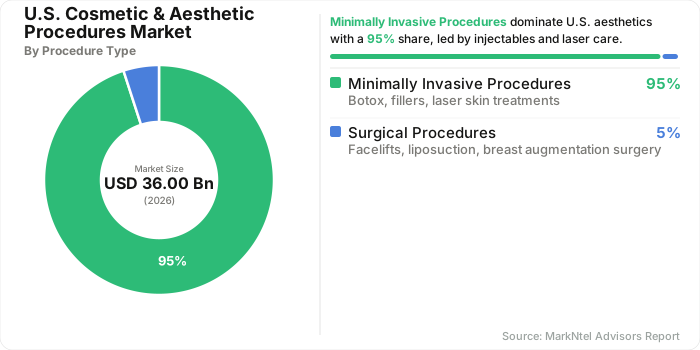
- Minimally invasive/non-surgical procedures led the procedure type segment with a 95% share in 2026.
- Medical spas led the provider setting segment with a 37% share in 2026.
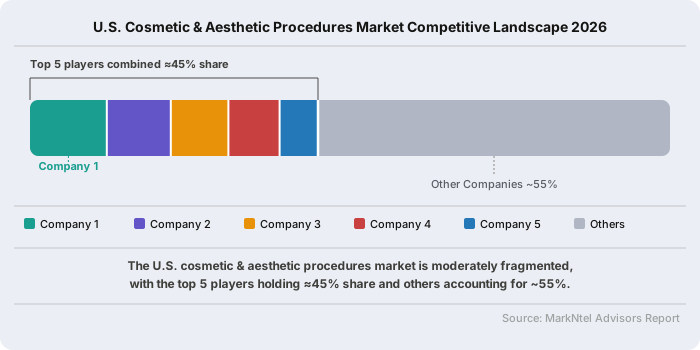
- The market is characterized by a moderately fragmented market structure, where the top five manufacturers hold roughly 35% of the market share.
U.S. Cosmetic & Aesthetic Procedures Market Size and Outlook
The U.S. cosmetic & aesthetic procedures market is driven by rising emphasis on appearance, healthy aging, self-confidence, and physical restoration following pregnancy, aging, and significant weight loss. These motivations are encouraging consumers to seek procedures that address facial aging, body contours, and other aesthetic concerns, while advances in treatment techniques, improved safety, shorter recovery periods, and growing accessibility are making procedures more acceptable across broader patient groups. The increasing preference for natural-looking outcomes and minimally invasive options is further supporting adoption as patients seek effective results with less downtime.
The market, valued at USD 32 billion in 2025, is projected to reach USD 75 billion by 2032, registering an approximate 13.01% CAGR during 2026–2032. This expansion is being supported by the continued shift toward minimally invasive procedures, particularly neuromodulators and dermal fillers, alongside growing demand for body contouring and restorative treatments following weight loss. ASPS reported 28.24 million minimally invasive procedures in 2024, demonstrating the scale of demand for lower-downtime aesthetic treatments. Going forward, manufacturers are likely to focus on safer, personalized, and technologically advanced solutions, increasing competition across injectables, laser and energy-based devices, implants, and surgical technologies while expanding treatment accessibility across U.S. aesthetic providers.
U.S. Cosmetic & Aesthetic Procedures Market Procedure Economics & Pricing Analysis
Procedure economics in the U.S. cosmetic & aesthetic procedures industry vary considerably based on treatment complexity, provider expertise, geographic location, facility requirements, anesthesia needs, and the technology or materials used, resulting in wide differences in patient expenditure. The American Society of Plastic Surgeons (ASPS) reported 2024 surgeon-fee ranges of USD 4,300–7,500 for liposuction, USD 8,000–13,500 for tummy tuck, and USD 12,000–19,000 for facelift, while the average cost was USD 715 for HA dermal fillers and USD 435 for botulinum toxin injections. These differences reflect the contrasting resource requirements and treatment intensity across surgical and minimally invasive procedures, with higher-complexity interventions generally requiring greater clinical time, specialized facilities, anesthesia, and postoperative management.
These differences create distinct economic models across the market, as surgical procedures generate higher revenue per treatment but involve additional expenses such as anesthesia, facility charges, medical tests, medications, and postoperative care, whereas office-based injectables require comparatively lower upfront spending. ASPS also notes that most cosmetic procedures are not covered by health insurance, making financing and affordability important considerations for patients. Consequently, providers increasingly need to balance premium pricing with accessibility, while aesthetic companies have greater incentives to develop products and technologies that reduce procedure complexity, improve treatment efficiency, and deliver durable outcomes. This dynamic can broaden treatment accessibility, support procedure adoption, and intensify competition around clinical value, cost efficiency, and patient outcomes.
U.S. Cosmetic & Aesthetic Procedures Market Scope
| Category | Segments |
|---|---|
| By Procedure Type | Surgical Procedures (Breast Augmentation, Breast Lift, Breast Reduction, Liposuction, Abdominoplasty, Rhinoplasty, Facelift, Eyelid Surgery, Hair Transplant, Other Surgical Procedures), Minimally Invasive / Non-Surgical Procedures (Botulinum Toxin Injections, Dermal Fillers, Chemical Peels, Laser Skin Resurfacing, Laser Hair Removal, Microdermabrasion, Microneedling, Non-Invasive Body Contouring, Thread Lift, Other Minimally Invasive / Non-Surgical Procedures |
| By Technology | Laser-Based, Light-Based / IPL, Radiofrequency-Based, Ultrasound-Based, Cryolipolysis-Based, Other Technologies |
| By Gender | Female, Male |
| By Age Group | Below 18 Years, 18 to 34 Years, 35 to 50 Years, Above 50 Years |
| By Treatment Area | Face & Neck, Breast, Abdomen & Waist, Buttocks, Thighs & Legs, Arms, Hair & Scalp, Other Body Areas |
| By Provider Setting | Hospitals / Hospital-Affiliated Centers, Dermatology Clinics, Plastic Surgery / Cosmetic Surgery Centers, Medical Spas, Other Aesthetic Clinics |
U.S. Cosmetic & Aesthetic Procedures Market Growth Drivers
Rising Focus on Appearance, Aging, and Self-Confidence
The U.S. market is gaining structural support from population aging and growing emphasis on maintaining appearance and confidence across different life stages. The latest U.S. Census Bureau estimates show that the population aged 65 and older reached 64.6 million in 2025, increasing 16.2% from 2020, creating a larger population with age-related concerns such as facial aging, skin laxity, and changes in body contours. This demographic shift is translating into measurable procedure demand, with ASPS reporting that cosmetic-procedure volume among patients aged 66 and older increased 24% in 2025, the fastest growth across age groups.
Beyond demographic aging, consumers are increasingly seeking procedures to restore appearance following pregnancy, weight loss, and other physical changes while improving confidence. ASPS identified aging, pregnancy, and weight loss as the leading motivations for aesthetic procedures in 2025, followed by aesthetic enhancement and increased confidence. These motivations are expanding treatment volumes across facial rejuvenation, lifts, injectables, and body contouring, while increasing demand for personalized, lower-downtime, and restoration-focused solutions. This shift is encouraging broader development of advanced injectables, energy-based technologies, and treatment platforms designed to address age-related and post-weight-loss aesthetic concerns with more natural-looking outcomes.
Recent Trends
Shift Toward Regenerative, Biostimulator, and Next-Generation Injectables Alongside Traditional Fillers
Patients are increasingly seeking aesthetic treatments that deliver natural-looking correction while addressing broader concerns such as facial volume loss and skin quality, encouraging greater differentiation within the injectable category. The purpose of this shift is to expand treatment options beyond conventional volumizing approaches and provide practitioners with formulations suited to specific aesthetic concerns. This is encouraging companies to introduce newer-generation injectable products alongside established fillers, creating a broader and more specialized treatment portfolio.
The change is visible in recent U.S. regulatory approvals, with the FDA approving saypha MagIQ in September 2025 for correction of moderate-to-severe facial wrinkles and folds, followed by saypha ChIQ in June 2026 for cheek augmentation and restoration of midface volume deficits. These additions demonstrate how differentiated injectable formulations are expanding the range of treatments available to aesthetic providers rather than replacing traditional fillers. As newer products continue entering the U.S. market, broader treatment choice and greater customization can support continued injectable procedure adoption and strengthen the minimally invasive segment.
U.S. Cosmetic & Aesthetic Procedures Market Opportunities and Challenges
Risk of Unsatisfactory Outcomes Driving AI-Powered Treatment Planning
As aesthetic procedures become more personalized, achieving consistent and satisfactory outcomes increasingly depends on accurate assessment of facial features, skin conditions, and treatment requirements. The consequences of inaccurate treatment decisions are evident in documented complications, with a 2025 American Academy of Ophthalmology review identifying 198 cases of vision loss following accidental intravascular injection of soft-tissue fillers, including 164 cases involving hyaluronic acid. Such outcomes are increasing the importance of precise patient evaluation and treatment planning, creating demand for technologies that can provide objective measurements and support more informed clinical decisions.
This need is encouraging the adoption of digital assessment tools, with Canfield Scientific introducing its next-generation VISIA 3D in March 2026, combining AI-driven skin analysis with three-dimensional facial imaging to support standardized assessment and treatment planning. By quantifying skin characteristics and facial features, these platforms can help practitioners develop more individualized treatment strategies and communicate expected outcomes more effectively. Wider adoption can therefore expand demand for AI-enabled diagnostic and visualization systems within aesthetic practices, while encouraging continued development of integrated technologies that improve treatment precision, consistency, and patient confidence.
Segmentation Insights
Minimally Invasive / Non-Surgical Procedures Dominate Procedure Type Segmentation with 95% Share Through Lower Downtime and Greater Accessibility
Minimally Invasive / Non-Surgical Procedures dominate the U.S. cosmetic & aesthetic procedures market because they provide aesthetic improvements with less downtime, lower procedural burden, and greater convenience than surgical interventions. Neuromodulators, dermal fillers, skin resurfacing, and laser-based treatments can address common concerns through relatively short treatment sessions, making them accessible to a broader consumer base. Their repeat-treatment potential also encourages continued utilization, supporting higher procedure frequency and sustained demand.
This advantage is reinforced by strong adoption of injectable treatments, with ASPS reporting 9.88 million neuromodulator injections and 5.33 million hyaluronic acid filler procedures in 2024. Continued product innovation, expanding availability through aesthetic practices and medical spas, and preference for lower-downtime treatments are further supporting adoption. The combination of convenience, broad applicability, and repeat-treatment potential strengthens the segment's position within the market. Based on procedure type, the market has been segmented into:
- Surgical Procedures
- Minimally Invasive / Non-Surgical Procedures
Medical Spas Dominate Provider Setting with 37% Share Through Convenient Access and Broad Non-Surgical Treatment Availability
Medical Spas dominate the provider-setting segment because they offer aesthetic treatments in a dedicated, convenience-oriented environment that is well suited to procedures requiring limited downtime and repeated visits. Their broader accessibility, flexible appointment models, and combination of treatments within one location make them attractive to consumers seeking facial rejuvenation, skin treatments, body contouring, and other minimally invasive procedures. This model also enables providers to build ongoing treatment relationships, encouraging maintenance visits and cross-treatment adoption rather than relying mainly on one-time surgical procedures.
The strength of this setting is further supported by the rapid expansion of medical-spa businesses across the U.S. According to the American Med Spa Association, the number of medical spas increased from 5,431 in 2018 to more than 10,000 in 2023, demonstrating substantial expansion of dedicated aesthetic-care infrastructure. As these facilities continue to expand their geographic presence, treatment portfolios, and investment in aesthetic technologies, consumers gain more convenient access to specialized services, supporting higher treatment frequency and strengthening the role of medical spas within the U.S. cosmetic and aesthetic procedures market. Based on provider setting, the market is categorized into:
- Hospitals / Hospital-Affiliated Centers
- Dermatology Clinics
- Plastic Surgery / Cosmetic Surgery Centers
- Medical Spas
- Other Aesthetic Clinics
U.S. Cosmetic & Aesthetic Procedures Market Competitive Analysis
The U.S. cosmetic & aesthetic procedures market is moderately fragmented, with leading domestic and international companies competing across injectables, aesthetic devices, and surgical technologies. The top five players, AbbVie Inc., Galderma S.A., Merz Pharma GmbH & Co. KGaA, Bausch Health Companies Inc., and Lumenis Ltd., collectively account for approximately 45% of the market, supported by continuous product innovation, advanced aesthetic technologies, and expanding treatment portfolios.
Key Players in U.S. Cosmetic & Aesthetic Procedures Market
- AbbVie Inc.
- Galderma S.A.
- Merz Pharma GmbH & Co. KGaA
- Bausch Health Companies Inc.
- Lumenis Ltd.
- Sisram Medical Ltd.
- Cynosure, LLC
- Candela Corporation
- Cutera, Inc.
- InMode Ltd.
- Others
U.S. Cosmetic & Aesthetic Procedures Industry News and Recent Developments
April 2026: Cartessa Aesthetics Introduces ONDA PRO, Expanding Non-Invasive Body Contouring in the U.S.
Cartessa Aesthetics introduced ONDA PRO by DEKA in the U.S. and Canada, expanding the availability of Coolwaves technology for non-invasive body contouring and cellulite treatment. The platform uses 2.45-GHz electromagnetic energy with specialized handpieces designed to target different tissue depths.
Impact Analysis: The launch expands treatment options for non-invasive body contouring and gives aesthetic practices an additional technology for addressing body-shaping concerns without surgery. Greater availability of differentiated energy-based platforms can encourage clinics to expand their treatment portfolios while increasing competition around treatment precision and technological performance.
April 2025: Candela Launches Vbeam Pro, Expanding Advanced Laser Treatment Capabilities in the U.S.
Candela launched Vbeam Pro at the 2025 American Society for Laser Medicine and Surgery meeting, introducing a platform that combines 595-nm pulsed-dye and 1064-nm Nd:YAG laser wavelengths. The system is designed to provide broader treatment capabilities for vascular and dermatological conditions while improving treatment control and versatility.
Impact Analysis: The launch strengthens the U.S. market for advanced laser-based aesthetic technologies by expanding the range of conditions addressable through a single platform. Greater treatment versatility can encourage aesthetic practices to upgrade equipment and broaden their service portfolios, increasing competition among laser-system manufacturers.
- Market Segmentation
- Introduction
- Product Definition
- Research Process
- Assumptions
- Executive Summary
- U.S. Cosmetic & Aesthetic Procedures Market Policies, Regulations, and Product Standards
- U.S. Cosmetic & Aesthetic Procedures Market Trends & Developments
- U.S. Cosmetic & Aesthetic Procedures Market Procedure Economics & Pricing Analysis
- U.S. Cosmetic & Aesthetic Procedures Market Dynamics
- Growth Factors
- Challenges
- U.S. Cosmetic & Aesthetic Procedures Market Hotspot & Opportunities
- U.S. Cosmetic & Aesthetic Procedures Market Outlook, 2022-2032
- Market Size & Outlook
- By Revenues (U.S.D Million)
- Market Segmentation & Outlook
- By Procedure Type- Market Size & Forecast 2022-2032, U.S.D Million
- Surgical Procedures
- Breast Augmentation
- Breast Lift
- Breast Reduction
- Liposuction
- Abdominoplasty
- Rhinoplasty
- Facelift
- Eyelid Surgery
- Hair Transplant
- Other Surgical Procedures
- Minimally Invasive / Non-Surgical Procedures
- Botulinum Toxin Injections
- Dermal Fillers
- Chemical Peels
- Laser Skin Resurfacing
- Laser Hair Removal
- Microdermabrasion
- Microneedling
- Non-Invasive Body Contouring
- Thread Lift
- Other Minimally Invasive / Non-Surgical Procedures
- Surgical Procedures
- By Technology- Market Size & Forecast 2022-2032, U.S.D Million
- Laser-Based
- Light-Based / IPL
- Radiofrequency-Based
- Ultrasound-Based
- Cryolipolysis-Based
- Other Technologies
- By Gender- Market Size & Forecast 2022-2032, U.S.D Million
- Female
- Male
- By Age Group- Market Size & Forecast 2022-2032, U.S.D Million
- Below 18 Years
- 18 to 34 Years
- 35 to 50 Years
- Above 50 Years
- By Treatment Area- Market Size & Forecast 2022-2032, U.S.D Million
- Face & Neck
- Breast
- Abdomen & Waist
- Buttocks
- Thighs & Legs
- Arms
- Hair & Scalp
- Other Body Areas
- By Provider Setting- Market Size & Forecast 2022-2032, U.S.D Million
- Hospitals / Hospital-Affiliated Centers
- Dermatology Clinics
- Plastic Surgery / Cosmetic Surgery Centers
- Medical Spas
- Other Aesthetic Clinics
- By Company
- Competition Characteristics
- Market Share & Analysis
- By Procedure Type- Market Size & Forecast 2022-2032, U.S.D Million
- Market Size & Outlook
- U.S. Cosmetic & Aesthetic Surgical Procedures Market Outlook, 2022-2032
- Market Size & Outlook
- By Revenues (U.S.D Million)
- Market Segmentation & Outlook
- By Technology- Market Size & Forecast 2022-2032, U.S.D Million
- By Gender- Market Size & Forecast 2022-2032, U.S.D Million
- By Age Group- Market Size & Forecast 2022-2032, U.S.D Million
- By Treatment Area- Market Size & Forecast 2022-2032, U.S.D Million
- By Provider Setting- Market Size & Forecast 2022-2032, U.S.D Million
- Market Size & Outlook
- U.S. Cosmetic & Aesthetic Minimally Invasive / Non-Surgical Procedures Market Outlook, 2022-2032
- Market Size & Outlook
- By Revenues (U.S.D Million)
- Market Segmentation & Outlook
- By Technology- Market Size & Forecast 2022-2032, U.S.D Million
- By Gender- Market Size & Forecast 2022-2032, U.S.D Million
- By Age Group- Market Size & Forecast 2022-2032, U.S.D Million
- By Treatment Area- Market Size & Forecast 2022-2032, U.S.D Million
- By Provider Setting- Market Size & Forecast 2022-2032, U.S.D Million
- Market Size & Outlook
- U.S. Cosmetic & Aesthetic Procedures Market Key Strategic Imperatives for Success & Growth
- Competitive Outlook
- Company Profiles
- AbbVie Inc.
- BU.S.iness Description
- Product Portfolio
- Collaborations & Alliances
- Recent Developments
- Financial Details
- Others
- Galderma S.A.
- BU.S.iness Description
- Product Portfolio
- Collaborations & Alliances
- Recent Developments
- Financial Details
- Others
- Merz Pharma GmbH & Co. KGaA
- BU.S.iness Description
- Product Portfolio
- Collaborations & Alliances
- Recent Developments
- Financial Details
- Others
- BaU.S.ch Health Companies Inc.
- BU.S.iness Description
- Product Portfolio
- Collaborations & Alliances
- Recent Developments
- Financial Details
- Others
- Lumenis Ltd.
- BU.S.iness Description
- Product Portfolio
- Collaborations & Alliances
- Recent Developments
- Financial Details
- Others
- Sisram Medical Ltd.
- BU.S.iness Description
- Product Portfolio
- Collaborations & Alliances
- Recent Developments
- Financial Details
- Others
- Cynosure, LLC
- BU.S.iness Description
- Product Portfolio
- Collaborations & Alliances
- Recent Developments
- Financial Details
- Others
- Candela Corporation
- BU.S.iness Description
- Product Portfolio
- Collaborations & Alliances
- Recent Developments
- Financial Details
- Others
- Cutera, Inc.
- BU.S.iness Description
- Product Portfolio
- Collaborations & Alliances
- Recent Developments
- Financial Details
- Others
- InMode Ltd.
- BU.S.iness Description
- Product Portfolio
- Collaborations & Alliances
- Recent Developments
- Financial Details
- Others
- AbbVie Inc.
- Company Profiles
- Disclaimer

MarkNtel Advisors follows a robust and iterative research methodology designed to ensure maximum accuracy and minimize deviation in market estimates and forecasts. Our approach combines both bottom-up and top-down techniques to effectively segment and quantify various aspects of the market. A consistent feature across all our research reports is data triangulation, which examines the market from three distinct perspectives to validate findings. Key components of our research process include:
1. Scope & Research Design At the outset, MarkNtel Advisors define the research objectives and formulate pertinent questions. This phase involves determining the type of research—qualitative or quantitative—and designing a methodology that outlines data collection methods, target demographics, and analytical tools. They also establish timelines and budgets to ensure the research aligns with client goals.
2. Sample Selection and Data Collection In this stage, the firm identifies the target audience and determines the appropriate sample size to ensure representativeness. They employ various sampling methods, such as random or stratified sampling, based on the research objectives. Data collection is carried out using tools like surveys, interviews, and observations, ensuring the gathered data is reliable and relevant.
3. Data Analysis and Validation Once data is collected, MarkNtel Advisors undertake a rigorous analysis process. This includes cleaning the data to remove inconsistencies, employing statistical software for quantitative analysis, and thematic analysis for qualitative data. Validation steps are taken to ensure the accuracy and reliability of the findings, minimizing biases and errors.

4. Data Forecast and FinalizationThe final phase involves forecasting future market trends based on the analyzed data. MarkNtel Advisors utilize predictive modeling and time series analysis to anticipate market behaviors. The insights are then compiled into comprehensive reports, featuring visual aids like charts and graphs, and include strategic recommendations to inform client decision-making
FILL THE FORM TO GET THE FREE SAMPLE PAGES
We offer flexible licensing options to cater to varying organizational needs. Choose the pricing pack that best suits your requirements:
Buy Now Inquire Before Buying
 Talk to our Consultant
 Request Customization