

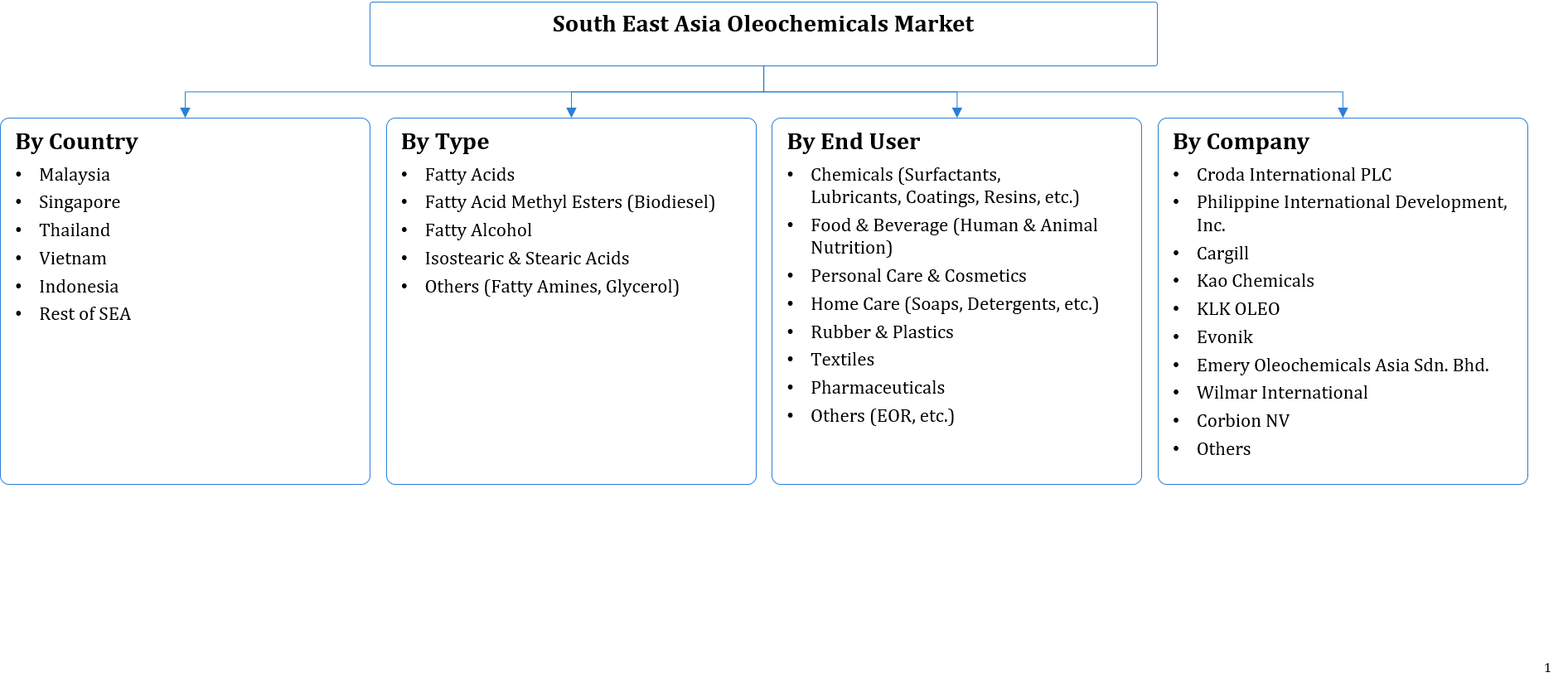
By Type (Fatty Acids Fatty Acid Methyl Esters (Biodiesel), Fatty Alcohol, Isostearic & Stearic Acids, Others (Fatty Amines, Glycerol)) By End Users (Chemicals (Surfactants, Lubrica......nts, Coatings, Resins, etc.), Food & Beverage (Human & Animal Nutrition), Personal Care & Cosmetics, Home Care (Soaps, Detergents, etc.), Rubber & Plastics, Textiles, Pharmaceuticals, Others (EOR, etc.)) By Country (Malaysia, Singapore, Thailand, Vietnam, Indonesia, Rest of SEA) By Company (Croda International PLC, Philippine International Development, Inc. , Cargill, Kao Chemicals, KLK OLEO, Evonik, Emery Oleochemicals Asia Sdn. Bhd., Wilmar International, Corbion NV, Others) Read more
- Chemicals
- Apr 2022
- 143
- PDF, Excel, PPT
Market Definition
Oleochemicals are chemical compounds derived through vegetable fats or oils. The splitting of fats through water-based hydrolysis, alcohol-based hydrolysis, and hydrogenation are some common ways of producing oleochemicals. These chemical compounds have a wide application in industrial manufacturing of personal care, home care, health care, chemicals, textiles, etc.
Market Insights
The Southeast Asia Oleochemicals Market is anticipated to grow at a CAGR of around 3.38% in terms of volume during the forecast period, i.e., 2022-27, says MarkNtel Advisors. Owing to the wide application of oleochemicals the Southeast Asia Oleochemicals market has witnessed robust growth during the historical period. Furthermore, the soaring investments & increasing establishment of production units of cosmetic products, chemicals (lubricants, coatings, etc.), pharmaceutical industries, etc., have also boosted the demand for oleochemicals. Moreover, the increasing construction activities in the region are also one of the prominent factors attributing to the growth of local paint manufacturing in Vietnam & Singapore, which, in turn, has further influenced the Southeast Asia Oleochemicals market.
| Report Coverage | Details |
|---|---|
| Study Period | Historical Data: 2017-20 |
| Base Year: 2021 | |
| Forecast Period: 2022-27 | |
| CAGR (2022-2027) | 3.38% |
| Country Covered | Malaysia, Singapore, Thailand, Vietnam, Indonesia, Rest of SEA |
| Key Companies Profiled | Croda International PLC, Philippine International Development, Inc. , Cargill, Kao Chemicals, KLK OLEO, Evonik, Emery Oleochemicals Asia Sdn. Bhd., Wilmar International, Corbion NV, Others |
| Unit Denominations | USD Million/Billion |
Additionally, the foreign direct investments (FDIs) in the region have also assisted in the development of the market. The key industries that have received a notable amount of FDIs are pharmaceuticals, chemicals, and food & beverages, in line with the Association of Southeast Asian Nations. During 2019-2020, Nestlé invested more than USD122 million in Indonesia & Malaysia for the expansion of its existing production capacity.
Further, in the same period, Nippon Shokubai and Sinochem invested approximately USD357 million in the establishment & development of acrylic acid & bioplastic in Indonesia & Thailand, respectively. Nevertheless, such financing in the region has implied a considerable growth of the market in the past period as well as a continuous steady increase in the market revenues & volume of oleochemicals in the forthcoming years.
Key Trend in the Market
Oleochemicals Replacing Petroleum Derived Ingredients
Oleochemicals are one of the key materials required by the manufacturers of home & personal care products. These chemicals are considered to have a minimal impact on the human body. Therefore, home & personal care companies are gradually moving towards using natural ingredients, which are safe on human skin while in use, rather than using harsh chemicals. Moreover, the consumer awareness to minimize the use of toxic elements on the skin is also contributing to the demand for all-natural & plant-based soaps & detergents. Therefore, Oleochemicals are emerging as a substitute for petrochemical-derived ingredients used in the personal care industry in the region. Further, Oleochemicals end-users are replacing petroleum-derived products to minimize their carbon footprints.
Impact of Covid-19 on the Southeast Asia Oleochemicals Market
FMCG is one of the most important end-user of the market, however, the market witnessed a marginal dip during the outbreak of the COVID-19 pandemic in 2020, primarily due to the disruption in the supply chain hampering the logistics of raw materials & finished goods. Furthermore, due to the pandemic, palm oil production has decreased. Eventually, the major disruption in the supply chain at all levels & across all regions impacted the growth of the regional oleochemicals market. However, the market began to recover in the latter half of 2020. The surge in drug & pharmaceutical manufacturing has resulted in an increase in demand for oleochemicals due to the use of oleochemicals in topical & oral medicine as well as drug formulation.
Furthermore, oleochemicals are used as emulsifiers, wetting agents, solubilizers, and cream bases, which are necessary components in the drug manufacturing process. The region has a broadened manufacturing base that has been fulfilling the domestic as well as the export demand. Besides, the growth in the pharmaceutical exports in the region aided in sustaining the oleochemicals market revenues during the pandemic period.
- Introduction
- Research Process
- Assumption
- Market Segmentation
- Market Definition
- Executive Summary
- Impact of COVID-19 on South East Asia Oleochemicals Market
- South East Asia Oleochemicals Market Trends & Insights
- South East Asia Oleochemicals Market Dynamics
- Growth Drivers
- Challenges
- Impact Analysis
- South East Asia Oleochemicals Market Hotspot and Opportunities
- South East Asia Oleochemicals Market Supply Chain Analysis
- South East Asia Oleochemicals Market Policies, Regulations, Material Type Standards
- South East Asia Oleochemicals Market Outlook, 2017- 2027F
- Market Size and Analysis
- By Revenues
- By Volume (in Tons)
- Market Share and Analysis
- By Type
- Fatty Acids
- Fatty Acid Methyl Esters (Biodiesel)
- Fatty Alcohol
- Isostearic & Stearic Acids
- Others (Fatty Amines, Glycerol)
- By End Users
- Chemicals (Surfactants, Lubricants, Coatings, Resins, etc.)
- Food & Beverage (Human & Animal Nutrition)
- Personal Care & Cosmetics
- Home Care (Soaps, Detergents, etc.)
- Rubber & Plastics
- Textiles
- Pharmaceuticals
- Others (EOR, etc.)
- By Country
- Malaysia
- Singapore
- Thailand
- Vietnam
- Indonesia
- Rest of SEA
- By Company
- Competition Characteristics
- Market Share & Analysis
- By Type
- Market Size and Analysis
- Malaysia Oleochemicals Market Outlook, 2017-2027F
- Market Size & Analysis
- By Revenues
- By Volume (in Tons)
- Market Share and Analysis
- By Type
- By End Users
- Market Size & Analysis
- Singapore Oleochemicals Market Outlook, 2017-2027F
- Market Size & Analysis
- By Revenues
- By Volume (in Tons)
- Market Share and Analysis
- By Type
- By End Users
- Market Size & Analysis
- Thailand Oleochemicals Market Outlook, 2017-2027F
- Market Size & Analysis
- By Revenues
- By Volume (in Tons)
- Market Share and Analysis
- By Type
- By End Users
- Market Size & Analysis
- Vietnam Oleochemicals Market Outlook, 2017-2027F
- Market Size & Analysis
- By Revenues
- By Volume (in Tons)
- Market Share and Analysis
- By Type
- By End Users
- Market Size & Analysis
- Indonesia Oleochemicals Market Outlook, 2017-2027F
- Market Size & Analysis
- By Revenues
- By Volume (in Tons)
- Market Share and Analysis
- By Type
- By End Users
- Market Size & Analysis
- South East Asia Oleochemicals Market Key Strategic Imperatives for Success and Growth
- Competitive Outlook
- Competition Matrix
- Material Type Portfolio
- Brand Specialization
- Target Markets
- Target Material Types
- Research & Development
- Strategic Alliances
- Strategic Initiatives
- Company Profiles (Business Description, Material Type Segments, Business Segments, Financials, Strategic Alliances/ Partnerships, Future Plans)
- Croda International PLC
- Philippine International Development, Inc.
- Cargill
- Kao Chemicals
- KLK OLEO
- Evonik
- Emery Oleochemicals Asia Sdn. Bhd.
- Wilmar International
- Corbion NV
- Others
- Competition Matrix
- Disclaimer
MarkNtel Advisors follows a robust and iterative research methodology designed to ensure maximum accuracy and minimize deviation in market estimates and forecasts. Our approach combines both bottom-up and top-down techniques to effectively segment and quantify various aspects of the market. A consistent feature across all our research reports is data triangulation, which examines the market from three distinct perspectives to validate findings. Key components of our research process include:
1. Scope & Research Design At the outset, MarkNtel Advisors define the research objectives and formulate pertinent questions. This phase involves determining the type of research—qualitative or quantitative—and designing a methodology that outlines data collection methods, target demographics, and analytical tools. They also establish timelines and budgets to ensure the research aligns with client goals.
2. Sample Selection and Data Collection In this stage, the firm identifies the target audience and determines the appropriate sample size to ensure representativeness. They employ various sampling methods, such as random or stratified sampling, based on the research objectives. Data collection is carried out using tools like surveys, interviews, and observations, ensuring the gathered data is reliable and relevant.
3. Data Analysis and Validation Once data is collected, MarkNtel Advisors undertake a rigorous analysis process. This includes cleaning the data to remove inconsistencies, employing statistical software for quantitative analysis, and thematic analysis for qualitative data. Validation steps are taken to ensure the accuracy and reliability of the findings, minimizing biases and errors.

4. Data Forecast and FinalizationThe final phase involves forecasting future market trends based on the analyzed data. MarkNtel Advisors utilize predictive modeling and time series analysis to anticipate market behaviors. The insights are then compiled into comprehensive reports, featuring visual aids like charts and graphs, and include strategic recommendations to inform client decision-making
FILL THE FORM TO GET THE FREE SAMPLE PAGES
We offer flexible licensing options to cater to varying organizational needs. Choose the pricing pack that best suits your requirements:
Buy Now Inquire Before Buying
 Talk to our Consultant
 Request Customization