

By Waste Type (Municipal Solid Waste, Plastic Waste, Paper & Cardboard Waste, Metal Waste, Glass Waste, E-Waste, Construction & Demolition Waste, Organic Waste), By Operation Mode (Automatic, Manual,... ... (Automatic, Manual, Semi-Automatic), By Technology (Sensor-Based Sorting, Magnetic Separation, Mechanical Sorting, Robotic Sorting, Others), By End User (Municipal, Recycling Facilities/MRFs, Industrial, Construction & Demolition, E-Waste Recycling), and others Read more
- Chemicals
- Jul 2026
- 140
- PDF, Excel, PPT
US Waste Sorting Equipment Market Key Takeaways
- The United States Waste Sorting Equipment market was valued at USD 188 Million in 2025, projected to reach USD 318 Million by 2032, expanding at a CAGR of 4.59% during the forecast period.
- The market is forecast to grow from USD 243 Million in 2026 to USD 318 Million by 2032.
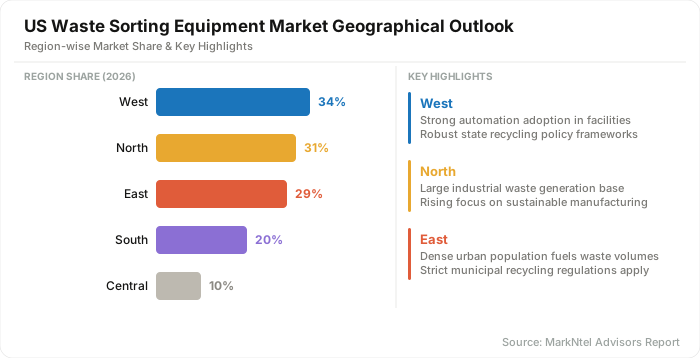
- The West leads all U.S. regions with approximately 34% market share.
- Municipal Solid Waste dominated the U.S. Waste Sorting Equipment Market with a 42% shares in 2026.
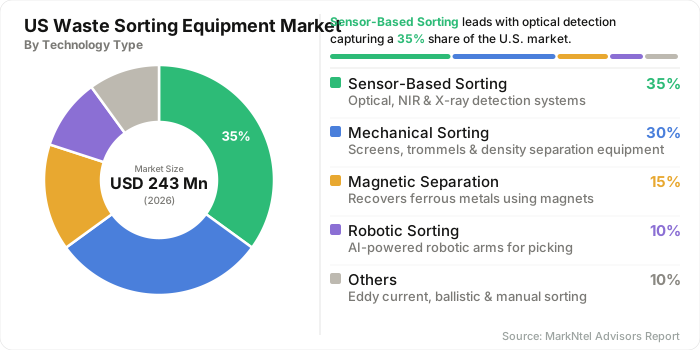
- Sensor-Based Sorting leads by technology with approximately 35% share in 2026.
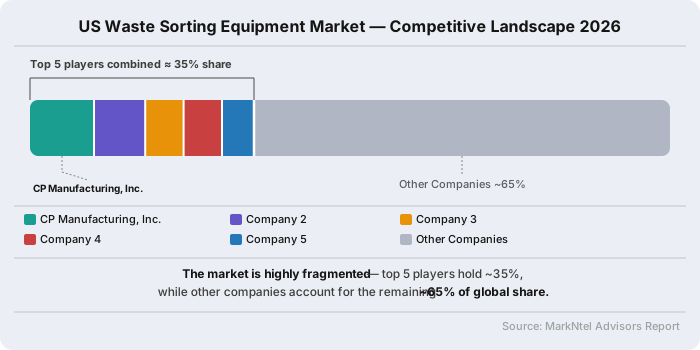
- The market is moderately consolidated, with the top five players collectively holding approximately 35% share, leaving significant room for regional and mid-tier equipment suppliers to compete.
US Waste Sorting Equipment Market Size and Outlook
The United States Waste Sorting Equipment market, valued at USD 188 Million in 2025, is projected to grow from USD 243 Million in 2026 to USD 318 Million by 2032, at a CAGR of 4.59%, during the forecast period i.e., 2026-32.
The demand for waste sorting equipment in the United States has expanded steadily alongside the modernization of the national recycling system and increasing investment in post-consumer materials management infrastructure. In 2025, the U.S. Environmental Protection Agency (EPA) updated and continued implementation of its National Recycling Strategy, which prioritizes improved collection, contamination reduction, and stronger recycling markets, creating sustained demand for advanced sorting technologies across recovery facilities. The EPA’s national objective of achieving a 50% recycling rate by 2030 further supports long-term equipment deployment and system upgrades.
Current market conditions are being reinforced by substantial public-sector funding directed toward recycling infrastructure. Through the Solid Waste Infrastructure for Recycling Program, funding authorized under federal legislation continues through 2026, supporting municipal recycling improvements and equipment modernization. In December 2025, EPA announced additional grant selectees after receiving applications requesting more than USD 1.072 billion, demonstrating strong nationwide demand for upgraded sorting capacity. Local governments, public waste authorities, and institutional operators are increasingly investing in automated systems to improve processing efficiency and material recovery performance.
Demand is also being shaped by diverse end-user segments. Residential recycling programs require higher-throughput sorting lines to manage mixed waste streams, while commercial facilities seek improved recovery of paper, plastics, and packaging materials. Industrial users are expanding investments in specialized processing of construction debris, metals, and reusable materials. Supporting these developments, EPA’s Recycling Infrastructure and Market Opportunities Map was updated in 2025 to identify infrastructure gaps and strengthen secondary material markets, encouraging equipment deployment in underserved regions and enhancing nationwide resource recovery capabilities.
Prospects remain favorable as manufacturers continue introducing more intelligent sorting solutions and digital plant-management capabilities. For instance, in 2026, AMP Robotics partnered with Waste Connections to equip and operate a next-generation recycling facility in Colorado scheduled for commissioning in early 2026. The facility incorporates AMP ONE™ and AMP Smart Sortation™ technologies to automate material identification and separation processes.
Together, regulatory support, infrastructure investment, technology innovation, and increasing material recovery requirements position the U.S. waste sorting equipment market for sustained expansion over the coming years
US Waste Sorting Equipment Market Key Indicators
- As of 2025, seven U.S. states California, Colorado, Maine, Maryland, Minnesota, Oregon, and Washington have enacted Extended Producer Responsibility (EPR) laws for packaging, with Oregon's Producer Responsibility Organization beginning full implementation in July 2025. EPR mandates oblige producer-funded collection and sorting programs, creating direct institutional demand for sorting equipment upgrades at MRFs across these states.
- The U.S. EPA's Landfill Methane Outreach Program (LMOP) database records more than 2,600 active municipal solid waste landfills nationally as of September 2024. Ongoing landfill capacity constraints, particularly in densely populated northeastern states, intensify pressure on upstream diversion infrastructure, including sorting facilities, to reduce inbound tonnage.
- The EPA's 2024 recycling infrastructure data identifies 421 multi-material MRFs, 83 glass recycling and beneficiation facilities, and 203 plastics-specific recycling facilities currently operating in the U.S. The majority of these facilities require technology upgrades, including optical sorters and robotic sorting arms to handle evolving, mixed-material waste streams, sustaining equipment replacement and retrofit demand.
- The U.S. generated approximately 8 million tons of electronic waste annually as of 2024, the second highest volume globally, with only around 15% formally recycled. These growing e-waste volumes entering the MSW stream require dedicated sorting capability at processing facilities to isolate hazardous materials and recover critical minerals, supporting investment in specialized separation and identification equipment.
US Waste Sorting Equipment Market Scope
| Category | Segments |
|---|---|
| By Waste Type | Municipal Solid Waste, Plastic Waste, Paper & Cardboard Waste, Metal Waste, Glass Waste, E-Waste, Construction & Demolition Waste, Organic Waste |
| By Operation Mode | Automatic, Manual, Semi-Automatic |
| By Technology | Sensor-Based Sorting, Magnetic Separation, Mechanical Sorting, Robotic Sorting, Others |
| By End User | Municipal, Recycling Facilities/MRFs, Industrial, Construction & Demolition, E-Waste Recycling |
US Waste Sorting Equipment Industry Growth Driver
Federal Recycling Infrastructure Investment Expanding Demand for Waste Sorting Equipment Across the United States
The Bipartisan Infrastructure Law directs USD 275 million through the U.S. EPA's Solid Waste Infrastructure for Recycling (SWIFR) Grant Program from fiscal year 2022 through fiscal year 2026 to fund improvements to municipal recycling programs and local waste management systems nationwide. Grant-eligible activities include upgrading post-consumer materials management capacity and expanding material recovery facility processing capability, both of which require procurement of new waste sorting equipment, optical sorters, and solid waste sorting solutions. With the EPA awarding approximately USD 32 million annually under the programme and continuing disbursements into fiscal year 2026, municipalities and political subdivisions across the United States are actively deploying federal funds toward recycling infrastructure modernisation.
This sustained federal commitment converts municipal recycling infrastructure from a discretionary budget line into a federally co-funded mandate, directly accelerating procurement of waste processing equipment, automated waste sorting systems, and material sorting systems at facilities that previously lacked capital for technology upgrades, thereby broadening the addressable base of the United States waste sorting equipment industry.
Recent Trends
Deployment of AI-Integrated Robotic Sorting Systems is Redefining MRF Operations Across the United States
Material recovery facilities across the United States are systematically replacing manual sorting lines with AI-integrated robotic sorting systems, a structural shift driven by chronic labor shortages, low recycling capture rates, and rising purity standards from commodity buyers. The U.S. Environmental Protection Agency's 2024 recycling infrastructure assessment estimated that USD 36.5 to USD 43.4 billion in investment is needed to modernize the nation's material recovery infrastructure, directly accelerating procurement of automated waste separation equipment at municipal and privately operated facilities.
This transition is quantifiably underway. Glacier expanded AI robotic sorter deployments across Los Angeles, Chicago, Detroit, Phoenix, and Seattle through 2025, with systems sorting over 90 million items and diverting more than 1,000 tonnes from landfills within a year. In October 2025, Glacier was deployed at Penn Waste Inc.'s MRF in York County, Pennsylvania, integrating robots on the fibre line to improve cardboard and PET recovery. Waste Connections separately partnered with AMP Robotics to build a predominantly automated MRF in Commerce City, Colorado. With commercial systems achieving up to 45 picks per minute across 70-plus material types, hybrid human-robot operations are becoming the standard configuration for next-generation U.S. sorting infrastructure.
US Waste Sorting Equipment Market Opportunities and Challenges
Fragmented State-Level EPR Compliance Complexity Creating Demand for Advanced Sorting Infrastructure
The rapid, non-uniform expansion of Extended Producer Responsibility Legislation across the U.S. presents a structural compliance challenge for waste sorting facility operators. As of 2025, seven states California, Colorado, Oregon, Maine, Maryland, Minnesota, and Washington have enacted mandatory packaging EPR laws, each with distinct fee structures, recyclability thresholds, reporting timelines, and producer responsibility organization requirements. Smaller MRF operators managing multi-state material streams face simultaneous compliance obligations with no standardized national framework, creating operational strain and capital uncertainty that slows equipment procurement cycles.
However, the same legislation that creates compliance pressure is generating a funded investment pipeline directly tied to sorting equipment. California's SB 54, with regulations entering full effect in May 2026, mandates that the Circular Action Alliance invest producer fee revenues into recycling and reuse infrastructure including sorting systems at MRFs. CalRecycle separately approved USD 10 million in April 2025 toward a mixed plastics sorting facility and multiple MRF retrofit grants. As additional states activate EPR programs through 2026 and beyond, producer-funded recycling infrastructure spending will progressively convert compliance mandates into durable capital demand for waste sorting equipment manufacturers.
Segmentation Insights
Municipal Solid Waste Leads the Market Owing to Large-Scale Recycling Infrastructure Investments
Municipal Solid Waste (MSW) is expected to remain the leading waste type segment in the U.S. Waste Sorting Equipment Market through 2032 with a share of 42% driven by rising urban waste generation, stringent recycling targets, and continuous modernization of material recovery facilities (MRFs). The U.S. generates millions of tons of household and commercial waste annually, creating sustained demand for advanced optical sorters, AI-enabled robotic systems, magnetic separators, and conveyor-based sorting technologies.
Recent investments by major industry participants have further strengthened this segment's dominance. In 2025–2026, WM (Waste Management) continued expanding automated recycling facilities and advanced sorting infrastructure, supporting higher throughput and material recovery rates across its network. Meanwhile, TOMRA Recycling opened its new Americas Test & Training Center in North Carolina in 2026, enhancing deployment of AI-powered AUTOSORT™ systems specifically designed for municipal waste streams.
These developments are improving sorting efficiency, reducing contamination, and increasing recycling yields. As municipalities prioritize circular economy goals and landfill diversion targets, MSW will continue generating the highest demand for waste sorting equipment, reinforcing its position as the market's largest and most commercially significant segment. By waste type the market is sub-divided into the following sub-categories:
- Municipal Solid Waste
- Plastic Waste
- Paper & Cardboard Waste
- Metal Waste
- Glass Waste
- E-Waste
- Construction & Demolition Waste
- Organic Waste
Rising Automation Drives Sensor-Based Sorting to the Forefront of the Market
Sensor-based sorting holds approximately 35% of the United States waste sorting equipment market by technology, driven by its versatility across NIR spectroscopy, hyperspectral imaging, and induction-based detection enabling simultaneous identification of polymer type, color, and contamination in a single pass. This multi-modal detection capability makes it the only technology category suited to the high-throughput, mixed-composition streams processed at large-scale single-stream MRFs. Republic Services upgraded its Peabody, Massachusetts MRF in early 2025 with advanced AI and sensor-based ballistic sorters, expanding processing capacity to 35–40 tons per hour.
Similarly, AMP Robotics' sensor-fusion platform, combining machine vision and hyperspectral imaging, was selected for a USD 200 million AI-powered MRF announced by the City of Portsmouth, Virginia, targeting single-stream recyclable recovery across Hampton Roads. As EPR compliance thresholds tighten and commodity buyers demand higher-purity recyclate, sensor-based systems capable of real-time spectral analysis will progressively displace single-sensor mechanical alternatives across the U.S. facilities. By technology, the market is further divided into the following sub-categories:
- Sensor-Based Sorting
- Magnetic Separation
- Mechanical Sorting
- Robotic Sorting
- Others
US Waste Sorting Equipment Industry Geographical Analysis
The Western region accounts for approximately 34% of the United States Waste Sorting Equipment Market, primarily driven by California's highly stringent waste management regulations and sustained investment in recycling infrastructure. The state has established one of the nation's most demanding regulatory environments through mandatory organics diversion requirements, SB 1383 compliance, and CalRecycle's minimum recycled-content standards. These policies require material recovery facilities (MRFs) to modernize operations with advanced sorting technologies, creating continuous capital expenditure requirements that exceed those of other U.S. regions.
This regulatory framework is translating into substantial investments in automated waste sorting infrastructure. In July 2025, the Western Placer Waste Management Authority completed a USD 120 million facility modernization project in Placer County, commissioning a new 110-ton-per-hour MRF equipped with BHS/Bollegraaf RoBB AI-powered robotic sorters capable of recovering up to 70 items per minute. Similarly, BLT Enterprises invested USD 10 million to upgrade its Fremont recycling and transfer station by installing two robotic sorting systems and five optical sorters across its 187,000-square-foot facility. Further strengthening regional capacity, Mid-Valley Recycling completed a USD 12 million commercial line upgrade in Fresno in 2026, increasing dual-stream processing capacity to 60 tons per hour.
Coupled with WM's USD 500 million commitment to Southern California recycling facilities under its broader USD 3 billion sustainability program, these investments position the West to maintain the highest per-capita waste sorting equipment investment across the United States throughout the forecast period.
US Waste Sorting Equipment Industry Competitive Landscape
The U.S. waste sorting equipment market exhibits a moderately consolidated competitive structure, with global technology leaders dominating high-value sensor-based and optical sorting systems, while system integrators and regional OEMs account for a fragmented mid- and lower-tier landscape. The top 5 players TOMRA Systems ASA, AMP Robotics Corporation, STEINERT The US, Inc., Bulk Handling Systems, Inc., and CP Manufacturing, Inc.- collectively account for approximately 35% of the market share.
Major Companies in the United States Waste Sorting Equipment Industry
- Bulk Handling Systems, Inc.
- CP Manufacturing, Inc.
- MSS, Inc.
- TOMRA Systems ASA
- Green Machine Sales LLC
- AMP Robotics Corporation
- Sherbrooke OEM Ltd.
- Van Dyk Recycling Solutions, LLC
- STEINERT The US, Inc.
- Hustler Conveyor Company
US Waste Sorting Equipment Industry News and Recent Developments
August 2025: Bulk Handling Systems Awarded USD 34.5 Million Contract to Modernize Sunnyvale's SMaRT Station in California
Bulk Handling Systems (BHS) was awarded a USD 34.5 million contract in August 2025 to design, manufacture, and install the NextGen Integrated Processing System at the Sunnyvale Materials Recovery and Transfer (SMaRT) Station in Sunnyvale, California a joint facility serving the cities of Sunnyvale and Mountain View. The NextGen system replaces all existing sorting equipment with a unified high-efficiency processing line capable of handling 100 tons per hour of municipal solid waste and 20 tons per hour of source-separated recyclables in a single integrated system. Core technologies include BHS's Debris Roll Screen, OCC Separator, Nihot Windshifter, and Single Drum Separator a combination of patented screening, density-based, and size-classification technologies engineered to maximize material purity and throughput simultaneously.
Impact analysis: The Sunnyvale contract establishes a new benchmark for publicly funded municipal sorting infrastructure modernization in California the state with the most advanced EPR framework in the U.S. For sorting equipment manufacturers, the award demonstrates that integrated multi-technology systems displacing piecemeal legacy equipment represent the emerging procurement model at large municipal MRFs, creating higher-value, longer-duration contract opportunities than single-equipment supply arrangements.
2025: WM Opens USD 72 Million Mesquite Creek Recycling Facility in New Braunfels, Texas
WM celebrated the grand opening of its Mesquite Creek Recycling Facility in New Braunfels, Texas on April 15, 2025 a USD 72 million, 110,000-square-foot MRF serving one of the fastest-growing markets in the United States. The facility is equipped with more than 16 AI-powered optical sorters using cameras and lasers to identify and accurately separate materials, with annual processing capacity of 144,000 tons. Prior to this facility, New Braunfels lacked a local MRF entirely, with recycling trucks driving to San Antonio multiple times daily since 2007. The Mesquite Creek facility is one of 27 recycling facilities WM had completed as of April 2025 within its 39-facility program.
Impact analysis: The New Braunfels opening illustrates the demand-driven expansion of modern waste sorting infrastructure into U.S. markets previously served by no local capacity. For sorting equipment suppliers, population-driven greenfield MRF builds in high-growth Sun Belt cities represent a distinct procurement category from urban retrofit projects — one where full-system specification rather than incremental upgrades determines the equipment mix, generating larger per-project contract values.
2025: Republic Services Announces 105,000-Square-Foot Recycling Center in Bridgeton, Missouri, Serving 3 million People
Republic Services announced plans in May 2025 to construct a 105,000-square-foot recycling center in Bridgeton, Missouri, targeting mid-2027 completion and processing 45 tons of single-stream recyclables per hour for approximately 3 million people across Greater St. Louis. The facility will feature a minimum of 10 optical sorters using digital recognition to separate materials in milliseconds, AI-enabled real-time system adjustments, and advanced screening technology, with groundbreaking expected in Q1 2026 and 60 permanent jobs created upon opening.
Impact analysis: The Bridgeton announcement confirms that the second-largest U.S. waste hauler is committing to optical sorter-intensive, AI-equipped facility designs as its standard specification for new-build MRFs signaling durable, multi-year procurement pipelines for sorting equipment suppliers serving the Midwest market.
2025: Casella Waste Systems Completes Nearly USD 20 Million Machine Upgrade at Willimantic, Connecticut MRF
Casella Waste Systems reopened its Willimantic, Connecticut MRF in May 2025 following a nearly USD 20 million upgrade led by Machinex, incorporating over a dozen new sorting elements including Samurai robotic sorters, a new tipping floor, enhanced fire suppression, and upgraded power infrastructure, doubling annual processing capacity from approximately 60,000 to 120,000 tons. The upgrade is part of more than USD 50 million Casella invested in its Resource Solutions operations over the preceding three years.
Impact analysis: The Willimantic project demonstrates that mid-sized regional operators not only national haulers are executing multi-million dollar robotic and optical sorting upgrades, broadening the addressable buyer base for MRF equipment manufacturers beyond the top three or four national waste companies.
- Market Segmentation
- Introduction
- Product Definition
- Research Process
- Assumptions
- Executive Summary
- US Waste Sorting Equipment Market Policies, Regulations, and Product Standards
- US Waste Sorting Equipment Market Trends & Developments
- US Waste Sorting Equipment Market Dynamics
- Growth Factors
- Challenges
- US Waste Sorting Equipment Market Hotspot & Opportunities
- US Waste Sorting Equipment Market Outlook, 2022-2032F
- Market Size & Outlook
- By Revenues (USD Million)
- Market Share & Outlook
- By Waste Type- Market Size & Forecast 2022-2032, USD Million
- Municipal Solid Waste
- Plastic Waste
- Paper & Cardboard Waste
- Metal Waste
- Glass Waste
- E-Waste
- Construction & Demolition Waste
- Organic Waste
- By Operation Mode- Market Size & Forecast 2022-2032, USD Million
- Automatic
- Manual
- Semi-Automatic
- By Technology- Market Size & Forecast 2022-2032, USD Million
- Sensor-Based Sorting
- Magnetic Separation
- Mechanical Sorting
- Robotic Sorting
- Others
- By End User- Market Size & Forecast 2022-2032, USD Million
- Municipal
- Recycling Facilities/MRFs
- Industrial
- Construction & Demolition
- E-Waste Recycling
- By Region - Market Size & Forecast 2022-2032, USD Million
- North-East
- Mid-West
- West
- South
- By Company
- Competition Characteristics
- Market Share & Analysis
- By Waste Type- Market Size & Forecast 2022-2032, USD Million
- Market Size & Outlook
- US Automatic Waste Sorting Equipment Market Outlook, 2022-2032
- Market Size & Outlook
- By Revenues (USD Million)
- Market Share & Outlook
- By Waste Type- Market Size & Forecast 2022-2032, USD Million
- By Operation Mode- Market Size & Forecast 2022-2032, USD Million
- By Technology- Market Size & Forecast 2022-2032, USD Million
- By End User- Market Size & Forecast 2022-2032, USD Million
- By Region - Market Size & Forecast 2022-2032, USD Million
- Market Size & Outlook
- US Manual Waste Sorting Equipment Market Outlook, 2022-2032
- Market Size & Outlook
- By Revenues (USD Million)
- Market Share & Outlook
- By Waste Type- Market Size & Forecast 2022-2032, USD Million
- By Operation Mode- Market Size & Forecast 2022-2032, USD Million
- By Technology- Market Size & Forecast 2022-2032, USD Million
- By End User- Market Size & Forecast 2022-2032, USD Million
- By Region - Market Size & Forecast 2022-2032, USD Million
- Market Size & Outlook
- US Semi-Automatic Waste Sorting Equipment Market Outlook, 2022-2032
- Market Size & Outlook
- By Revenues (USD Million)
- Market Share & Outlook
- By Waste Type- Market Size & Forecast 2022-2032, USD Million
- By Operation Mode- Market Size & Forecast 2022-2032, USD Million
- By Technology- Market Size & Forecast 2022-2032, USD Million
- By End User- Market Size & Forecast 2022-2032, USD Million
- By Region - Market Size & Forecast 2022-2032, USD Million
- Market Size & Outlook
- US Waste Sorting Equipment Market Key Strategic Imperatives for Success & Growth
- Competitive Outlook
- Company Profiles
- Bulk Handling Systems, Inc.
- Business Description
- Product Portfolio
- Collaborations & Alliances
- Recent Developments
- Financial Details
- Others
- CP Manufacturing, Inc.
- Business Description
- Product Portfolio
- Collaborations & Alliances
- Recent Developments
- Financial Details
- Others
- MSS, Inc.
- Business Description
- Product Portfolio
- Collaborations & Alliances
- Recent Developments
- Financial Details
- Others
- TOMRA Systems ASA
- Business Description
- Product Portfolio
- Collaborations & Alliances
- Recent Developments
- Financial Details
- Others
- Green Machine Sales LLC
- Business Description
- Product Portfolio
- Collaborations & Alliances
- Recent Developments
- Financial Details
- Others
- AMP Robotics Corporation
- Business Description
- Product Portfolio
- Collaborations & Alliances
- Recent Developments
- Financial Details
- Others
- Sherbrooke OEM Ltd.
- Business Description
- Product Portfolio
- Collaborations & Alliances
- Recent Developments
- Financial Details
- Others
- Van Dyk Recycling Solutions, LLC
- Business Description
- Product Portfolio
- Collaborations & Alliances
- Recent Developments
- Financial Details
- Others
- STEINERT US, Inc.
- Business Description
- Product Portfolio
- Collaborations & Alliances
- Recent Developments
- Financial Details
- Others
- Hustler Conveyor Company
- Business Description
- Product Portfolio
- Collaborations & Alliances
- Recent Developments
- Financial Details
- Others
- Bulk Handling Systems, Inc.
- Company Profiles
- Disclaimer

MarkNtel Advisors follows a robust and iterative research methodology designed to ensure maximum accuracy and minimize deviation in market estimates and forecasts. Our approach combines both bottom-up and top-down techniques to effectively segment and quantify various aspects of the market. A consistent feature across all our research reports is data triangulation, which examines the market from three distinct perspectives to validate findings. Key components of our research process include:
1. Scope & Research Design At the outset, MarkNtel Advisors define the research objectives and formulate pertinent questions. This phase involves determining the type of research—qualitative or quantitative—and designing a methodology that outlines data collection methods, target demographics, and analytical tools. They also establish timelines and budgets to ensure the research aligns with client goals.
2. Sample Selection and Data Collection In this stage, the firm identifies the target audience and determines the appropriate sample size to ensure representativeness. They employ various sampling methods, such as random or stratified sampling, based on the research objectives. Data collection is carried out using tools like surveys, interviews, and observations, ensuring the gathered data is reliable and relevant.
3. Data Analysis and Validation Once data is collected, MarkNtel Advisors undertake a rigorous analysis process. This includes cleaning the data to remove inconsistencies, employing statistical software for quantitative analysis, and thematic analysis for qualitative data. Validation steps are taken to ensure the accuracy and reliability of the findings, minimizing biases and errors.

4. Data Forecast and FinalizationThe final phase involves forecasting future market trends based on the analyzed data. MarkNtel Advisors utilize predictive modeling and time series analysis to anticipate market behaviors. The insights are then compiled into comprehensive reports, featuring visual aids like charts and graphs, and include strategic recommendations to inform client decision-making
We’d love to understand what matters most to you.