

By Treatment Technology (Reverse Osmosis (RO), Electrodeionization (EDI), Ultrafiltration/Microfiltration, UV Oxidation, Ion Exchange, Degasification & Membrane Contactors, Others), By Application (Wa... ... , By Application (Wafer Cleaning, Chemical Dilution, Rinse Water, Process Water, Ingredient Water, Laboratory Water, Boiler Feed Water, Others), By End User (Semiconductor, Pharmaceuticals & Biotechnology, Power Generation, Food & Beverage, Healthcare & Laboratories, Chemicals & Petrochemicals, Research Institutes, Others), and others Read more
- Environment
- Aug 2026
- 125
- PDF, Excel, PPT
US Ultra-Pure Water Market Key Takeaways
- The United States ultra-pure water market was valued at USD 3.13 billion in 2025 and is projected to grow from USD 3.38 billion in 2026 to USD 5.32 billion by 2032.
- The industry is projected to witness steady growth at a CAGR of 7.84% during 2026–2032.
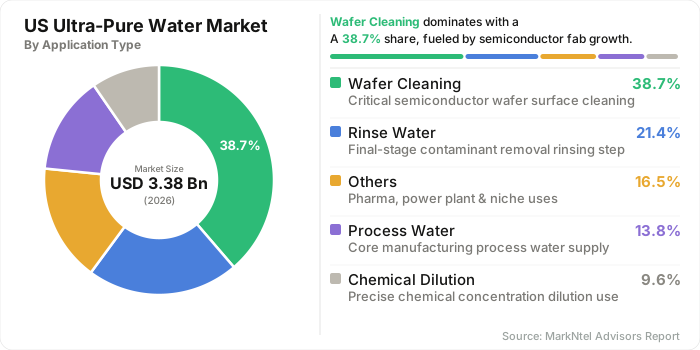
- Wafer cleaning remains the dominant application segment, accounting for 38.7% of the market share in 2026.
- By end user, the semiconductor segment leads the market with a 51.6% share in 2026.
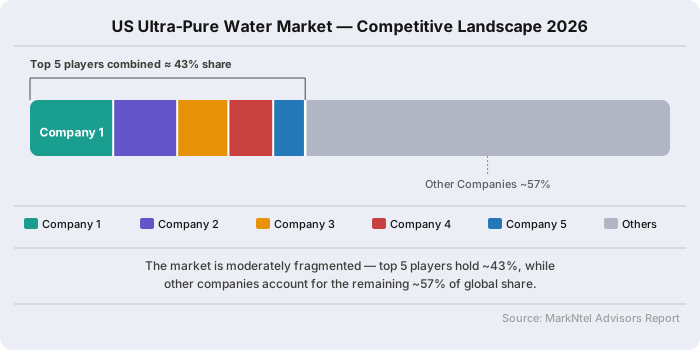
- The industry is moderately consolidated, with the top five companies collectively accounting for approximately 43% of the market in 2026.
US Ultra-Pure Water Market Size & Outlook
The ultra-pure water market in the United States is projected to grow at a CAGR of 7.84% during 2026–2032, increasing from USD 3.38 billion in 2026 to USD 5.32 billion by 2032, registering a compound annual growth rate (CAGR) of 7.84% during the forecast period (2026–2032).
Market growth is primarily driven by expanding investments in semiconductor fabrication, pharmaceutical manufacturing, and other high-value industrial sectors that require stringent water purity standards. The increasing deployment of ultra-pure water systems and advanced water treatment technologies is enabling manufacturers to enhance process efficiency, improve product quality, and maintain contamination-free production environments.
The continued expansion of the U.S. semiconductor ecosystem is creating sustained demand for sophisticated water purification infrastructure. According to the Semiconductor Industry Association (SIA), the United States accounted for 50.8% of the global fabless semiconductor industry's market share in 2024, highlighting the country's leadership in semiconductor innovation and design. As advanced manufacturing capacity continues to expand, fabrication facilities are increasing investments in high-capacity UPW generation, recycling, and polishing systems to support precision manufacturing operations.
Growth prospects are also supported by increasing innovation across the pharmaceutical and biotechnology industries. According to the U.S. Food and Drug Administration (FDA), the Center for Drug Evaluation and Research (CDER) approved 50 novel drugs in 2024, reflecting a strong pipeline of advanced therapeutics entering commercial production. The expansion of biologics manufacturing and sterile processing facilities continues to increase demand for validated high-purity process water systems capable of meeting stringent regulatory and quality requirements.
Looking ahead, technological advancements in membrane filtration, electrodeionization, digital water monitoring, and closed-loop water reuse are expected to reshape the competitive landscape. Rising investments in resource-efficient manufacturing, coupled with stricter environmental compliance requirements, are encouraging industrial operators to modernize water infrastructure and adopt sustainable purification solutions. These developments are expected to strengthen long-term demand for UPW technologies across semiconductor, pharmaceutical, power generation, and other critical manufacturing industries throughout the forecast period.
US Ultra-Pure Water Market Key Indicators
- According to the U.S. Department of Commerce, the CHIPS Incentives Program has finalized more than USD 32 billion in semiconductor manufacturing incentives as of December 2024, supporting over USD 450 billion in announced private-sector semiconductor investments across the United States. The expansion of advanced fabrication facilities significantly increases demand for ultrapure water production, polishing, and recycling systems required for leading-edge chip manufacturing.
- In July 2026, Taiwan Semiconductor Manufacturing Company (TSMC) announced an additional USD 100 billion investment in its U.S. operations, increasing its total planned U.S. investment to USD 265 billion to expand advanced semiconductor manufacturing capacity in Arizona, reinforcing long-term demand for ultra-pure water infrastructure.
- The U.S. Department of Energy reported in December 2024 that data center electricity demand could increase to between 325 and 580 TWh annually by 2028, driven primarily by AI computing and hyperscale facilities. The rapid deployment of liquid-cooled AI infrastructure is accelerating demand for high-purity process water and closed-loop cooling water treatment systems within next-generation data centers.
- According to the U.S. Environmental Protection Agency (EPA), over 46,000 facilities operate under the National Pollutant Discharge Elimination System (NPDES) permitting program, with industrial manufacturers required to comply with stringent wastewater discharge regulations. Increasing compliance requirements are encouraging manufacturers to invest in ultrapure water recycling, reuse, and advanced polishing technologies.
US Ultra-Pure Water Market Scope
| Category | Segments |
|---|---|
| By Treatment Technology | Reverse Osmosis (RO), Electrodeionization (EDI), Ultrafiltration/Microfiltration, UV Oxidation, Ion Exchange, Degasification & Membrane Contactors, Others |
| By Application | Wafer Cleaning, Chemical Dilution, Rinse Water, Process Water, Ingredient Water, Laboratory Water, Boiler Feed Water, Others |
| By End User | Semiconductor, Pharmaceuticals & Biotechnology, Power Generation, Food & Beverage, Healthcare & Laboratories, Chemicals & Petrochemicals, Research Institutes, Others |
US Ultra-Pure Water Market Growth Drivers
Semiconductor Manufacturing Expansion Fuels UPW Adoption
The expansion of domestic semiconductor manufacturing under the CHIPS and Science Act continues to accelerate demand for ultra-pure water infrastructure and semiconductor water treatment solutions across the United States. In April 2024, the U.S. Department of Commerce announced proposed CHIPS funding of up to USD 6.4 billion for Samsung Electronics to support more than USD 40 billion in private investment across advanced semiconductor manufacturing and R&D facilities in Texas. These projects require advanced UPW purification systems to sustain contamination-free wafer production.
The growing focus on advanced semiconductor packaging further strengthens investment in electronics-grade water systems with stringent purity requirements. In January 2025, the U.S. Department of Commerce launched the USD 1.4 billion National Advanced Packaging Manufacturing Program (NAPMP) to accelerate domestic packaging innovation and manufacturing capabilities. As next-generation packaging facilities expand, demand rises for multi-stage reverse osmosis, continuous electrodeionization, ultraviolet oxidation, and polishing technologies that ensure consistent ultrapure water quality throughout precision manufacturing processes.
Recent Trends
Integration of Advanced Membrane and Filtration Technologies
The rapid expansion of AI-driven hyperscale facilities is accelerating investments in data center water management and advanced membrane filtration technologies to improve cooling efficiency and water sustainability. In December 2024, the U.S. Department of Energy reported that domestic data center electricity demand is expected to double or triple by 2028, driven by artificial intelligence and cloud computing. As facilities adopt direct-to-chip liquid cooling architectures, operators increasingly integrate high-efficiency reverse osmosis and water reuse systems to secure reliable, high-quality process water.
The trend is further reinforced by continuous product innovation from technology providers. In August 2025, QUA Group, an Aquatech company, introduced three advanced membrane technologies, including FEDI® GIGA for high-flow ultrapure water production, EnviQ® RF ultrafiltration membranes, and Q-SEP® Q-Connect modular ultrafiltration systems. These innovations strengthen industrial water purification capabilities by improving purification efficiency, reducing system footprints, and supporting high-purity applications across semiconductor, power, and advanced manufacturing industries.
US Ultra-Pure Water Market Opportunities and Challenges
PFAS Compliance Accelerates Closed-Loop Water Innovation
The tightening regulatory framework surrounding per- and polyfluoroalkyl substances (PFAS) presents a significant challenge for industries dependent on industrial wastewater treatment and PFAS water treatment technologies. In April 2024, the U.S. Environmental Protection Agency (EPA) finalized the first-ever National Primary Drinking Water Regulation for six PFAS, establishing legally enforceable Maximum Contaminant Levels (MCLs) and requiring public water systems to complete initial monitoring and prepare for compliance within the prescribed implementation timeline. As semiconductor, pharmaceutical, and advanced manufacturing facilities increasingly handle fluorinated process chemicals, stricter discharge expectations are driving higher compliance costs and more complex wastewater management strategies.
The evolving regulatory landscape simultaneously creates substantial opportunities for advanced treatment providers offering zero liquid discharge (ZLD) and PFAS destruction solutions. In May 2025, Gradiant introduced ForeverGone™, an integrated PFAS removal and destruction technology capable of permanently eliminating PFAS without generating secondary hazardous waste streams. The launch expands the industry's transition from conventional adsorption technologies toward complete on-site PFAS destruction, enabling industrial customers to strengthen regulatory compliance while advancing sustainable water reuse and closed-loop manufacturing operations.
Segmentation Insights
Wafer Cleaning Leads UPW Consumption
Wafer Cleaning dominates the U.S. ultra-pure water industry, accounting for 38.7% of total market revenue in 2026, as it represents the most water-intensive application in semiconductor fabrication. The demand for wafer cleaning systems and electronics-grade water continues to increase with the expansion of advanced logic and memory manufacturing. According to SEMI, global silicon wafer shipments reached a record 12,266 million square inches (MSI) in 2024, reflecting sustained semiconductor production that directly elevates ultrapure water consumption for repeated cleaning and contamination control throughout wafer fabrication.
The segment's leadership is further reinforced by continued expansion of domestic semiconductor manufacturing capacity. In February 2025, Intel reaffirmed its commitment to the Ohio One semiconductor campus, representing an investment of more than USD 28 billion to establish two leading-edge fabrication facilities in Ohio. The project continues to strengthen long-term demand for ultra-pure water systems, as wafer cleaning remains the largest UPW application across photolithography, etching, deposition, and chemical mechanical polishing (CMP) processes. Based on application type, the industry is segmented into:
- Wafer Cleaning
- Chemical Dilution
- Rinse Water
- Process Water
- Ingredient Water
- Laboratory Water
- Boiler Feed Water
- Others
Semiconductor Manufacturing Powers UPW Market
The semiconductor sector dominates the U.S. ultra-pure water industry, accounting for 51.6% of total market share in 2026, driven by the industry's stringent water purity requirements across wafer fabrication processes. Demand for semiconductor UPW systems and high-purity water solutions continues to expand as domestic chip manufacturing capacity increases. According to SEMI, North America recorded USD 137.7 billion in semiconductor equipment billings during 2024, reflecting sustained investment in fabrication infrastructure that directly supports large-scale deployment of ultrapure water generation and polishing systems.
The segment's leadership is further supported by the expansion of domestic semiconductor research infrastructure. In January 2025, the U.S. Department of Commerce announced the first National Semiconductor Technology Center (NSTC) Prototyping and National Advanced Packaging Piloting Facility (NAPF), operated by Natcast, to accelerate advanced semiconductor manufacturing and packaging innovation in the United States. The establishment of these national R&D facilities is increasing demand for electronics-grade water systems capable of supporting pilot-scale fabrication, advanced packaging, precision cleaning, and contamination-controlled process development. By the end user type, the industry is further segmented into:
- Semiconductor
- Pharmaceuticals & Biotechnology
- Power Generation
- Food & Beverage
- Healthcare & Laboratories
- Chemicals & Petrochemicals
- Research Institutes
- Others
US Ultra-Pure Water Market Competitive Analysis
The United States ultra-pure water industry remains moderately consolidated, with the top five companies collectively accounting for 43% of the market in 2026. Market leadership is driven by comprehensive UPW system portfolios, proprietary membrane and electrodeionization technologies, strong engineering capabilities, and long-term service contracts with semiconductor, pharmaceutical, power generation, and advanced manufacturing facilities.
Top Companies in the US Ultra-Pure Water industry:
- Veolia Water Technologies & Solutions LLC
- Evoqua Water Technologies LLC (now operating as part of Xylem Inc.)
- Kurita America Inc.
- Ovivo USA LLC
- DuPont Water Solutions
- Ecolab Inc. (Nalco Water)
- Organo Corporation
- SUEZ Water Technologies & Solutions (operating under Veolia)
- Pall Corporation
- Pentair plc
US Ultra-Pure Water Industry News and Recent Developments
March 2025: DuPont Launches FilmTec™ Hypershell™ XP RO Elements for High-Purity Industrial Water Applications
DuPont Water Solutions introduced its FilmTec™ Hypershell™ XP Reverse Osmosis (RO) elements, engineered to deliver higher water productivity while reducing energy consumption across industrial water treatment applications. The new RO platform is designed for high-recovery operations and supports industries requiring stringent water quality, including semiconductor manufacturing, pharmaceuticals, and other advanced industrial processes.
Impact Analysis: The product launch strengthens DuPont's position in the U.S. ultra-pure water market by expanding its portfolio of next-generation membrane technologies. Improved membrane efficiency and higher recovery rates are expected to help industrial users optimize operating costs while enhancing the performance of high-purity water systems used in critical manufacturing environments
- Market Segmentation
- Introduction
- Product Definition
- Research Process
- Assumptions
- Executive Summary
- US Ultra-Pure Water Market Policies, Regulations, and Product Standards
- US Ultra-Pure Water Market Trends & Developments
- US Ultra-Pure Water Market Dynamics
- Growth Factors
- Challenges
- US Ultra-Pure Water Market Hotspot & Opportunities
- US Ultra-Pure Water Market Outlook, 2022-2032
- Market Size & Outlook
- By Revenues (USD Million)
- Market Share & Analysis
- By Treatment Technology- Market Size & Forecast 2022-2032, USD Million
- Reverse Osmosis (RO)
- Electrodeionization (EDI)
- Ultrafiltration/Microfiltration
- UV Oxidation
- Ion Exchange
- Degasification & Membrane Contactors
- Others
- By Application- Market Size & Forecast 2022-2032, USD Million
- Wafer Cleaning
- Chemical Dilution
- Rinse Water
- Process Water
- Ingredient Water
- Laboratory Water
- Boiler Feed Water
- Others
- By End User- Market Size & Forecast 2022-2032, USD Million
- Semiconductor
- Pharmaceuticals & Biotechnology
- Power Generation
- Food & Beverage
- Healthcare & Laboratories
- Chemicals & Petrochemicals
- Research Institutes
- Others
- By Region- Market Size & Forecast 2022-2032, USD Million
- North
- West
- South
- East
- By Company
- Competition Characteristics
- Market Share & Analysis
- By Treatment Technology- Market Size & Forecast 2022-2032, USD Million
- Market Size & Outlook
- North US Ultra-Pure Water Market Outlook, 2022-2032
- Market Size & Outlook
- By Revenues (USD Million)
- Market Segmentation & Analysis
- By Application- Market Size & Forecast 2022-2032, USD Million
- By End User- Market Size & Forecast 2022-2032, USD Million
- By Region- Market Size & Forecast 2022-2032, USD Million
- Market Size & Outlook
- West US Ultra-Pure Water Market Outlook, 2022-2032
- Market Size & Outlook
- By Revenues (USD Million)
- Market Segmentation & Analysis
- By Application- Market Size & Forecast 2022-2032, USD Million
- By End User- Market Size & Forecast 2022-2032, USD Million
- By Region- Market Size & Forecast 2022-2032, USD Million
- Market Size & Outlook
- US Ultra-Pure Water Market Outlook, 2022-2032
- Market Size & Outlook
- By Revenues (USD Million)
- Market Segmentation & Analysis
- By Application- Market Size & Forecast 2022-2032, USD Million
- By End User- Market Size & Forecast 2022-2032, USD Million
- By Region- Market Size & Forecast 2022-2032, USD Million
- Market Size & Outlook
- East US-Ultra Pure Water Market Outlook, 2022-2032
- Market Size & Outlook
- By Revenues (USD Million)
- Market Segmentation & Analysis
- By Application- Market Size & Forecast 2022-2032, USD Million
- By End User- Market Size & Forecast 2022-2032, USD Million
- By Region- Market Size & Forecast 2022-2032, USD Million
- Market Size & Outlook
- US Ultra-Pure Water Market Key Strategic Imperatives for Success & Growth
- Competitive Outlook
- Company Profiles
- Veolia Water Technologies & Solutions USA Inc.
- Business Description
- Product Portfolio
- Collaborations & Alliances
- Recent Developments
- Financial Details
- Others
- Xylem Inc.
- Business Description
- Product Portfolio
- Collaborations & Alliances
- Recent Developments
- Financial Details
- Others
- Kurita Water Industries Ltd.
- Business Description
- Product Portfolio
- Collaborations & Alliances
- Recent Developments
- Financial Details
- Others
- Organo Corporation
- Business Description
- Product Portfolio
- Collaborations & Alliances
- Recent Developments
- Financial Details
- Others
- Ovivo USA LLC
- Business Description
- Product Portfolio
- Collaborations & Alliances
- Recent Developments
- Financial Details
- Others
- DuPont de Nemours, Inc.
- Business Description
- Product Portfolio
- Collaborations & Alliances
- Recent Developments
- Financial Details
- Others
- Danaher Corporation
- Business Description
- Product Portfolio
- Collaborations & Alliances
- Recent Developments
- Financial Details
- Others
- Merck KGaA
- Business Description
- Product Portfolio
- Collaborations & Alliances
- Recent Developments
- Financial Details
- Others
- Pentair plc
- Business Description
- Product Portfolio
- Collaborations & Alliances
- Recent Developments
- Financial Details
- Others
- Toray Industries, Inc.
- Business Description
- Product Portfolio
- Collaborations & Alliances
- Recent Developments
- Financial Details
- Others
- Asahi Kasei Corporation
- Business Description
- Product Portfolio
- Collaborations & Alliances
- Recent Developments
- Financial Details
- Others
- Veolia Water Technologies & Solutions USA Inc.
- Company Profiles
- Disclaimer

MarkNtel Advisors follows a robust and iterative research methodology designed to ensure maximum accuracy and minimize deviation in market estimates and forecasts. Our approach combines both bottom-up and top-down techniques to effectively segment and quantify various aspects of the market. A consistent feature across all our research reports is data triangulation, which examines the market from three distinct perspectives to validate findings. Key components of our research process include:
1. Scope & Research Design At the outset, MarkNtel Advisors define the research objectives and formulate pertinent questions. This phase involves determining the type of research—qualitative or quantitative—and designing a methodology that outlines data collection methods, target demographics, and analytical tools. They also establish timelines and budgets to ensure the research aligns with client goals.
2. Sample Selection and Data Collection In this stage, the firm identifies the target audience and determines the appropriate sample size to ensure representativeness. They employ various sampling methods, such as random or stratified sampling, based on the research objectives. Data collection is carried out using tools like surveys, interviews, and observations, ensuring the gathered data is reliable and relevant.
3. Data Analysis and Validation Once data is collected, MarkNtel Advisors undertake a rigorous analysis process. This includes cleaning the data to remove inconsistencies, employing statistical software for quantitative analysis, and thematic analysis for qualitative data. Validation steps are taken to ensure the accuracy and reliability of the findings, minimizing biases and errors.

4. Data Forecast and FinalizationThe final phase involves forecasting future market trends based on the analyzed data. MarkNtel Advisors utilize predictive modeling and time series analysis to anticipate market behaviors. The insights are then compiled into comprehensive reports, featuring visual aids like charts and graphs, and include strategic recommendations to inform client decision-making
We’d love to understand what matters most to you.