

By Instrument Type (Handheld Instruments, Electrosurgical Instruments, Laparoscopic Instruments, Surgical Scopes, Cutting and Dissecting Instruments, Others), By Application (Neurosurgery, Plastic & R... ... surgery, Plastic & Reconstructive Surgery, Wound Closure, Obstetrics & Gynecology, Cardiovascular, Orthopedic, Others), By End User (Hospitals & Clinics, Ambulatory Surgery Centers, Others), and others Read more
- Healthcare
- Jul 2026
- 140
- PDF, Excel, PPT
US Surgical Instruments Market Key Takeaways
- The United States surgical instruments market was valued at USD 5.98 billion in 2025 and is projected to reach USD 12.38 billion by 2032 from USD 6.89 billion in 2026.
- The industry is projected to witness steady growth at a CAGR of 10.26% during the forecast period.
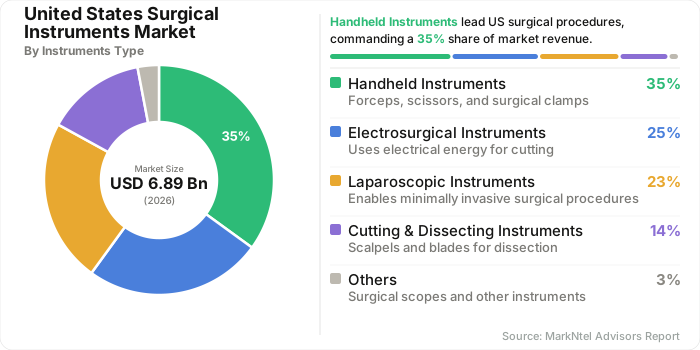
- Handheld instruments led the market by instrument type, accounting for 35% of the total market share in 2025.
- Orthopedic surgery dominated the market by application, capturing 25% of the overall market share.
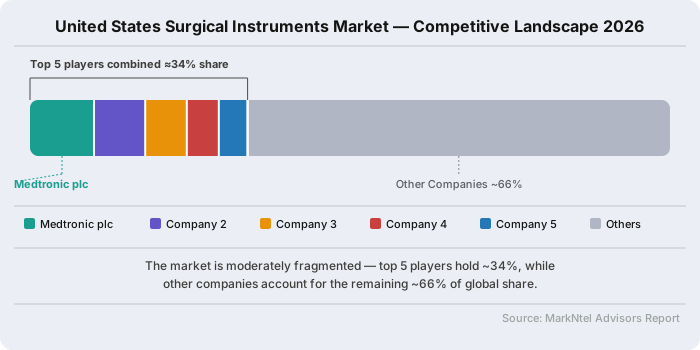
- The industry is moderately fragmented, with the top five companies collectively accounting for 34% of the market revenue.
US Surgical Instruments Market Size and Outlook
The surgical instruments market in the United States is valued at USD 5.98 billion in 2025, and is forecast to grow at a CAGR of 10.26% to reach USD 12.38 billion by 2032, rising from USD 6.89 billion in 2026. This trajectory is anchored in the country's accelerating aging demographic.
The U.S. Census Bureau reported that the population aged 65 and older reached 61.2 million in 2024, representing 18.0% of the total population, up from 12.4% in 2004, with this cohort growing 13.0% between 2020 and 2024 alone, significantly outpacing working-age population growth.
This demand is reinforced by an accelerating shift of procedures into outpatient settings under favorable federal policy. The Centers for Medicare & Medicaid Services (CMS) expanded its Ambulatory Surgical Center Covered Procedures List by 32 new and 33 previously non payable procedures in 2025, widening the range of interventions ambulatory facilities can perform without hospital admission. CMS is also launching a five-year voluntary prior authorization demonstration across 10 states, including Texas, Florida, and New York, effective December 2025, covering procedures such as rhinoplasty and vein ablation, and requiring instrument manufacturers to align their documentation with new federal review protocols.
Regulatory clearances are simultaneously enabling new instrument supply models. In March 2026, Restore Robotics received additional FDA 510(k) clearances for remanufacturing two more da Vinci Xi robotic surgical instruments, expanding cost-effective, sustainable alternatives to new OEM instruments for U.S. hospitals and surgery centers. This follows the FDA's broader acceleration of innovation pathways, having granted 136 breakthrough device designations in fiscal year 2025, supporting faster commercialization of next-generation surgical tools.
With the population aged 65 and older projected to climb to 82 million by 2050, nearly a quarter of all Americans, structural demand for procedural volume is set to persist well beyond the current forecast horizon. Sustained federal reimbursement support for outpatient care, combined with expanding regulatory pathways for instrument innovation, position the coming years for continued, demographically underpinned expansion.
US Surgical Instruments Market Key Indicators
- According to the CDC's latest National Diabetes Statistics Report (2026), 29.1 million Americans have been diagnosed with diabetes. The rising burden of diabetes continues to increase the need for surgical interventions to manage complications such as diabetic foot ulcers, peripheral vascular disease, and severe infections. As a result, healthcare providers perform a growing number of vascular access procedures, wound debridement surgeries, and lower-limb amputations, all of which require specialized surgical instruments. This expanding surgical workload is supporting consistent demand for advanced surgical instrumentation across hospitals, ambulatory surgery centers, and specialty clinics throughout the United States.
- According to the Agency for Healthcare Research and Quality (AHRQ, 2024), more than 9 million inpatient hospital stays in the United States involve surgical procedures each year, representing over one-fourth of all hospital admissions. This consistently high surgical volume reflects the country's strong reliance on inpatient surgical care for treating a wide range of acute and chronic conditions. As a result, hospitals require a continuous supply of general, orthopedic, and intra-abdominal surgical instrument sets to support routine and complex procedures, thereby sustaining steady demand for surgical instruments across the U.S. healthcare system.
- CMS introduced the Hospital-Level Total Hip Arthroplasty (THA)/Total Knee Arthroplasty (TKA) Patient-Reported Outcome-Based Performance Measure under its Hospital Inpatient Quality Reporting (IQR) Program, with pre-operative data collection beginning in July 2024 and mandatory reporting commencing for the July 2025–June 2026 reporting period. These quality reporting requirements encourage hospitals to standardize surgical workflows, documentation, and instrumentation to support consistent outcomes and meet Medicare quality and reimbursement benchmarks.
US Surgical Instruments Market Scope
| Category | Segments |
|---|---|
| By Instrument Type | (Handheld Instruments, Electrosurgical Instruments, Laparoscopic Instruments, Surgical Scopes, Cutting and Dissecting Instruments, Others), |
| By Application | (Neurosurgery, Plastic & Reconstructive Surgery, Wound Closure, Obstetrics & Gynecology, Cardiovascular, Orthopedic, Others), |
| By End User | (Hospitals & Clinics, Ambulatory Surgery Centers, Others), |
US Surgical Instruments Market Growth Drivers
Rising Joint Pain and Arthritis Prevalence Among Aging Americans Driving Orthopedic Instrument Demand
The age-adjusted prevalence of diagnosed arthritis among U.S. adults reached 18.9% in 2022, rising from 3.6% among adults aged 18–34 to 53.9% among adults aged 75 and older, according to the CDC's National Center for Health Statistics, published February 2024 (NCHS Data Brief No. 497, 2024). This steep age gradient concentrates progressive joint degeneration in the older population, creating direct, recurring demand for orthopedic surgical instrument sets used in hip and knee arthroplasty.
Additionally, 24.3% of U.S. adults reported chronic pain and 8.5% reported high-impact chronic pain that limited daily activity in 2023, according to the CDC's National Center for Health Statistics, published November 2024 (NCHS Data Brief No. 518, 2024). Both conditions rose sharply with age: chronic pain reached 36.0% and high-impact chronic pain reached 13.5% among adults aged 65 and older, compared with 12.3% and 3.0%, respectively, among adults aged 18–29.
Instrument manufacturers supplying arthroplasty-specific tooling, rather than general surgical sets, are positioned to capture demand concentrated in the fastest-growing segment of the U.S. population as this pain burden compounds with age.
Recent Trends
Faster FDA Clearance Pathways Accelerating AI-Guided Surgical Instrument Adoption
The FDA cleared 295 artificial intelligence and machine learning-enabled medical devices in 2025, lifting cumulative authorizations to 1,451 since it began tracking such devices in 1995. Median review time for 2025 clearances fell to 142 days, with a quarter of submissions cleared in under 90 days. Furthermore, within orthopedic surgery specifically, the pace of AI device clearances rose from 3.0 per year during 2017–2019 to 16.6 per year during 2022–2024, with spinal instrumentation accounting for 42.9% of clearances and hip and knee instrumentation for 20.0%.
Additionally, this faster regulatory pathway is translating directly into instrument-level adoption. Medtronic's Stealth Axis Surgical System, cleared in 2026, replaces freehand pedicle screw placement tools with AI-guided navigation hardware for U.S. spine procedures, directing the tool path in real time rather than relying on visual estimation.
As FDA review timelines continue compressing, faster clearance is enabling a broader wave of AI-guided instrumentation to reach U.S. operating rooms, pushing demand toward sensor- and navigation-equipped instruments and away from conventional freehand tools across spine, hip, and knee procedures.
US Surgical Instruments Market Opportunities and Challenges
High Sterilization Compliance Costs Create Growth Opportunities for Single-Use Surgical Instruments
Healthcare providers across the United States are facing increasing operational challenges as stricter infection prevention regulations and sterile processing requirements raise the cost of maintaining reusable surgical instruments. The implementation of updated CMS hospital infection control survey guidelines in July 2025 has intensified oversight of sterile processing departments, requiring hospitals to invest more in staff training, equipment validation, documentation, and quality assurance. In addition, rising labor shortages within central sterile services departments and the growing complexity of surgical instrument reprocessing are increasing turnaround times and operating costs. As hospitals and ambulatory surgery centers (ASCs) seek to maintain compliance while improving workflow efficiency, many are shifting toward sterile, single-use surgical instruments that eliminate reprocessing requirements and reduce the risk of cross-contamination.
This operational challenge is creating a significant market opportunity for surgical instrument industry manufacturers offering disposable and procedure-specific surgical instruments. Responding to this demand, leading companies are expanding their manufacturing and innovation capabilities. In 2025, Johnson & Johnson announced an investment of more than USD 55 billion in U.S. manufacturing , research, and technology infrastructure, including MedTech operations, while Zimmer Biomet partnered with Getinge to enhance integrated operating room and infection prevention solutions for ambulatory surgery centers, further supporting the growing adoption of advanced surgical instruments across the U.S. surgical instruments industry.
Segmentation Insights
Handheld Instruments Lead the Industry with 35% Share Owing to Their Essential Role Across Surgical Procedures
Handheld instruments account for leading share in the United States surgical instruments industry due to their indispensable role across general surgery, orthopedics, cardiovascular, gynecology, neurosurgery, and minimally invasive procedures. Instruments such as forceps, retractors, graspers, dilators, and spatulas are fundamental for tissue manipulation, exposure, dissection, and wound closure, making them the most frequently used surgical devices in hospitals and ambulatory surgery centers (ASCs). The segment continues to benefit from rising surgical volumes and increasing demand for precision, ergonomics, and workflow efficiency. Manufacturers are also transforming conventional handheld instruments by integrating robotics, navigation, and intelligent sensing technologies.
Companies’ specific examples, such as in 2025, include THINK Surgical commercializing its TMINI® Miniature Robotic System, a compact, handheld robotic platform for total knee arthroplasty that delivers robotic precision without the footprint of traditional robotic systems, making it well-suited for ASCs. In late 2025, MMI received FDA clearance for its Nano-Wrist® robotic microsurgical scissors and forceps, enabling surgeons to perform highly precise soft tissue procedures on microscopic vessels. Further advancing the segment, Foundation Surgical received FDA clearance in 2026 for its Navigated Inter wedge System, integrating handheld spinal instruments with real-time navigation platforms to improve procedural accuracy and surgical outcomes. By the instrument type, the market is further segmented into the following sub-categories:
- Handheld Instruments
- Electrosurgical Instruments
- Laparoscopic Instruments
- Surgical Scopes
- Cutting and Dissecting Instruments
- Others
Orthopedic Surgery Leads the Industry with Approximately 25% Share Owing to Rising Joint Replacement Procedures
Orthopedic surgery accounts for approximately 25% of the U.S. surgical instruments market, making it the largest application segment. Growth is primarily driven by the increasing prevalence of osteoarthritis, osteoporosis, sports injuries, and other musculoskeletal disorders, particularly among the aging population, which continues to increase the volume of hip, knee, and shoulder replacement procedures. These surgeries require a wide range of specialized instruments, including cutting guides, reamers, fixation devices, and navigation-enabled systems, resulting in higher instrument utilization per procedure than most other surgical specialties. Demand is further supported by the growing adoption of robotic-assisted orthopedic surgery, which relies on precision-engineered instrumentation to improve surgical accuracy and patient outcomes.
Reflecting this, Smith & Nephew launched the AETOS™ Shoulder System in the U.S. in 2024 and expanded its CORIOGRAPH™ planning platform to support total hip arthroplasty in 2025. Additionally, CONMED Corporation introduced the BioBrace® RC Delivery System in 2025 following FDA 510(k) clearance, expanding its orthopedic soft-tissue repair portfolio. Further reinforcing market growth, the American Joint Replacement Registry (AJRR) surpassed 4 million recorded hip and knee replacement procedures in 2024, while ambulatory surgery center (ASC) joint replacement volumes continued to rise, driving demand for efficient, procedure-specific surgical instrument systems. By application the market is further segmented into the following sub-categories:
- Neurosurgery
- Plastic & Reconstructive Surgery
- Wound Closure
- Obstetrics & Gynecology
- Cardiovascular
- Orthopedic
- Others
US Surgical Instruments Market Competitive Landscape
The U.S. surgical instruments market remains moderately fragmented, with a small number of diversified medical technology companies commanding the majority of instrument categories across handheld, electrosurgical, laparoscopic, and orthopedic segments. The top 5 market players are Medtronic plc, Johnson & Johnson MedTech, Stryker Corporation, Intuitive Surgical, Inc., and Boston Scientific Corporation, with top 5 companies sharing a collective share of 34%.
Major Surgical Instruments Companies in the United States
- Medtronic plc
- Johnson & Johnson
- Stryker Corporation
- Intuitive Surgical, Inc.
- Boston Scientific Corporation
- Smith & Nephew plc
- B. Braun SE
- Olympus Corporation
- CONMED Corporation
- Cardinal Health, Inc.
US Surgical Instruments Market News and Recent Developments
2026: Boston Scientific Announces Agreement to Acquire Penumbra for Approximately USD 14.5 Billion
Boston Scientific Corporation and Penumbra, Inc. entered a definitive agreement under which Boston Scientific will acquire Penumbra in a cash-and-stock transaction valuing the company at $374 per share, reflecting an enterprise value of approximately $14.5 billion. The deal gives Boston Scientific scaled entry into mechanical thrombectomy and neurovascular device categories, adjacent to its existing cardiovascular surgical instrument portfolio. The transaction is structured to preserve Penumbra's existing manufacturing and R&D operations and is expected to close within the year, subject to customary regulatory clearance and shareholder approval.
Impact Analysis: The acquisition strengthens Boston Scientific's competitive positioning in vascular and neurovascular instrument categories, narrowing the capability gap with larger diversified competitors and raising the capital threshold smaller players face when competing in thrombectomy-adjacent instrument lines. It signals continued consolidation pressure across the broader U.S. surgical device supply base heading into 2027.
2026: Stryker Launches TPX HD® Power Tool for Small Bone Surgical Procedures
In June 2026, Stryker launched the TPX HD® Power Tool, a next -generation surgical power instrument designed for small bone orthopedic procedures. The system is intended for use in orthopedic, revision, minimally invasive, oral-maxillofacial, hand, wrist, foot, and ankle surgeries. It features a lightweight ergonomic design, high-speed performance, and improved precision to enhance surgical efficiency and provide greater control during complex procedures. The launch expands Stryker's portfolio of powered surgical instruments, addressing the growing demand for advanced tools that support minimally invasive and precision-based surgeries.
Market Impact Analysis: The launch strengthens competition in the U.S. Surgical Instruments Market by expanding the availability of advanced powered surgical instruments. It is expected to drive the adoption of high-performance orthopedic surgical tools, improve procedural efficiency and precision, and support the increasing preference for minimally invasive surgeries across hospitals and ambulatory surgical centers in the United States.
2025: Triopsy Medical Receives FDA 510(k) Clearance for Integrated Biopsy System
In January 2025, Triopsy Medical received U.S. FDA 510(k) clearance for its Integrated Biopsy System (IBS), an all-in-one device designed to streamline prostate biopsy procedures. The system integrates multiple biopsy components into a single handheld instrument, reducing procedural complexity, minimizing instrument exchanges, and improving workflow efficiency. The device is intended to support more accurate tissue sampling while simplifying prostate cancer diagnosis in hospitals, ambulatory surgical centers, and urology clinics.
Market Impact Analysis: The FDA clearance strengthens innovation in the U.S. Surgical Instruments Market by expanding the availability of advanced minimally invasive biopsy instruments. It is expected to increase the adoption of integrated surgical devices in urology, improve procedural efficiency, reduce operating time, and encourage manufacturers to develop multifunctional surgical instruments that enhance precision and clinical outcomes.
2025: Zimmer Biomet Announces Definitive Agreement to Acquire Monogram Technologies, Expanding Robotics Suite with Autonomous Solutions
In July 2025, Zimmer Biomet announced a definitive agreement to acquire Monogram Technologies for an upfront equity value of approximately USD 177 million. The acquisition expands Zimmer Biomet's orthopedic robotics portfolio by integrating Monogram's semi-autonomous and future fully autonomous robotic technologies into its ROSA Robotics platform. The transaction is expected to strengthen the company's navigation and AI-enabled surgical solutions, support revenue growth from 2027 onward, and enhance its ability to offer a broader range of robotic-assisted orthopedic procedures.
Market Impact Analysis: The acquisition is expected to accelerate innovation in the U.S. Surgical Instruments Market by increasing the adoption of robotic-assisted surgical instruments and AI-enabled navigation systems. It will intensify competition among leading surgical device manufacturers while driving demand for precision orthopedic instruments, advanced robotic platforms, and minimally invasive surgical technologies across U.S. hospitals and ambulatory surgical centers.
- Market Segmentation
- Introduction
- Product Definition
- Research Process
- Assumptions
- Executive Summary
- US Surgical Instruments Market Policies, Regulations, and Product Standards
- US Surgical Instruments Market Trends & Developments
- US Surgical Instruments Market Dynamics
- Growth Factors
- Challenges
- US Surgical Instruments Market Hotspot & Opportunities
- US Surgical Instruments Market Outlook, 2022-2032
- Market Size & Outlook
- By Revenues (USD Million)
- Market Share & Outlook
- By Instrument Type- Market Size & Forecast 2022-2032, USD Million
- Handheld Instruments
- Electrosurgical Instruments
- Laparoscopic Instruments
- Surgical Scopes
- Cutting and Dissecting Instruments
- Others
- By Application- Market Size & Forecast 2022-2032, USD Million
- Neurosurgery
- Plastic & Reconstructive Surgery
- Wound Closure
- Obstetrics & Gynecology
- Cardiovascular
- Orthopedic
- Others
- By End User - Market Size & Forecast 2022-2032, USD Million
- Hospitals & Clinics
- Ambulatory Surgery Centers
- Others
- By Region - Market Size & Forecast 2022-2032, USD Million
- North
- South
- East
- West
- Central
- By Company
- Competition Characteristics
- Market Share & Analysis
- By Instrument Type- Market Size & Forecast 2022-2032, USD Million
- Market Size & Outlook
- US Handheld Surgical Instruments Market Outlook, 2022-2032
- Market Size & Outlook
- By Revenues (USD Million)
- Market Share & Outlook
- By Application- Market Size & Forecast 2022-2032, USD Million
- By End User - Market Size & Forecast 2022-2032, USD Million
- By Region - Market Size & Forecast 2022-2032, USD Million
- Market Size & Outlook
- US
- Market Size & Outlook
- By Revenues (USD Million)
- Market Share & Outlook
- By Application- Market Size & Forecast 2022-2032, USD Million
- By End User - Market Size & Forecast 2022-2032, USD Million
- By Region - Market Size & Forecast 2022-2032, USD Million
- Market Size & Outlook
- US Laparoscopic Surgical Instruments Market Outlook, 2022-2032
- Market Size & Outlook
- By Revenues (USD Million)
- Market Share & Outlook
- By Application- Market Size & Forecast 2022-2032, USD Million
- By End User - Market Size & Forecast 2022-2032, USD Million
- By Region - Market Size & Forecast 2022-2032, USD Million
- Market Size & Outlook
- US
- Market Size & Outlook
- By Revenues (USD Million)
- Market Share & Outlook
- By Application- Market Size & Forecast 2022-2032, USD Million
- By End User - Market Size & Forecast 2022-2032, USD Million
- By Region - Market Size & Forecast 2022-2032, USD Million
- Market Size & Outlook
- US Cutting and Dissecting Instruments Market Outlook, 2022-2032
- Market Size & Outlook
- By Revenues (USD Million)
- Market Share & Outlook
- By Application- Market Size & Forecast 2022-2032, USD Million
- By End User - Market Size & Forecast 2022-2032, USD Million
- By Region - Market Size & Forecast 2022-2032, USD Million
- Market Size & Outlook
- Surgical Instrument Market Key Strategic Imperatives for Success & Growth
- Competitive Outlook
- Company Profiles
- Medtronic plc
- Business Description
- Product Portfolio
- Collaborations & Alliances
- Recent Developments
- Financial Details
- Others
- Boston Scientific Corporation
- Business Description
- Product Portfolio
- Collaborations & Alliances
- Recent Developments
- Financial Details
- Others
- Johnson & Johnson
- Business Description
- Product Portfolio
- Collaborations & Alliances
- Recent Developments
- Financial Details
- Others
- CONMED Corporation
- Business Description
- Product Portfolio
- Collaborations & Alliances
- Recent Developments
- Financial Details
- Others
- Smith & Nephew plc
- Business Description
- Product Portfolio
- Collaborations & Alliances
- Recent Developments
- Financial Details
- Others
- B. Braun SE
- Business Description
- Product Portfolio
- Collaborations & Alliances
- Recent Developments
- Financial Details
- Others
- Olympus Corporation
- Business Description
- Product Portfolio
- Collaborations & Alliances
- Recent Developments
- Financial Details
- Others
- Cardinal Health, Inc.
- Business Description
- Product Portfolio
- Collaborations & Alliances
- Recent Developments
- Financial Details
- Others
- Stryker Corporation
- Business Description
- Product Portfolio
- Collaborations & Alliances
- Recent Developments
- Financial Details
- Others
- Intuitive Surgical, Inc.
- Business Description
- Product Portfolio
- Collaborations & Alliances
- Recent Developments
- Financial Details
- Others
- Medtronic plc
- Company Profiles
- Disclaimer

MarkNtel Advisors follows a robust and iterative research methodology designed to ensure maximum accuracy and minimize deviation in market estimates and forecasts. Our approach combines both bottom-up and top-down techniques to effectively segment and quantify various aspects of the market. A consistent feature across all our research reports is data triangulation, which examines the market from three distinct perspectives to validate findings. Key components of our research process include:
1. Scope & Research Design At the outset, MarkNtel Advisors define the research objectives and formulate pertinent questions. This phase involves determining the type of research—qualitative or quantitative—and designing a methodology that outlines data collection methods, target demographics, and analytical tools. They also establish timelines and budgets to ensure the research aligns with client goals.
2. Sample Selection and Data Collection In this stage, the firm identifies the target audience and determines the appropriate sample size to ensure representativeness. They employ various sampling methods, such as random or stratified sampling, based on the research objectives. Data collection is carried out using tools like surveys, interviews, and observations, ensuring the gathered data is reliable and relevant.
3. Data Analysis and Validation Once data is collected, MarkNtel Advisors undertake a rigorous analysis process. This includes cleaning the data to remove inconsistencies, employing statistical software for quantitative analysis, and thematic analysis for qualitative data. Validation steps are taken to ensure the accuracy and reliability of the findings, minimizing biases and errors.

4. Data Forecast and FinalizationThe final phase involves forecasting future market trends based on the analyzed data. MarkNtel Advisors utilize predictive modeling and time series analysis to anticipate market behaviors. The insights are then compiled into comprehensive reports, featuring visual aids like charts and graphs, and include strategic recommendations to inform client decision-making
We’d love to understand what matters most to you.