

By Water Source Type (Municipal Wastewater, Industrial Wastewater, Stormwater & Rainwater, Other Alternative Water Sources), By Technology (Membrane Filtration (Microfiltration (MF), Ultrafiltration (... ... ), Ultrafiltration (UF), Nanofiltration (NF), Reverse Osmosis (RO)), Biological Treatment, Advanced Oxidation & Disinfection, Activated Carbon & Ion Exchange, Conventional Filtration, Hybrid & Integrated Treatment), By Application (Potable Water Reuse, Industrial Process Water, Cooling Water, Boiler Feed Water, Irrigation & Landscaping, Construction Activities, Environmental & Surface Water Replenishment, Other Non-Potable Applications), By End User (Municipal Utilities, Industrial (Semiconductor & Electronics, Chemicals & Petrochemicals, Food & Beverage, Pharmaceuticals & Life Sciences, Power Generation, Others), Commercial, Residential, Government & Public Infrastructure) Read more
- Environment
- Jul 2026
- 160
- PDF, Excel, PPT
Taiwan Water Recycle and Reuse Market Key Takeaways
- The Taiwan water recycle & reuse market was valued at USD 755 million in 2025 and is projected to grow from USD 831 million in 2026 to USD 1,473 million by 2032.
- The industry is projected to witness steady growth at a CAGR of 10.0% during 2026–2032.
- By technology, membrane filtration systems dominate the market, accounting for 46.8% of the total market share in 2026.
- By water source, industrial wastewater remains the leading segment, holding 52.3% market share in 2026.
- The market remains moderately fragmented, with the top five companies collectively accounting for 32.0% of the market share in 2026.
Taiwan Water Recycle and Reuse Market Size & Outlook
The Taiwan water recycle & reuse market is valued at USD 755 million in 2025 and is projected to reach USD 831 million in 2026, before expanding to USD 1,473 million by 2032, registering a CAGR of 10.0% during the forecast period.
The market continues to benefit from increasing investments in water security, industrial sustainability, and resilient water infrastructure as manufacturers seek to reduce dependence on conventional freshwater supplies. Growing adoption of industrial water reuse solutions is expected to remain a key contributor to market expansion throughout the forecast period.
Taiwan's long-term infrastructure investment strategy further supports market growth. According to the Ministry of Economic Affairs (MOEA), the government continues implementing its 10-year water infrastructure improvement program, valued at approximately USD 5.67 billion, covering reservoir enhancement, pipeline modernization, water treatment facilities, and network resilience. While the program addresses the broader water sector, it also creates favorable conditions for expanding reclaimed water infrastructure and advanced treatment systems, stimulating demand for water infrastructure modernization and sustainable water management solutions.
The country's expanding semiconductor ecosystem also strengthens the long-term outlook for water recycling technologies. According to TSMC's 2024 Sustainability Report, the company contracted approximately 45,000 m³/day of reclaimed water during 2024 to support manufacturing operations, reflecting the increasing integration of alternative water resources into advanced semiconductor production. As next-generation fabrication facilities require highly reliable process water, investments in semiconductor water reuse systems continue to accelerate across Taiwan's industrial landscape.
Taiwan's market outlook is further reinforced by ongoing improvements in urban water efficiency and favorable global industry trends. According to the Taipei Water Department, the city continues investing approximately USD 780 million in pipeline renewal and leakage reduction initiatives, targeting a reduction in water loss to below 10% through network modernization. At the same time, the International Water Association (IWA) identifies sustained global investment in water reuse technologies and circular water management as a key growth driver, enabling Taiwanese technology providers and infrastructure developers to capitalize on increasing demand for advanced water recycling technologies and smart water infrastructure both domestically and internationally.
Taiwan Water Recycle and Reuse Market Key Indicators
- According to the Water Resources Agency (WRA), Ministry of Economic Affairs, Taiwan's 11 reclaimed water plants are either operational or under construction as of 2025, strengthening long-term industrial water security in major science parks and water-deficient regions through dedicated reclaimed water infrastructure.
- The National Science and Technology Council (NSTC) reports that Taiwan's three major science parks approved over USD 59 billion in new investment commitments during 2024, reinforcing sustained demand for high-purity recycled process water across semiconductor and advanced electronics manufacturing facilities.
- According to UN Comtrade (HS Code 8421), Taiwan imported more than USD 1.6 billion worth of filtering and purifying machinery and apparatus during 2024, reflecting continued investment in advanced membrane filtration, reverse osmosis, and industrial water treatment systems.
- Taiwan's Reclaimed Water Resources Development Act, administered by the Water Resources Agency (WRA), Ministry of Economic Affairs, requires eligible new high-water-use developments to incorporate reclaimed water into approved water-use plans. The government is simultaneously targeting a reclaimed water supply capacity of 1.32 million m³/day by 2031, equivalent to around 10% of Taiwan's total water supply, creating a strong policy foundation.
Taiwan Water Recycle and Reuse Market Scope
| Category | Segments |
|---|---|
| By Water Source Type | Municipal Wastewater, Industrial Wastewater, Stormwater & Rainwater, Other Alternative Water Sources |
| By Technology | Membrane Filtration (Microfiltration (MF), Ultrafiltration (UF), Nanofiltration (NF), Reverse Osmosis (RO)), Biological Treatment, Advanced Oxidation & Disinfection, Activated Carbon & Ion Exchange, Conventional Filtration, Hybrid & Integrated Treatment |
| By Application | Potable Water Reuse, Industrial Process Water, Cooling Water, Boiler Feed Water, Irrigation & Landscaping, Construction Activities, Environmental & Surface Water Replenishment, Other Non-Potable Applications |
| By End User | Municipal Utilities, Industrial (Semiconductor & Electronics, Chemicals & Petrochemicals, Food & Beverage, Pharmaceuticals & Life Sciences, Power Generation, Others), Commercial, Residential, Government & Public Infrastructure |
Taiwan Water Recycle and Reuse Market Growth Driver
Escalating Water Security Challenges Accelerate Industrial Water Reuse Investments
Taiwan's increasing exposure to climate variability and prolonged dry-season risks continues to accelerate investment in industrial water resilience and advanced water reclamation solutions. According to the Water Resources Agency (WRA), Ministry of Economic Affairs, the authority conducted 17 dedicated water-condition coordination meetings before and during the 2024 dry season while implementing nationwide water-saving dispatch measures that conserved approximately 760 million m³ of water, underscoring the strategic importance of recycled water for maintaining uninterrupted industrial production and public supply.
The country's high-tech manufacturing ecosystem further reinforces demand for semiconductor water recycling and circular water infrastructure as stable process-water availability becomes a critical production requirement. The Ministry of Economic Affairs (MOEA) reports that Taiwan entered the 2024–2025 dry season with major water supply reservoirs maintaining an average storage rate of approximately 95% following proactive reservoir management, rainfall capture, and optimized water dispatch operations. This continued emphasis on drought preparedness encourages wider deployment of industrial water reuse systems to strengthen long-term supply security amid increasingly volatile climate conditions.
Recent Trends
Smart Water Digitalization is Optimizing Water Operations
Taiwan's water reuse sector increasingly adopts smart water management and digital water monitoring technologies to improve operational efficiency and process reliability. According to the Industrial Development Administration (IDA), Ministry of Economic Affairs, the government continues expanding its Industrial Water Efficiency Improvement Program during 2024–2025, providing technical guidance and digital optimization support for manufacturers to strengthen water conservation and process water recovery. This trend accelerates the deployment of intelligent monitoring platforms capable of real-time water quality analysis, leak detection, and predictive maintenance across industrial facilities.
The increasing complexity of semiconductor manufacturing is accelerating the adoption of membrane filtration systems and ultrapure water treatment solutions across Taiwan's industrial facilities. SEMI states that next-generation semiconductor fabrication requires increasingly stringent water purity and contamination control standards, driving demand for advanced RO, UF, EDI, and MBR technologies. Supporting this trend, Kurita Water Industries Ltd. launched S.sensing WEB 2.0 in April 2024, a cloud-based remote water treatment monitoring platform that enables five-minute data acquisition intervals, predictive analytics, and remote operational management to optimize industrial water reuse efficiency and improve plant reliability.
Taiwan Water Recycle and Reuse Market Opportunities and Challenges
Rising Industrial Water Consumption Unlocks Smart Reuse Opportunities
Taiwan's rapidly expanding high-tech manufacturing sector continues to place significant pressure on available water resources, creating challenges for industrial water sustainability and high-purity water treatment. According to the National Science and Technology Council (NSTC), the three major science parks consumed approximately 236.4 million metric tons of water in 2024, reflecting sustained growth in water-intensive semiconductor and advanced electronics production. At the same time, increasingly stringent discharge requirements under the Ministry of Environment's (MOENV) Water Pollution Control Act require manufacturers to invest in advanced wastewater treatment and higher recovery efficiencies, raising capital expenditure and operating costs for industrial facilities while increasing the complexity of water management systems.
These challenges simultaneously create substantial opportunities for advanced water reuse technologies and industrial wastewater recycling solutions as manufacturers seek to improve water security and operational resilience. Supporting this opportunity, Xylem Inc. introduced its Vue powered by GoAigua digital water platform in 2024, enabling utilities and industrial operators to integrate real-time network analytics, predictive monitoring, and intelligent water management into reuse infrastructure. The platform enhances operational efficiency, reduces non-revenue water losses, and optimizes reclaimed water distribution, aligning with Taiwan's accelerating adoption of digitalized industrial water systems and strengthening the long-term outlook for smart water recycling investments.
Segmentation Insights
Advanced Membrane Technologies Strengthen Technology Segment Leadership
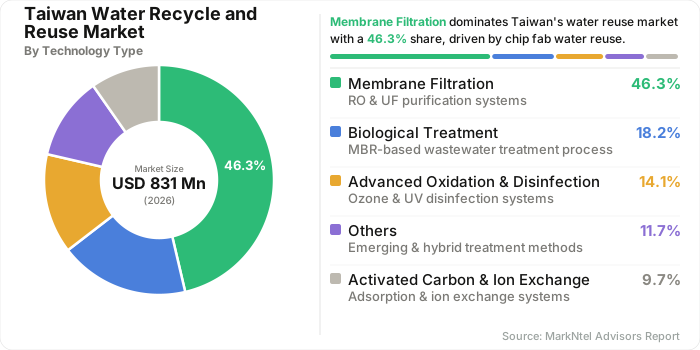
The membrane filtration systems segment dominates the Taiwan water recycle & reuse industry, accounting for 46.8% market share in 2026, making it the leading technology category. The extensive deployment of Reverse Osmosis (RO), Ultrafiltration (UF), Microfiltration (MF), and Nanofiltration (NF) across semiconductor fabrication, electronics manufacturing, industrial wastewater reclamation, and municipal water reuse projects continues to drive segment growth. Increasing adoption of membrane separation technology and industrial water purification systems is further supported by Taiwan's stringent process-water quality requirements, particularly within high-value manufacturing industries requiring reliable high-purity recycled water.
Continuous technological innovation reinforces the segment's market leadership. In April 2024, Kurita Water Industries Ltd. launched S.sensing WEB 2.0, a cloud-based digital platform that integrates real-time monitoring, predictive analytics, and remote operational management for industrial water treatment facilities. The solution enhances membrane system performance by enabling proactive maintenance and optimizing filtration efficiency, supporting higher operational reliability for advanced water recycling plants. As Taiwan continues expanding high-performance industrial water treatment infrastructure, investments in intelligent membrane filtration solutions are expected to strengthen the long-term commercial position of this technology segment. Based on technology type, the industry is segmented into:
- Membrane Filtration
- Biological Treatment
- Advanced Oxidation & Disinfection
- Activated Carbon & Ion Exchange
- Conventional Filtration
- Hybrid & Integrated Treatment
Industrial Wastewater Dominates Water Source Segment Through High Industrial Water Demand
The Industrial Wastewater segment accounts for an estimated 52.3% of the Taiwan water recycle & reuse industry in 2026, making it the largest water source segment. Taiwan's export-oriented manufacturing base continues to generate significant volumes of process wastewater requiring advanced treatment and reuse. According to the Ministry of Environment (MOENV), industrial wastewater discharge permits exceeded 19,000 active facilities in 2024, reflecting the extensive industrial base requiring wastewater treatment and reclamation. This large industrial footprint continues to accelerate demand for industrial wastewater recycling solutions, particularly across semiconductor, electronics, petrochemical, and precision manufacturing industries.
The segment's leadership is further reinforced by ongoing investments in industrial water recycling infrastructure. In September 2024, Taiwan Semiconductor Manufacturing Company (TSMC) confirmed that its advanced manufacturing facilities continue expanding reclaimed water utilization and high-efficiency water recovery systems as part of its sustainability roadmap. Additionally, TSMC's 2024 Sustainability Report states that the company achieved a process water recycling rate exceeding 87% across its global manufacturing operations, demonstrating continued investment in advanced water reuse technologies. The increasing adoption of industrial water reuse infrastructure systems by leading manufacturers continues to strengthen the commercial outlook for the industrial wastewater segment in Taiwan. By the water source type, the industry is segmented into:
- Municipal Wastewater
- Industrial Wastewater
- Stormwater & Rainwater
- Other Alternative Water Sources
Taiwan Water Recycle and Reuse Market Competitive Analysis
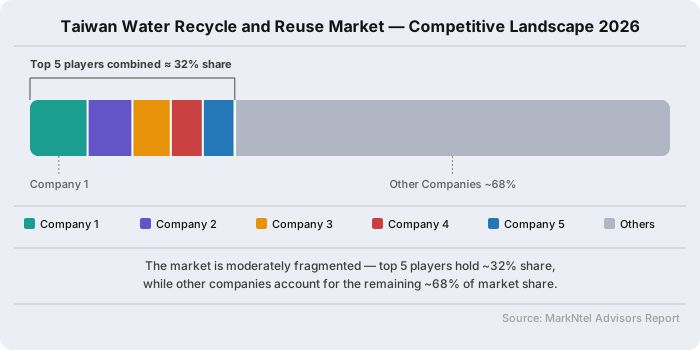
Taiwan water recycle & reuse industry remains moderately fragmented, with the top five companies accounting for 32% of the market in 2026. Competition is driven by technological capabilities, long-term industrial contracts, membrane treatment expertise, and operation & maintenance (O&M) services, while domestic engineering firms compete alongside global water technology providers for semiconductor, municipal, and industrial water reuse projects.
Top Companies in the Water Recycle and Reuse Industry in Taiwan
- Veolia Water Technologies Taiwan Co., Ltd.
- Kurita Water Industries Ltd.
- Organo Corporation
- Xylem Inc.
- Evoqua Water Technologies LLC
- Hsin Sheng Li Water Co., Ltd.
- CTCI Smart Engineering Corporation
- MiTAC Information Technology Corp. (Smart Water Solutions)
- AQUA Water Corporation Ltd.
- Ecolab Inc.
Taiwan Water Recycle and Reuse Industry News and Recent Developments
April 2024: Kurita Water Industries Launches S.sensing WEB 2.0 to Advance Digital Water Management
Kurita Water Industries Ltd. introduced S.sensing WEB 2.0, an upgraded cloud-based water treatment monitoring platform designed to strengthen remote operation, predictive maintenance, and real-time performance analytics for industrial water treatment systems. The platform provides five-minute interval data acquisition, alarm management, and operational visualization, enabling manufacturers to optimize water reuse processes and improve treatment efficiency across water-intensive industries, including semiconductor manufacturing.
Impact Analysis: The launch accelerates the adoption of digital water management and intelligent monitoring technologies within Taiwan's industrial water reuse sector. Enhanced predictive analytics and remote asset management improve operational reliability, reduce maintenance costs, and support wider deployment of advanced water recycling systems in semiconductor and high-tech manufacturing facilities.
June 2024: Taichung Accelerates Shuinan Reclaimed Water Project to Supply Central Taiwan Science Park
The Taichung City Water Resources Bureau announced that the Shuinan Reclaimed Water Project is nearing completion and will officially begin supplying reclaimed water to the Central Taiwan Science Park (CTSP) by the end of 2024. The project incorporates upgraded Membrane Bioreactor (MBR) modules and Reverse Osmosis (RO) systems to produce industrial-grade reclaimed water for high-tech manufacturing. The upgraded MBR system improves water production efficiency by 40% while reducing electricity consumption by 40%, supporting reliable water supply for semiconductor and advanced electronics industries.
Impact Analysis: The project significantly expands Taiwan's reclaimed water infrastructure and strengthens industrial water reuse capabilities for high-value manufacturing clusters. The integration of advanced MBR and RO technologies enhances operational efficiency while providing a resilient alternative water source for science parks, creating sustained demand for advanced water treatment equipment, membrane systems, and digital water management solutions.
- Market Segmentation
- Introduction
- Product Definition
- Research Process
- Assumptions
- Executive Summary
- Taiwan Water Recycle and Reuse Market Policies, Regulations, and Product Standards
- Taiwan Water Recycle and Reuse Market Trends & Developments
- Taiwan Water Recycle and Reuse Market Dynamics
- Growth Factors
- Challenges
- Taiwan Water Recycle and Reuse Market Hotspot & Opportunities
- Taiwan Water Recycle and Reuse Market Outlook, 2022-2032
- Market Size & Outlook
- By Revenues (USD Million)
- Market Share & Outlook
- By Water Source Type- Market Size & Forecast 2022-2032, USD Million
- Municipal Wastewater
- Industrial Wastewater
- Stormwater & Rainwater
- Other Alternative Water Sources
- By Technology- Market Size & Forecast 2022-2032, USD Million
- Membrane Filtration
- Microfiltration (MF)
- Ultrafiltration (UF)
- Nanofiltration (NF)
- Reverse Osmosis (RO)
- Biological Treatment
- Advanced Oxidation & Disinfection
- Activated Carbon & Ion Exchange
- Conventional Filtration
- Hybrid & Integrated Treatment
- Membrane Filtration
- By Application- Market Size & Forecast 2022-2032, USD Million
- Potable Water Reuse
- Industrial Process Water
- Cooling Water
- Boiler Feed Water
- Irrigation & Landscaping
- Construction Activities
- Environmental & Surface Water Replenishment
- Other Non-Potable Applications
- By End User- Market Size & Forecast 2022-2032, USD Million
- Municipal Utilities
- Industrial
- Semiconductor & Electronics
- Chemicals & Petrochemicals
- Food & Beverage
- Pharmaceuticals & Life Sciences
- Power Generation
- Others
- Commercial
- Residential
- Government & Public Infrastructure
- By Company
- Competition Characteristics
- Market Share & Analysis
- By Water Source Type- Market Size & Forecast 2022-2032, USD Million
- Market Size & Outlook
- Taiwan Municipal Wastewater Recycle and Reuse Market Outlook, 2022-2032
- Market Size & Outlook
- By Revenues (USD Million)
- Market Segmentation & Outlook
- By Technology- Market Size & Forecast 2022-2032, USD Million
- By Application- Market Size & Forecast 2022-2032, USD Million
- By End User- Market Size & Forecast 2022-2032, USD Million
- Market Size & Outlook
- Taiwan Industrial Wastewater Recycle and Reuse Market Outlook, 2022-2032
- Market Size & Outlook
- By Revenues (USD Million)
- Market Segmentation & Outlook
- By Technology- Market Size & Forecast 2022-2032, USD Million
- By Application- Market Size & Forecast 2022-2032, USD Million
- By End User- Market Size & Forecast 2022-2032, USD Million
- Market Size & Outlook
- Taiwan Stormwater & Rainwater Recycle and Reuse Market Outlook, 2022-2032
- Market Size & Outlook
- By Revenues (USD Million)
- Market Segmentation & Outlook
- By Technology- Market Size & Forecast 2022-2032, USD Million
- By Application- Market Size & Forecast 2022-2032, USD Million
- By End User- Market Size & Forecast 2022-2032, USD Million
- Market Size & Outlook
- Taiwan Water Recycle and Reuse Market Key Strategic Imperatives for Success & Growth
- Competitive Outlook
- Company Profiles
- Veolia Environnement S.A.
- Business Description
- Product Portfolio
- Collaborations & Alliances
- Recent Developments
- Financial Details
- Others
- Kurita Water Industries Ltd.
- Business Description
- Product Portfolio
- Collaborations & Alliances
- Recent Developments
- Financial Details
- Others
- SUEZ International SAS
- Business Description
- Product Portfolio
- Collaborations & Alliances
- Recent Developments
- Financial Details
- Others
- Organo Corporation
- Business Description
- Product Portfolio
- Collaborations & Alliances
- Recent Developments
- Financial Details
- Others
- CTCI Corporation
- Business Description
- Product Portfolio
- Collaborations & Alliances
- Recent Developments
- Financial Details
- Others
- Ever-Clear Environmental Eng. Corp.
- Business Description
- Product Portfolio
- Collaborations & Alliances
- Recent Developments
- Financial Details
- Ecolab Inc.
- Business Description
- Product Portfolio
- Collaborations & Alliances
- Recent Developments
- Financial Details
- Others
- DuPont de Nemours, Inc.
- Business Description
- Product Portfolio
- Collaborations & Alliances
- Recent Developments
- Financial Details
- Others
- Aquatech International LLC
- Business Description
- Product Portfolio
- Collaborations & Alliances
- Recent Developments
- Financial Details
- Others
- Xylem Inc.
- Business Description
- Product Portfolio
- Collaborations & Alliances
- Recent Developments
- Financial Details
- Others
- Veolia Environnement S.A.
- Company Profiles
- Disclaimer

MarkNtel Advisors follows a robust and iterative research methodology designed to ensure maximum accuracy and minimize deviation in market estimates and forecasts. Our approach combines both bottom-up and top-down techniques to effectively segment and quantify various aspects of the market. A consistent feature across all our research reports is data triangulation, which examines the market from three distinct perspectives to validate findings. Key components of our research process include:
1. Scope & Research Design At the outset, MarkNtel Advisors define the research objectives and formulate pertinent questions. This phase involves determining the type of research—qualitative or quantitative—and designing a methodology that outlines data collection methods, target demographics, and analytical tools. They also establish timelines and budgets to ensure the research aligns with client goals.
2. Sample Selection and Data Collection In this stage, the firm identifies the target audience and determines the appropriate sample size to ensure representativeness. They employ various sampling methods, such as random or stratified sampling, based on the research objectives. Data collection is carried out using tools like surveys, interviews, and observations, ensuring the gathered data is reliable and relevant.
3. Data Analysis and Validation Once data is collected, MarkNtel Advisors undertake a rigorous analysis process. This includes cleaning the data to remove inconsistencies, employing statistical software for quantitative analysis, and thematic analysis for qualitative data. Validation steps are taken to ensure the accuracy and reliability of the findings, minimizing biases and errors.

4. Data Forecast and FinalizationThe final phase involves forecasting future market trends based on the analyzed data. MarkNtel Advisors utilize predictive modeling and time series analysis to anticipate market behaviors. The insights are then compiled into comprehensive reports, featuring visual aids like charts and graphs, and include strategic recommendations to inform client decision-making
We’d love to understand what matters most to you.