

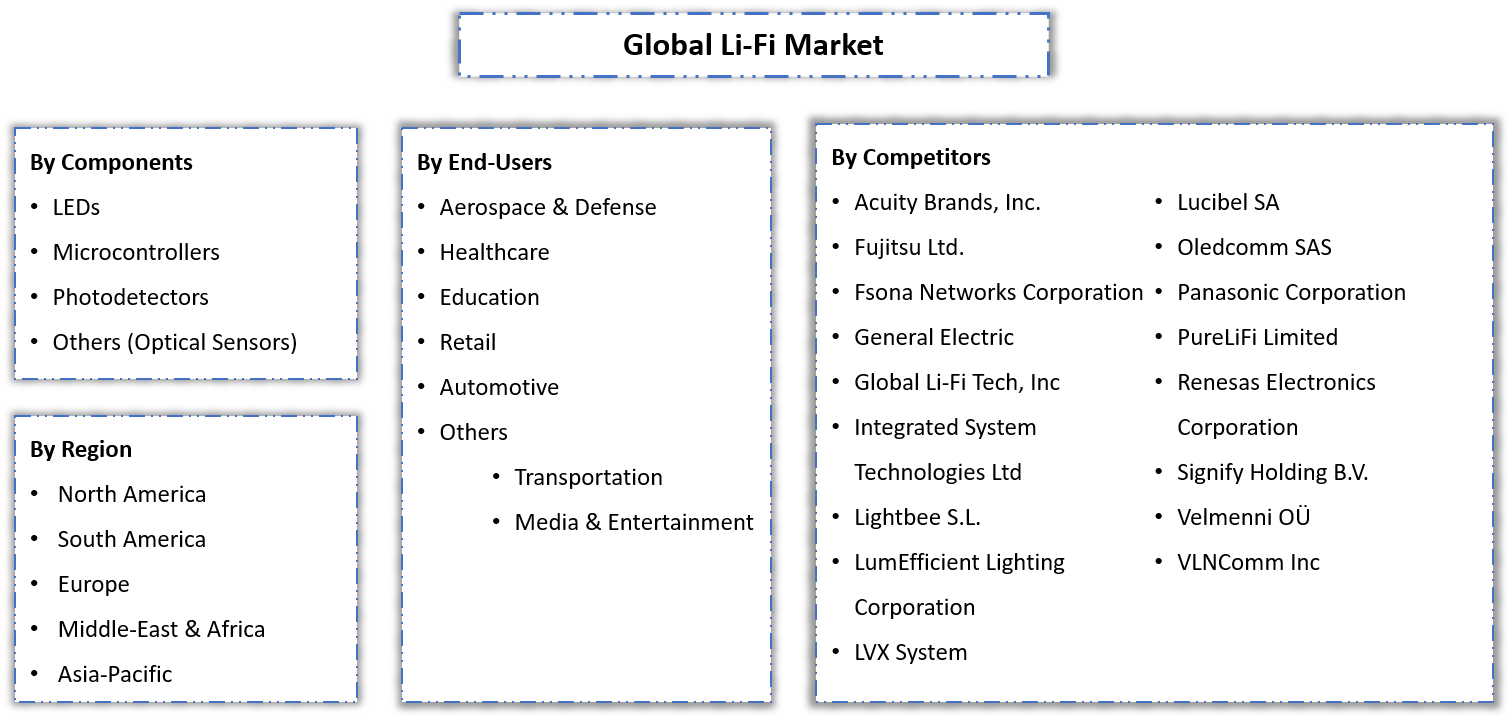
By Components (LEDs, Microcontrollers, Photodetectors, Others (Optical Sensors, etc.)) By End-Users (Aerospace & Defense, Healthcare, Education, Retail, Automotive, Others (Transportation, Media & Ent... ... rtation, Media & Entertainment, etc.)) By Region (North America, South America, Europe, Middle East & Africa, Asia-Pacific) By Company (Acuity Brands, Inc., Fujitsu Ltd., Fsona Networks Corporation, General Electric, Global Li-Fi Tech, Inc, Integrated System Technologies Ltd, Lightbee S.L., LumEfficient Lighting Corporation, LVX System, Lucibel SA, Oledcomm SAS, Panasonic Corporation, PureLiFi Limited, Renesas Electronics Corporation) Read more
- ICT & Electronics
- Jun 2022
- 193
- PDF, Excel, PPT
Market Definition
Currently, the most trending communication technology adopted by the masses is WiFi, of which the user base is rapidly expanding every year. As a result, it has instigated the need for developing a more robust solution to cater to user requirements.
Li-Fi (Light Fidelity) is the latest wireless communication technology that holds immense potential to deliver data speeds faster than what presently is available. It belongs to VLC (Visible Light Communication) system and thus comprises a photo-detector to receive light and a signal processing element that converts the data into streams. It uses visible light waves for high-speed 2D (bi-directional) data transmission, is believed to be more secure & efficient than current wireless technologies, and offers 100 times more range than WiFi.
Market Insights
The Global Li-Fi Market is expected to register more than 60% CAGR during the forecast period, i.e., 2022-27. Presently, the Li-Fi technology is in the early stage but gaining significant attention worldwide. The mounting demand for high-speed & secured data transmission across various industries would primarily drive the Li-Fi market globally in the future.
Besides, the projected crunch of RF spectrum, various ongoing & upcoming smart city projects promoted by governments of several countries worldwide, and the mounting adoption of advanced technologies like cloud computing, big data, etc., across several industries would further boost the global market through 2027.
| Report Coverage | Details |
|---|---|
| Study Period | Historical Data: 2017-20 |
| Base Year: 2021 | |
| Forecast Period: 2022-27 | |
| CAGR (2022-2027) | 60% |
| Regions Covered | North America: The US, Canada, Mexico |
| Europe: Germany, The UK, France, Italy, Benelux, Rest of Europe | |
| Asia-Pacific: China, Japan, India, South Korea, | |
| South America: Brazil, Rest of South America | |
| Middle East & Africa: UAE, Saudi Arabia, Rest of Middle East & Africa | |
| Key Companies Profiled |
Acuity Brands, Inc., Fujitsu Ltd., Fsona Networks Corporation, General Electric, Global Li-Fi Tech, Inc, Integrated System Technologies Ltd, Lightbee S.L., LumEfficient Lighting Corporation, LVX System, Lucibel SA, Oledcomm SAS, Panasonic Corporation, PureLiFi Limited, Renesas Electronics Corporation |
| Unit Denominations | USD Million/Billion |
The Li-Fi technology is more economical & environmentally friendly than WiFi, with great potential in applications like smart lighting, location-based services, etc. Due to its higher bandwidth & speed and secured connectivity, it is expected to find substantial use in electromagnetic-sensitive areas like nuclear power plants, hospitals, & airplanes over the forecast years.
As a result, government authorities across several countries worldwide are massively investing in R&D activities to promote developments in the technology, which project lucrative prospects for the Global Li-Fi Market in the coming years.
The Li-Fi market comprises numerous suppliers of raw materials like LEDs, photodetectors, microcontrollers, etc., required for manufacturing Li-Fi solutions. Since the LED infrastructure globally has become enormous, owing to various factors like enhanced energy efficiency, reduced prices, & increasing installation in residential & public spaces, it would also generate remunerative opportunities for the Li-Fi market through 2027. Furthermore, Industry 4.0 and the burgeoning penetration of the IoT are also expected to be high revenue-generating aspects for the Li-Fi industry in the nearer future.
- Introduction
- Research Process
- Assumption
- Market Segmentation
- Market Definition
- Executive Summary
- Impact of Covid-19 on Global Li-Fi Market
- Global Li-Fi Market Trends & Insights
- Global Li-Fi Market Dynamics
- Growth Drivers
- Challenges
- Global Li-Fi Market Hotspot & Opportunities
- Global Li-Fi Market Outlook, 2017–2027F
- Market Size and Analysis
- By Revenues (USD Billion)
- Market Share and Analysis
- By Components
- LEDs
- Microcontrollers
- Photodetectors
- Others (Optical Sensors, etc.)
- By End-Users
- Aerospace & Defense
- Healthcare
- Education
- Retail
- Automotive
- Others (Transportation, Media & Entertainment, etc.)
- By Region
- North America
- South America
- Europe
- Middle East & Africa
- Asia-Pacific
- By Company
- Competition Characteristics
- Revenue Shares
- Competitor Placement in MarkNtel Quadrant
- By Components
- Market Size and Analysis
- North America Li-Fi Market Outlook, 2017–2027F
- Market Size and Analysis
- By Revenues
- Market Share and Analysis
- By Components
- By End-Users
- By Country
- The US
- Canada
- Mexico
- Market Size and Analysis
- South America Li-Fi Market Outlook, 2017–2027F
- Market Size and Analysis
- By Revenues
- Market Share and Analysis
- By Components
- By End-Users
- By Country
- Brazil
- Rest of South America
- Market Size and Analysis
- Europe Li-Fi Market Outlook, 2017–2027F
- Market Size and Analysis
- By Revenues
- Market Share and Analysis
- By Components
- By End-Users
- By Country
- Germany
- The UK
- France
- Italy
- Benelux
- Rest of Europe
- Market Size and Analysis
- Middle East & Africa Li-Fi Market Outlook, 2017–2027F
- Market Size and Analysis
- By Revenues
- Market Share and Analysis
- By Components
- By End-Users
- By Country
- UAE
- Saudi Arabia
- Rest of Middle East & Africa
- Market Size and Analysis
- Asia-Pacific Li-Fi Market Outlook, 2017–2027F
- Market Size and Analysis
- By Revenues
- Market Share and Analysis
- By Components
- By End-Users
- By Country
- China
- Japan
- India
- South Korea
- Rest of Asia-Pacific
- Market Size and Analysis
- Global Li-Fi Market Key Strategic Imperatives for Success and Growth
- Competitive Outlook
- Competition Matrix
- Application Portfolio
- Brand Specialization
- Target Markets
- Target Applications
- Research & Development
- Strategic Alliances
- Strategic Initiatives
- Company Profiles (Business Description, Application Segments, Business Segments, Financials, Strategic Alliances/ Partnerships, Future Plans)
- Acuity Brands, Inc.
- Fujitsu Ltd.
- Fsona Networks Corporation
- General Electric
- Global Li-Fi Tech, Inc
- Integrated System Technologies Ltd
- Lightbee S.L.
- LumEfficient Lighting Corporation
- LVX System
- Lucibel SA
- Oledcomm SAS
- Panasonic Corporation
- PureLiFi Limited
- Renesas Electronics Corporation
- Signify Holding B.V.
- Velmenni OÜ
- VLNComm Inc
- Others
- Competition Matrix
- Disclaimer
MarkNtel Advisors follows a robust and iterative research methodology designed to ensure maximum accuracy and minimize deviation in market estimates and forecasts. Our approach combines both bottom-up and top-down techniques to effectively segment and quantify various aspects of the market. A consistent feature across all our research reports is data triangulation, which examines the market from three distinct perspectives to validate findings. Key components of our research process include:
1. Scope & Research Design At the outset, MarkNtel Advisors define the research objectives and formulate pertinent questions. This phase involves determining the type of research—qualitative or quantitative—and designing a methodology that outlines data collection methods, target demographics, and analytical tools. They also establish timelines and budgets to ensure the research aligns with client goals.
2. Sample Selection and Data Collection In this stage, the firm identifies the target audience and determines the appropriate sample size to ensure representativeness. They employ various sampling methods, such as random or stratified sampling, based on the research objectives. Data collection is carried out using tools like surveys, interviews, and observations, ensuring the gathered data is reliable and relevant.
3. Data Analysis and Validation Once data is collected, MarkNtel Advisors undertake a rigorous analysis process. This includes cleaning the data to remove inconsistencies, employing statistical software for quantitative analysis, and thematic analysis for qualitative data. Validation steps are taken to ensure the accuracy and reliability of the findings, minimizing biases and errors.

4. Data Forecast and FinalizationThe final phase involves forecasting future market trends based on the analyzed data. MarkNtel Advisors utilize predictive modeling and time series analysis to anticipate market behaviors. The insights are then compiled into comprehensive reports, featuring visual aids like charts and graphs, and include strategic recommendations to inform client decision-making
We’d love to understand what matters most to you.