

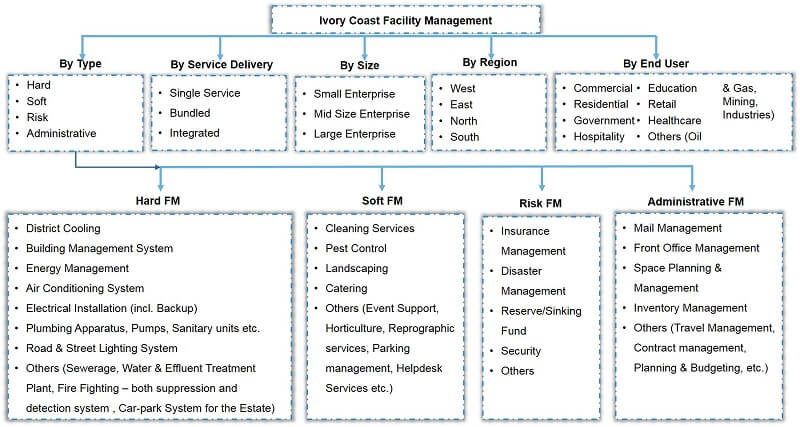
By Type (Hard (District Cooling, Building Management, Plumbing Apparatus, Pumps, Sanitary units, etc., Electrical Installation, Energy Management , Air Conditioning System, Roads & Street Lighting Sys... ... Street Lighting System, Others), Soft (Cleaning, Catering, Pest Control, Landscaping, Others), Risk (Insurance Management, Security, Disaster Management, Reserve/Sinking Fund, Others), Administrative (Mail Management, Front Office Management, Space Planning & Management, Inventory Management, Others), By Operating Model (In-House, Outsourced), By Service Delivery (Integrated, Bundled, Single Services), By End Users (Commercial, Residential, Government, Retail, Education, Healthcare, Hospitality, Others), By Enterprise Size (Large, Mid-Size, Small), By Region, By Company Read more
- Buildings, Construction, Metals & Mining
- Nov 2019
- 114
- PDF, Excel, PPT
The rising construction projects in the country are one of the major drivers for the growth of the Ivory Coast Facility Management market. The growing focus of the government toward social development and political stability is positively impacting the rate of foreign and domestic investments in the country. Therefore, it is anticipated to strongly contribute to the boosting demand for facility management services in the country.
According to the MarkNtel Advisors’ research report titled “Ivory Coast Facility Management Market Analysis, 2020”, the Facility Management market is estimated to grow at a CAGR of around 13% during 2020-25. After the elimination of economic sanctions by the US and European Union, the country experienced growth in the number of foreign investments. In 2018, Ivory Coast announced its plan for infrastructure development over the next five years, which includes earmarking USD 7.07 billion for the said plan.
1. Introduction
1.1. Product Definition
1.2. Research Process
1.3. Assumptions
1.4. Market Segmentation
2. Executive Summary
3. Expert Verbatim- What our Experts Say?
4. Macroeconomic Outlook
5. Ivory Coast Facility Management Market Analysis, 2015-2025F
5.1. Market Size & Analysis
5.1.1. By Revenues
5.2. Market Share & Analysis
5.2.1. By Type
5.2.1.1. Hard
5.2.1.2. Soft
5.2.1.3. Risk
5.2.1.4. Administrative
5.2.2. By Operating Model
5.2.2.1. In-House
5.2.2.2. Outsourced
5.2.3. By Service Delivery
5.2.3.1. Integrated
5.2.3.2. Bundled
5.2.3.3. Single Services
5.2.4. By End Users
5.2.4.1. Commercial
5.2.4.2. Residential
5.2.4.3. Government
5.2.4.4. Retail
5.2.4.5. Education
5.2.4.6. Healthcare
5.2.4.7. Hospitality
5.2.4.8. Others
5.2.5. By Enterprise Size
5.2.5.1. Large
5.2.5.2. Mid-Size
5.2.5.3. Small
5.2.6. By Region
5.2.6.1. West
5.2.6.2. East
5.2.6.3. North
5.2.6.4. South
5.2.7. By Company
5.2.7.1. Revenue Sizes
5.2.7.2. Strategic Factorial Indexing
5.2.7.3. Competitor Placement in MarkNtel Quadrant
6. Ivory Coast Hard Facility Management Market Analysis, 2015-2025F
6.1. Market Size & Analysis
6.1.1. By Revenues
6.2. Market Share & Analysis
6.2.1. By Type
6.2.1.1. District Cooling
6.2.1.2. Building Management
6.2.1.3. Plumbing Apparatus, Pumps, Sanitary units, etc.
6.2.1.4. Electrical Installation
6.2.1.5. Energy Management
6.2.1.6. Air Conditioning System
6.2.1.7. Roads & Street Lighting System
6.2.1.8. Others
6.2.2. By Operating Model
6.2.3. By Service Delivery
6.2.4. By End User
6.2.5. By Enterprise Size
6.2.6. By Region
7. Ivory Coast Soft Facility Management Market Analysis, 2015-2025F
7.1. Market Size & Analysis
7.1.1. By Revenues
7.2. Market Share & Analysis
7.2.1. By Type
7.2.1.1. Cleaning Services
7.2.1.2. Catering
7.2.1.3. Pest Control
7.2.1.4. Landscaping
7.2.1.5. Others
7.2.2. By Operating Model
7.2.3. By Service Delivery
7.2.4. By End User
7.2.5. By Enterprise Size
7.2.6. By Region
8. Ivory Coast Risk Facility Management Market Analysis, 2015-2025F
8.1. Market Size & Analysis
8.1.1. By Revenues
8.2. Market Share & Analysis
8.2.1. By Type
8.2.1.1. Insurance Management
8.2.1.2. Security
8.2.1.3. Disaster Management
8.2.1.4. Reserve/Sinking Fund
8.2.1.5. Others
8.2.2. By Operating Model
8.2.3. By Service Delivery
8.2.4. By End User
8.2.5. By Enterprise Size
8.2.6. By Region
9. Ivory Coast Administrative Facility Management Market Analysis, 2015-2025F
9.1. Market Size & Analysis
9.1.1. By Revenues
9.2. Market Share & Analysis
9.2.1. By Type
9.2.1.1. Mail Management
9.2.1.2. Front Office Management
9.2.1.3. Space Planning & Management
9.2.1.4. Inventory Management
9.2.1.5. Others
9.2.2. By Operating Model
9.2.3. By Service Delivery
9.2.4. By End User
9.2.5. By Enterprise Size
9.2.6. By Region
10. Ivory Coast Facility Management Market Regulations
11. Ivory Coast Facility Management Market Trends & Developments
12. Ivory Coast Facility Management Market Dynamics
12.1.Impact Analysis
12.2.Drivers
12.3.Challenges
13. Ivory Coast Facility Management Services Market, Customer Buying Behaviour, 2019
13.1.Factors Influencing Customer’s Decision
13.2.Priority Matrix of Customer’s Need
13.3.Customer and Service Provider Proximity Analysis
14. Ivory Coast Facility Management Market Winning Strategies, 2019
14.1.Investment Scenario
14.2.Hotspots
15. Ivory Coast Facility Management Market Attractiveness Index, 2020- 2025
15.1.By Type
15.2.By Operating Model
15.3.By End Users
15.4.By Service Delivery
15.5.By Enterprise Size
15.6.By Region
16. Ivory Coast Facility Management Market Porter’s Five Forces Analysis
17. Ivory Coast Facility Management Market Pricing Analysis, 2019
18. Competitive Benchmarking
18.1.Competition Matrix
18.1.1. Product Portfolio
18.1.2. Target Markets
18.1.3. Target End Users
18.1.4. Research & Development
18.1.5. Strategic Alliances
18.1.6. Strategic Initiatives
18.2. Company Profiles
18.2.1. Atalian Cote d'ivoire
18.2.2. Tsebo Solutions Group (Pty) Ltd
18.2.3. Broll Properties (Pty) Ltd
18.2.4. G4S PLC
18.2.5. GLS Catering
18.2.6. Solmed Alliance
18.2.7. Elife Services
18.2.8. Group Ortec
18.2.9. Supreme Group B.V.
18.2.10. Eburny Property Solutions
19. Disclaimer
MarkNtel Advisors follows a robust and iterative research methodology designed to ensure maximum accuracy and minimize deviation in market estimates and forecasts. Our approach combines both bottom-up and top-down techniques to effectively segment and quantify various aspects of the market. A consistent feature across all our research reports is data triangulation, which examines the market from three distinct perspectives to validate findings. Key components of our research process include:
1. Scope & Research Design At the outset, MarkNtel Advisors define the research objectives and formulate pertinent questions. This phase involves determining the type of research—qualitative or quantitative—and designing a methodology that outlines data collection methods, target demographics, and analytical tools. They also establish timelines and budgets to ensure the research aligns with client goals.
2. Sample Selection and Data Collection In this stage, the firm identifies the target audience and determines the appropriate sample size to ensure representativeness. They employ various sampling methods, such as random or stratified sampling, based on the research objectives. Data collection is carried out using tools like surveys, interviews, and observations, ensuring the gathered data is reliable and relevant.
3. Data Analysis and Validation Once data is collected, MarkNtel Advisors undertake a rigorous analysis process. This includes cleaning the data to remove inconsistencies, employing statistical software for quantitative analysis, and thematic analysis for qualitative data. Validation steps are taken to ensure the accuracy and reliability of the findings, minimizing biases and errors.

4. Data Forecast and FinalizationThe final phase involves forecasting future market trends based on the analyzed data. MarkNtel Advisors utilize predictive modeling and time series analysis to anticipate market behaviors. The insights are then compiled into comprehensive reports, featuring visual aids like charts and graphs, and include strategic recommendations to inform client decision-making
We’d love to understand what matters most to you.