

By Product Type (Cold Coffee Premix, Iced Tea Premix, Fruit-Based & Flavored Drinks Premix, Other), By Form (Powder, Liquid), By End User (Corporate Offices, HoReCa (Hotels, Restaurants, Cafés), Insti... ... rants, Cafés), Institutions (Education & Healthcare)), and others Read more
- Food & Beverages
- May 2026
- 145
- PDF, Excel, PPT
India Cold Beverage Premix Market Key Takeaways
- The India cold beverage premix market, valued at nearly USD 18 million in 2025, is anticipated to expand steadily, reaching USD 38 million by 2032 from USD 20 million in 2026, reflecting a CAGR of 11.29% during 2026–2032.
- In 2026, South India emerged as the leading regional market, accounting for approximately 31.42% of the total share.
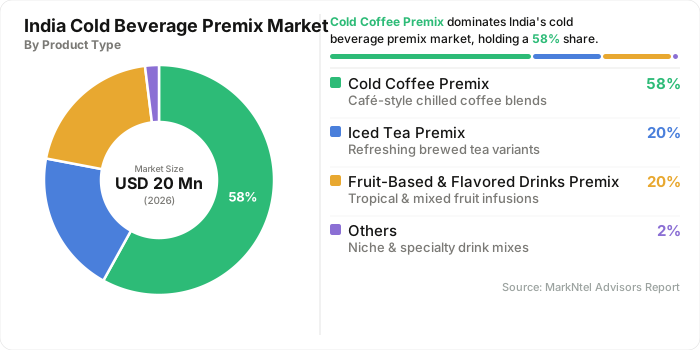
- Based on product type, cold coffee premix held the dominant position, contributing approximately 58% of the market share in 2026.
- By end user, the corporate office segment led the market, accounting for approximately 42% of the share in 2026, supported by high workplace consumption and strong demand for convenient beverage solutions.
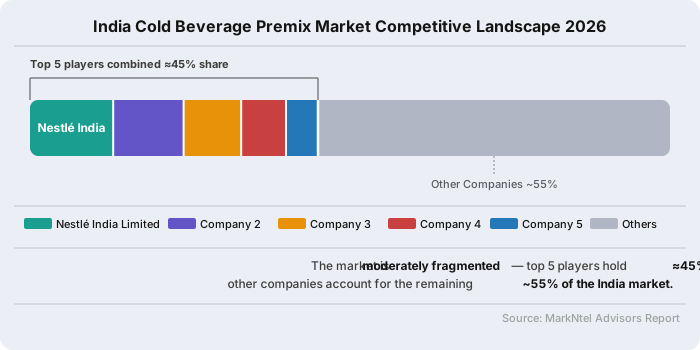
- The market structure remains moderately fragmented, with an estimated 40–60 manufacturers and suppliers. Leading players collectively account for around 45% of the market, while the remaining share is distributed among regional and niche participants.
India Cold Beverage Premix Market Size and Outlook
The cold beverage premix market in India is projected to grow at a CAGR of around 11.29% over 2026–2032, supported by the growth of organized foodservice channels and rising urban demand. The Economic Survey 2025–26 reports that the services sector contributed 53.6% of India’s GDP, reinforcing demand across offices, hospitality, and retail environments . In parallel, urbanization reaching 36.87% of the population in 2024 as per the World Bank, has increased dependence on convenient beverage formats . This transition has gradually strengthened the demand for ready-to-mix cold beverages across the country, particularly through vending-based consumption in workplaces and transit hubs.
As the demand ecosystem continues to mature, the India cold beverage premix industry, valued at USD 18 million in 2025, is increasingly driven by institutional and commercial segments due to their consistent, high-volume consumption patterns. Offices, hospitals, educational institutions, and quick-service restaurants are progressively adopting automated dispensing systems, thereby supporting the growth of vending machine-based drink premix solutions. At the same time, the Smart Cities Mission has accelerated infrastructure development, with over 93% of projects completed, including metro networks and commercial hubs that generate significant consumer footfall. This alignment between infrastructure expansion and workplace formalization is reinforcing organized beverage consumption.
Simultaneously, supportive policy frameworks are strengthening supply-side capabilities and improving overall market efficiency. Initiatives such as Make in India and the Production Linked Incentive Scheme are encouraging domestic production of food processing inputs and vending technologies. Meanwhile, the Food Safety and Standards Authority of India continues to enforce stringent quality and safety standards, enhancing consumer confidence in premix products. Complementary investments by the Ministry of Food Processing Industries are further improving cold chain infrastructure and distribution efficiency
In the coming years, the convergence of economic, infrastructure-led, and regulatory developments is expected to consistently support the market’s long-term growth trajectory and significantly accelerate its expansion from USD 20 million in 2026 to USD 38 million by 2032. Moreover, rising disposable incomes and evolving consumer preferences will continue to strengthen demand for convenient beverage solutions. In response, major industry players are focusing on product innovation, including low-sugar and functional formulations, to align with shifting consumption trends. As infrastructure development extends into semi-urban regions, the market is well positioned to broaden its reach while maintaining steady growth.
India Cold Beverage Premix Market Key Indicators
- According to the Coffee Board of India under the Ministry of Commerce and Industry, domestic coffee consumption increased from 84,000 tonnes in 2012 to 91,000 tonnes in 2023, driven by rising café culture and evolving consumer preferences. This growing adoption of coffee is supporting demand for instant and ready-to-mix beverage formats, particularly cold coffee premixes used in vending machines and institutional consumption settings, thereby contributing to instant cold beverage mix market in India .
- As per the Ministry of Tourism, India’s tourism and hospitality sector continues to grow, with premium hotel occupancy projected at around 72–74% in FY2026. Rising travel activity and increased hotel occupancy are driving demand for beverage premix solutions across hotels, restaurants, and catering services, thereby strengthening HoReCa consumption of cold beverages and supporting overall cold beverage premix market expansion .
- Under the Ministry of Food Processing Industries, more than 400 cold chain projects have been approved by 2026 to strengthen storage and transportation of temperature-sensitive products. The expansion of cold chain infrastructure is improving the availability and consistency of key beverage ingredients such as dairy, flavors, and syrups, enabling smoother production cycles and more reliable supply of cold beverage premixes across end-use segments .
- As part of the Smart Cities Mission, over 93% of more than 8,000 projects have been completed by 2026, significantly enhancing urban infrastructure across cities. The development of metro systems, airports, and commercial hubs has created high-footfall zones, leading to increased deployment of beverage vending machines and higher consumption of cold beverage premixes across urban locations.
India Cold Beverage Premix Market Scope
| Category | Segments |
|---|---|
| By Product Type | Cold Coffee Premix, Iced Tea Premix, Fruit-Based & Flavored Drinks Premix, Other |
| By Form | Powder, Liquid |
| By End User | Corporate Offices, HoReCa (Hotels, Restaurants, Cafés), Institutions (Education & Healthcare |
India Cold Beverage Premix Market Growth Drivers
Expansion of Out-of-Home Consumption
Out-of-home consumption has expanded significantly in recent years, supported by rising urban workforce participation and shifts in consumption behavior. According to the Organisation for Economic Co-operation and Development, India’s growth outlook highlights strengthening private consumption driven by improving real incomes and labor market conditions. Urban employment growth, estimated at around 4.5% in 2025, reflects a gradual shift toward organized workplaces and commercial hubs. This transition is contributing to increase on-the-go beverage consumption in India, thereby expanding the frequency of daily consumption occasions.
This shift is increasingly evident across institutional and commercial end-user segments, where consumption patterns are becoming more frequent and volume-driven. As per NITI Aayog indicate that the services sector added nearly 40 million jobs over six years, increasing its share in total employment. As more consumers spend extended hours in offices and commercial environments, the demand for convenience beverages in India continues to rise steadily. Consequently, office beverage premix solutions are witnessing higher adoption, ensuring consistency, speed, and operational efficiency across these settings.
As this pattern continues to evolve, it is structurally expanding market volume by increasing both the frequency and scale of consumption beyond household settings. Unlike occasional purchases, out-of-home consumption creates repeated daily demand across multiple touchpoints, particularly in high-footfall environments. Institutional buyers therefore prefer bulk, reliable, and easy-to-prepare beverage formats, reinforcing the role of premixes in routine operations. This sustained shift toward multi-location consumption is steadily embedding premix-based beverages into daily consumption ecosystems across institutional and commercial settings.
Recent Trends
Rising Inclination Towards Cold-Soluble Premix Innovation
Advancements in cold-soluble premix formulations are enabling beverage powders to dissolve efficiently in cold water, eliminating the need for additional processing steps. Such innovations highlight an emerging cold beverage premix market trend in India, where convenience-driven consumption patterns are gaining prominence. According to the International Monetary Fund, private consumption in India grew by around 7.2% in 2025, supported by stable urban demand and improving rural consumption, thereby increasing the adoption of easy-to-prepare beverage formats.
This evolving shift is transforming the beverage value chain by enabling consistent and easy-to-use preparation methods across both institutional and residential segments. Cold-soluble premixes eliminate the need for heating infrastructure, making them suitable for offices, cafés, and home consumption. Recent product innovations, such as the 2025 launch of lemon iced tea premix by Continental Coffee, further illustrate the growing demand for convenient cold beverage formats. These developments highlight how manufacturers are aligning product design with evolving expectations for speed, consistency, and accessibility.
As this momentum continues, the trend is expected to persist, supported by sustained demand for convenience-driven products and ongoing advancements in food processing technologies. Manufacturers are increasingly focusing on improving solubility, flavor retention, and product stability to enhance user experience. This continuous innovation is reinforcing the role of cold-soluble premixes as a practical solution across multiple consumption settings. Over time, it is set to shape product development strategies while influencing long-term consumption patterns in the market.
India Cold Beverage Premix Market Opportunities and Challenges
Health Concerns & Regulatory Pressure Accelerating the Development of Low-Sugar, Clean-Label, and Functional Beverage Premixes
Rising health awareness and tightening food safety regulations are emerging as a significant challenge for conventional high-sugar beverage premix formulations in India. Regulatory authorities are increasingly emphasizing sugar reduction, transparent labeling, and ingredient disclosure to address growing concerns related to lifestyle diseases. The Food Safety and Standards Authority of India continues to promote consumer awareness around sugar intake and processed food composition, while the World Health Organization recommendation to limit free sugar intake to less than 10% of total daily energy consumption is increasing regulatory and industry focus on sugar reduction in beverage formulations . These developments are collectively pushing manufacturers to reassess traditional premix compositions.
At the same time, this challenge is creating strong opportunities for the development of low-sugar, clean-label, and functional beverage premixes. Manufacturers are introducing reduced-sugar formulations, natural sweeteners, and functional ingredients to align with evolving consumer preferences. For instance, in 2025, the introduction of low-calorie iced tea premixes by Vahdam India reflects this shift toward healthier and convenient beverage solutions designed for everyday consumption . As consumers increasingly prioritize health and transparency, companies are focusing on innovation and product differentiation, which is expected to reshape product portfolios and support long-term market evolution.
Segmentation Insights
Cold Coffee Premix is the Leading Product Segment
With an estimated 58% market share, cold coffee premix represents the dominant product segment within the India cold beverage premix market across diverse end-use settings. This leadership is primarily driven by the rapid expansion of café culture and increasing consumer preference for coffee-based beverages. According to the Coffee Board of India, domestic coffee consumption has shown steady growth, reflecting evolving taste preferences and rising exposure to café-style beverages. Cold coffee premixes offer convenience, consistent taste, and quick preparation, making them highly suitable for vending machines, offices, and workplace beverage solutions.
Additionally, the expansion of organized foodservice channels, along with rising workplace consumption, is contributing to the increased adoption of cold coffee premixes. The growth of cafés, quick-service restaurants, and corporate offices is increasing the need for standardized beverage solutions, particularly across HoReCa beverage solutions in India, to ensure speed and operational efficiency. At the same time, milk-based formulations used in cold coffee premixes align well with India’s strong dairy consumption base, enabling seamless integration into daily consumption patterns. Together, these factors reinforce the continued dominance of cold coffee premix across both consumer and institutional segments in India. Based on product type, the study is segmented into:
- Cold Coffee Premix
- Iced Tea Premix
- Fruit-Based & Flavored Drinks Premix
- Other
Corporate Offices Dominating the Industry with Accelerated Growth Trends
Corporate offices account for approximately 42% share of the India cold beverage premix market by end user, making them the dominant consumption segment. This leadership is primarily driven by the growing number of organized workplaces and increasing employee presence in office environments. Data from the Reserve Bank of India and PMI metrics indicate that India’s services sector is experiencing sustained growth, supported by resilient domestic demand and ongoing business expansion, which is steadily increasing workplace density across urban centers. This, in turn, is contributing to higher in-office consumption of convenient beverage solutions.
Regular and high-frequency beverage consumption across corporate offices during working hours significantly contributes to overall demand volume. At the same time, the expansion of IT parks, business districts, and co-working spaces is further increasing the need for standardized and efficient beverage solutions, with large-scale office developments such as the addition of over 425,000 sq. ft. of managed workspace in Maharashtra reflecting rising enterprise demand and workforce concentration. Premix-based systems offer operational ease, reduced preparation time, and uniform quality, aligning well with corporate requirements for scalable and efficient office beverage premix solutions. Additionally, companies are increasingly investing in workplace amenities to enhance employee experience, including access to ready-to-prepare beverages, thereby reinforcing the segment’s leading position. Based on end user, the market is categorized into:
- Corporate Offices
- HoReCa (Hotels, Restaurants, Cafés)
- Institutions (Education & Healthcare)
India Cold Beverage Premix Market Geographical Outlook
Accounting for approximately 31.42% of the market, South India emerges as the most prominent regional segment in the India cold beverage premix industry. This leadership is primarily driven by the region’s strong coffee culture and higher consumption of coffee-based beverages compared to other parts of the country. Coffee production in India is predominantly concentrated in southern states, which reinforces both supply accessibility and higher consumption familiarity within the region. This deep-rooted preference for coffee-based beverages, combined with growing exposure to café-style consumption, significantly strengthens demand for cold coffee premixes across the region.

South India’s well-developed urban infrastructure, combined with a high concentration of IT hubs, continues to reinforce its dominance from a demand perspective. Cities such as Bengaluru and Hyderabad have emerged as major corporate centers, with recent data indicating that they together accounted for nearly 50% of India’s tech-sector office leasing in H1 2025, reflecting high workforce concentration and sustained business activit y. This concentration of working professionals is driving consistent out-of-home and workplace beverage consumption, reflecting evolving urban consumption patterns in beverages. Additionally, the presence of a strong café ecosystem, along with warm climatic conditions for most of the year, encourages frequent consumption of cold beverages. As a result, South India continues to lead the market, supported by a combination of cultural preference, corporate workforce density, and favorable consumption patterns.
India Cold Beverage Premix Market Competitive Analysis
The India cold beverage premix industry is characterized by moderate fragmentation, with an estimated 40–60 players participating across institutional and retail channels. Prominent companies including Nestlé India, CCL Products (India) Limited, Rasna Private Limited, Girnar Food & Beverages, and Atlantis collectively contribute nearly 45% of total market share, supported by established distribution networks, broad product portfolios, and increasing penetration across HoReCa and office-based consumption segments.
Leading Beverage Premix Companies in India
- Daromas
- CCL Products (India) Limited (Continental Coffee)
- Nestlé India
- Atlantis
- Girnar Food & Beverages
- Senso Foods
- Neel Beverages Pvt Ltd
- CafenTea
- Octavius Tea
- Rasna Private Limited
- Sleepy Owl Coffee
- Others
India Cold Beverage Premix Industry News and Recent Developments
February 2025: Rasna Private Limited Expands Portfolio with New Fruit Drink Concentrate
Rasna launched a new fruit drink concentrate in early 2025, expanding its cold beverage offerings beyond traditional powdered formats. The product is designed for easy dilution and targets household consumption as well as bulk usage during peak summer demand, strengthening the company’s presence in the liquid beverage segment.
Impact Analysis: This development reflects a broader shift toward convenient, ready-to-mix liquid beverage formats in India’s cold beverage market. It indicates increasing consumer preference for easy-to-prepare drinks at home, while also highlighting how established players are expanding beyond powder premixes to capture evolving consumption patterns.
- Market Segmentation
- Introduction
- Product Definition
- Research Process
- Assumptions
- Executive Summary
- India Cold Beverage Premix Market Policies, Regulations, and Product Standards
- India Cold Beverage Premix Market Trends & Developments
- India Cold Beverage Premix Market Dynamics
- Growth Factors
- Challenges
- India Cold Beverage Premix Market Hotspot & Opportunities
- India Cold Beverage Premix Market Outlook, 2022-2032F
- Market Size & Outlook
- By Revenues (USD Million)
- Market Share & Outlook
- By Product Type- Market Size & Forecast 2022-2032, USD Million
- Cold Coffee Premix
- Iced Tea Premix
- Fruit-Based & Flavored Drinks Premix
- Other
- By Form- Market Size & Forecast 2022-2032, USD Million
- Powder
- Liquid
- By End User- Market Size & Forecast 2022-2032, USD Million
- Corporate Offices
- HoReCa (Hotels, Restaurants, Cafés)
- Institutions (Education & Healthcare)
- By Region- Market Size & Forecast 2022-2032, USD Million
- North India
- East India
- West India
- South India
- By Company
- Competition Characteristics
- Market Share & Analysis
- By Product Type- Market Size & Forecast 2022-2032, USD Million
- Market Size & Outlook
- India Cold Coffee Premix Market Outlook, 2022-2032
- Market Size & Outlook
- By Revenues (USD Million)
- Market Share & Outlook
- By Form- Market Size & Forecast 2022-2032, USD Million
- By End User- Market Size & Forecast 2022-2032, USD Million
- By Region- Market Size & Forecast 2022-2032, USD Million
- Market Size & Outlook
- India Iced Tea Premix Market Outlook, 2022-2032
- Market Size & Outlook
- By Revenues (USD Million)
- Market Share & Outlook
- By Form- Market Size & Forecast 2022-2032, USD Million
- By End User- Market Size & Forecast 2022-2032, USD Million
- By Region- Market Size & Forecast 2022-2032, USD Million
- Market Size & Outlook
- India Fruit-Based & Flavored Drinks Premix Market Outlook, 2022-2032
- Market Size & Outlook
- By Revenues (USD Million)
- Market Share & Outlook
- By Form- Market Size & Forecast 2022-2032, USD Million
- By End User- Market Size & Forecast 2022-2032, USD Million
- By Region- Market Size & Forecast 2022-2032, USD Million
- Market Size & Outlook
- India Cold Beverage Premix Market Key Strategic Imperatives for Success & Growth
- Competitive Outlook
- Company Profiles
- Nestlé India
- Business Description
- Product Portfolio
- Collaborations & Alliances
- Recent Developments
- Financial Details
- Others
- Atlantis
- Business Description
- Product Portfolio
- Collaborations & Alliances
- Recent Developments
- Financial Details
- Others
- Coffee Day Beverages
- Business Description
- Product Portfolio
- Collaborations & Alliances
- Recent Developments
- Financial Details
- Others
- Barista Coffee Company
- Business Description
- Product Portfolio
- Collaborations & Alliances
- Recent Developments
- Financial Details
- Others
- Senso Foods
- Business Description
- Product Portfolio
- Collaborations & Alliances
- Recent Developments
- Financial Details
- Others
- Perfect Beverages Pvt. Ltd.
- Business Description
- Product Portfolio
- Collaborations & Alliances
- Recent Developments
- Financial Details
- Others
- Coftea
- Business Description
- Product Portfolio
- Collaborations & Alliances
- Recent Developments
- Financial Details
- Others
- Rasna Private Limited
- Business Description
- Product Portfolio
- Collaborations & Alliances
- Recent Developments
- Financial Details
- Others
- Girnar Food & Beverages
- Business Description
- Product Portfolio
- Collaborations & Alliances
- Recent Developments
- Financial Details
- Others
- Amazon Vending Solutions
- Business Description
- Product Portfolio
- Collaborations & Alliances
- Recent Developments
- Financial Details
- Others
- Nestlé India
- Company Profiles
- Disclaimer

MarkNtel Advisors follows a robust and iterative research methodology designed to ensure maximum accuracy and minimize deviation in market estimates and forecasts. Our approach combines both bottom-up and top-down techniques to effectively segment and quantify various aspects of the market. A consistent feature across all our research reports is data triangulation, which examines the market from three distinct perspectives to validate findings. Key components of our research process include:
1. Scope & Research Design At the outset, MarkNtel Advisors define the research objectives and formulate pertinent questions. This phase involves determining the type of research—qualitative or quantitative—and designing a methodology that outlines data collection methods, target demographics, and analytical tools. They also establish timelines and budgets to ensure the research aligns with client goals.
2. Sample Selection and Data Collection In this stage, the firm identifies the target audience and determines the appropriate sample size to ensure representativeness. They employ various sampling methods, such as random or stratified sampling, based on the research objectives. Data collection is carried out using tools like surveys, interviews, and observations, ensuring the gathered data is reliable and relevant.
3. Data Analysis and Validation Once data is collected, MarkNtel Advisors undertake a rigorous analysis process. This includes cleaning the data to remove inconsistencies, employing statistical software for quantitative analysis, and thematic analysis for qualitative data. Validation steps are taken to ensure the accuracy and reliability of the findings, minimizing biases and errors.

4. Data Forecast and FinalizationThe final phase involves forecasting future market trends based on the analyzed data. MarkNtel Advisors utilize predictive modeling and time series analysis to anticipate market behaviors. The insights are then compiled into comprehensive reports, featuring visual aids like charts and graphs, and include strategic recommendations to inform client decision-making
We’d love to understand what matters most to you.