

By Pump Type: Centrifugal Pump (Overhung Pump (Vertical Inline, Horizontal End Suction), Split Case Pump (Single/Two Stage, Multistage), Vertical Pump (Turbine (Solid handling, Non solid handling), Ax... ... solid handling), Axial, Mixed Flow), Submersible Pump (Solid Handling, Non-solid Handling)), Positive Displacement Pump (Diaphragm Pump, Piston Pump, Progressive Cavity Pump, Peristaltic Pump) By Operation: Electrical, Hydraulic, Air Driven By Distribution Channel: Distributors & Dealers, Direct Sales, Retail Stores & Hardware Shops, Online Channels By Application: Ground water Intake, Wastewater Outlet, Water Pressure Boosting, Rain Water Harvesting, Hot Water Recirculation, Heating), and others Read less Read more
- Environment
- Aug 2026
- 130
- PDF, Excel, PPT
Ghana Agriculture Water Pump Market Key Takeaways
- The Ghana agriculture water pump market was valued at USD 10.29 million in 2025 and is projected to grow from USD 12.62 million in 2026 to USD 22.38 million by 2032.
- The industry is projected to witness steady growth at a CAGR of 10.05% during 2026–2032.
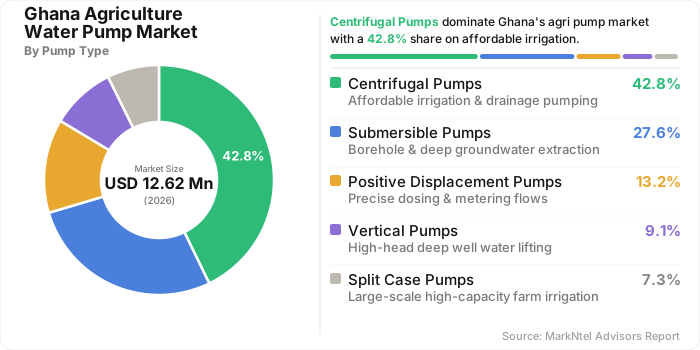
- Centrifugal pumps dominate the market by pump type, accounting for approximately 42.8% of the total market share in 2026.
- By application, irrigation remains the leading segment, capturing approximately 71.6% of the market in 2026.
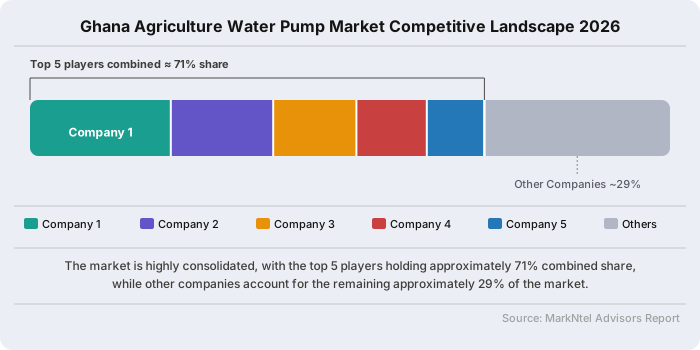
- The market is moderately consolidated, with the top five companies collectively accounting for approximately 71% of the market share in 2026.
Ghana Agriculture Water Pump Market Size & Outlook
The agriculture water pump market in Ghana was valued at USD 10.29 million in 2025 and is projected to grow from USD 12.62 million in 2026 to USD 22.38 million by 2032, registering a CAGR of 10.05% during the forecast period, i.e., 2026- 2032.
The market is witnessing sustained growth, supported by increasing mechanization of agriculture, expansion of irrigated farming, and rising adoption of climate-resilient irrigation technologies. Growing investment in efficient water management solutions is further strengthening demand for agricultural pumping equipment as farmers seek to improve crop productivity and reduce dependence on erratic rainfall.
The industry continues to benefit from Ghana's increasing focus on irrigation-led agricultural transformation. According to the World Bank (2024), less than 3% of Ghana's cultivated land is irrigated, highlighting substantial opportunities for irrigation expansion and increased deployment of agricultural water pumps. At the same time, the International Water Management Institute (IWMI) identifies Ghana as having significant untapped groundwater resources suitable for farmer-led irrigation, supporting broader adoption of pumping technologies across smallholder farming systems. These structural conditions are creating long-term opportunities for irrigation equipment manufacturers and distributors.
Rising climate variability is further accelerating investment in reliable irrigation infrastructure. The Ghana Meteorological Agency reported continued rainfall irregularities during the 2024 agricultural season, while seasonal climate outlooks highlight increasing rainfall variability across major crop-producing regions. These changing weather patterns are encouraging farmers to invest in irrigation systems capable of ensuring stable crop production during prolonged dry spells. Consequently, demand for efficient pumping equipment continues to increase as agricultural producers seek greater resilience against climate-related production risks.
Looking ahead, the market is expected to benefit from continued modernization of Ghana's agricultural sector and increasing emphasis on sustainable water management. Rising investments in irrigation development, expanding climate adaptation programmes, and greater adoption of renewable-powered pumping technologies are creating favorable conditions for long-term industry growth. Together, these structural developments are expected to accelerate the deployment of modern agricultural water pumps, strengthen year-round crop production, and reinforce the market's positive growth trajectory through 2032.
Ghana Agriculture Water Pump Market Key Indicators
- According to the Ministry of Finance, Ghana allocated approximately USD 146 million to the agriculture sector in the 2025 national budget, representing 0.54% of the total USD 27.09 billion budget. Continued public funding for irrigation, mechanization, and climate-resilient agriculture supports procurement of agricultural water pumps and farm irrigation equipment across both smallholder and commercial farming operations.
- The Ghana Irrigation Development Authority (GIDA) allocated USD 90 million earmarked for the Mechanization, Irrigation and Water Management programme. The dedicated allocation accelerates irrigation infrastructure development, creating sustained demand for surface pumps, submersible pumps, and related irrigation pumping systems.
- As per the World Bank and the Ministry of Food and Agriculture, the Ghana Commercial Agriculture Project (GCAP) continues implementation with financing of USD 100 million from the World Bank and an additional USD 16.95 million grant from USAID to strengthen irrigation infrastructure and commercial agriculture. Ongoing investments continue driving deployment of efficient agricultural pumping technologies across project areas.
- Data published by the Ministry of Food and Agriculture (MoFA) indicates that dedicated funding for irrigation infrastructure through the Ghana Irrigation Development Authority, with USD 89.8 million specifically directed toward irrigation and water management activities. This investment supports increasing adoption of solar irrigation pumps and high-efficiency pumping technologies across irrigated farming schemes.
Ghana Agriculture Water Pump Market Scope
| Category | Segments |
|---|---|
| By Pump Type | Centrifugal Pump (Overhung Pump (Vertical Inline, Horizontal End Suction), Split Case Pump (Single/Two Stage, Multistage), Vertical Pump (Turbine (Solid handling, Non solid handling), Axial, Mixed Flow), Submersible Pump (Solid Handling, Non-solid Handling)), Positive Displacement Pump (Diaphragm Pump, Piston Pump, Progressive Cavity Pump, Peristaltic Pump |
| By Operation | Electrical, Hydraulic, Air Driven By Distribution Channel: Distributors & Dealers, Direct Sales, Retail Stores & Hardware Shops, Online Channels |
| By Application | Ground water Intake, Wastewater Outlet, Water Pressure Boosting, Rain Water Harvesting, Hot Water Recirculation, Heating), and others |
Ghana Agriculture Water Pump Market Growth Drivers
Extreme Weather and Changing Rainfall Patterns
Erratic rainfall patterns and increasing climate variability are accelerating demand for reliable irrigation infrastructure across Ghana, driving the adoption of climate-smart irrigation, agricultural water pumps, and efficient on-farm water management systems. The Food and Agriculture Organization reported that nearly 2 million people in Ghana faced acute food insecurity between June and August 2025, while localized dry spells in key agricultural regions disrupted crop establishment despite an overall favorable rainy season. These conditions are encouraging farmers to reduce dependence on rainfall through mechanized irrigation solutions.
Recent climate monitoring further reinforces the need for irrigation resilience. The Ghana Meteorological Agency documented persistent rainfall anomalies through its 2024 Flood and Drought Monitoring Bulletin, while FAO-supported geospatial assessments identified prolonged dry spells across central and northern Ghana during the 2024 growing season, with some areas receiving only 7 mm of rainfall compared with the long-term average of 24 mm in early July. Rising rainfall uncertainty is therefore increasing investment in solar irrigation systems and farm water management technologies to stabilize agricultural productivity and improve water-use efficiency.
Recent Trends
Rising Adoption of Smart and Solar Irrigation Technologies
The integration of digital technologies into irrigation practices is emerging as a key trend in the Ghana agricultural water pump industry, with increasing adoption of smart irrigation pumps and solar-powered irrigation systems. In April 2024, the International Water Management Institute and the Ghana Irrigation Development Authority signed a five-year Memorandum of Understanding (MoU) to strengthen sustainable irrigation, climate-smart water management, and technology adoption across farming communities. The partnership promotes advanced irrigation tools that improve water-use efficiency and support year-round agricultural production.
Technology-driven irrigation services are also expanding across the country. During 2025, IWMI, in partnership with Farmerline and Pumptech, launched IRRILINE, a digital advisory platform that connects farmers with irrigation scheduling guidance, solar pumping solutions, equipment suppliers, and financing options. The platform combines digital decision support with climate data to improve irrigation planning, reflecting the growing shift toward digital agriculture solutions and intelligent irrigation technologies that enhance farm productivity while reducing water and energy consumption.
Ghana Agriculture Water Pump Market Opportunities and Challenges
Limited Rural Electrification Accelerating Solar Irrigation Pump Adoption
Limited access to reliable electricity continues to hinder mechanized irrigation across Ghana, particularly in remote farming communities where irrigation demand is increasing. In 2024, the Energy Commission reported persistent disparities in electricity quality and supply reliability between urban and rural areas, affecting the operation of electrically powered irrigation equipment. As a result, many farmers continue to rely on diesel-powered pumping systems, exposing them to fuel price volatility, higher operating costs, and maintenance challenges. These constraints slow the adoption of electric irrigation pumps while limiting investment in modern irrigation infrastructure.
The growing need for reliable off-grid irrigation is creating significant opportunities for solar water pumping systems and renewable irrigation technologies. In 2024, Lorentz strengthened its presence across Africa by expanding its portfolio of solar-powered agricultural pumping solutions through regional distribution partners serving Ghana and other West African markets. Additionally, the International Solar Alliance continues advancing solar water pumping programmes that improve access to clean irrigation technologies for smallholder farmers. These initiatives are accelerating commercial adoption of solar pumping solutions, reducing dependence on fossil fuels, and supporting sustainable expansion of irrigated agriculture.
Segmentations Insights
Centrifugal Pumps Lead the Market Through Their Versatility in Surface Irrigation Applications
The Centrifugal Pumps segment holds the largest share under Pump Type, accounting for approximately 42.8% of the Ghana agriculture water pump industry, owing to its high pumping efficiency, cost-effectiveness, and suitability for surface water irrigation. According to the Food and Agriculture Organization, smallholder farmers account for nearly 80% of agricultural production in Ghana, creating sustained demand for portable and easy-to-maintain pumping solutions for vegetable, maize, and rice cultivation. Their ability to efficiently lift water from rivers, reservoirs, and canals continues to support widespread deployment of surface irrigation pumps across both smallholder and commercial farms.
The segment further benefits from expanding irrigation modernization initiatives that prioritize efficient surface water utilization for year-round farming. The International Water Management Institute continues supporting climate-smart irrigation programmes in Ghana by promoting improved water-lifting technologies and sustainable irrigation practices for farming communities. These initiatives, combined with the country's increasing emphasis on dry-season crop production, continue to strengthen demand for centrifugal water pumps and irrigation pumping systems, reinforcing the segment's leadership across the agricultural sector. Based on Pump Type, the market has been segmented into:
- Centrifugal Pumps
- Split Case Pumps
- Vertical Pumps
- Submersible Pumps
- Positive Displacement Pumps
Irrigation Commands Market Leadership Through Expanding Climate-Resilient Farming
The irrigation segment holds the largest share under application segments, accounting for approximately 71.6% of the Ghana agriculture water pump market, driven by increasing investment in irrigated agriculture and year-round crop production. According to the Ghana Irrigation Development Authority, the Afram Plains Economic Enclave Irrigation Project commenced in 2024, developing 3,500 hectares of irrigable land while supporting 1,000 outgrower farmers, significantly expanding demand for irrigation pumping equipment. Furthermore, recent research indicates that 231,100 hectares are currently under irrigation in Ghana, with nearly 189,000 hectares managed through farmer-led irrigation practices, reinforcing irrigation as the dominant application for agricultural water pumps.
The segment continues to benefit from the expansion of climate-resilient agricultural practices and improved irrigation infrastructure. In 2024, the International Water Management Institute and the Ghana Irrigation Development Authority entered a collaboration to strengthen irrigation development, sustainable water management, and technology adoption across Ghana. The initiative supports efficient irrigation practices and improved water accessibility, reinforcing investment in irrigation pumping equipment and sustaining the dominance of agricultural irrigation pumps within the country's farming sector. Based on Application, the market has been segmented into:
- Irrigation
- Livestock Watering
- Aquaculture
Ghana Agriculture Water Pump Market Competitive Analysis
The agriculture water pump industry in Ghana is moderately consolidated, with the top five companies accounting for approximately 71% of the market share in 2026. Leading participants, including HTC Waterpumps, Grundfos, Xylem Inc., Wilo SE, and LORENTZ GmbH, compete through expanding solar-powered irrigation portfolios, strengthening local distributor networks, product localization, and after-sales service capabilities to address the growing demand for efficient agricultural pumping solutions across Ghana.
Top Companies for Agriculture Water Pump Industry in Ghana
- HTC Waterpumps
- Grundfos
- Sulzer
- Xylem Inc.
- KSB SE & Co. KGaA
- Wilo SE
- Pumptech Limited
- Aquatec Services Limited
- DAB Pumps
- LORENTZ GmbH
- Others
Ghana Agriculture Water Pump Industry News and Recent Developments
December 2025: Pumptech Limited Partners with IWMI and Farmerline to Launch IRRILINE Solar Irrigation Platform
Pumptech Limited, in collaboration with International Water Management Institute (IWMI) and Farmerline, launched IRRILINE, a digital advisory platform that connects smallholder farmers with solar irrigation equipment, financing services, and irrigation scheduling tools. The platform is designed to accelerate adoption of solar-powered irrigation while improving water-use efficiency and farm productivity across Ghana.
Impact Analysis: The launch is expected to strengthen the commercialization of solar irrigation technologies by integrating equipment suppliers with digital advisory and financing services. It also expands market opportunities for irrigation pump manufacturers and distributors while supporting wider adoption of climate-smart irrigation solutions among Ghana's smallholder farming communities.
September 2024: LORENTZ Strengthens Solar Pump Deployment Through Expanded Distribution Network in Ghana
LORENTZ GmbH expanded its presence in Ghana by strengthening its certified distribution and service network through partners including Pumptech Limited, DENG Ghana, and Foundries & Agriculture Ghana. The company also showcased multiple new solar pumping installations completed across Ghana during 2024, supporting irrigation and rural water supply projects with high-capacity photovoltaic pumping systems.
Impact Analysis: The expansion enhances the availability of advanced solar-powered pumping technologies and strengthens local after-sales support, training, and maintenance capabilities. A broader distribution network is expected to accelerate adoption of solar irrigation pumps among commercial farms and smallholder producers while increasing competition within Ghana's agricultural water pump market through improved product accessibility and technical service coverage.
- Market Segmentation
- Introduction
- Product Definition
- Research Process
- Assumptions
- Executive Summary
- Ghana Agriculture Water Pump Import-Export Analysis
- Ghana Agriculture Water Pump Market Trends & Developments
- Ghana Agriculture Water Pump Market Dynamics
- Growth Drivers
- Challenges
- Ghana Agriculture Water Pump Market Policies, Regulations & Product Standards
- Ghana Agriculture Water Pump Market Hotspot & Opportunities
- Ghana Agriculture Water Pump Market Outlook, 2022-2032
- Market Size & Analysis
- By Revenues (USD Million)
- By Quantity Sold (Thousand Units)
- Market Segmentation & Outlook
- By Pump Type- Market Size & Forecast 2022-2032, USD Million & Thousand Units
- Centrifugal Pumps
- Overhung Pumps
- Vertical Inline
- Horizontal End Suction
- Split Case Pumps
- Single/Two Stage
- Multistage
- Vertical Pumps
- Turbine
- Solid Handling
- Non-solid Handling
- Axial
- Mixed Flow
- Turbine
- Submersible Pumps
- Solid Handling
- Non-solid Handling
- Overhung Pumps
- Positive Displacement Pumps
- Diaphragm Pumps
- Piston Pumps
- Progressive Cavity Pumps
- Peristaltic Pumps
- Centrifugal Pumps
- By Operation- Market Size & Forecast 2022-2032, USD Million & Thousand Units
- Electrical
- Hydraulic
- Air Driven
- By Distribution Channel- Market Size & Forecast 2022-2032, USD Million & Thousand Units
- Distributors & Dealers
- Direct Sales
- Retail Stores & Hardware Shops
- Online Channels
- By Application- Market Size & Forecast 2022-2032, USD Million & Thousand Units
- Irrigation
- Livestock Watering
- Aquaculture
- By Companies
- Competition Characteristics
- Market Share and Analysis
- By Pump Type- Market Size & Forecast 2022-2032, USD Million & Thousand Units
- Market Size & Analysis
- Ghana Agriculture Centrifugal Water Pump Market Outlook, 2022-2032
- Market Size & Analysis
- By Revenues (USD Million)
- By Quantity Sold (Thousand Units)
- Market Segmentation & Outlook
- By Pump Type- Market Size & Forecast 2022-2032, USD Million & Thousand Units
- By Operation- Market Size & Forecast 2022-2032, USD Million & Thousand Units
- By Distribution Channel- Market Size & Forecast 2022-2032, USD Million & Thousand Units
- By Application- Market Size & Forecast 2022-2032, USD Million & Thousand Units
- Market Size & Analysis
- Ghana Agriculture Positive Displacement Water Pump Market Outlook, 2022-2032
- Market Size & Analysis
- By Revenues (USD Million)
- By Quantity Sold (Thousand Units)
- Market Segmentation & Outlook
- By Pump Type- Market Size & Forecast 2022-2032, USD Million & Thousand Units
- By Operation- Market Size & Forecast 2022-2032, USD Million & Thousand Units
- By Distribution Channel- Market Size & Forecast 2022-2032, USD Million & Thousand Units
- By Application- Market Size & Forecast 2022-2032, USD Million & Thousand Units
- Market Size & Analysis
- Ghana Agriculture Water Pump Market Key Strategic Imperatives for Success & Growth
- Competition Benchmarking
- Company Profiles
- HTC Waterpumps
- Business Description
- Product Portfolio
- Strategic Alliances or Partnerships
- Recent Developments
- Financial Details
- Others
- Grundfos
- Business Description
- Product Portfolio
- Strategic Alliances or Partnerships
- Recent Developments
- Financial Details
- Others
- Sulzer Pump
- Business Description
- Product Portfolio
- Strategic Alliances or Partnerships
- Recent Developments
- Financial Details
- Others
- Xylem Inc.
- Business Description
- Product Portfolio
- Strategic Alliances or Partnerships
- Recent Developments
- Financial Details
- Others
- KSB SE & Co.
- Business Description
- Product Portfolio
- Strategic Alliances or Partnerships
- Recent Developments
- Financial Details
- Others
- Wilo SE
- Business Description
- Product Portfolio
- Strategic Alliances or Partnerships
- Recent Developments
- Financial Details
- Others
- Pumptech Limited
- Business Description
- Product Portfolio
- Strategic Alliances or Partnerships
- Recent Developments
- Financial Details
- Others
- Aquatec Services Limited
- Business Description
- Product Portfolio
- Strategic Alliances or Partnerships
- Recent Developments
- Financial Details
- Others
- DAB Pumps
- Business Description
- Product Portfolio
- Strategic Alliances or Partnerships
- Recent Developments
- Financial Details
- Others
- LORENTZ GmbH
- Business Description
- Product Portfolio
- Strategic Alliances or Partnerships
- Recent Developments
- Financial Details
- Others
- Others
- HTC Waterpumps
- Company Profiles
- Disclaimer

MarkNtel Advisors follows a robust and iterative research methodology designed to ensure maximum accuracy and minimize deviation in market estimates and forecasts. Our approach combines both bottom-up and top-down techniques to effectively segment and quantify various aspects of the market. A consistent feature across all our research reports is data triangulation, which examines the market from three distinct perspectives to validate findings. Key components of our research process include:
1. Scope & Research Design At the outset, MarkNtel Advisors define the research objectives and formulate pertinent questions. This phase involves determining the type of research—qualitative or quantitative—and designing a methodology that outlines data collection methods, target demographics, and analytical tools. They also establish timelines and budgets to ensure the research aligns with client goals.
2. Sample Selection and Data Collection In this stage, the firm identifies the target audience and determines the appropriate sample size to ensure representativeness. They employ various sampling methods, such as random or stratified sampling, based on the research objectives. Data collection is carried out using tools like surveys, interviews, and observations, ensuring the gathered data is reliable and relevant.
3. Data Analysis and Validation Once data is collected, MarkNtel Advisors undertake a rigorous analysis process. This includes cleaning the data to remove inconsistencies, employing statistical software for quantitative analysis, and thematic analysis for qualitative data. Validation steps are taken to ensure the accuracy and reliability of the findings, minimizing biases and errors.

4. Data Forecast and FinalizationThe final phase involves forecasting future market trends based on the analyzed data. MarkNtel Advisors utilize predictive modeling and time series analysis to anticipate market behaviors. The insights are then compiled into comprehensive reports, featuring visual aids like charts and graphs, and include strategic recommendations to inform client decision-making
We’d love to understand what matters most to you.