

By Type (Oxidizing Biocides (Halogen Compounds , Non-Oxidizing Biocides ), Metallic Compounds (Quaternary Ammonium Compounds , Organosulfur Compounds , Glutaraldehyde , Organic Acids , Phenolic Comp... ... ganic Acids , Phenolic Compounds , Others )), By Application (Water Treatment (Municipal Water Treatment , Industrial Water Treatment (Oil & Gas , Power Generation , Pulp & Paper , Mining ), Recreational Water (Swimming Pools) , Other Water Treatment Applications ), Industrial & Institutional Cleaning and Home Care , Wood Preservatives , Paints & Coatings (Marine Coatings , Other Paint & Coating Applications ), Other Applications), and others Read more
- Environment
- Jul 2026
- 230
- PDF, Excel, PPT
GCC Biocides Market Key Takeaways
- The GCC biocides market was valued at USD 311 million in 2025 and is projected to reach USD 511 million by 2032 from USD 339 million in 2026, growing at a CAGR of 7.07% during 2026-32.
- Non-oxidizing biocides led the market by type, accounting for 57% of total market share in 2026.
- Water treatment led the market by application, accounting for 38% of total market share in 2026.
- Saudi Arabia led the market, accounting for 51% of total market share in 2026.
- The industry is moderately consolidated, with the top five companies collectively accounting for 39% of market revenue.
GCC Biocides Market Size and Outlook
The GCC biocides market size was valued at USD 311 million in 2025 and is projected to grow from USD 339 million in 2026 to USD 511 million by 2032. Along with this, the market is estimated to grow at a CAGR of around 7.07% during the forecast period, i.e., 2026-32.
The market's growth is fundamentally driven by the GCC region's strategic focus on water security and hydrocarbon production. As one of the world's most water-scarce regions, GCC countries rely heavily on desalination to meet municipal and industrial water requirements. According to the World Bank, the region accounts for nearly half of the world's daily desalinated water output despite representing less than 1% of the global population. Maintaining the operational efficiency of desalination and reverse-osmosis plants requires continuous application of biocides to control microbial contamination, biofouling, and membrane degradation. Consequently, biocide consumption in the region is closely aligned with desalination capacity expansion rather than broader industrial activity.
Beyond desalination, the increasing emphasis on wastewater recycling is creating an additional long-term avenue for market growth. Governments across the GCC are investing in advanced wastewater treatment infrastructure to improve water sustainability. For instance, Saudi Arabia's Ministry of Environment, Water and Agriculture has established a target of recycling and reusing more than 70% of treated wastewater by 2030. Achieving this objective will require the development and modernization of wastewater treatment facilities, each of which depends on biocides to control pathogens, algae, and biofilm, thereby ensuring the safe reuse of treated water. This transition is expanding biocide demand beyond conventional desalination applications and strengthening the market's long-term growth outlook.
Alongside water treatment, the region's dominant oil and gas industry constitutes the second major demand pillar for biocides. According to the Organization of Arab Petroleum Exporting Countries (OAPEC), Saudi Arabia, the UAE, Kuwait, Qatar, and Bahrain collectively accounted for approximately 17.2% of global crude oil production in 2024. Across upstream, midstream, and processing operations, biocides are widely used to mitigate microbiologically induced corrosion (MIC), reservoir souring, and microbial contamination in pipelines, storage systems, and production facilities. As a result, sustained hydrocarbon production continues to generate stable and recurring demand for industrial biocides, complementing the region's expanding water treatment sector.
These parallel demand drivers are also influencing product innovation across the GCC biocides industry. Manufacturers are increasingly developing application-specific formulations that deliver effective microbial control while meeting increasingly stringent corrosion management and environmental discharge requirements. The convergence of the region's water security initiatives and energy infrastructure investments is therefore accelerating the adoption of higher-performance biocide chemistries, supporting a gradual transition from conventional commodity products toward specialized, value-added solutions.
GCC Biocides Market Key Indicators
- GCC chemical producers are directing capital toward new capacity rather than upgrading legacy plants. As per Gulf Petrochemicals and Chemicals Association (GPCA), the region's chemical investment pipeline stands at USD 19.8 billion through 2029, with 75.9% classified as greenfield. As new integrated chemical complexes come online, each requires water-treatment and process-cooling systems that depend on biocides from day one, embedding fresh demand directly into the industry's expansion cycle.
- Environmental performance is now a core investment driver in GCC chemicals. GPCA reports wastewater intensity across the industry fell to a record 0.81 m³ per ton in 2024, an 85% reduction over the past decade, while environmental investment more than tripled to USD 330 million. This tightening of wastewater discharge and treatment standards is pushing formulators toward biocides engineered for lower environmental impact and stricter compliance.
- GCC chemical output is expanding faster than the rest of the world, broadening the base of process water requiring biocide treatment. As per GPCA, GCC chemical production rose 5.7% in 2024, outperforming the global average of 3.9% , even as production growth stalled or contracted in markets like Japan and the US. Because cooling towers, utility water, and effluent systems scale directly with output, this above-average growth is compounding baseline biocide demand across the industry.
GCC Biocides Market Scope
| Category | Segments |
|---|---|
| By Type | Oxidizing Biocides (Halogen Compounds , Non-Oxidizing Biocides ), Metallic Compounds (Quaternary Ammonium Compounds , Organosulfur Compounds , Glutaraldehyde , Organic Acids , Phenolic Compounds , Others |
| By Application | Water Treatment (Municipal Water Treatment , Industrial Water Treatment (Oil & Gas , Power Generation , Pulp & Paper , Mining ), Recreational Water (Swimming Pools) , Other Water Treatment Applications ), Industrial & Institutional Cleaning and Home Care , Wood Preservatives , Paints & Coatings (Marine Coatings , Other Paint & Coating Applications ), Other Applications |
GCC Biocides Market Growth Drivers
Mandated Wastewater Reuse Closing a 22 Percentage Point Gap Across the Region
Government-mandated wastewater reuse targets are directly accelerating biocide adoption by turning treatment plants into permanent, continuous-dosing facilities rather than one-time infrastructure projects. As reused water is directed toward irrigation and public green spaces, every treatment plant must run ongoing biocide programs to control bacterial growth, algae, and biofilm across basins, filtration systems, and distribution networks, since higher-purity reuse standards leave no room for lapses in water quality. The UAE illustrates this at scale: it now operates more than 160 wastewater treatment plants with a combined capacity exceeding 3 million cubic metres per day, currently reusing 73% of treated wastewater, according to the UAE Ministry of Energy and Infrastructure.
Under the Water Security Strategy 2036, the government is targeting a rise to 95% reuse, meaning existing and new plants must be upgraded or expanded to close that gap, expanding the installed base of facilities requiring continuous biocide treatment rather than one-off dosing.
Because the 2036 target is fixed and government-mandated, closing this gap requires sustained capital investment in plant upgrades over the next decade, not incremental adjustment. This gives municipal wastewater reuse a locked-in, multi-year expansion runway for biocide demand, adding a distinct growth engine to the GCC biocides market alongside Saudi Arabia's water and oilfield demand.
Recent Trends
GCC Desalination Moving from 40 to 50% Recovery Toward 60% and Above
New desalination plants across the GCC are being engineered for substantially higher water recovery than the industry's long-standing standard. Conventional seawater reverse osmosis plants across the region have historically recovered 40-50% of intake water as usable output, with the remainder discharged as brine. NEOM's seawater desalination facility, developed by ENOWA, is being built in three phases toward a total capacity of 1,000,000 cubic metres per day, using advanced reverse osmosis and hybrid membrane technologies engineered for recovery rates above 60%, alongside zero liquid discharge brine processing that converts waste into marketable minerals.
Because higher recovery concentrates dissolved solids and biological material onto a smaller membrane surface, this shift raises biofouling risk substantially compared to conventional plants, requiring more precise, continuous biocide and antiscalant dosing to protect performance. As more GCC operators pursue this same higher-recovery, zero-discharge design standard rather than the conventional 40-50% benchmark, they are collectively pulling regional demand toward advanced, high-specification biocide formulations rather than the commodity water-treatment chemistries used across the region's legacy plants.
GCC Biocides Market Opportunities and Challenges
GCC Chemical R&D Intensity Trailing the Global Average by 0.2 Percentage Points
GCC biocide formulators face a structural innovation gap relative to international chemical producers. According to GPCA, regional chemical producers' R&D intensity reached 0.9% of sales in 2024 , still below the global chemical industry average, meaning GCC-based manufacturers have historically had less capacity to develop advanced, region-specific biocide chemistries and have instead relied on imported formulations engineered for other markets' regulatory and environmental conditions. This has kept the region structurally dependent on foreign chemical innovation rather than building domestic capability suited to Gulf water chemistry and climate conditions.
This gap represents an opening rather than a fixed constraint. GCC chemical R&D spending grew 27% year-on-year in 2024, the fastest pace in a decade , and if this trajectory holds, regional producers are positioned to close the intensity gap with the broader global chemical industry within the coming years. Doing so would let domestic and regional players develop biocide formulations purpose-built for Gulf conditions, displacing imported formulations and capturing higher-margin, specification-driven demand that currently flows to foreign suppliers.
Segmentation Insights
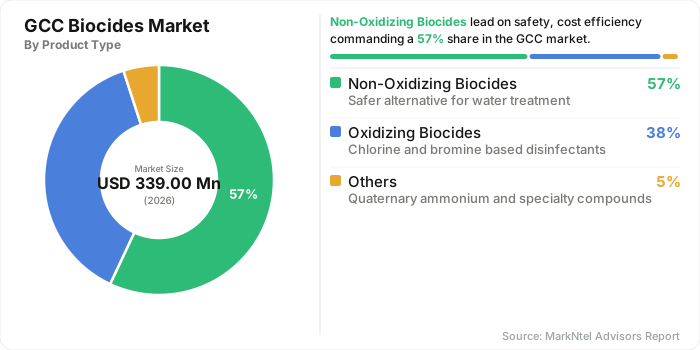
Non-Oxidizing Biocides Commanding 57% Share by Serving More Customer Segments at Once
Non-oxidizing biocides lead the GCC market because they let producers and distributors serve a much wider customer base from a single product category than oxidizing biocides can. Since this category spans quaternary ammonium compounds, metallic compounds, organosulfurs, glutaraldehyde, organic acids, and phenolics, suppliers can sell into industrial cleaning, healthcare, personal care-adjacent, and long-cycle water treatment customers simultaneously, rather than depending on one narrow buyer segment. For businesses, this means lower customer concentration risk and more stable revenue across economic cycles.
Reflecting the commercial strength of this position, Arxada, which generated CHF 2 billion (USD 2.26 billion) in global sales in 2024, signed a long-term agreement with Clorox Healthcare in June 2026 to bring its Quanticare disinfectant into hospital supply chains, following US regulatory approval. The deal lets a single formulation replace multiple disinfectant products a facility previously had to purchase separately, giving Arxada a recurring, high-volume revenue stream tied directly into a major distributor's existing retail network.
Because non-oxidizing biocides let suppliers reach more end markets and lock in longer customer relationships than a single fast-acting chemistry allows, this category retains a structural lead in both revenue scale and customer retention across the region. By the type, the market is further segmented into the following sub-categories:
- Oxidizing Biocides
- Non-Oxidizing Biocides
- Others
Water Treatment Commanding 36% Share Anchored by the Region's Water Scarcity Imperative
Water treatment leads the GCC biocides market because it spans the widest range of end-uses in a region defined by extreme water scarcity: desalination intake and membrane protection, municipal potable water disinfection, and industrial process and effluent water, all of which require continuous microbial control. According to Science of the Total Environment, GCC countries hold 43% of total global desalination capacity, concentrating an outsized share of the world's biocide-dependent water infrastructure within just six countries. Unlike oil and gas or food and beverage applications, which draw on biocides for narrower, sector-specific purposes, water treatment cuts across nearly every GCC industry and household, giving it the broadest structural demand base of any application category.
Reinforcing this position, Veolia announced in 2025 a major agreement with Marafiq and Lamar, alongside Saudi refiner Saudi Aramco Total Refining and Petrochemical Company (SATORP), to implement one of the Middle East's largest complex industrial water recycling projects in Jubail Industrial City, treating challenging industrial effluent for reuse . Projects of this scale require sustained biocide dosing to control microbial growth across recycling infrastructure, directly expanding water treatment's biocide demand base.
As GCC governments and industry continue investing in desalination, municipal networks, and industrial water recycling simultaneously, water treatment's breadth across sectors keeps it structurally ahead of every other application category. By application, the market is further segmented into the following sub-categories:
- Water Treatment
- Industrial & Institutional Cleaning and Home Care
- Wood Preservatives
- Paints & Coatings
- Other Applications
GCC Biocides Market Regional Analysis
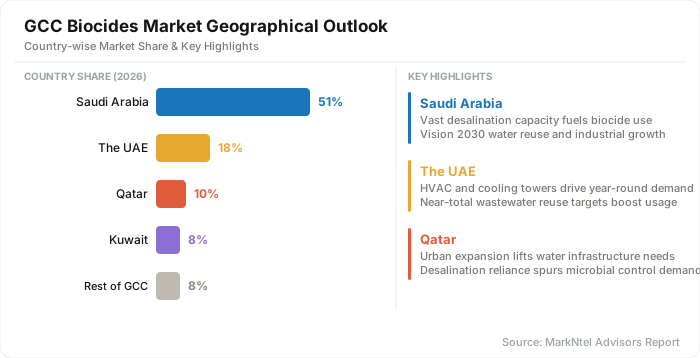
Saudi Arabia Commanding 51% Share as the GCC's Largest Water and Hydrocarbon Base
Saudi Arabia leads the GCC biocides market because it anchors the region's two largest biocide-consuming sectors at once. The Kingdom is the GCC's dominant crude oil producer, and its water infrastructure includes the Saline Water Conversion Corporation's network of 139 desalination and purification plants, with a combined production capacity of approximately 4 million cubic metres per day distributed across the Kingdom, according to AIIB's own project documentation . This combination of scale in both oilfield water handling and public water supply gives Saudi Arabia a structurally larger biocide-consuming base than any other GCC state, reinforced by Vision 2030's parallel push to expand industrial diversification and water security simultaneously.
This leadership is being reinforced through active infrastructure renewal. The Asian Infrastructure Investment Bank is providing approximately USD 450 million toward a USD 650 million financing package to rebuild the Jubail and Khobar desalination plants, converting them from thermal to reverse osmosis technology and extending their operational life by at least 20 years, requiring updated biocide programs suited to membrane-based treatment.
As Saudi Arabia continues modernizing both its oilfield water infrastructure and municipal desalination base under Vision 2030, its combined scale across hydrocarbon and water sectors keeps it structurally ahead of every other GCC market. By country, the market is further segmented into the following sub-categories-
- Saudi Arabia
- The UAE
- Qatar
- Kuwait
- Oman
- Bahrain
GCC Biocides Market Competitive Landscape
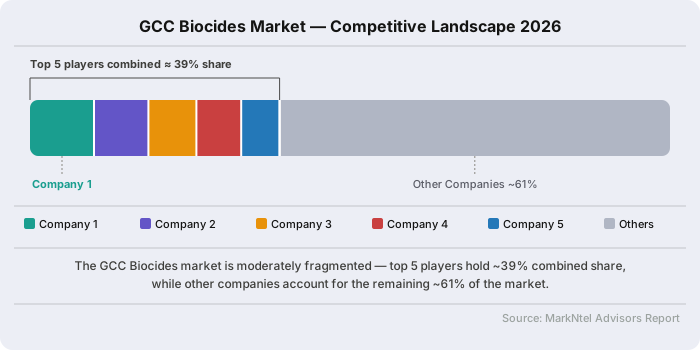
The GCC biocides industry is fragmented, with multinational specialty chemical companies holding strong positions across industrial water treatment, oil & gas production chemicals, coatings preservatives, and institutional disinfection applications. Major participants include BASF SE, LANXESS AG, Arxada AG, Ecolab Inc., Clariant AG, Kemira Oyj, Solvay SA, Dow Inc., Nouryon, Evonik Industries AG, Lubrizol Corporation (Berkshire Hathaway Inc.), and Thor Group Ltd. The top five companies collectively account for approximately 39% of market revenue, reflecting a competitive landscape characterized by global suppliers with established regional distribution networks and technical service capabilities across GCC countries.
Major Companies of GCC Biocides Industry
- BASF SE
- LANXESS AG
- Arxada AG
- Ecolab Inc.
- Clariant AG
- Kemira Oyj
- Solvay SA
- Dow Inc.
- Nouryon Chemicals Holding B.V.
- Evonik Industries AG
- Lubrizol Corporation (Berkshire Hathaway Inc.)
- Thor Group Ltd.
GCC Biocides Market News and Recent Developments
2025: LANXESS Showcases Non-Oxidizing Biocides for Membrane Biofouling Control at Aquatech
At Aquatech 2025, LANXESS presented its non-oxidizing biocide portfolio, including Aqucar DB 20, Kathon WTE, and Aqucar GA 50, designed to protect industrial reverse osmosis and nanofiltration membranes against microbiological fouling. According to the company, biofouling increases energy consumption, shortens membrane lifespan, and can force costly production shutdowns if left uncontrolled.
Impact Analysis: Membrane-based reverse osmosis is the core technology behind GCC desalination, so continued innovation in non-oxidizing biocides for this exact application directly supports the region's largest single source of biocide demand, reinforcing the segment's structural importance as GCC desalination capacity keeps expanding.
2025-2026: GCC Standardization Organization Updates Chemical Classification and Labeling Standard
The GCC Standardization Organization notified the World Trade Organization on December 17, 2025, of a draft technical regulation, GSO 2654:2025, updating the region's chemical classification and labeling framework to align with the tenth revised edition of the UN Globally Harmonized System, with a public comment period closing February 15, 2026. The regulation directly governs how biocides, as hazardous chemicals, must be classified and labeled across Safety Data Sheets and product labels in GCC member states, with Saudi Arabia continuing under its own separate national framework.
Impact Analysis: This standard boosts market growth by forcing a clear divide between compliant and non-compliant suppliers, pushing buyers toward manufacturers who can produce properly documented, bilingual Safety Data Sheets and labels rather than informally packaged legacy products. As enforcement tightens, formulators that already meet international GHS standards gain an edge over smaller, non-compliant local blenders, consolidating demand toward established, quality-assured biocide brands and supporting higher average selling prices as customers pay a premium for verified compliance.
- Market Segmentation
- Introduction
- Product Definition
- Research Process
- Assumptions
- Executive Summary
- GCC Biocides Market Policies, Regulations, and Product Standards
- GCC Biocides Market Trends & Developments
- GCC Biocides Market Dynamics
- Growth Factors
- Challenges
- GCC Biocides Market Hotspot & Opportunities
- GCC Biocides Market Outlook, 2022-2032
- Market Size & Outlook
- By Revenues (USD Million)
- Market Share & Outlook
- By Type- Market Size & Forecast 2022-2032, USD Million
- Oxidizing Biocides
- Halogen Compounds
- Non-Oxidizing Biocides
- Metallic Compounds
- Quaternary Ammonium Compounds
- Organosulfur Compounds
- Glutaraldehyde
- Organic Acids
- Phenolic Compounds
- Others
- Oxidizing Biocides
- By Application- Market Size & Forecast 2022-2032, USD Million
- Water Treatment
- Municipal Water Treatment
- Industrial Water Treatment
- Oil & Gas
- Power Generation
- Pulp & Paper
- Mining
- Recreational Water (Swimming Pools)
- Other Water Treatment Applications
- Industrial & Institutional Cleaning and Home Care
- Wood Preservatives
- Paints & Coatings
- Marine Coatings
- Other Paint & Coating Applications
- Other Applications
- Water Treatment
- By Country
- Saudi Arabia
- The UAE
- Qatar
- Kuwait
- Oman
- Bahrain
- By Company
- Competition Characteristics
- Market Share & Analysis
- By Type- Market Size & Forecast 2022-2032, USD Million
- Market Size & Outlook
- Saudi Arabia Biocides Market Outlook, 2022-2032
- Market Size & Outlook
- By Revenues (USD Million)
- Market Segmentation & Outlook
- By Type- Market Size & Forecast 2022-2032, USD Million
- By Application- Market Size & Forecast 2022-2032, USD Million
- Market Size & Outlook
- The UAE Biocides Market Outlook, 2022-2032
- Market Size & Outlook
- By Revenues (USD Million)
- Market Segmentation & Outlook
- By Type- Market Size & Forecast 2022-2032, USD Million
- By Application- Market Size & Forecast 2022-2032, USD Million
- Market Size & Outlook
- Qatar Biocides Market Outlook, 2022-2032
- Market Size & Outlook
- By Revenues (USD Million)
- Market Segmentation & Outlook
- By Type- Market Size & Forecast 2022-2032, USD Million
- By Application- Market Size & Forecast 2022-2032, USD Million
- Market Size & Outlook
- Kuwait Biocides Market Outlook, 2022-2032
- Market Size & Outlook
- By Revenues (USD Million)
- Market Segmentation & Outlook
- By Type- Market Size & Forecast 2022-2032, USD Million
- By Application- Market Size & Forecast 2022-2032, USD Million
- Market Size & Outlook
- Oman Biocides Market Outlook, 2022-2032
- Market Size & Outlook
- By Revenues (USD Million)
- Market Segmentation & Outlook
- By Type- Market Size & Forecast 2022-2032, USD Million
- By Application- Market Size & Forecast 2022-2032, USD Million
- Market Size & Outlook
- GCC Biocides Market Key Strategic Imperatives for Success & Growth
- Competitive Outlook
- Company Profiles
- BASF SE
- Business Description
- Product Portfolio
- Collaborations & Alliances
- Recent Developments
- Financial Details
- Others
- LANXESS AG
- Business Description
- Product Portfolio
- Collaborations & Alliances
- Recent Developments
- Financial Details
- Others
- Arxada AG
- Business Description
- Product Portfolio
- Collaborations & Alliances
- Recent Developments
- Financial Details
- Others
- Ecolab Inc.
- Business Description
- Product Portfolio
- Collaborations & Alliances
- Recent Developments
- Financial Details
- Others
- Clariant AG
- Business Description
- Product Portfolio
- Collaborations & Alliances
- Recent Developments
- Financial Details
- Others
- Kemira Oyj
- Business Description
- Product Portfolio
- Collaborations & Alliances
- Recent Developments
- Financial Details
- Others
- Solvay SA
- Business Description
- Product Portfolio
- Collaborations & Alliances
- Recent Developments
- Financial Details
- Others
- Dow Inc.
- Business Description
- Product Portfolio
- Collaborations & Alliances
- Recent Developments
- Financial Details
- Others
- Nouryon Chemicals Holding B.V.
- Business Description
- Product Portfolio
- Collaborations & Alliances
- Recent Developments
- Financial Details
- Others
- Evonik Industries AG
- Business Description
- Product Portfolio
- Collaborations & Alliances
- Recent Developments
- Financial Details
- Others
- Lubrizol Corporation (Berkshire Hathaway Inc.)
- Business Description
- Product Portfolio
- Collaborations & Alliances
- Recent Developments
- Financial Details
- Others
- Thor Group Ltd.
- Business Description
- Product Portfolio
- Collaborations & Alliances
- Recent Developments
- Financial Details
- Others
- BASF SE
- Company Profiles
- Disclaimer

MarkNtel Advisors follows a robust and iterative research methodology designed to ensure maximum accuracy and minimize deviation in market estimates and forecasts. Our approach combines both bottom-up and top-down techniques to effectively segment and quantify various aspects of the market. A consistent feature across all our research reports is data triangulation, which examines the market from three distinct perspectives to validate findings. Key components of our research process include:
1. Scope & Research Design At the outset, MarkNtel Advisors define the research objectives and formulate pertinent questions. This phase involves determining the type of research—qualitative or quantitative—and designing a methodology that outlines data collection methods, target demographics, and analytical tools. They also establish timelines and budgets to ensure the research aligns with client goals.
2. Sample Selection and Data Collection In this stage, the firm identifies the target audience and determines the appropriate sample size to ensure representativeness. They employ various sampling methods, such as random or stratified sampling, based on the research objectives. Data collection is carried out using tools like surveys, interviews, and observations, ensuring the gathered data is reliable and relevant.
3. Data Analysis and Validation Once data is collected, MarkNtel Advisors undertake a rigorous analysis process. This includes cleaning the data to remove inconsistencies, employing statistical software for quantitative analysis, and thematic analysis for qualitative data. Validation steps are taken to ensure the accuracy and reliability of the findings, minimizing biases and errors.

4. Data Forecast and FinalizationThe final phase involves forecasting future market trends based on the analyzed data. MarkNtel Advisors utilize predictive modeling and time series analysis to anticipate market behaviors. The insights are then compiled into comprehensive reports, featuring visual aids like charts and graphs, and include strategic recommendations to inform client decision-making
We’d love to understand what matters most to you.