

By Product Type (Room Air Conditioners (Window AC (Upto 1 Ton, 1 Ton to 2 Ton, Above 2 Ton), Split AC (Upto 1 Ton, 1 Ton to 1.5 Ton, Above 1.6 to 2 Ton, Above 2 Ton)), VRF Systems, Chillers (Air-coole... ... Chillers (Air-cooled chillers, Water-cooled chillers, Others), Packaged Air Conditioners (Upto 5 Tons, 6 to 10 Tons, 11 to 20 Tons, Above 20 Tons), Cassette Air Conditioners (Upto 2 Tons, 2.1 to 4 Tons, 4.1 to 5 Tons, Above 5 Tons), Ducted Split Systems (Upto 5 Tons, 6 to 10 Tons, 11 to 20 Tons, Above 20 Tons), Boilers, Heat Pump, Others (Air Handling Units (AHU) / Fan Coil Units (FCU), etc.)), By Sales Channel (Direct Sales, Authorized Dealers & Distributors, Multi-Brand Stores, Online), By Refrigerant Type (R32, R410A, R134a, R290, R1234ze / R1234yf, Others), By End-User (Residential, Offices, Retail & Malls, Hotels & Hospitality, Hospitals & Healthcare, Educational Institutions, Manufacturing, Pharmaceuticals, Food & Beverage, Centers), and others Read more
- Environment
- Aug 2026
- 295
- PDF, Excel, PPT
Europe HVAC Market Key Takeaways
- The Europe HVAC market was valued at USD 37.28 billion in 2025 and is projected to grow from USD 41.29 billion in 2026 to USD 52.39 billion by 2032.
- The industry is projected to witness steady growth at a CAGR of 4.01% during 2026–2032.
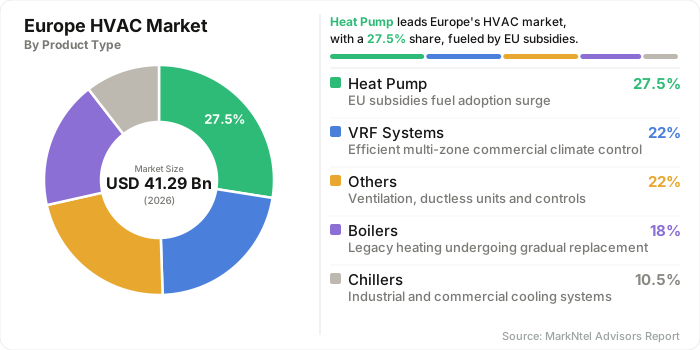
- By product type, heating pump dominates the market, accounting for a 27.5% share in 2026.
- By end user, the residential segment holds the largest market share at approximately 46.5% in 2026.
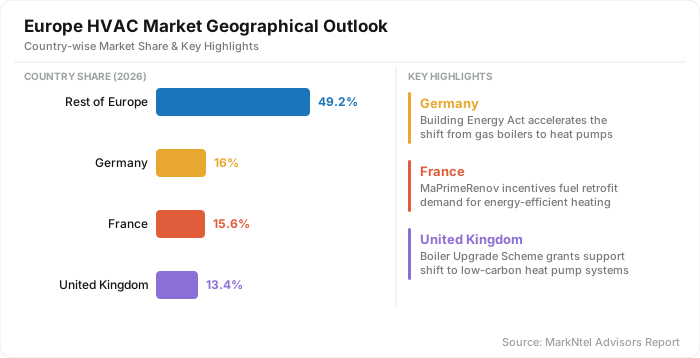
- Germany leads the industry with an estimated 16% share in 2026.
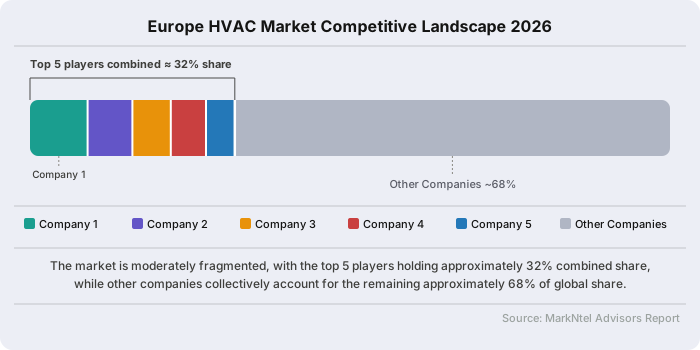
- The industry is moderately fragmented, with the top five companies collectively accounting for an estimated 32% market share in 2026.
Europe HVAC Market Size & Outlook
The Europe HVAC market was valued at USD 37.28 billion in 2025 and is projected to reach USD 41.29 billion in 2026. The market is further expected to attain USD 52.39 billion by 2032, expanding at a CAGR of 4.01% during the forecast period.
Market growth is primarily driven by the increasing replacement of aging heating and cooling systems, expanding commercial infrastructure, and rising demand for sustainable indoor climate solutions. Growing investments in energy-efficient HVAC systems and intelligent climate control are expected to support steady revenue growth across the region.
The market is witnessing robust momentum from the continued expansion of Europe's heat pump industry. According to the European Heat Pump Association (EHPA), Finland's heat pump market exceeded USD 720 million in 2025, while air-to-air heat pump installations increased by 14% to approximately 96,000 units. The growing deployment of heat pumps across residential apartments, public buildings, and commercial facilities is strengthening demand for heat pump systems, demand-controlled ventilation, and integrated heat recovery technologies that improve building energy performance.
Growth is also supported by the recovery of heating equipment demand across Central Europe. According to the European Heat Pump Association (EHPA), the correction of electricity tariff structures in the Czech Republic resulted in a 31% increase in heat pump sales during 2025, restoring market demand toward pre-crisis levels. The recovery is accelerating residential and commercial building renovations, increasing investments in advanced hydronic heating systems, smart controls, and building automation solutions to comply with evolving European energy performance requirements.
Furthermore, Europe's ongoing transition toward digital and sustainable buildings continues to create long-term opportunities for the HVAC industry. Manufacturers are increasingly integrating connected controls, predictive maintenance capabilities, and renewable heating technologies into next-generation product portfolios to address changing customer requirements. Rising investments in commercial buildings, healthcare facilities, logistics infrastructure, and industrial modernization are expected to accelerate the adoption of smart HVAC technologies and advanced ventilation systems, sustaining market expansion throughout the forecast period.
Europe HVAC Market Key Indicators
- According to Eurostat, the European Union exported approximately USD 4.4 billion worth of air conditioning machines and heat pump equipment (HS 8415/841861) to global markets in 2024, demonstrating Europe's strong manufacturing base for premium HVAC equipment and reinforcing continued investments in advanced production capacity across the region.
- According to the European Heat Pump Association (EHPA), residential heat pump sales across 16 European countries increased by 10.3% in 2025, reaching approximately 2.62 million units from 2.38 million units in 2024. Rising heat pump adoption is driving demand for hydronic heating, air-to-water systems, and energy-efficient HVAC equipment across the region.
- The European Environment Agency (EEA) reports that the EU's hydrofluorocarbon (HFC) emissions under the F-Gas phase-down framework have declined by approximately 33% from 2014 peak levels, while the revised F-Gas Regulation introduces an allocation fee of USD 4.8 per tonne of CO₂ equivalent from January 2026. The stricter regulatory framework is accelerating the adoption of low-GWP refrigerants and next-generation air conditioning, VRF, and chiller systems.
- According to the European Commission, the recast Energy Performance of Buildings Directive (Directive (EU) 2024/1275) requires Member States to transpose the legislation by May 2026, while subsidies for standalone fossil-fuel boilers ended in January 2025. These measures are accelerating building renovation projects and increasing demand for high-efficiency HVAC systems across residential and commercial buildings.
Europe HVAC Market Scope
| Category | Segments |
|---|---|
| By Product Type | Room Air Conditioners (Window AC (Upto 1 Ton, 1 Ton to 2 Ton, Above 2 Ton), Split AC (Upto 1 Ton, 1 Ton to 1.5 Ton, Above 1.6 to 2 Ton, Above 2 Ton)), VRF Systems, Chillers (Air-cooled chillers, Water-cooled chillers, Others), Packaged Air Conditioners (Upto 5 Tons, 6 to 10 Tons, 11 to 20 Tons, Above 20 Tons), Cassette Air Conditioners (Upto 2 Tons, 2.1 to 4 Tons, 4.1 to 5 Tons, Above 5 Tons), Ducted Split Systems (Upto 5 Tons, 6 to 10 Tons, 11 to 20 Tons, Above 20 Tons), Boilers, Heat Pump, Others (Air Handling Units (AHU) / Fan Coil Units (FCU), etc. |
| By Sales Channel | Direct Sales, Authorized Dealers & Distributors, Multi-Brand Stores, Online |
| By Refrigerant Type | R32, R410A, R134a, R290, R1234ze / R1234yf, Others |
| By End-User | Residential, Offices, Retail & Malls, Hotels & Hospitality, Hospitals & Healthcare, Educational Institutions, Manufacturing, Pharmaceuticals, Food & Beverage, Centers |
Europe HVAC Market Growth Driver
Expansion of Commercial Construction and Infrastructure Investments
The continued expansion of commercial and public infrastructure across Europe is accelerating the deployment of advanced heating, ventilation, and air conditioning systems in newly developed buildings. According to Eurostat, the European Union recorded approximately 1.55 million building permits for residential construction in 2024, while non-residential construction activity remained resilient across healthcare, education, office, and mixed-use developments. This sustained building pipeline is strengthening demand for commercial HVAC solutions, energy-efficient climate control, and integrated ventilation systems across the region.
Large-scale infrastructure developments are further supporting long-term HVAC installations throughout Europe. According to the Centre Hospitalier Universitaire (CHU) de Nantes, the Nantes University Hospital project spans approximately 220,000 square metres and remains on schedule for commissioning in 2027, making it one of Europe's largest healthcare infrastructure developments. Such high-value institutional projects require centralized air conditioning, air handling units, and smart building technologies, thereby accelerating demand for smart HVAC systems and building automation solutions across Europe's commercial construction sector.
Recent Trends
Rising Adoption of AI-Powered Smart Building Climate Solutions
The rapid digitalization of commercial and residential buildings is accelerating the adoption of AI-powered HVAC systems across Europe, as building owners increasingly prioritize intelligent energy optimization and predictive climate control. According to the European Commission, the Artificial Intelligence Act (Regulation (EU) 2024/1689) entered into force in August 2024, establishing a harmonized regulatory framework for AI deployment across the European Union. In addition, by 2024, 16 EU Member States had launched national Smart Readiness Indicator (SRI) pilot programs, with more than 1,000 buildings formally assessed and certified, accelerating the adoption of smart building technologies, connected HVAC equipment, and integrated digital energy management platforms.
Leading manufacturers are continuously enhancing their product portfolios with AI-enabled technologies to improve operational efficiency and user experience. For instance, at Mostra Convegno Expocomfort (MCE) 2026, Samsung Electronics Co., Ltd. showcased its Bespoke AI WindFree™ air conditioner series featuring AI Energy Mode, which intelligently analyzes occupancy patterns and indoor environmental conditions to reduce energy consumption by up to 30%. The growing commercialization of AI-enabled HVAC platforms is strengthening demand for connected climate control systems, enabling predictive maintenance, remote monitoring, and intelligent energy optimization across residential and commercial buildings.
Europe HVAC Market Opportunities and Challenges
Regulatory Transformation Unlocks Sustainable HVAC Growth
The evolving regulatory framework across Europe is increasing compliance complexity for HVAC manufacturers, distributors, and contractors. The recast Energy Performance of Buildings Directive (EPBD) (Directive (EU) 2024/1275), the revised F-Gas Regulation (EU) 2024/573, and national regulations such as Germany's GEG 2024 and France's BACS and Tertiary Decrees have created a fragmented compliance landscape with varying implementation timelines, certification requirements, and reporting obligations. Furthermore, the accelerated HFC quota phase-down toward a 2050 HFC phase-out, coupled with the USD 3.4 per tonne CO₂eq allocation fee from January 2026, is increasing product redesign, certification, and compliance costs, challenging manufacturers to rapidly transition toward next-generation low-carbon HVAC solutions and energy-efficient climate technologies.
At the same time, the regulatory transition is creating significant opportunities for innovation and sustainable product development. Major OEMs are responding through strategic investments and advanced product launches, with Viessmann, Bosch Thermotechnik, and NIBE expanding their R290-based monoblock and hybrid heat pump portfolios, while Systemair, FläktGroup, and Carrier are strengthening their offerings with AI-enabled building automation and low-GWP chiller platforms. These developments are accelerating the adoption of renewable HVAC systems, smart HVAC ecosystems, and integrated energy management solutions, positioning the European market for long-term growth while helping customers achieve both regulatory compliance and higher building energy performance.
Segmentation Insights
Cold Climate Strengthens Heating Equipment Demand
Heating pump dominates the market with 27.5% Share in 2026, of the Europe HVAC industry, making it the largest revenue-generating segment. The region's long and cold winters, particularly across Northern, Central, and Eastern Europe, create consistent demand for space heating throughout much of the year. Boilers, heat pumps, radiators, and hydronic heating systems are widely installed in residential buildings, offices, hospitals, schools, and industrial facilities to maintain indoor thermal comfort. Rising investments in energy-efficient heating systems and building decarbonization continue to reinforce the segment's market leadership.
The segment is further strengthened by Europe's expanding manufacturing capabilities and transition toward renewable heating technologies. According to the European Heat Pump Association (EHPA), more than 300 heat pump production facilities are operating across Europe in 2025, supporting regional supply and innovation. In response to evolving energy regulations, manufacturers are expanding high-efficiency heat pump portfolios for both new construction and retrofit projects. The growing adoption of hydronic HVAC solutions and renewable heating technologies continues to sustain the dominance of heating equipment across the European HVAC market. Based on product type, the scope has been bifurcated into:
- Room Air Conditioners
- VRF Systems
- Chillers
- Packaged Air Conditioners
- Cassette Air Conditioners
- Ducted Split Systems
- Boilers
- Heat Pump
- Others (Air Handling Units (AHU) / Fan Coil Units (FCU), etc.)
Extensive Housing Stock and Renovation Activities Sustain Residential HVAC Demand
Residential Segment Dominates with 46.5% Market share of the Europe HVAC industry, making it the largest end-user segment. The dominance is driven by Europe's vast residential building stock, prolonged heating requirements across Northern and Central Europe, and increasing cooling demand during warmer summers. HVAC systems are extensively installed in single-family homes, apartments, and multi-dwelling residential buildings to provide year-round thermal comfort. Growing investments in residential HVAC systems, home climate control, and energy-efficient ventilation solutions continue to reinforce the segment's market leadership.
The segment is further supported by Europe's large-scale residential renovation pipeline. According to the European Commission's Renovation Wave Strategy, the European Union aims to renovate 35 million buildings by 2030 while creating opportunities for the replacement of aging heating and cooling equipment with high-efficiency alternatives. The region is also home to approximately 197 million households, representing one of the world's largest installed bases for residential HVAC systems. Consequently, manufacturers continue expanding inverter air conditioners, residential heat pumps, and smart home HVAC solutions, strengthening long-term demand for energy-efficient residential climate control across Europe. By the end user the industry is segmented into:
- Residential
- Offices
- Retail
- Hospitality
- Healthcare
- Educational Institutions
- Industrial
- Others
Europe HVAC Market Geographical Outlook
Germany is estimated to account for 16% of the Europe HVAC market, making it the largest country-level contributor. The country's dominance is supported by its extensive residential, commercial, and industrial building stock, coupled with strong demand for heating, cooling, and ventilation systems. Continuous investments in energy-efficient HVAC, building climate control, and sustainable infrastructure projects further strengthen equipment installations across new construction and retrofit applications.
Germany also benefits from one of Europe's largest construction and renovation markets. According to Destatis, the value of building construction permits reached approximately EUR 104.4 billion in 2024, reflecting sustained investments in residential and non-residential infrastructure. The expanding construction pipeline continues to increase demand for advanced HVAC equipment, particularly in offices, healthcare facilities, educational institutions, and manufacturing plants requiring high-performance indoor climate solutions.
The country's leadership is further reinforced by its strong domestic manufacturing ecosystem and technology innovation. Germany is home to leading HVAC manufacturers such as Bosch Home Comfort Group, Viessmann Climate Solutions, and Systemair Germany, alongside extensive research and engineering capabilities. Continuous investments in smart HVAC systems, renewable heating technologies, and intelligent building automation continue to strengthen Germany's position as the leading market for HVAC equipment in Europe.
Europe HVAC Market Competitive Analysis
The Europe HVAC market is moderately consolidated, with the top five companies holding an estimated 32% of the total market revenue in 2026. Competition is centered on product innovation, energy-efficient technologies, low-GWP refrigerant adoption, and smart building integration. Leading manufacturers continue to strengthen their market positions through regional manufacturing expansion, strategic partnerships, and the commercialization of advanced HVAC equipment and smart climate control systems.
Top Companies in the Europe HVAC Industry
- Haier Europe
- Gree Electric Appliances, Inc. of Zhuhai
- Johnson Controls
- Mitsubishi Electric Europe B.V.
- LG Electronics
- Samsung Electronics
- Daikin Europe N.V.
- Midea Group
- Hisense Europe
- Beko Europe
- BSH Hausgeräte GmbH
- Carrier Global Corporation
- Trane Technologies plc
- Hitachi Europe Ltd.
- Aermec S.p.A.
- Lennox EMEA
- Bosch Home Comfort Group
- Climaveneta S.p.A.
- Groupe Atlantic
- Systemair AB
- Vaillant Group
- NIBE Group
- Panasonic Heating & Ventilation Air Conditioning Europe
- Others
Europe HVAC Industry News and Recent Developments
March 2025: Daikin Showcases Next-Generation Low-Carbon HVAC Solutions at ISH 2025
Daikin Europe introduced its latest Daikin Altherma 4 heat pump, CO₂ VRV, and new R290-based commercial heat pump technologies at ISH 2025 in Frankfurt. The company also highlighted its refrigerant strategy focused on natural refrigerants and low-GWP solutions to support Europe's decarbonization objectives and compliance with evolving F-Gas regulations.
Impact Analysis: The launch strengthens the transition toward sustainable heating and cooling technologies across Europe. By expanding its portfolio of natural refrigerant and low-GWP products, Daikin is expected to accelerate adoption of smart HVAC systems, support regulatory compliance, and intensify competition in the region's high-efficiency HVAC market.
March 2025: Carrier Expands AquaForce Chiller Portfolio for Large Commercial Projects
Carrier Global Corporation expanded its AquaForce® 30XW(H)VZE variable-speed chiller and heat pump range with new models delivering capacities of up to 1,635 kW cooling and 1,930 kW heating using R-515B and R-1234ze(E) low-GWP refrigerants. The systems are designed for data centers, industrial facilities, and large commercial buildings requiring high energy efficiency.
Impact Analysis: The portfolio expansion enhances Carrier's presence in Europe's commercial HVAC sector while supporting compliance with the revised EU F-Gas Regulation. The introduction of larger-capacity, low-GWP chillers is expected to drive demand for commercial HVAC equipment, strengthen sustainable cooling solutions, and accelerate the replacement of conventional cooling systems in high-capacity applications.
- Market Segmentation
- Introduction
- Product Definition
- Research Process
- Assumptions
- Executive Summary
- Europe HVAC Market Production Trend, 2022-2032
- Europe HVAC Production Trend by Product Type
- Room Air Conditioners
- VRF Systems
- Chillers
- Packaged Air Conditioners
- Cassette Air Conditioners
- Ducted Split Systems
- Boilers
- Heat Pump
- Others (Air Handling Units (AHU) / Fan Coil Units (FCU), etc.)
- Company-Wise Production Plants and Statistics
- Installed Production Capacity
- Actual Production
- Planned Production Target
- Europe HVAC Production Trend by Product Type
- Europe HVAC Market Pricing Analysis, By Type of Product, 2022-2032
- Europe HVAC Market Pricing Trend (USD Million) 2022-2032
- Europe HVAC Pricing Trend (USD Million) By Product Type
- Room Air Conditioners
- VRF Systems
- Chillers
- Packaged Air Conditioners
- Cassette Air Conditioners
- Ducted Split Systems
- Boilers
- Heat Pump
- Others (Air Handling Units (AHU) / Fan Coil Units (FCU), etc.)
- Europe HVAC Market Policies, Regulations, and Product Standards
- Europe HVAC Market Trends & Developments
- Europe HVAC Market Dynamics
- Growth Factors
- Challenges
- Europe HVAC Market Hotspot & Opportunities
- Europe HVAC Market Outlook, 2022-2032
- Market Size & Outlook
- By Revenues (USD Million)
- Market Segmentation & Outlook
- By Product Type- Market Size & Forecast 2022-2032, USD Million
- Room Air Conditioners
- Window AC
- Upto 1 Ton
- 1 Ton to 2 Ton
- Above 2 Ton
- Split AC
- Upto 1 Ton
- 1 Ton to 1.5 Ton
- Above 1.6 to 2 Ton
- Above 2 Ton
- Window AC
- VRF Systems
- Chillers
- Air-cooled chillers
- Water-cooled chillers
- Others
- Packaged Air Conditioners
- Upto 5 Tons
- 6 to 10 Tons
- 11 to 20 Tons
- Above 20 Tons
- Cassette Air Conditioners
- Upto 2 Tons
- 2.1 to 4 Tons
- 4.1 to 5 Tons
- Above 5 Tons
- Ducted Split Systems
- Upto 5 Tons
- 6 to 10 Tons
- 11 to 20 Tons
- Above 20 Tons
- Boilers
- Heat Pump
- Others (Air Handling Units (AHU) / Fan Coil Units (FCU), etc.)
- Room Air Conditioners
- By Sales Channel- Market Size & Forecast 2022-2032, USD Million
- Direct Sales
- Authorized Dealers & Distributors
- Multi-Brand Stores
- Online
- By Refrigerant Type- Market Size & Forecast 2022-2032, USD Million
- R32
- R410A
- R134a
- R290
- R1234ze / R1234yf
- Others
- By End-User- Market Size & Forecast 2022-2032, USD Million
- Residential
- Offices
- Retail & Malls
- Hotels & Hospitality
- Hospitals & Healthcare
- Educational Institutions
- Manufacturing
- Pharmaceuticals
- Food & Beverage
- Data Centers
- Others
- By Country
- Germany
- United Kingdom
- Europe
- Italy
- Spain
- The Netherlands
- Poland
- Rest of Europe
- By Company
- Competition Characteristics
- Market Segmentation & Outlook
- By Product Type- Market Size & Forecast 2022-2032, USD Million
- Market Size & Outlook
- Germany HVAC Market Outlook, 2022-2032
- Market Size & Outlook
- By Revenues (USD Million)
- Market Segmentation & Outlook
- By Product Type- Market Size & Forecast 2022-2032, USD Million
- By Sales Channel- Market Size & Forecast 2022-2032, USD Million
- By Refrigerant Type- Market Size & Forecast 2022-2032, USD Million
- By End-User- Market Size & Forecast 2022-2032, USD Million
- Market Size & Outlook
- United Kingdom HVAC Market Outlook, 2022-2032
- Market Size & Outlook
- By Revenues (USD Million)
- Market Segmentation & Outlook
- By Product Type- Market Size & Forecast 2022-2032, USD Million
- By Sales Channel- Market Size & Forecast 2022-2032, USD Million
- By Refrigerant Type- Market Size & Forecast 2022-2032, USD Million
- By End-User- Market Size & Forecast 2022-2032, USD Million
- Market Size & Outlook
- Europe HVAC Market Outlook, 2022-2032
- Market Size & Outlook
- By Revenues (USD Million)
- Market Segmentation & Outlook
- By Product Type- Market Size & Forecast 2022-2032, USD Million
- By Sales Channel- Market Size & Forecast 2022-2032, USD Million
- By Refrigerant Type- Market Size & Forecast 2022-2032, USD Million
- By End-User- Market Size & Forecast 2022-2032, USD Million
- Market Size & Outlook
- Italy HVAC Market Outlook, 2022-2032
- Market Size & Outlook
- By Revenues (USD Million)
- Market Segmentation & Outlook
- By Product Type- Market Size & Forecast 2022-2032, USD Million
- By Sales Channel- Market Size & Forecast 2022-2032, USD Million
- By Refrigerant Type- Market Size & Forecast 2022-2032, USD Million
- By End-User- Market Size & Forecast 2022-2032, USD Million
- Market Size & Outlook
- Spain HVAC Market Outlook, 2022-2032
- Market Size & Outlook
- By Revenues (USD Million)
- Market Segmentation & Outlook
- By Product Type- Market Size & Forecast 2022-2032, USD Million
- By Sales Channel- Market Size & Forecast 2022-2032, USD Million
- By Refrigerant Type- Market Size & Forecast 2022-2032, USD Million
- By End-User- Market Size & Forecast 2022-2032, USD Million
- Market Size & Outlook
- The Netherlands HVAC Market Outlook, 2022-2032
- Market Size & Outlook
- By Revenues (USD Million)
- Market Segmentation & Outlook
- By Product Type- Market Size & Forecast 2022-2032, USD Million
- By Sales Channel- Market Size & Forecast 2022-2032, USD Million
- By Refrigerant Type- Market Size & Forecast 2022-2032, USD Million
- By End-User- Market Size & Forecast 2022-2032, USD Million
- Market Size & Outlook
- Poland HVAC Market Outlook, 2022-2032
- Market Size & Outlook
- By Revenues (USD Million)
- Market Segmentation & Outlook
- By Product Type- Market Size & Forecast 2022-2032, USD Million
- By Sales Channel- Market Size & Forecast 2022-2032, USD Million
- By Refrigerant Type- Market Size & Forecast 2022-2032, USD Million
- By End-User- Market Size & Forecast 2022-2032, USD Million
- Market Size & Outlook
- Europe HVAC Market Key Strategic Imperatives for Success & Growth
- Competitive Outlook
- Company Profiles
- Haier Europe
- Business Description
- Product Portfolio
- Collaborations & Alliances
- Recent Developments
- Financial Details
- Others
- Gree Electric Appliances
- Business Description
- Product Portfolio
- Collaborations & Alliances
- Recent Developments
- Financial Details
- Others
- Johnson Controls
- Business Description
- Product Portfolio
- Collaborations & Alliances
- Recent Developments
- Financial Details
- Others
- Mitsubishi Electric Europe B.V.
- Business Description
- Product Portfolio
- Collaborations & Alliances
- Recent Developments
- Financial Details
- Others
- LG Electronics
- Business Description
- Product Portfolio
- Collaborations & Alliances
- Recent Developments
- Financial Details
- Others
- Samsung Electronics
- Business Description
- Product Portfolio
- Collaborations & Alliances
- Recent Developments
- Financial Details
- Others
- Midea Group
- Business Description
- Product Portfolio
- Collaborations & Alliances
- Recent Developments
- Financial Details
- Others
- Hisense Europe
- Business Description
- Product Portfolio
- Collaborations & Alliances
- Recent Developments
- Financial Details
- Others
- Beko Group
- Business Description
- Product Portfolio
- Collaborations & Alliances
- Recent Developments
- Financial Details
- Others
- BSH Hausgeräte GmbH
- Business Description
- Product Portfolio
- Collaborations & Alliances
- Recent Developments
- Financial Details
- Others
- Carrier Global Corporation
- Business Description
- Product Portfolio
- Collaborations & Alliances
- Recent Developments
- Financial Details
- Others
- Trane Technologies plc
- Business Description
- Product Portfolio
- Collaborations & Alliances
- Recent Developments
- Financial Details
- Others
- Hitachi Europe Ltd.
- Business Description
- Product Portfolio
- Collaborations & Alliances
- Recent Developments
- Financial Details
- Others
- Aermec S.p.A.
- Business Description
- Product Portfolio
- Collaborations & Alliances
- Recent Developments
- Financial Details
- Others
- Lennox EMEA
- Business Description
- Product Portfolio
- Collaborations & Alliances
- Recent Developments
- Financial Details
- Others
- Bosch Home Comfort Group
- Business Description
- Product Portfolio
- Collaborations & Alliances
- Recent Developments
- Financial Details
- Others
- Climaveneta S.p.A.
- Business Description
- Product Portfolio
- Collaborations & Alliances
- Recent Developments
- Financial Details
- Others
- Groupe Atlantic
- Business Description
- Product Portfolio
- Collaborations & Alliances
- Recent Developments
- Financial Details
- Others
- Systemair AB
- Business Description
- Product Portfolio
- Collaborations & Alliances
- Recent Developments
- Financial Details
- Others
- Vaillant Group
- Business Description
- Product Portfolio
- Collaborations & Alliances
- Recent Developments
- Financial Details
- Others
- NIBE Group
- Business Description
- Product Portfolio
- Collaborations & Alliances
- Recent Developments
- Financial Details
- Others
- Panasonic Heating & Ventilation Air Conditioning Europe
- Business Description
- Product Portfolio
- Collaborations & Alliances
- Recent Developments
- Financial Details
- Others
- Others
- Haier Europe
- Company Profiles
- Disclaimer

MarkNtel Advisors follows a robust and iterative research methodology designed to ensure maximum accuracy and minimize deviation in market estimates and forecasts. Our approach combines both bottom-up and top-down techniques to effectively segment and quantify various aspects of the market. A consistent feature across all our research reports is data triangulation, which examines the market from three distinct perspectives to validate findings. Key components of our research process include:
1. Scope & Research Design At the outset, MarkNtel Advisors define the research objectives and formulate pertinent questions. This phase involves determining the type of research—qualitative or quantitative—and designing a methodology that outlines data collection methods, target demographics, and analytical tools. They also establish timelines and budgets to ensure the research aligns with client goals.
2. Sample Selection and Data Collection In this stage, the firm identifies the target audience and determines the appropriate sample size to ensure representativeness. They employ various sampling methods, such as random or stratified sampling, based on the research objectives. Data collection is carried out using tools like surveys, interviews, and observations, ensuring the gathered data is reliable and relevant.
3. Data Analysis and Validation Once data is collected, MarkNtel Advisors undertake a rigorous analysis process. This includes cleaning the data to remove inconsistencies, employing statistical software for quantitative analysis, and thematic analysis for qualitative data. Validation steps are taken to ensure the accuracy and reliability of the findings, minimizing biases and errors.

4. Data Forecast and FinalizationThe final phase involves forecasting future market trends based on the analyzed data. MarkNtel Advisors utilize predictive modeling and time series analysis to anticipate market behaviors. The insights are then compiled into comprehensive reports, featuring visual aids like charts and graphs, and include strategic recommendations to inform client decision-making
We’d love to understand what matters most to you.