

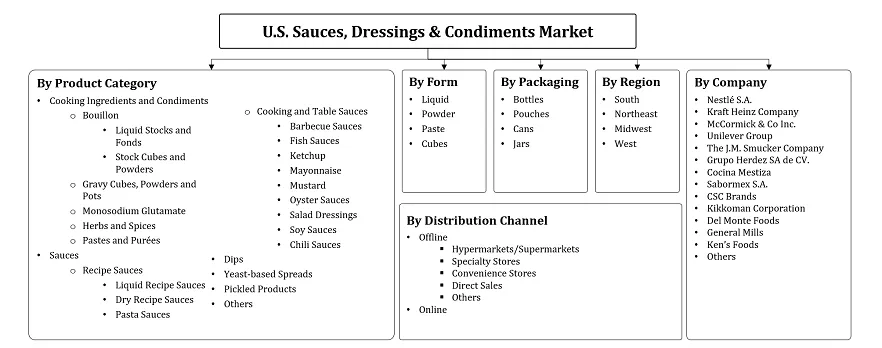
By Product Category (Cooking Ingredients and Condiments, Sauces, Dips, Yeast-based Spreads, Pickled Products, Others), By Form (Liquid, Powder, Paste, Cubes), By Packaging (Bottles......, Pouches, Cans, Jars), By Distribution channel (Offline, Hypermarkets/Supermarkets, Specialty Stores, Convenience Stores, Direct Sales, Others, Online), and others Read more
- Food & Beverages
- Jul 2026
- 140
- PDF, Excel, PPT
US Sauces, Dressings, and Condiments Market Key Takeaways
- The US sauces, dressings and condiments market size was valued at USD 39.11 billion in 2025 and is projected to grow from USD 41.02 billion in 2026 to USD 53.29 billion by 2032.
- The industry is projected to reflect sustained growth at a steady CAGR of 4.46% during 2026-2032.
- South-west holds the largest share of about 29% in 2026.
- By form, liquid holds a significant share of about 65% in 2026.
- By product category, sauces seized a significant share of about 48% in 2026.
- The industry is moderately fragmented. However, the top five players collectively account for nearly 34% share.
US Sauces, Dressings, and Condiments Market Size and Outlook
The sauces, dressings, and condiments market size in the United States was valued at USD 39.11 billion in 2025 and is projected to grow from USD 41.02 billion in 2026 to USD 53.29 billion by 2032. Along with this, the market is estimated to grow at a CAGR of around 4.46% during the forecast period, i.e., 2026-32, supported by strong consumer food expenditure, changing dietary preferences, and sustained demand across retail and foodservice channels. Consumer spending on food remains a major growth driver, as these products are essential components of everyday meals at home and in restaurants.
According to the U.S. Department of Agriculture Economic Research Service (USDA ERS), total U.S. food spending reached USD 2.51 trillion in 2025, with USD 1.41 trillion spent on food away from home, while consumers spent 9.7% of their disposable personal income on food in 2025. This sustained expenditure continues to support consistent demand for sauces, dressings, and condiments across both grocery and foodservice channels.
At the same time, manufacturers are responding to evolving health-conscious preferences by reformulating products with cleaner labels and reduced sodium content. For instance, Conagra Brands previously introduced a reformulated version of Hunt’s ketchup in 2010 that removed high fructose corn syrup and highlighted a simpler ingredient profile consisting of tomatoes, vinegar, sugar, salt, and seasonings, marketed as a “100% natural” product.
The company positioned this change as a response to evolving consumer preference for simpler and more recognizable ingredients in packaged foods. However, due to weaker-than-expected consumer demand, the company later reintroduced HFCS into certain ketchup formulations in 2012, reflecting the balance between clean-label trends and taste expectations in the U.S. condiments market.
Overall, strong consumer spending, continuous product innovation, and foodservice expansion collectively underpin the stable long-term outlook of the United States sauces, dressings, and condiments market.
US Sauces, Dressings and Condiments Market Key Indicators
- According to the United States Bureau of Economic Analysis, disposable personal income increased by USD 63.7 billion (0.3%) in November 2025 after rising USD 12.0 billion (0.1%) in October 2025. Rising household income enables consumers to spend more on premium sauces, organic dressings, specialty condiments, and internationally inspired flavors. Higher purchasing power also encourages experimentation with gourmet and clean-label products, supporting premiumization across the market.
- The expansion of the U.S. restaurant industry is driving higher demand for sauces, dressings, and condiments across quick-service, fast-casual, and full-service restaurants. According to the National Restaurant Association, the U.S. foodservice industry is projected to generate USD 1.5 trillion in sales in 2025 and employ 15.9 million people. As restaurants expand their menus with signature sauces, globally inspired flavors, and customizable condiments, commercial demand for ketchup, mayonnaise, barbecue sauces, salad dressings, and specialty sauces continues to increase, supporting sustained growth across the U.S. sauces, dressings, and condiments market.
- Per capita food consumption reflects changing dietary habits and the frequency with which consumers use sauces, dressings, and condiments in everyday meals. According to the United States Department of Agriculture Economic Research Service, per capita total U.S. food spending increased by 3.2% in 2024, exceeding the 2.3% increase in food prices during the same period. This indicates stronger consumer demand despite inflation, supported by increased spending at both grocery stores and restaurants, thereby driving sustained consumption of sauces, dressings, and condiments.
- According to the USDA Economic Research Service, processing tomatoes accounted for approximately 65% of total U.S. processing vegetable production by volume in 2025. The USDA National Agricultural Statistics Service (NASS) also reported that U.S. processing tomato production reached approximately 11.6 million tons in 2025, up 5% from 11.1 million tons in 2024, supported by record yields. Stable domestic production helps manufacturers secure ingredient supplies, reduce sourcing risks, and support consistent production of ketchup, pasta sauces, salsa, and barbecue sauces.
US Sauces, Dressings, and Condiments Market Scope
| Category | Segments |
|---|---|
| By Product Category | Cooking Ingredients and Condiments, Sauces, Dips, Yeast-based Spreads, Pickled Products, Others |
| By Form | Liquid, Powder, Paste, Cubes |
| By Packaging | Bottles, Pouches, Cans, Jars |
| By Distribution channel | Offline, Hypermarkets/Supermarkets, Specialty Stores, Convenience Stores, Direct Sales, Others, Online |
US Sauces, Dressings, and Condiments Market Growth Drivers
Growing Popularity of International Cuisines Driving Demand for Sauces, Dressings, and Condiments
International cuisines are now gaining strong popularity in the U.S., significantly influencing consumer food habits and driving demand for sauces, dressings, and condiments. As of 2024, the United States had around 50.2 million foreign-born residents, accounting for approximately 14.8% of the total population, reflecting the deep cultural diversity shaping American food consumption patterns. This large immigrant base has accelerated the integration of Mexican, Asian, Middle Eastern, and South Asian cuisines into mainstream diets, making global flavors a daily part of U.S. eating habits rather than occasional choices.
Among key ethnic influences, India remains one of the top three countries of origin for new immigrants in 2024, contributing significantly to the growth of South Asian culinary preferences in the U.S. Similarly, Mexican cuisine continues to be one of the most widely consumed ethnic food categories, with sustained high penetration in both retail and foodservice channels due to its strong integration into everyday meals.
This demographic shift is encouraging food manufacturers to rapidly expand global-inspired product lines, particularly in sauces and condiments, where demand for bold, ethnic, and fusion flavors is increasing. Major brands such as Heinz, McCormick, and Tabasco have responded by introducing international and fusion variants, including Asian-inspired sauces, Latin-style chili condiments, and globally flavored dressings. Overall, the rising immigrant population and mainstream adoption of international cuisines are structurally reshaping U.S. food habits and significantly expanding the sauces, dressings, and condiments market.
- Market Segmentation
- Introduction
- Product Definition
- Research Process
- Assumptions
- Executive Summary
- US Sauces, Dressings, and Condiments Market Policies, Regulations, and Product Standards
- US Sauces, Dressings & Condiments Market Production Trend 2022-2032
- US Sauces, Dressings & Condiments Market Production Trend By Type of Product
- Cooking Ingredients and Condiments
- Bouillon
- Liquid Stocks and Fonds
- Stock Cubes and Powders
- Gravy Cubes, Powders, and Pots
- Monosodium Glutamate
- Herbs and Spices
- Pastes and Purées
- Bouillon
- Sauces
- Recipe Sauces
- Liquid Recipe Sauces
- Dry Recipe Sauces
- Pasta Sauces
- Cooking and Table Sauces
- Barbecue Sauces
- Fish Sauces
- Ketchup
- Mayonnaise
- Mustard
- Oyster Sauces
- Salad Dressings
- Soy Sauces
- Chili Sauces
- Recipe Sauces
- Dips
- Yeast-based Spreads
- Pickled Products
- Others
- Cooking Ingredients and Condiments
- Company-Wise Production Plants and Statistics
- Installed Production Capacity
- Actual Production
- Planned Production Target
- US Sauces, Dressings & Condiments Market Production Trend By Type of Product
- US Sauces, Dressings & Condiments Market Pricing Analysis 2022-2032
- US Sauces, Dressings & Condiments Market Pricing Trend (USD/Tons) 2022-2032
- US Sauces, Dressings & Condiments Market Pricing Trend (USD/Tons) By Regions 2022-2032
- South West
- South East
- Northeast
- Midwest
- West
- US Sauces, Dressings & Condiments Market Pricing Trend (USD/Tons) By Product Type 2022-2032
- Cooking Ingredients and Condiments
- Bouillon
- Liquid Stocks and Fonds
- Stock Cubes and Powders
- Gravy Cubes, Powders, and Pots
- Monosodium Glutamate
- Herbs and Spices
- Pastes and Purées
- Bouillon
- Sauces
- Recipe Sauces
- Liquid Recipe Sauces
- Dry Recipe Sauces
- Pasta Sauces
- Cooking and Table Sauces
- Barbecue Sauces
- Fish Sauces
- Ketchup
- Mayonnaise
- Mustard
- Oyster Sauces
- Salad Dressings
- Soy Sauces
- Chili Sauces
- Recipe Sauces
- Dips
- Yeast-based Spreads
- Pickled Products
- Others
- Cooking Ingredients and Condiments
- US Sauces, Dressings, and Condiments Market Trends & Developments
- US Sauces, Dressings, and Condiments Market Dynamics
- Growth Factors
- Challenges
- US Sauces, Dressings, and Condiments Market Hotspot & Opportunities
- US Sauces, Dressings, and Condiments Market Supply Chain Analysis
- US Sauces, Dressings, and Condiments Market Outlook, 2022-2032F
- Market Size & Outlook
- By Revenues (USD Million)
- By Quantity Sold (Thousand Tons)
- Market Share & Outlook
- By Product Category- Market Size & Forecast 2022-2032, USD Million & Thousand Tons
- Cooking Ingredients and Condiments
- Bouillon
- Liquid Stocks and Fonds
- Stock Cubes and Powders
- Gravy Cubes, Powders, and Pots
- Monosodium Glutamate
- Herbs and Spices
- Pastes and Purées
- Bouillon
- Sauces
- Recipe Sauces
- Liquid Recipe Sauces
- Dry Recipe Sauces
- Pasta Sauces
- Cooking and Table Sauces
- Barbecue Sauces
- Fish Sauces
- Ketchup
- Mayonnaise
- Mustard
- Oyster Sauces
- Salad Dressings
- Soy Sauces
- Chili Sauces
- Recipe Sauces
- Dips
- Yeast-based Spreads
- Pickled Products
- Others
- Cooking Ingredients and Condiments
- By Form- Market Size & Forecast 2022-2032, USD Million & Thousand Tons
- Liquid
- Powder
- Paste
- Cubes
- By Packaging- Market Size & Forecast 2022-2032, USD Million & Thousand Tons
- Bottles
- Pouches
- Cans
- Jars
- By Distribution channel- Market Size & Forecast 2022-2032, USD Million & Thousand Tons
- Offline
- Hypermarkets/Supermarkets
- Specialty Stores
- Convenience Stores
- Direct Sales
- Others
- Online
- By Region- Market Size & Forecast 2022-2032, USD Million & Thousand Tons
- South West
- South East
- Northeast
- Midwest
- West
- By Company
- Competition Characteristics
- Market Share & Analysis
- By Product Category- Market Size & Forecast 2022-2032, USD Million & Thousand Tons
- Market Size & Outlook
- US Cooking Ingredients and Condiments Market Outlook, 2022-2032
- Market Size & Outlook
- By Revenues (USD Million)
- By Quantity Sold (Thousand Tons)
- Market Share & Outlook
- By Form- Market Size & Forecast 2022-2032, USD Million & Thousand Tons
- By Packaging- Market Size & Forecast 2022-2032, USD Million & Thousand Tons
- By Distribution channel- Market Size & Forecast 2022-2032, USD Million & Thousand Tons
- By Region- Market Size & Forecast 2022-2032, USD Million & Thousand Tons
- Market Size & Outlook
- US Dips Market Outlook, 2022-2032
- Market Size & Outlook
- By Revenues (USD Million)
- By Quantity Sold (Thousand Tons)
- Market Share & Outlook
- By Form- Market Size & Forecast 2022-2032, USD Million & Thousand Tons
- By Packaging- Market Size & Forecast 2022-2032, USD Million & Thousand Tons
- By Distribution channel- Market Size & Forecast 2022-2032, USD Million & Thousand Tons
- By Region- Market Size & Forecast 2022-2032, USD Million & Thousand Tons
- Market Size & Outlook
- US Yeast-based Spreads Market Outlook, 2022-2032
- Market Size & Outlook
- By Revenues (USD Million)
- By Quantity Sold (Thousand Tons)
- Market Share & Outlook
- By Form- Market Size & Forecast 2022-2032, USD Million & Thousand Tons
- By Packaging- Market Size & Forecast 2022-2032, USD Million & Thousand Tons
- By Distribution channel- Market Size & Forecast 2022-2032, USD Million & Thousand Tons
- By Region- Market Size & Forecast 2022-2032, USD Million & Thousand Tons
- Market Size & Outlook
- US Pickled Products Market Outlook, 2022-2032
- Market Size & Outlook
- By Revenues (USD Million)
- By Quantity Sold (Thousand Tons)
- Market Share & Outlook
- By Form- Market Size & Forecast 2022-2032, USD Million & Thousand Tons
- By Packaging- Market Size & Forecast 2022-2032, USD Million & Thousand Tons
- By Distribution channel- Market Size & Forecast 2022-2032, USD Million & Thousand Tons
- By Region- Market Size & Forecast 2022-2032, USD Million & Thousand Tons
- Market Size & Outlook
- US Sauces, Dressings and Condiments Market Key Strategic Imperatives for Success & Growth
- Competitive Outlook
- Company Profiles
- Kraft Heinz Company
- Business Description
- Product Portfolio
- Collaborations & Alliances
- Recent Developments
- Financial Details
- Others
- McCormick & Company, Incorporated
- Business Description
- Product Portfolio
- Collaborations & Alliances
- Recent Developments
- Financial Details
- Others
- Conagra Brands, Inc.
- Business Description
- Product Portfolio
- Collaborations & Alliances
- Recent Developments
- Financial Details
- Others
- Hormel Foods Corporation
- Business Description
- Product Portfolio
- Collaborations & Alliances
- Recent Developments
- Financial Details
- Others
- Clorox Company
- Business Description
- Product Portfolio
- Collaborations & Alliances
- Recent Developments
- Financial Details
- Others
- Ken's Foods, LLC
- Business Description
- Product Portfolio
- Collaborations & Alliances
- Recent Developments
- Financial Details
- Others
- Ventura Foods, LLC
- Business Description
- Product Portfolio
- Collaborations & Alliances
- Recent Developments
- Financial Details
- Others
- T. Marzetti Company
- Business Description
- Product Portfolio
- Collaborations & Alliances
- Recent Developments
- Financial Details
- Others
- Litehouse, Inc.
- Business Description
- Product Portfolio
- Collaborations & Alliances
- Recent Developments
- Financial Details
- Others
- Sauer Brands, Inc.
- Business Description
- Product Portfolio
- Collaborations & Alliances
- Recent Developments
- Financial Details
- Others
- Kraft Heinz Company
- Company Profiles
- Disclaimer
MarkNtel Advisors follows a robust and iterative research methodology designed to ensure maximum accuracy and minimize deviation in market estimates and forecasts. Our approach combines both bottom-up and top-down techniques to effectively segment and quantify various aspects of the market. A consistent feature across all our research reports is data triangulation, which examines the market from three distinct perspectives to validate findings. Key components of our research process include:
1. Scope & Research Design At the outset, MarkNtel Advisors define the research objectives and formulate pertinent questions. This phase involves determining the type of research—qualitative or quantitative—and designing a methodology that outlines data collection methods, target demographics, and analytical tools. They also establish timelines and budgets to ensure the research aligns with client goals.
2. Sample Selection and Data Collection In this stage, the firm identifies the target audience and determines the appropriate sample size to ensure representativeness. They employ various sampling methods, such as random or stratified sampling, based on the research objectives. Data collection is carried out using tools like surveys, interviews, and observations, ensuring the gathered data is reliable and relevant.
3. Data Analysis and Validation Once data is collected, MarkNtel Advisors undertake a rigorous analysis process. This includes cleaning the data to remove inconsistencies, employing statistical software for quantitative analysis, and thematic analysis for qualitative data. Validation steps are taken to ensure the accuracy and reliability of the findings, minimizing biases and errors.

4. Data Forecast and FinalizationThe final phase involves forecasting future market trends based on the analyzed data. MarkNtel Advisors utilize predictive modeling and time series analysis to anticipate market behaviors. The insights are then compiled into comprehensive reports, featuring visual aids like charts and graphs, and include strategic recommendations to inform client decision-making
FILL THE FORM TO INQUIRE BEFORE BUYING THIS REPORT
We offer flexible licensing options to cater to varying organizational needs. Choose the pricing pack that best suits your requirements:
Buy Now Talk to our Consultant
 Request Customization