

By Product Type (Sustainable Food & Beverages, Eco-friendly Home Care, Sustainable Personal Care & Beauty, Green Baby Care, Sustainable Pet Care, Eco Paper & Hygiene Products), By......Packaging Type (Recyclable Packaging, Biodegradable Packaging, Compostable Packaging, Reusable Packaging, Refillable Packaging), By Material Type (Paper & Paperboard, Glass, Metal, Bioplastics, Recycled Plastics, Plant-Based Materials, Others), By Consumer Group (Individual Consumers, Families and Households, Health-Conscious Consumers, Environmentally Conscious Consumers, Premium Consumers), By End User (Residential Consumers, Commercial Buyers), and others Read more
- FMCG
- Jul 2026
- 140
- PDF, Excel, PPT
Saudi Arabia Green Consumer Packaged Goods Market Key Takeaways
- The Saudi Arabia green consumer packaged goods market was valued at USD 4.39 billion in 2025 and is projected to reach USD 6.28 billion in 2026 and USD 15.28 billion by 2032.
- The industry is projected to witness steady growth at a 15.97% CAGR during 2026-2032.
- Sustainable food & beverages emerged as the leading product type, accounting for approximately 40% of the overall market share.
- Residential consumers dominated end-user demand, capturing approximately 82% of the market share in 2026.
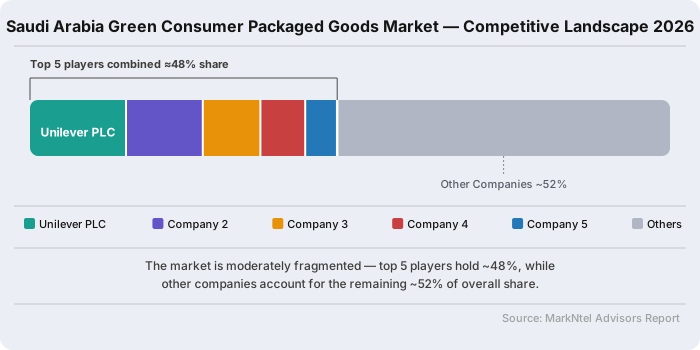
- The industry remains moderately fragmented, with the top five players collectively accounting for nearly 48% of the total market share.
Saudi Arabia Green Consumer Packaged Goods Market Size and Outlook
The Saudi Arabia green consumer packaged goods market size was valued at USD 4.39 billion in 2025 and is projected to grow from USD 6.28 billion in 2026 to USD 15.28 billion by 2032, registering a CAGR of around 15.97% during 2026–2032. Growth will be supported by Government-backed expansion of recycling infrastructure and rising adoption of recycled-content and circular packaging materials by food and beverage producers, strengthening circular economy adoption across the consumer goods value chain.
The Saudi Green Initiative continues to anchor long-term demand for sustainable product formats, with the first wave of more than 60 initiatives representing over USD 186.67 billion in investment. The initiative encourages food, beverage, and consumer goods manufacturers to adopt biodegradable and recyclable packaging while supporting Vision 2030's diversification objectives. This policy environment is accelerating responsible consumption by making sustainable packaging an increasingly essential industry requirement.
Waste generation trends further reinforce the need for sustainable product development. GASTAT's Waste Accounts publication for 2024 recorded that total waste generated reached 135.1 million tons, compared with 111.4 million tons in pervious year, with plastic waste accounting for 5.8% of total waste. These figures are encouraging packaged goods producers to accelerate biodegradable material substitution, improve packaging circularity, and strengthen renewable packaging materials adoption to reduce contributions to the national waste stream.
Digital commerce is expected to further support expansion of the Saudi Arabia green consumer packaged goods industry as consumer purchasing habits continue evolving. According to SAMA, electronic payments represented 79% of total retail payments in 2024, up from 70% in the previous year, while non-cash transaction volume increased to 12.6 billion from 10.8 billion. Greater e-commerce grocery penetration enables sustainably packaged food and personal care brands to reach convenience-seeking households through direct digital channels.
Saudi Arabia Green Consumer Packaged Goods Market Key Indicators
- Saudi Arabia's population reached 35.3 million in 2024, according to GASTAT, with Saudi nationals comprising 55.6% of total residents. This expanding, urbanized consumer base continues to widen the retail footprint for packaged staples, directly increasing demand for shelf-stable formats packaged in biodegradable packaging materials across supermarkets nationwide.
- Nearly seven in ten young Saudi citizens are under the age of 35as per the GASTAT's 2024 demographic release showed this age group comprising 69.4% of the national Saudi population. Digitally native and value-conscious, this cohort increasingly favors brands with visible eco-friendly credentials, pushing manufacturers to prioritize sustainable packaging design to retain loyalty among younger grocery shoppers.
- The Saudi Green Initiative has mobilized substantial national funding, since its inauguration, 77 initiatives have been activated, representing an investment of more than USD 186 billion, per the initiative's official Vision 2030 platform . This scale of funding directly incentivizes food and beverage producers to redesign packaging around circular economy principles, making sustainable material adoption a condition of continued market access.
Saudi Arabia Green Consumer Packaged Goods Market Scope
| Category | Segments |
|---|---|
| By Product Type | Sustainable Food & Beverages, Eco-friendly Home Care, Sustainable Personal Care & Beauty, Green Baby Care, Sustainable Pet Care, Eco Paper & Hygiene Products |
| By Packaging Type | Recyclable Packaging, Biodegradable Packaging, Compostable Packaging, Reusable Packaging, Refillable Packaging |
| By Material Type | Paper & Paperboard, Glass, Metal, Bioplastics, Recycled Plastics, Plant-Based Materials, Others |
| By Consumer Group | Individual Consumers, Families and Households, Health-Conscious Consumers, Environmentally Conscious Consumers, Premium Consumers |
| By End User | Residential Consumers, Commercial Buyers |
Saudi Arabia Green Consumer Packaged Goods Market Growth Drivers
Government-Backed Expansion of Recycling Infrastructure Through the Saudi Investment Recycling Company (SIRC)
The Saudi Investment Recycling Company (SIRC), a Public Investment Fund subsidiary, is strengthening the Saudi Arabia green consumer packaged goods market by expanding national recycling infrastructure that improves the commercial viability of recyclable packaging. This government-backed approach supports resource efficiency while encouraging manufacturers to adopt sustainable manufacturing and recyclable packaging, creating a stronger foundation for environmentally responsible consumer goods production across the Kingdom.
In July 2025, SIRC formed a joint venture with MVW Lechtenberg to process approximately 3 million tonnes of municipal solid waste annually, cutting CO2 emissions by an estimated 1.79 million tonnes yearly through advanced Sustainable Manufacturing practices . The initiative enhances the availability of recycled materials, enabling consumer goods manufacturers to integrate environmentally responsible packaging solutions into their production processes while reducing dependence on virgin resources.
SIRC's recycling network extends across more than 65 Saudi cities, treating close to 400 tons of industrial waste annually through its integrated platform, with a target processing capacity of 35 million tonnes per year by 2035. As recycling infrastructure expands, the Saudi Arabia green consumer packaged goods industry is expected to benefit from greater raw material availability, stronger circular value chains, and wider adoption of recyclable packaging across consumer product categories.
Recent Trends
Rising Adoption of Recycled-Content and Circular Packaging Materials by Food and Beverage Producers
Circular packaging innovation is emerging as a defining trend in the Saudi Arabia green consumer packaged goods market, with manufacturers increasingly adopting advanced recycling technologies to support green FMCG production. In February 2026, SABIC partnered with Alpek to produce the Kingdom's first commercial batch of food-grade recycled PET (rPET) from chemical-recycling oil at a pilot unit in Jubail, enabling closed-loop supply for beverage brands packaging water, juice, and carbonated drinks in PET bottles.
The transition extends beyond beverage packaging, reinforcing broader sustainability momentum across the industry. SABIC's TRUCIRCLE initiative, partnered with Napco National and FONTE, delivered the Kingdom's first circular bread packaging using 100% recycled polyethylene sourced from pyrolysis oil in April 2025. Producers are complementing these developments with Industry 4.0 technologies, including automated optical sorting, to support clean-label products and improve packaging efficiency .
As chemical-recycling capacity scales beyond pilot volumes, beverage producers gain a domestic, traceable alternative to imported virgin PET, strengthening supply chain resilience. This evolution positions recycled-content packaging as a mainstream specification within the Saudi Arabia green consumer packaged goods industry, replacing its earlier role as a limited-edition sustainability initiative and accelerating adoption across diverse consumer product categories by the end of the decade.
Saudi Arabia Green Consumer Packaged Goods Market Opportunities and Challenges
Low Regional Plastic Recycling Rates Driving Investment in Circular Recycling Infrastructure
Gulf region recyclers process only about 10 percent of the nearly 10 million tons of plastic waste generated annually, according to Arab News reporting on the region's circular economy gaps. Maher Al-Rashed, associate professor of plastic science at King Saud University, attributes this shortfall to the low cost of virgin plastic relative to recycled alternatives, undermining private investment in advanced sustainable consumer goods recycling systems.
For packaged food and beverage producers within the Saudi Arabia green consumer packaged goods industry, this constrains the domestic supply of quality-certified recycled packaging material needed to meet sustainability commitments, forcing some manufacturers to rely on imported recycled resin at a cost premium. This supply gap is simultaneously creating a commercial opening for early movers in domestic recycling infrastructure.
The National Center for Waste Management (MWAN) told Arab News that the Kingdom has established a dedicated regulator, passed an advanced Waste Management Law, and published a comprehensive infrastructure master plan over five years . SABIC and Alpek capitalized on this environment, producing the Kingdom's first food-grade recycled PET batch at Jubail, to secure long-term beverage supply contracts and advance environmentally friendly products in the Saudi Arabia green consumer packaged goods market.
Segmentation Insights
Sustainable Food & Beverages Holds the Largest Share Due to High Household Food Expenditure
Sustainable food & beverages account for approximately 40% share of the Saudi Arabia green consumer packaged goods industry, making it the largest product category. The segment benefits from consistently high consumer spending on essential food purchases while manufacturers continue expanding portfolios featuring organic packaged food and environmentally responsible product offerings that align with evolving sustainability expectations across the Kingdom.
This dominance reflects the weight of food and beverage spending within Saudi household budgets. According to the General Authority for Statistics, Saudi households allocate an average of USD 998 per month to food and beverages, exceeding expenditure on any other discretionary category. Such spending patterns provide a stable consumption base that supports sustained demand for environmentally responsible packaged food products.
Growing consumer preference for healthier products, combined with increasing availability through modern retail channels, continues to reinforce the leadership of this segment. Manufacturers are investing in product innovation, premium ingredients, and eco- friendly products to meet changing purchasing preferences. These factors collectively position sustainable food & beverages to maintain their leading contribution. Based on product type, the scope has been divided into:
- Sustainable Food & Beverages
- Eco-friendly Home Care
- Laundry Care
- Sustainable Personal Care & Beauty
- Green Baby Care
- Sustainable Pet Care
- Eco Paper & Hygiene Products
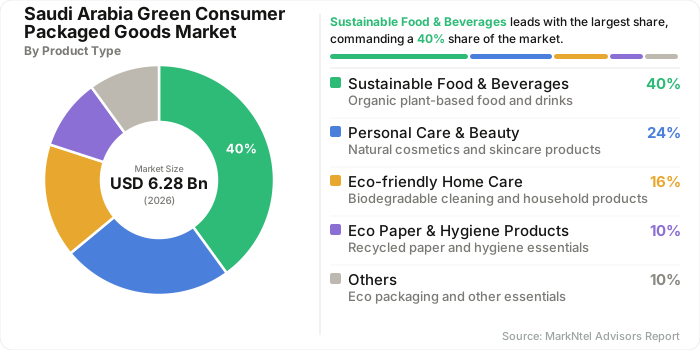
Residential Consumers Lead the End-User Segment Due to Strong Demand for Sustainable Everyday Purchases
Residential Consumers account for approximately 82% share of end-user demand within the Saudi Arabia green consumer packaged goods market, with Commercial Buyers comprising the remaining share. The segment's leadership is driven by increasing household preference for environmentally responsible daily essentials, while the expansion of sustainable retail channels has made green consumer products more accessible across urban and suburban regions.
Households generate recurring demand because consumer packaged goods are purchased regularly for food, beverages, personal care, and home care needs. Greater environmental awareness, improving product availability, and expanding retail networks continue encouraging consumers to incorporate sustainable alternatives into routine purchasing decisions, supporting consistent sales growth across residential end users.
Manufacturers are strengthening this segment through green product innovation, introducing improved packaging formats, responsibly sourced materials, and enhanced product performance to meet evolving consumer expectations. Continued innovation, broader product availability, and increasing household acceptance of sustainable alternatives are expected to reinforce residential consumers' dominant contribution throughout the forecast period. The key end users mapped in the study involve:
- Residential Consumers
- Commercial Buyers
Saudi Arabia Green Consumer Packaged Goods Market Competitive Analysis
The Saudi Arabia green consumer packaged goods industry is moderately fragmented, with the top five players Unilever PLC, Nestlé, Procter & Gamble, PepsiCo, and The Coca-Cola Company collectively accounting for an estimated 48% of total revenue. These companies maintain strong positions through diversified product portfolios, extensive distribution networks, and continuous investments in sustainable packaging, product innovation, and ESG initiatives. Regional companies further intensify competition by leveraging strong domestic brands and local supply chains. Consequently, competition is driven by sustainability leadership, innovation, pricing, and expanding retail presence.
Key Players in Saudi Arabia Green Consumer Packaged Goods Market
- Unilever PLC
- Nestlé
- Procter & Gamble
- PepsiCo
- The Coca-Cola Company
- Almarai
- Savola Group
- National Agricultural Development Co. (NADEC)
- Saudi Dairy & Foodstuff Co (SADAFCO)
- Al Rabie
- Others
Saudi Arabia Green Consumer Packaged Goods Industry News and Recent Developments
January 2026: Unilever Begins Local Production of OMO Liquid Detergent in Saudi Arabia
Unilever inaugurated expanded Home Care production at the Binzagr Unilever Factory, commencing local manufacturing of OMO liquid detergent in Saudi Arabia. The expansion, supported by government entities and the Binzagr Group, strengthens domestic manufacturing capabilities while incorporating biodegradable ingredients and environmentally conscious packaging designed to meet local consumer requirements and reinforce Saudi Arabia's industrial development agenda.
Impact Analysis: Localizing detergent production reduces import dependence while strengthening regional supply chains and manufacturing resilience. The initiative encourages wider adoption of sustainable product formulations and environmentally conscious packaging within the household care segment. By combining local production with sustainability-focused product design, Unilever supports national localization goals, stimulates value creation, and encourages competing manufacturers to expand investments in environmentally responsible consumer packaged goods.
July 2025: PepsiCo Expands Dammam Manufacturing Facility to Strengthen Sustainable Production
PepsiCo inaugurated its expanded manufacturing facility in Dammam following approximately USD 80 million investment. The 55,000-square-meter plant integrates smart manufacturing technologies, solar panels generating 510 MWh annually, and water-saving systems while serving as a regional production and export hub. The expansion forms part of PepsiCo's broader USD 2.4 billion investment in Saudi Arabia over the past eight years.
Impact Analysis: The investment strengthens domestic production capacity for sustainably packaged food products while supporting Vision 2030's industrial diversification objectives. Advanced manufacturing technologies, renewable energy integration, and local sourcing improve operational efficiency and reduce environmental impact. Expanded export capabilities also reinforce Saudi Arabia's position as a regional manufacturing hub, encouraging further investments in sustainable consumer goods production and accelerating adoption of environmentally responsible manufacturing practices across the FMCG sector,
- Market Segmentation
- Introduction
- Product Definition
- Research Process
- Assumptions
- Executive Summary
- Saudi Arabia Green Consumer Packaged Goods Market Dynamics
- Growth Drivers
- Challenges
- Saudi Arabia Green Consumer Packaged Goods Market Hotspot & Opportunities
- Saudi Arabia Green Consumer Packaged Goods Market Policies, Regulations, Product Standards
- Saudi Arabia Green Consumer Packaged Goods Production Trend 2022-2032
- Saudi Arabia Green Consumer Packaged Goods Trend by Type of Product Type
- Sustainable Food & Beverages
- Eco-friendly Home Care
- Laundry Care
- Sustainable Personal Care & Beauty
- Green Baby Care
- Sustainable Pet Care
- Eco Paper & Hygiene Products
- Company Wise Production Plants and Statistics
- Installed Production Capacity
- Actual Production
- Planned Production Target
- Saudi Arabia Green Consumer Packaged Goods Trend by Type of Product Type
- Saudi Arabia Green Consumer Packaged Goods Pricing Analysis 2022-2032
- Saudi Arabia Green Consumer Packaged Goods Pricing Trend 2022-2032
- Saudi Arabia Green Consumer Packaged Goods Pricing Trend by Product Type 2022-2032
- Sustainable Food & Beverages
- Eco-friendly Home Care
- Laundry Care
- Sustainable Personal Care & Beauty
- Green Baby Care
- Sustainable Pet Care
- Eco Paper & Hygiene Products
- Saudi Arabia Green Consumer Packaged Goods Market Outlook, 2022-2032F
- Market Size & Analysis
- By Revenues (USD Million)
- Market Segmentation & Outlook
- By Product Type- Market Size & Forecast 2022-2032, USD Million
- Sustainable Food & Beverages
- Organic Food
- Natural Food Products
- Plant Based Food and Beverages
- Healthy Snacks
- Functional Beverages
- Eco-friendly Home Care
- Laundry Care
- Dishwashing Products
- Surface Cleaners
- Toilet and Bathroom Cleaners
- Air Care Products
- Sustainable Personal Care & Beauty
- Skincare
- Haircare
- Bath and Body Care
- Oral Care
- Cosmetics
- Men's Grooming
- Green Baby Care
- Baby Food
- Baby Skincare
- Baby Wipes
- Eco-Friendly Diapers
- Baby Toiletries
- Sustainable Pet Care
- Pet Food
- Pet Grooming Products
- Pet Hygiene Products
- Biodegradable Cat Litter
- Eco Paper & Hygiene Products
- Toilet Tissue
- Facial Tissue
- Paper Towels
- Napkins
- Wet Wipes
- Sustainable Food & Beverages
- By Packaging Type- Market Size & Forecast 2022-2032, USD Million
- Recyclable Packaging
- Biodegradable Packaging
- Compostable Packaging
- Reusable Packaging
- Refillable Packaging
- By Material Type- Market Size & Forecast 2022-2032, USD Million
- Paper & Paperboard
- Glass
- Metal
- Bioplastics
- Recycled Plastics
- Plant-Based Materials
- Others
- By Consumer Group- Market Size & Forecast 2022-2032, USD Million
- Individual Consumers
- Families and Households
- Health-Conscious Consumers
- Environmentally Conscious Consumers
- Premium Consumers
- By End User- Market Size & Forecast 2022-2032, USD Million
- Residential Consumers
- Commercial Buyers
- Hotels
- Restaurants
- Cafés
- Corporate Offices
- Educational Institutions
- By Region
- North
- East
- West
- South
- Central
- By Competitors
- Competition Characteristics
- Market Share & Analysis
- By Product Type- Market Size & Forecast 2022-2032, USD Million
- Market Size & Analysis
- Saudi Arabia Sustainable Packaged Food & Beverages Market Outlook, 2022-2032F
- Market Size & Analysis
- By Revenues (USD Million)
- Market Segmentation & Outlook
- By Packaging Type- Market Size & Forecast 2022-2032, USD Million
- By Material Type- Market Size & Forecast 2022-2032, USD Million
- By Consumer Group- Market Size & Forecast 2022-2032, USD Million
- By End User- Market Size & Forecast 2022-2032, USD Million
- Market Size & Analysis
- Saudi Arabia Eco-friendly Packaged Home Care Market Outlook, 2022-2032F
- Market Size & Analysis
- By Revenues (USD Million)
- Market Segmentation & Outlook
- By Packaging Type- Market Size & Forecast 2022-2032, USD Million
- By Material Type- Market Size & Forecast 2022-2032, USD Million
- By Consumer Group- Market Size & Forecast 2022-2032, USD Million
- By End User- Market Size & Forecast 2022-2032, USD Million
- Market Size & Analysis
- Saudi Arabia Sustainable Packaged Personal Care & Beauty Market Outlook, 2022-2032F
- Market Size & Analysis
- By Revenues (USD Million)
- Market Segmentation & Outlook
- By Packaging Type- Market Size & Forecast 2022-2032, USD Million
- By Material Type- Market Size & Forecast 2022-2032, USD Million
- By Consumer Group- Market Size & Forecast 2022-2032, USD Million
- By End User- Market Size & Forecast 2022-2032, USD Million
- Market Size & Analysis
- Saudi Arabia Green Packaged Baby Care Market Outlook, 2022-2032F
- Market Size & Analysis
- By Revenues (USD Million)
- Market Segmentation & Outlook
- By Packaging Type- Market Size & Forecast 2022-2032, USD Million
- By Material Type- Market Size & Forecast 2022-2032, USD Million
- By Consumer Group- Market Size & Forecast 2022-2032, USD Million
- By End User- Market Size & Forecast 2022-2032, USD Million
- Market Size & Analysis
- Saudi Arabia Sustainable Packaged Pet Care Market Outlook, 2022-2032F
- Market Size & Analysis
- By Revenues (USD Million)
- Market Segmentation & Outlook
- By Packaging Type- Market Size & Forecast 2022-2032, USD Million
- By Material Type- Market Size & Forecast 2022-2032, USD Million
- By Consumer Group- Market Size & Forecast 2022-2032, USD Million
- By End User- Market Size & Forecast 2022-2032, USD Million
- Market Size & Analysis
- Saudi Arabia Eco-Packaged Paper & Hygiene Products Market Outlook, 2022-2032F
- Market Size & Analysis
- By Revenues (USD Million)
- Market Segmentation & Outlook
- By Packaging Type- Market Size & Forecast 2022-2032, USD Million
- By Material Type- Market Size & Forecast 2022-2032, USD Million
- By Consumer Group- Market Size & Forecast 2022-2032, USD Million
- By End User- Market Size & Forecast 2022-2032, USD Million
- Market Size & Analysis
- Saudi Arabia Green Consumer Packaged Goods Market Key Strategic Imperatives for Growth & Success
- Competition Outlook
- Company Profile
- Unilever PLC
- Business Description
- Solution Portfolio
- Strategic Alliances or Partnerships
- Recent Developments
- Financial Details
- Others
- Nestlé
- Business Description
- Solution Portfolio
- Strategic Alliances or Partnerships
- Recent Developments
- Financial Details
- Others
- Procter & Gamble
- Business Description
- Solution Portfolio
- Strategic Alliances or Partnerships
- Recent Developments
- Financial Details
- Others
- PepsiCo
- Business Description
- Solution Portfolio
- Strategic Alliances or Partnerships
- Recent Developments
- Financial Details
- Others
- The Coca-Cola Company
- Business Description
- Solution Portfolio
- Strategic Alliances or Partnerships
- Recent Developments
- Financial Details
- Others
- Almarai
- Business Description
- Solution Portfolio
- Strategic Alliances or Partnerships
- Recent Developments
- Financial Details
- Others
- Savola Group
- Business Description
- Solution Portfolio
- Strategic Alliances or Partnerships
- Recent Developments
- Financial Details
- Others
- National Agricultural Development Co. (NADEC)
- Business Description
- Solution Portfolio
- Strategic Alliances or Partnerships
- Recent Developments
- Financial Details
- Others
- Saudi Dairy & Foodstuff Co (SADAFCO)
- Business Description
- Solution Portfolio
- Strategic Alliances or Partnerships
- Recent Developments
- Financial Details
- Others
- Al Rabie
- Business Description
- Solution Portfolio
- Strategic Alliances or Partnerships
- Recent Developments
- Financial Details
- Others
- Others
- Unilever PLC
- Company Profile
- Disclaimer

MarkNtel Advisors follows a robust and iterative research methodology designed to ensure maximum accuracy and minimize deviation in market estimates and forecasts. Our approach combines both bottom-up and top-down techniques to effectively segment and quantify various aspects of the market. A consistent feature across all our research reports is data triangulation, which examines the market from three distinct perspectives to validate findings. Key components of our research process include:
1. Scope & Research Design At the outset, MarkNtel Advisors define the research objectives and formulate pertinent questions. This phase involves determining the type of research—qualitative or quantitative—and designing a methodology that outlines data collection methods, target demographics, and analytical tools. They also establish timelines and budgets to ensure the research aligns with client goals.
2. Sample Selection and Data Collection In this stage, the firm identifies the target audience and determines the appropriate sample size to ensure representativeness. They employ various sampling methods, such as random or stratified sampling, based on the research objectives. Data collection is carried out using tools like surveys, interviews, and observations, ensuring the gathered data is reliable and relevant.
3. Data Analysis and Validation Once data is collected, MarkNtel Advisors undertake a rigorous analysis process. This includes cleaning the data to remove inconsistencies, employing statistical software for quantitative analysis, and thematic analysis for qualitative data. Validation steps are taken to ensure the accuracy and reliability of the findings, minimizing biases and errors.

4. Data Forecast and FinalizationThe final phase involves forecasting future market trends based on the analyzed data. MarkNtel Advisors utilize predictive modeling and time series analysis to anticipate market behaviors. The insights are then compiled into comprehensive reports, featuring visual aids like charts and graphs, and include strategic recommendations to inform client decision-making
FILL THE FORM TO INQUIRE BEFORE BUYING THIS REPORT
We offer flexible licensing options to cater to varying organizational needs. Choose the pricing pack that best suits your requirements:
Buy Now Talk to our Consultant
 Request Customization