

By Hotel Type (Luxury Hotels, Upper Mid-Scale Hotels, Mid-scale Hotels, Economy/Budget Hotels, Boutique Hotels, Serviced Apartments, Extended Stay Hotels), By Ownership (Chain / Br......anded Hotel, Independent Operators, Franchise Model, Asset-Light Model), By Booking Channel (Online Travel Agencies (OTAs), Direct Booking (Websites & Apps), Corporate Booking Platforms, Offline Travel Agents, Walk-in Reservations), By Traveler Type (Domestic Travelers, International Travelers, Group Travelers, Solo Travelers), By Purpose of Travel (Leisure Travel, Business Travel, Religious Tourism, MICE (Meetings, Incentives, Conferences & Exhibitions), Medical Tourism, Education Tourism), By End User (Individual Consumers, Corporate Clients, Government & Institutional Clients, Families, Tour Groups), and others Read more
- FMCG
- Jun 2026
- 155
- PDF, Excel, PPT
Philippines Hotel Market Key Takeaways
- The Philippines hotel market is projected to grow from USD 3.17 billion in 2025 to USD 3.76 billion in 2026 and USD 5.99 billion by 2032.
- The industry growth is projected to witness steady growth at a CAGR of 8.07% during the forecast period.
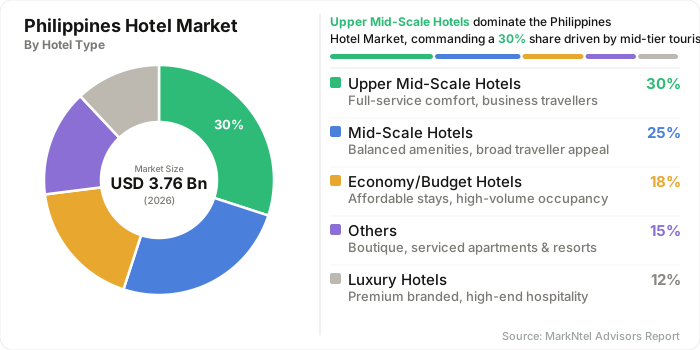
- Upper mid-scale hotels represent a significant category, accounting for approximately 30% of total market revenue.
- Individual customers dominate demand generation, capturing nearly 50% market share in 2026.
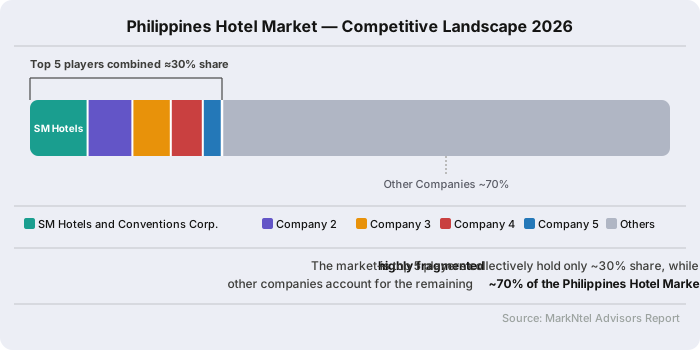
- Market competition remains moderately fragmented, with the top five operators collectively controlling nearly 30% of industry revenue.
Philippines Hotel Market Size and Outlook
The Philippines hotel market size was valued at USD 3.17 billion in 2025 and is projected to increase to USD 3.76 billion in 2026, reaching approximately USD 5.99 billion by 2032, registering a CAGR of 8.07% during 2026–2032. The market’s growth trajectory reflects the country’s strengthening tourism ecosystem, expanding accommodation demand, and rising investor confidence in hospitality assets. Growing visitor volumes, improving travel infrastructure, and increasing hotel development activity are collectively supporting sustained expansion across multiple lodging categories and destination clusters.
A major pillar supporting the industry is the increasing economic contribution of tourism-related activities. According to the Philippine Statistics Authority, Tourism Direct Gross Value Added reached approximately USD 40.9 billion in 2024, accounting for 8.9% of national GDP . In addition, travel and tourism generated approximately USD 91.8 billion in economic output during 2025, representing 19.9% of the country’s economy . This substantial contribution is encouraging investment in premium accommodation, while strengthening occupancy prospects and revenue generation across both urban and resort-oriented hospitality establishments.
The long-term outlook is reinforced by government initiatives designed to accelerate tourism growth. The National Tourism Development Plan 2023–2028 targets 11.5 million international tourist arrivals by 2028, creating significant demand for new room supply across established and emerging destinations . Simultaneously, enhanced connectivity and destination development programs are increasing the attractiveness of secondary tourism hubs. The resulting expansion of destination resorts and diversified lodging options is expected to support broader geographic market penetration while creating opportunities for operators across luxury, mid-scale, and budget segments.
Another important growth catalyst is the increasing adoption of branded-residence models to support hospitality development. Developers introduced Sheraton Residences Mactan Cebu ahead of its corresponding hotel launch and applied a similar approach to JW Marriott Panglao Bohol, demonstrating the model’s effectiveness in attracting capital . Furthermore, leading hospitality groups have established dedicated branded-residence teams to expand this investment avenue. The rise of mixed-use hospitality developments is enhancing project feasibility, unlocking alternative funding channels, and strengthening the long-term competitiveness of the Philippines hotel industry.
Philippines Hotel Market Key Indicators
- The Department of Tourism reported tourism receipts of approximately USD 12.1 billion in 2025, supported by foreign visitors whose per-trip spending exceeded that of outbound Filipinos traveling abroad. This spending pattern strengthens hotel earnings by improving room revenue generation and supporting higher average daily rates. The resulting increase in guest expenditure intensity enables operators to reinvest in property enhancements and service quality improvements.
- Visitor behavior continues to create favorable accommodation demand conditions. According to the Department of Tourism, international travelers recorded an average stay of 11 nights in 2024, while repeat visitors accounted for more than 70% of arrivals. Such loyalty and extended travel duration significantly increase room-night consumption. The trend particularly benefits extended-stay lodging formats, which can capture greater occupancy levels and maximize revenue per available room.
- Cruise tourism is emerging as an important demand contributor across gateway destinations. The Philippine Ports Authority recorded 142,574 cruise passengers in 2024, representing annual growth of 61.9%, and projected volumes of 185,000 passengers in 2025. Many travelers require accommodation before embarkation or after disembarkation, creating additional demand for transit hospitality services in key destinations such as Manila, Puerto Princesa, and Boracay.
- Infrastructure expansion is broadening tourism accessibility across the country. The Department of Public Works and Highways, in partnership with the Department of Tourism, is constructing more than 700 kilometres of tourism roads to improve access to emerging destinations . Enhanced connectivity reduces travel barriers and encourages private-sector investment in previously underserved regions. This expansion supports regional accommodation diversification, enabling hospitality development beyond traditional tourism centers and strengthening long-term demand distribution.
Philippines Hotel Market Scope
| Category | Segments |
|---|---|
| By Hotel Type | Luxury Hotels, Upper Mid-Scale Hotels, Mid-scale Hotels, Economy/Budget Hotels, Boutique Hotels, Serviced Apartments, Extended Stay Hotels |
| By Ownership | Chain / Branded Hotel, Independent Operators, Franchise Model, Asset-Light Model |
| By Booking Channel | Online Travel Agencies (OTAs), Direct Booking (Websites & Apps), Corporate Booking Platforms, Offline Travel Agents, Walk-in Reservations |
| By Traveler Type | Domestic Travelers, International Travelers, Group Travelers, Solo Travelers |
| By Purpose of Travel | Leisure Travel, Business Travel, Religious Tourism, MICE (Meetings, Incentives, Conferences & Exhibitions), Medical Tourism, Education Tourism |
| By End User | Individual Consumers, Corporate Clients, Government & Institutional Clients, Families, Tour Groups |
Philippines Hotel Market Growth Drivers
Resilient Domestic Tourism Spending
Domestic travel remains the principal demand driver for the Philippines hotel market, providing a stable occupancy base across the country. As per the Philippine Statistics Authority, domestic tourism expenditure reached approximately USD 55.2 billion in 2024, increasing 16.4% from the previous year. As resident spending substantially exceeded inbound tourism receipts, the industry benefited from stronger resident travel demand, supporting consistent room utilization across midscale, economy, and provincial accommodation segments.
The momentum persisted in 2025 as domestic tourism expenditure rose to approximately USD 56.9 billion, while tourism-related employment expanded to 7.7 million jobs. The dominance of local travel spending provides an important buffer against fluctuations in international visitor arrivals and external economic uncertainties. Consequently, accommodation operators benefit from enhanced occupancy stability, enabling more predictable revenue streams and reducing reliance on a limited number of overseas source markets for business sustainability.
This resilient domestic travel environment is reshaping investment priorities across the hospitality sector. Branded operators and local developers are increasingly focusing on focused-service, budget, and midscale properties in secondary cities and leisure destinations where family and group travel remains concentrated. Sustained local demand also supports longer booking visibility and stable operating performance. The rise of value-oriented hospitality strengthens investment confidence and provides a durable foundation for Philippines hotel industry.
Recent Trends
Rising Adoption of Serviced Residences and Extended-Stay Accommodations
Serviced residences and extended-stay properties are becoming an increasingly important trend within the Philippines hotel industry, particularly across major urban and commercial centres. Demand from corporate travelers, expatriates, relocation professionals, and long-duration visitors is encouraging operators to expand apartment-style accommodation offerings. This shift reflects growing preference for long-stay lodging solutions that combine residential convenience with hotel-grade amenities, providing greater flexibility and comfort than traditional room-based accommodation formats.
The trend gained further momentum in March 2025 when The Ascott Limited signed Ascott Ortigas Manila, adding 232 units and approximately 1,700 square metres of event space within Metro Manila’s business district . The development highlights increasing investor confidence in accommodation models. As business travel patterns evolve, corporate accommodation solutions are becoming more attractive due to their ability to serve project-based workers, relocating employees, and multinational business travelers seeking longer-term housing options.
The expansion of this segment is supported by substantial portfolio development activity. The Ascott Limited currently operates and develops more than 80 properties comprising over 17,400 units, demonstrating the scale and growth potential of the category . Longer guest stays help reduce occupancy volatility while generating recurring revenue streams. The rise of apartment-style hospitality is enhancing market resilience and establishing serviced residences as a strategically important growth factor for Philippines hotel market.
Philippines Hotel Market Opportunities and Challenges
Slow International Arrival Recovery Driving Source-Market Diversification and Visa Liberalization
A key challenge facing the Philippines hotel industry is the slower recovery of international visitor arrivals compared with several regional peers. The country recorded approximately 5.24 million foreign visitors during the first eleven months of 2025, remaining significantly below pre-pandemic levels. At the same time, the tourism promotion budget declined to approximately USD 1.8 million in 2025 from around USD 23.3 million. This reduction in promotional spending limits destination visibility and weakens competitive positioning against better-funded tourism markets across ASEAN.
The recovery gap places additional pressure on upscale and luxury accommodation providers that rely heavily on inbound leisure demand. Dependence on a limited number of source markets, particularly South Korea and the United States, increases exposure to fluctuations in traveler sentiment, economic conditions, and airline capacity. Furthermore, Chinese visitor arrivals remain below historical peaks, contributing to revenue uncertainty for internationally oriented properties. These conditions highlight the need for stronger inbound demand diversification to support long-term occupancy growth.
Despite these challenges, significant opportunities are emerging through strategic initiatives. The introduction of visa-free entry for Indian nationals, the launch of Air India’s direct Delhi–Manila service, and the resumption of e-visa processing for Chinese travelers are improving accessibility for large and underpenetrated visitors. These measures are expected to strengthen source-market expansion, broaden international demand, and support the recovery of premium accommodation performance. Collectively, successful diversification of inbound tourism flows could transform a current recovery challenge into a sustainable growth opportunity.
Segmentation Insights
Mid-scale Hotels Dominate Owing to High Demand from Domestic and Regional Travelers
Mid-scale Hotels hold the leading position in the Philippines hotel market, accounting for approximately 38% of total revenue. The segment’s dominance stems from its ability to balance affordability, service quality, and brand reliability, making it highly attractive to domestic travelers and regional visitors. As travel demand increasingly centers on value-conscious consumers, cost-efficient accommodation options continue to capture a substantial share of leisure, family, and business-related stays across major destinations.
The segment is also benefiting from growing interest among international hospitality operators seeking scalable growth opportunities. In April 2025, Hilton announced its first Hilton Garden Inn properties in the Philippines, including a 210-room hotel in Quezon City and a 151-room property in Cebu Mactan. Such investments highlight rising confidence in select-service hospitality, which offers standardized experiences while maintaining operating efficiencies and competitive pricing structures.
Strong domestic tourism expenditure, expanding intercity travel, and increasing regional business activity continue to reinforce demand for mid-scale accommodation. These properties are strategically positioned to serve travelers seeking dependable lodging without premium pricing, allowing operators to maintain healthy occupancy levels. The segment also benefits from growing development activity in secondary cities and emerging destinations. The industry analysis segments the market according to hotel type as follows:
- Luxury Hotels
- Upper Mid-Scale Hotels
- Mid-scale Hotels
- Economy/Budget Hotels
- Boutique Hotels
- Serviced Apartments
- Extended Stay Hotels
Individual Customers Dominate Due to the Leisure-Oriented Tourism
Individual Customers account for approximately 68% of the Philippines Hotel industry by customer type, making them the largest demand segment. Their dominance is supported by the country’s strong leisure tourism appeal, extensive island destinations, and high proportion of repeat visitors. Independent travelers generate a significant share of accommodation demand across beach resorts, urban centers, and nature-based attractions. As a result, leisure-driven bookings continue to underpin occupancy performance across multiple hotel categories.
The segment also benefits from favorable travel policies that encourage international visitation. The Philippines grants visa-free entry to nationals from 157 countries, reducing travel barriers and simplifying trip planning for foreign visitors. Easier market access supports growth in self-directed travel, where guests independently arrange transportation and accommodation. This trend is strengthening free independent travel demand, particularly among travelers seeking flexibility, personalized experiences, and destination-specific itineraries across the country.
Growing digital adoption is further reinforcing the segment’s leadership position. Online travel platforms, mobile booking applications, and direct reservation channels enable travelers to compare options and secure accommodation efficiently. These tools support greater transparency and convenience while expanding hotel visibility. Combined with strong leisure demand and repeat visitation patterns, direct booking activity is expected to sustain the segment’s leadership and support long-term accommodation demand. The study profiles the following key end-user classifications:
- Individual Consumers
- Corporate Clients
- Government & Institutional Clients
- Families
- Tour Groups
Philippines Hotel Market Competitive Analysis
The Philippines hotel industry remains fragmented, with the top five operators collectively accounting for an estimated 30% of total market revenue. While international chains such as Marriott International, Accor, and Hilton Worldwide dominate the upscale and luxury segments, domestic groups including Megaworld Hotels & Resorts and AyalaLand Hotels & Resorts Corp. maintain strong positions across urban and resort destinations. The industry is characterized by the presence of numerous independent hotels, regional operators, boutique properties, and budget accommodations, limiting concentration.
Prominent Companies in Philippines Hotel Market
- SM Hotels and Conventions Corp.
- Robinsons Hotels & Resorts
- AyalaLand Hotels & Resorts Corp.
- Megaworld Hotels & Resorts
- DoubleDragon
- Marriott International
- Accor Group
- Hilton Worldwide
- Shangri-La Group
- Ascott Limited
- Others
Philippines Hotel Industry News and Recent Developments:
February 2026: La Vie Hotels & Resorts Enters the Philippines Through Casiana Partnerships
La Vie Hotels & Resorts entered the Philippines hospitality sector in February 2026 through management agreements for Hotel Casiana & Events Centre in Tagaytay and the Grand Casiana Hotel in Pampanga. The move marks the company’s first managed properties in the country following the establishment of its local office in 2025. The expansion strengthens La Vie’s presence in Southeast Asia while targeting both leisure and business travel corridors.
Impact Analysis: The development highlights growing international operator confidence in the Philippines hospitality sector and reinforces the attractiveness of secondary destinations beyond Metro Manila. By combining a leisure-focused property in Tagaytay with a business-oriented project in Pampanga, La Vie is diversifying demand exposure across multiple traveler segments. The entry of a new management company is also expected to intensify competition, elevate service standards, and encourage additional foreign investment
January 2026: Marriott Introduces the AC Hotels Brand to the Philippines
Marriott launched the first AC Hotel by Marriott in the Philippines through the opening of AC Hotel by Marriott Manila in Ortigas. Located within the LEED Platinum-certified GLAS Tower, the property features 160 rooms and suites designed around the brand’s European-inspired lifestyle hospitality concept. The opening expands Marriott’s brand portfolio in the country while strengthening its presence within Metro Manila’s key commercial districts.
Impact Analysis: The launch reflects increasing demand for lifestyle-oriented accommodation that blends business functionality with modern design. Marriott’s introduction of a new brand segment broadens customer choice and strengthens competition within Metro Manila’s upper midscale and upscale categories. The property’s location in Ortigas also supports the growing convergence of corporate travel, extended stays, and mixed-use developments.
August 2025: Hilton Expands Lifestyle Hospitality with Canopy by Hilton Makati
Hilton announced the signing of Canopy by Hilton Makati, scheduled to open in 2026 as the brand’s first property in the Philippines. Developed in partnership with Ayala Land Hospitality, the 400-room hotel will form part of the One Ayala mixed-use development in Makati. The project introduces Hilton’s lifestyle-focused Canopy brand, emphasizing locally inspired experiences, contemporary design, and community-centered hospitality.
Impact Analysis: The signing demonstrates growing investor confidence in lifestyle and experiential accommodation formats, particularly in prime urban destinations. By integrating hospitality within a major mixed-use development, the project strengthens Makati’s position as a leading business and tourism hub. The addition of the Canopy brand also reflects increasing demand for locally curated guest experiences rather than standardized hotel offerings. Over the longer term, the development is expected to enhance market sophistication, attract higher-spending travelers.
- Market Segmentation
- Introduction
- Product Definition
- Research Process
- Assumptions
- Executive Summary
- Philippines Hotel Market Policies, Regulations, and Product Standards
- Philippines Hotel Market Trends & Developments
- Philippines Hotel Market Dynamics
- Growth Factors
- Challenges
- Philippines Hotel Supply & Pipeline Analysis, 2022-2032
- Existing Room Inventory by Tier & Region
- New Supply Pipeline (Upcoming Hotel Openings)
- Brand Vs. Independent Split
- Supply-Demand Gap Analysis
- Philippines Hotel Hotel Performance Metrics, 2022-2032
- Occupancy Rate Trends (National & City-Level)
- Average Daily Rate (ADR) Trends
- Revpar Performance
- Seasonality & Peak Demand Patterns
- Philippines Hotel Mice & Corporate Travel, 2022-2032
- Mice Market Size & Growth
- Key Mice Hubs and Venues
- Corporate Travel Demand Trends
- Government & Event-Driven Demand (ASEAN Summit, Etc.)
- Philippines Hotel Workforce & Talent, 2022-2032
- Employment Landscape in Hospitality
- Talent Shortage & Attrition Challenges
- Training Partnerships (Tesda, Universities)
- Wage Trends & Labor Cost Outlook
- Philippines Hotel Market Hotspot & Opportunities
- Philippines Hotel Market Outlook, 2022-2032F
- Market Size & Outlook
- By Revenues (USD Million)
- Market Share & Outlook
- By Hotel Type- Market Size & Forecast 2022-2032, USD Million
- Luxury Hotels
- Upper Mid-Scale Hotels
- Mid-scale Hotels
- Economy/Budget Hotels
- Boutique Hotels
- Serviced Apartments
- Extended Stay Hotels
- By Ownership- Market Size & Forecast 2022-2032, USD Million
- Chain / Branded Hotel
- Independent Operators
- Franchise Model
- Asset-Light Model
- By Booking Channel - Market Size & Forecast 2022-2032, USD Million
- Online Travel Agencies (OTAs)
- Direct Booking (Websites & Apps)
- Corporate Booking Platforms
- Offline Travel Agents
- Walk-in Reservations
- By Traveler Type- Market Size & Forecast 2022-2032, USD Million
- Domestic Travelers
- International Travelers
- Group Travelers
- Solo Travelers
- By Purpose of Travel- Market Size & Forecast 2022-2032, USD Million
- Leisure Travel
- Business Travel
- Religious Tourism
- MICE (Meetings, Incentives, Conferences & Exhibitions)
- Medical Tourism
- Education Tourism
- By End User- Market Size & Forecast 2022-2032, USD Million
- Individual Consumers
- Corporate Clients
- Government & Institutional Clients
- Families
- Tour Groups
- By Region- Market Size & Forecast 2022-2032, USD Million
- Luzon
- Visayas
- Mindanao
- By Company
- Competition Characteristics
- Market Share & Analysis
- By Hotel Type- Market Size & Forecast 2022-2032, USD Million
- Market Size & Outlook
- Philippines Luxury Hotels Market Outlook, 2022-2032
- Market Size & Outlook
- By Revenues (USD Million)
- Market Segmentation & Outlook
- By Ownership- Market Size & Forecast 2022-2032, USD Million
- By Booking Channel - Market Size & Forecast 2022-2032, USD Million
- By Traveler Type- Market Size & Forecast 2022-2032, USD Million
- By Purpose of Travel- Market Size & Forecast 2022-2032, USD Million
- By End User- Market Size & Forecast 2022-2032, USD Million
- Market Size & Outlook
- Philippines Upper Mid-Scale Hotels Market Outlook, 2022-2032
- Market Size & Outlook
- By Revenues (USD Million)
- Market Segmentation & Outlook
- By Service Level - Market Size & Forecast 2022-2032, USD Million
- By Ownership- Market Size & Forecast 2022-2032, USD Million
- By Booking Channel - Market Size & Forecast 2022-2032, USD Million
- By Traveler Type- Market Size & Forecast 2022-2032, USD Million
- By Purpose of Travel- Market Size & Forecast 2022-2032, USD Million
- By End User- Market Size & Forecast 2022-2032, USD Million
- Market Size & Outlook
- Philippines Mid-Scale Hotels Market Outlook, 2022-2032
- Market Size & Outlook
- By Revenues (USD Million)
- Market Segmentation & Outlook
- By Ownership- Market Size & Forecast 2022-2032, USD Million
- By Booking Channel - Market Size & Forecast 2022-2032, USD Million
- By Traveler Type- Market Size & Forecast 2022-2032, USD Million
- By Purpose of Travel- Market Size & Forecast 2022-2032, USD Million
- By End User- Market Size & Forecast 2022-2032, USD Million
- Market Size & Outlook
- Philippines Economy/Budget Hotels Market Outlook, 2022-2032
- Market Size & Outlook
- By Revenues (USD Million)
- Market Segmentation & Outlook
- By Ownership- Market Size & Forecast 2022-2032, USD Million
- By Booking Channel - Market Size & Forecast 2022-2032, USD Million
- By Traveler Type- Market Size & Forecast 2022-2032, USD Million
- By Purpose of Travel- Market Size & Forecast 2022-2032, USD Million
- By End User- Market Size & Forecast 2022-2032, USD Million
- Market Size & Outlook
- Philippines Boutique Hotels Market Outlook, 2022-2032
- Market Size & Outlook
- By Revenues (USD Million)
- Market Segmentation & Outlook
- By Ownership- Market Size & Forecast 2022-2032, USD Million
- By Booking Channel - Market Size & Forecast 2022-2032, USD Million
- By Traveler Type- Market Size & Forecast 2022-2032, USD Million
- By Purpose of Travel- Market Size & Forecast 2022-2032, USD Million
- By End User- Market Size & Forecast 2022-2032, USD Million
- Market Size & Outlook
- Philippines Serviced Apartments Market Outlook, 2022-2032
- Market Size & Outlook
- By Revenues (USD Million)
- Market Segmentation & Outlook
- By Ownership- Market Size & Forecast 2022-2032, USD Million
- By Booking Channel - Market Size & Forecast 2022-2032, USD Million
- By Traveler Type- Market Size & Forecast 2022-2032, USD Million
- By Purpose of Travel- Market Size & Forecast 2022-2032, USD Million
- By End User- Market Size & Forecast 2022-2032, USD Million
- Market Size & Outlook
- Philippines Extended Stay Hotels Market Outlook, 2022-2032
- Market Size & Outlook
- By Revenues (USD Million)
- Market Segmentation & Outlook
- By Ownership- Market Size & Forecast 2022-2032, USD Million
- By Booking Channel - Market Size & Forecast 2022-2032, USD Million
- By Traveler Type- Market Size & Forecast 2022-2032, USD Million
- By Purpose of Travel- Market Size & Forecast 2022-2032, USD Million
- By End User- Market Size & Forecast 2022-2032, USD Million
- Market Size & Outlook
- Philippines Hotel Market Key Strategic Imperatives for Success & Growth
- Competitive Outlook
- Company Profiles
- SM Hotels and Conventions Corp.
- Business Description
- Product Portfolio
- Collaborations & Alliances
- Recent Developments
- Financial Details
- Others
- Robinsons Hotels & Resorts
- Business Description
- Product Portfolio
- Collaborations & Alliances
- Recent Developments
- Financial Details
- Others
- AyalaLand Hotels & Resorts Corp.
- Business Description
- Product Portfolio
- Collaborations & Alliances
- Recent Developments
- Financial Details
- Others
- Megaworld Hotels & Resorts
- Business Description
- Product Portfolio
- Collaborations & Alliances
- Recent Developments
- Financial Details
- Others
- DoubleDragon
- Business Description
- Product Portfolio
- Collaborations & Alliances
- Recent Developments
- Financial Details
- Others
- Marriott International
- Business Description
- Product Portfolio
- Collaborations & Alliances
- Recent Developments
- Financial Details
- Others
- Accor Group
- Business Description
- Product Portfolio
- Collaborations & Alliances
- Recent Developments
- Financial Details
- Others
- Hilton Worldwide
- Business Description
- Product Portfolio
- Collaborations & Alliances
- Recent Developments
- Financial Details
- Others
- Shangri-La Group
- Business Description
- Product Portfolio
- Collaborations & Alliances
- Recent Developments
- Financial Details
- Others
- Ascott Limited
- Business Description
- Product Portfolio
- Collaborations & Alliances
- Recent Developments
- Financial Details
- Others
- Others
- SM Hotels and Conventions Corp.
- Company Profiles
- Disclaimer

MarkNtel Advisors follows a robust and iterative research methodology designed to ensure maximum accuracy and minimize deviation in market estimates and forecasts. Our approach combines both bottom-up and top-down techniques to effectively segment and quantify various aspects of the market. A consistent feature across all our research reports is data triangulation, which examines the market from three distinct perspectives to validate findings. Key components of our research process include:
1. Scope & Research Design At the outset, MarkNtel Advisors define the research objectives and formulate pertinent questions. This phase involves determining the type of research—qualitative or quantitative—and designing a methodology that outlines data collection methods, target demographics, and analytical tools. They also establish timelines and budgets to ensure the research aligns with client goals.
2. Sample Selection and Data Collection In this stage, the firm identifies the target audience and determines the appropriate sample size to ensure representativeness. They employ various sampling methods, such as random or stratified sampling, based on the research objectives. Data collection is carried out using tools like surveys, interviews, and observations, ensuring the gathered data is reliable and relevant.
3. Data Analysis and Validation Once data is collected, MarkNtel Advisors undertake a rigorous analysis process. This includes cleaning the data to remove inconsistencies, employing statistical software for quantitative analysis, and thematic analysis for qualitative data. Validation steps are taken to ensure the accuracy and reliability of the findings, minimizing biases and errors.

4. Data Forecast and FinalizationThe final phase involves forecasting future market trends based on the analyzed data. MarkNtel Advisors utilize predictive modeling and time series analysis to anticipate market behaviors. The insights are then compiled into comprehensive reports, featuring visual aids like charts and graphs, and include strategic recommendations to inform client decision-making
FILL THE FORM TO INQUIRE BEFORE BUYING THIS REPORT
We offer flexible licensing options to cater to varying organizational needs. Choose the pricing pack that best suits your requirements:
Buy Now Talk to our Consultant
 Request Customization