

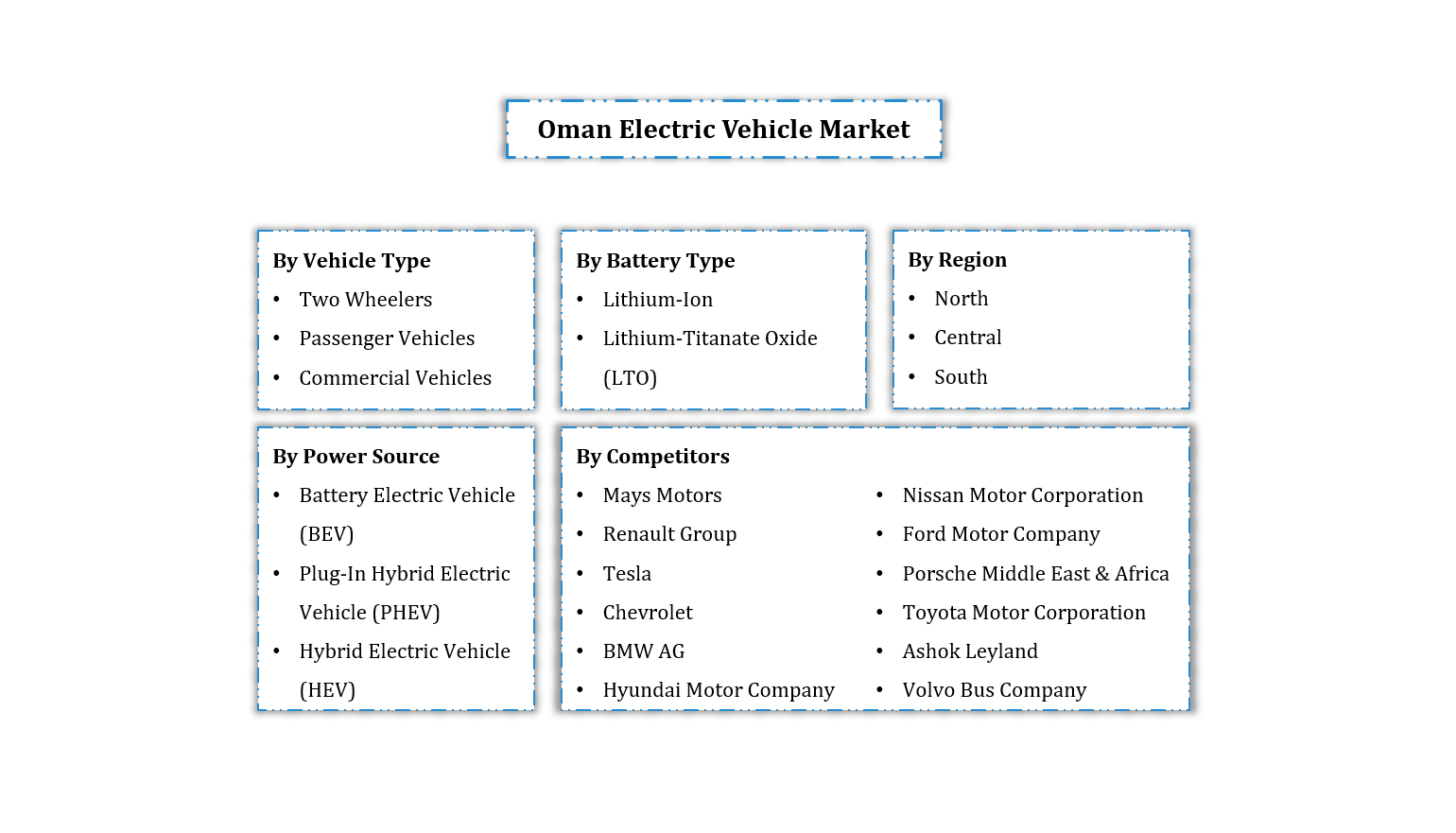
Oman Electric Vehicle Market - By Vehicle Type (Passenger Vehicles, Two Wheelers, Commercial Vehicles), By Power Source (Battery Electric Vehicle (BEV), Plug-In Hybrid Electric Veh......icle (PHEV), Hybrid Electric Vehicle (HEV)) By Battery Type (Lithium-Ion Battery, Lithium Titanate Oxide), By Region (North, South, Central), By Company (Mays Motors, Renault Group, Tesla, Chevrolet, BMW AG, Hyundai Motor Company, Nissan Motor Corporation, Ford Motor Company, Porsche Middle East & Africa, Toyota Motor Corporation, Ashok Leyland, Volvo Bus Company, Others) Read more
- Automotive
- Jul 2025
- 134
- PDF, Excel, PPT
Market Definition
Electric vehicles (EVs) are automobiles that are primarily powered by electricity stored (and sometimes even generated) on board the vehicle in batteries. These vehicles are generally seen as cleaner forms of transport as compared to conventional internal combustion engine (ICE)-powered vehicles because of minimal or zero emissions.
Market Insights and Analysis: Oman Electric Vehicle Market (2025-2030):
The Oman Electric Vehicle Market size was valued at around USD 200 million in 2024 and is projected to reach USD 831.28 million by 2030. Along with this, the market is estimated to grow at a CAGR of around 26.80% during the forecast period, i.e., 2025-30. This high growth is likely to be driven by government mandates on emissions, policy support for rapid adoption, and an expanding charging infrastructure.
The Omani government has committed to net-zero emissions by 2050, which also includes a complete transition to EVs by that date. The government also has an interim target for a 15% transition to EVs by 2030. These mandates are encouraging vehicle manufacturers to develop and offer various EV technologies to gradually replace ICE vehicles to meet the country’s net-zero commitments, driving market demand for EVs in Oman.
EV adoption in Oman is further supported by various policies that are making the purchase of EVs more attractive compared to ICE vehicles. The government's exemption of registration charges and Value-Added Tax for EVs is reducing the cost of EVs to some extent. The government also levies 0% import tariffs on EVs, which is significant as most EVs available in the country are currently being imported from outside. These policy initiatives are increasing market demand for EVs by reducing the difference between the cost of an EV compared to an ICE vehicle.
| Report Coverage | Details |
|---|---|
| Historical Years | 2020–23 |
| Base Years | 2024 |
| Forecast Years | 2025–30 |
| Market Value in 2024 | USD 200 Million |
| Market Value by 2030 | USD 831.28 Million |
| CAGR (2025–30) | 26.80% |
| Top Key Players | Mays Motors are Renault Group, Tesla, Chevrolet, BMW AG, Hyundai Motor Company, Nissan Motor Corporation, Ford Motor Company, Porsche Middle East & Africa, Toyota Motor Corporation, Ashok Leyland, Volvo Bus Company, and others. |
| Segmentation | By Vehicle Type (Passenger Vehicles, Two Wheelers, Commercial Vehicles), By Power Source (Battery Electric Vehicle (BEV), Plug-In Hybrid Electric Vehicle (PHEV), Hybrid Electric Vehicle (HEV)) By Battery Type (Lithium-Ion Battery, Lithium Titanate Oxide), By Region (North, South, Central), By Company (Mays Motors, Renault Group, Tesla, Chevrolet, BMW AG, Hyundai Motor Company, Nissan Motor Corporation, Ford Motor Company, Porsche Middle East & Africa, Toyota Motor Corporation, Ashok Leyland, Volvo Bus Company, Others) |
| Key Report Highlights |
|
*Boost strategic growth with in-depth market analysis - Get a free sample preview today!
Moreover, the market demand for EVs is also supported by an expanding charging network across the country. The number of public chargers is estimated to grow from 200 at the start of 2025 to 350 by 2027. This expansion includes installations at key vehicle interaction points such as fuel stations, which is mandated by the government. This reduces the effect of limited driving range on the viability of EVs, supporting further consumer adoption and driving market growth & expansion.
Oman Electric Vehicle Market Driver:
Government Mandates and Policy Support Driving Market Demand – The EV industry in Oman is primarily being driven by the government’s targets as well as policy support for faster adoption of EVs. The government is shaping market demand through a phased transition to EVs by 2050 that includes a 15% target for 2030. This is encouraging industry players to invest in EVs and supporting infrastructure to hasten EV adoption across the country. This is highlighted in the government’s 2024 mandate that made it necessary for fuel stations to install EV chargers. It has also facilitated the formation of Electric Vehicles One (EVO), a JV between the Oman Oil Marketing Company (OOMCO) and New Zealand-based Synergy Investments that is working on the development of charging infrastructure in the country.
The government is also encouraging consumers to opt for EVs by offering various incentives that make them a viable transport alternative. It has waived the registration charges and the standard 5% VAT for EVs, along with a 100% exemption on import tariffs. This has helped to reduce the cost of EVs by 10-20% making them a more attractive option. EV owners are also offered free public charging at several locations, which reduces running costs while providing quick and convenient charging options. Government initiatives are thus driving market demand for EVs in the country.
- Market Segmentation
- Introduction
- Research Process
- Product Definition
- Assumption
- Executive Summary
- Oman Electric Vehicle Market Trends & Developments
- Oman Electric Vehicle Market Dynamics
- Drivers
- Challenges
- Oman Electric Vehicle Market Regulations, Norms, & Product Standards
- Oman Electric Vehicle Market Imports & Exports Analysis
- Oman Electric Vehicle Market Hotspots & Opportunities
- Oman Electric Vehicle Market Value Chain Analysis
- Oman Electric Vehicle Market Analysis (2020- 2030)
- Market Size & Analysis
- By Revenues (USD Million)
- By Units Sold (Thousand Units)
- Market Share & Analysis
- By Vehicle Type
- Passenger Vehicles
- Two-wheelers
- Commercial Vehicles
- By Power Source
- Battery Electric Vehicle (BEV)
- Plug-in Hybrid Electric Vehicle (PHEV)
- Hybrid Electric Vehicle (HEV)
- By Battery Type
- Lithium-ion Battery
- Lithium Titanate Oxide
- By Region
- North
- South
- Central
- By Vehicle Type
- By Company
- Competition Characteristics
- Market Share & Analysis
- Market Size & Analysis
- Oman Electric Passenger Vehicles Market Analysis, 2020- 2030
- Market Size & Analysis
- By Revenues (USD Million)
- By Units Sold (Thousand Units)
- Market Share & Analysis
- By Power Source
- By Company
- By Region
- Market Size & Analysis
- Oman Electric Two Wheelers Market Analysis, 2020- 2030
- Market Size & Analysis
- By Revenues (USD Million)
- By Units Sold (Thousand Units)
- Market Share & Analysis
- By Power Source
- By Company
- By Region
- Market Size & Analysis
- Oman Electric Commercial Vehicles Market Analysis, 2020- 2030
- Market Size & Analysis
- By Revenues (USD Million)
- By Units Sold (Thousand Units)
- Market Share & Analysis
- By Power Source
- By Company
- By Region
- Market Size & Analysis
- Oman Electric Vehicle Market Key Strategic Imperatives for Success & Growth
- Oman Electric Vehicle Market Competition Outlook
- Competition Matrix
- Product Portfolio
- Target Markets
- Research & Development
- Strategic Alliances
- Strategic Initiatives
- Company Profiles (Business Description, Product Portfolio, Recent Development, Key Executives, Contact Details)
- Mays Motors
- Renault Group
- Tesla
- Chevrolet
- BMW AG
- Hyundai Motor Company
- Nissan Motor Corporation
- Ford Motor Company
- Porsche Middle East & Africa
- Toyota Motor Corporation
- Ashok Leyland
- Volvo Bus Company
- Others
- Competition Matrix
- Disclaimer
MarkNtel Advisors follows a robust and iterative research methodology designed to ensure maximum accuracy and minimize deviation in market estimates and forecasts. Our approach combines both bottom-up and top-down techniques to effectively segment and quantify various aspects of the market. A consistent feature across all our research reports is data triangulation, which examines the market from three distinct perspectives to validate findings. Key components of our research process include:
1. Scope & Research Design At the outset, MarkNtel Advisors define the research objectives and formulate pertinent questions. This phase involves determining the type of research—qualitative or quantitative—and designing a methodology that outlines data collection methods, target demographics, and analytical tools. They also establish timelines and budgets to ensure the research aligns with client goals.
2. Sample Selection and Data Collection In this stage, the firm identifies the target audience and determines the appropriate sample size to ensure representativeness. They employ various sampling methods, such as random or stratified sampling, based on the research objectives. Data collection is carried out using tools like surveys, interviews, and observations, ensuring the gathered data is reliable and relevant.
3. Data Analysis and Validation Once data is collected, MarkNtel Advisors undertake a rigorous analysis process. This includes cleaning the data to remove inconsistencies, employing statistical software for quantitative analysis, and thematic analysis for qualitative data. Validation steps are taken to ensure the accuracy and reliability of the findings, minimizing biases and errors.

4. Data Forecast and FinalizationThe final phase involves forecasting future market trends based on the analyzed data. MarkNtel Advisors utilize predictive modeling and time series analysis to anticipate market behaviors. The insights are then compiled into comprehensive reports, featuring visual aids like charts and graphs, and include strategic recommendations to inform client decision-making
FILL THE FORM TO INQUIRE BEFORE BUYING THIS REPORT
We offer flexible licensing options to cater to varying organizational needs. Choose the pricing pack that best suits your requirements:
Buy Now Talk to our Consultant
 Request Customization