

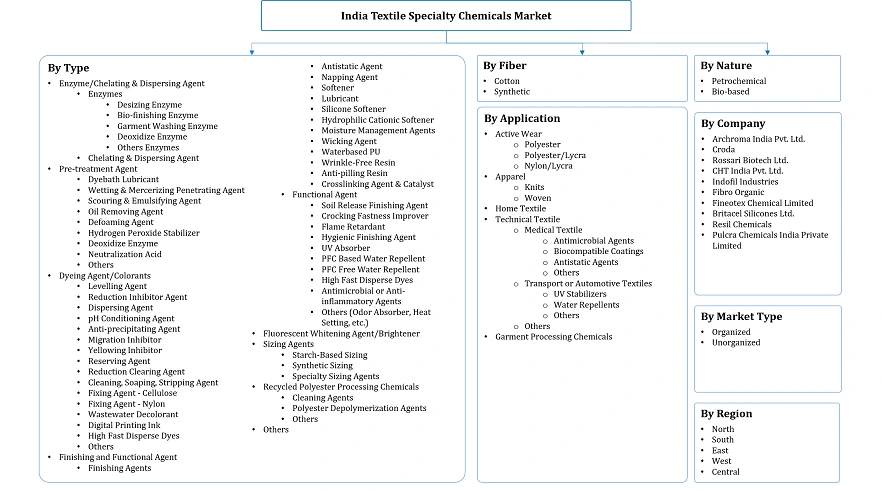
By Type (Enzyme/Chelating & Dispersing Agent (Enzymes (Desizing Enzyme, Bio-finishing Enzyme, Garment Washing Enzyme, Deoxidize Enzyme, Others Enzymes), Chelating & Dispersing Agen......t), Pre-treatment Agent (Dyebath Lubricant, Wetting & Mercerizing Penetrating Agent, Scouring & Emulsifying Agent, Oil Removing Agent, Defoaming Agent, Hydrogen Peroxide Stabilizer, Deoxidize Enzyme, Neutralization Acid, Others), Dyeing Agent/Colorants (Levelling Agent, Reduction Inhibitor Agent, Dispersing Agent, pH Conditioning Agent, Anti-precipitating Agent, Migration Inhibitor, Yellowing Inhibitor, Reserving Agent, Reduction Clearing Agent, Cleaning, Soaping, Stripping Agent, Fixing Agent - Cellulose, Fixing Agent - Nylon, Wastewater Decolorant, Digital Printing Ink, High Fast Disperse Dyes, Others), Finishing Agent (Antistatic Agent, Napping Agent, Softener, Lubricant, Silicone Softener, Hydrophilic Cationic Softener, Moisture Management Agents, Wicking Agent, Waterbased PU, Wrinkle-Free Resin, Anti-pilling Resin, Crosslinking Agent & Catalyst), Functional Agent (Soil Release Finishing Agent, Crocking Fastness Improver, Flame Retardant, Hygienic Finishing Agent, UV Absorber, PFC-Based Water Repellent, PFC Free Water Repellent, High Fast Disperse Dyes, Antimicrobial or Anti-inflammatory Agents, Others (Odor Absorber, Heat Setting, etc.)), Fluorescent Whitening Agent/Brightener, Sizing Agents (Starch-Based Sizing, Synthetic Sizing, Specialty Sizing Agents), Recycled Polyester Processing Chemicals (Cleaning Agents, Polyester Depolymerization Agents, Others), Others), By Fiber (Cotton, Synthetic), By Application (Active Wear (Polyester, Polyester/Lycra, Nylon/Lycra), Apparel (Knits, Woven), Home Textile, Technical Textile (Medical Textile (Antimicrobial Agents, Biocompatible Coatings, Antistatic Agents, Others), Transport or Automotive Textiles (UV Stabilizers, Water Repellents, Others), Others), Garment Processing Chemicals), By Nature (Petrochemical, Bio-based), By Market Type (Organized, Unorganized),and others Read more
- Chemicals
- Jun 2026
- 240
- PDF, Excel, PPT
India Textile Specialty Chemicals Market Key Takeaways
- The India Textile Specialty Chemicals Market size was valued at approximately USD 1.65 billion in 2026 and is projected to reach nearly USD 2.65 billion by 2032, expanding at a CAGR of around 8.2% during 2026-2032.
- By fiber, cotton accounted for approximately 65% of the total market share in 2026.
- By application, technical textiles held nearly 40% share of the textile market in 2026.
- This industry is moderately consolidated, with the top five players estimated to collectively account for approximately 20% of the total market in 2026.
India Textile Specialty Chemicals Market Size & Outlook
India Textile Specialty Chemicals Market is entering a structurally transformative growth phase, driven by the ongoing evolution of the country’s textile manufacturing ecosystem toward higher-value, performance-oriented, and export-compliant production. Valued at USD 1.65 billion in 2026, the market is projected to reach USD 2.65 billion by 2032, expanding at a CAGR of 8.2% during 2026–2032, supported by the rising adoption of man-made fibers, technical textiles, and sustainable processing technologies.
Government initiatives are playing a pivotal role in accelerating this industry transformation. The revised Textile Production Linked Incentive scheme attracted 84 new investment proposals worth nearly USD 1.19 billion in February 2026 across MMF fabrics and technical textile segments. In addition, Budget 2026–27 identified technical textiles, sustainable manufacturing, and Mega Textile Parks as strategic priorities for industrial development. These policy measures are encouraging capacity expansion and modernization across the textile value chain, thereby increasing demand for advanced specialty chemicals used in dyeing, coating, finishing, printing, and performance enhancement applications.
The impact of this transition is particularly evident within India’s synthetic textile manufacturing sector. Surat, which accounts for nearly 60% of the country’s MMF textile production, is witnessing renewed investment activity following the withdrawal of Quality Control Orders on key polyester feedstocks. The resulting reduction in raw material costs has improved the competitiveness of domestic synthetic textile manufacturing and stimulated expansion in chemical-intensive processing operations. Consequently, demand for specialty auxiliaries, dispersants, coating agents, softeners, and high-performance finishing chemicals is expected to increase steadily across major production clusters.
At the same time, evolving global sustainability requirements are reshaping chemical consumption patterns within India’s export-oriented textile industry. Regulatory developments such as European PFAS restrictions, ESG-linked sourcing requirements, ZDHC compliance standards, and low-emission procurement frameworks are encouraging textile manufacturers to adopt environmentally responsible processing solutions. This transition is accelerating the use of fluorine-free water repellents, low-VOC textile chemicals, recyclable chemistries, and water-efficient treatment solutions, creating new opportunities for specialty chemical suppliers focused on sustainable innovation.
Further supporting market growth is the rapid expansion of India’s technical textiles sector. Increasing applications across industrial, healthcare, automotive, construction, agriculture, and protective textile segments are driving demand for functional, performance-enhancing, and compliance-ready specialty chemicals tailored to high-value textile applications. The growing emphasis on durability, safety, flame resistance, antimicrobial performance, and advanced fabric functionality is further increasing the need for specialized textile chemical formulations.
Supported by rising domestic manufacturing investments, expanding specialty chemical production capacities, favorable government policies, and ongoing China+1 sourcing diversification strategies, India’s textile specialty chemicals industry is progressively evolving into a technology-intensive and globally integrated specialty materials market. This structural transformation is expected to create strong medium- to long-term growth opportunities while enhancing the industry's competitiveness in both domestic and international textile value chains.
India Textile Specialty Chemicals Market Key Indicators
- Surat textile industry associations have projected more than INR 45,000 crore (approximately USD 5.3 billion) in future textile manufacturing investments. These investments are expected to expand textile processing capacities and increase demand for specialty chemicals used in dyeing, finishing, coating, and performance enhancement applications.
- India revoked 14 Quality Control Orders (QCOs) on key textile intermediates, including purified terephthalic acid (PTA) and monoethylene glycol (MEG), in late 2025 to improve raw material availability and enhance the competitiveness of domestic MMF production. The policy is expected to stimulate synthetic textile manufacturing and support higher consumption of textile processing chemicals, dispersants, auxiliaries, and finishing agents.
- Cumulative foreign direct investment (FDI) inflows into India’s chemicals sector reached approximately USD 23 billion by FY25–FY26, reflecting strong investor confidence in the country's specialty chemical manufacturing ecosystem. Increasing investments in chemical production capacity, technology upgrades, and sustainable formulations are expected to support the long-term growth of textile specialty chemicals.
- India’s textile exports, including handicrafts, reached ₹3.16 lakh crore in FY 2025–26, increasing by 2.1% year-over-year. Growing export volumes require higher consumption of textile specialty chemicals such as dyes, finishing agents, coating chemicals, softeners, and processing auxiliaries to meet international quality, colorfastness, and performance standards, thereby supporting market growth.
- Exports of ready-made garments (RMG) increased from ₹1.35 lakh crore in FY 2024–25 to ₹1.39 lakh crore in FY 2025–26, registering 2.9% growth. Rising garment manufacturing activity increases demand for textile processing chemicals used in pretreatment, dyeing, printing, wrinkle resistance, antimicrobial treatment, and finishing applications.
- The Government's Production Linked Incentive (PLI) Scheme for MMF apparel, MMF fabrics, and technical textiles has approved 74 applicants with proposed investments exceeding USD 3.01 billion. Capacity expansion in man-made fiber and technical textile manufacturing is expected to substantially increase demand for specialty textile chemicals over the coming years.
India Textile Specialty Chemicals Market Scope
| Category | Segments |
|---|---|
| By Type | Enzyme/Chelating & Dispersing Agent (Enzymes (Desizing Enzyme, Bio-finishing Enzyme, Garment Washing Enzyme, Deoxidize Enzyme, Others Enzymes), Chelating & Dispersing Agent), Pre-treatment Agent (Dyebath Lubricant, Wetting & Mercerizing Penetrating Agent, Scouring & Emulsifying Agent, Oil Removing Agent, Defoaming Agent, Hydrogen Peroxide Stabilizer, Deoxidize Enzyme, Neutralization Acid, Others), Dyeing Agent/Colorants (Levelling Agent, Reduction Inhibitor Agent, Dispersing Agent, pH Conditioning Agent, Anti-precipitating Agent, Migration Inhibitor, Yellowing Inhibitor, Reserving Agent, Reduction Clearing Agent, Cleaning, Soaping, Stripping Agent, Fixing Agent - Cellulose, Fixing Agent - Nylon, Wastewater Decolorant, Digital Printing Ink, High Fast Disperse Dyes, Others), Finishing Agent (Antistatic Agent, Napping Agent, Softener, Lubricant, Silicone Softener, Hydrophilic Cationic Softener, Moisture Management Agents, Wicking Agent, Waterbased PU, Wrinkle-Free Resin, Anti-pilling Resin, Crosslinking Agent & Catalyst), Functional Agent (Soil Release Finishing Agent, Crocking Fastness Improver, Flame Retardant, Hygienic Finishing Agent, UV Absorber, PFC-Based Water Repellent, PFC Free Water Repellent, High Fast Disperse Dyes, Antimicrobial or Anti-inflammatory Agents, Others (Odor Absorber, Heat Setting, etc.)), Fluorescent Whitening Agent/Brightener, Sizing Agents (Starch-Based Sizing, Synthetic Sizing, Specialty Sizing Agents), Recycled Polyester Processing Chemicals (Cleaning Agents, Polyester Depolymerization Agents, Others |
| By Fiber | Cotton, Synthetic |
| By Application | Active Wear (Polyester, Polyester/Lycra, Nylon/Lycra), Apparel (Knits, Woven), Home Textile, Technical Textile (Medical Textile (Antimicrobial Agents, Biocompatible Coatings, Antistatic Agents, Others), Transport or Automotive Textiles (UV Stabilizers, Water Repellents, Others), Others), Garment Processing Chemicals |
| By Nature | Petrochemical, Bio-based |
| By Market Type | Organized, Unorganized |
India Textile Specialty Chemicals Market Growth Drivers
Technical Textile Expansion Accelerating Specialty Chemical Demand
India’s textile specialty chemicals industry is witnessing accelerated growth driven by the rapid modernization of domestic textile manufacturing infrastructure and increasing export-oriented production. In 2026, the Government of India approved 52 additional Textile PLI applications, materially expanding downstream demand for specialty dyeing auxiliaries, coating chemicals, and functional finishing agents. Simultaneously, India’s technical textile exports increased exponentially, reflecting rising global demand across sectors requiring high-performance specialty chemicals.
The market is also benefiting from increasing sustainability-driven transformation across textile processing operations. During 2025–2026, Indian textile manufacturers accelerated the adoption of fluorine-free repellents, recyclable textile chemistries, low-voc auxiliaries, and water-efficient dyeing technologies. In parallel, the ministry of textiles launched sustainability-focused initiatives across multiple textile clusters aimed at eliminating hazardous chemicals and improving environmentally compliant textile manufacturing capabilities.
Additionally, expanding AI and automation integration across textile processing facilities is improving operational efficiency and specialty chemical utilization rates. Supported by rising specialty chemical exports, increasing foreign investments, and continued China+1 supply-chain diversification, India’s textile specialty chemicals industry is progressively evolving into a technology-intensive and globally competitive specialty materials ecosystem.
- Market Segmentation
- Introduction
- Product Definition
- Research Process
- Assumptions
- Executive Summary
- India Textile Specialty Chemicals Market Policies, Regulations, and Product Standards
- India Textile Specialty Chemicals Production (Thousand Tons) Trend 2022-2032
- India Textile Specialty Chemicals Production (Thousand Tons) Trend by Type
- Enzyme/Chelating & Dispersing Agent
- Pre-treatment Agent
- Dyeing Agent/Colorants
- Finishing Agent
- Functional Agent
- Fluorescent Whitening Agent/Brightener
- Sizing Agents
- Recycled Polyester Processing Chemicals
- India Textile Specialty Chemicals Production (Thousand Tons) Trend by Type
- Company-Wise Production Plants and Statistics
- Installed Production Capacity
- Actual Production
- Planned Production Target
- India Textile Specialty Chemicals Market Trends & Developments
- India Textile Specialty Chemicals Market Dynamics
- Growth Factors
- Challenges
- India Textile Specialty Chemicals Market Hotspot & Opportunities
- India Textile Specialty Chemicals Market Outlook, 2022-2032F
- Market Size & Outlook
- By Revenues (USD Million)
- By Quantity Sold (Thousand Tons)
- Market Share & Outlook
- By Type - Market Size & Forecast 2022-2032, USD Million
- Enzyme/Chelating & Dispersing Agent
- Enzymes
- Desizing Enzyme
- Bio-finishing Enzyme
- Garment Washing Enzyme
- Deoxidize Enzyme
- Others Enzymes
- Chelating & Dispersing Agent
- Enzymes
- Pre-treatment Agent
- Dyebath Lubricant
- Wetting & Mercerizing Penetrating Agent
- Scouring & Emulsifying Agent
- Oil Removing Agent
- Defoaming Agent
- Hydrogen Peroxide Stabilizer
- Deoxidize Enzyme
- Neutralization Acid
- Others
- Dyeing Agent/Colorants
- Levelling Agent
- Reduction Inhibitor Agent
- Dispersing Agent
- pH Conditioning Agent
- Anti-precipitating Agent
- Migration Inhibitor
- Yellowing Inhibitor
- Reserving Agent
- Reduction Clearing Agent
- Cleaning, Soaping, Stripping Agent
- Fixing Agent - Cellulose
- Fixing Agent - Nylon
- Wastewater Decolorant
- Digital Printing Ink
- High Fast Disperse Dyes
- Others
- Finishing Agent
- Antistatic Agent
- Napping Agent
- Softener
- Lubricant
- Silicone Softener
- Hydrophilic Cationic Softener
- Moisture Management Agents
- Wicking Agent
- Waterbased PU
- Wrinkle-Free Resin
- Anti-pilling Resin
- Crosslinking Agent & Catalyst
- Functional Agent
- Soil Release Finishing Agent
- Crocking Fastness Improver
- Flame Retardant
- Hygienic Finishing Agent
- UV Absorber
- PFC-Based Water Repellent
- PFC Free Water Repellent
- High Fast Disperse Dyes
- Antimicrobial or Anti-inflammatory Agents
- Others (Odor Absorber, Heat Setting, etc.)
- Fluorescent Whitening Agent/Brightener
- Sizing Agents
- Starch-Based Sizing
- Synthetic Sizing
- Specialty Sizing Agents
- Recycled Polyester Processing Chemicals
- Cleaning Agents
- Polyester Depolymerization Agents
- Others
- Others
- Enzyme/Chelating & Dispersing Agent
- By Fiber - Market Size & Forecast 2022-2032, USD Million
- Cotton
- Synthetic
- By Application- Market Size & Forecast 2022-2032, USD Million
- Active Wear
- Polyester
- Polyester/Lycra
- Nylon/Lycra
- Apparel
- Knits
- Woven
- Home Textile
- Technical Textile
- Medical Textile
- Antimicrobial Agents
- Biocompatible Coatings
- Antistatic Agents
- Others
- Transport or Automotive Textiles
- UV Stabilizers
- Water Repellents
- Others
- Others
- Medical Textile
- Garment Processing Chemicals
- Active Wear
- By Nature - Market Size & Forecast 2022-2032, USD Million
- Petrochemical
- Bio-based
- By Market Type- Market Size & Forecast 2022-2032, USD Million
- Organized
- Unorganized
- By Region
- North
- South
- Central
- East
- West
- By Company
- Competition Characteristics
- Market Share & Analysis
- By Type - Market Size & Forecast 2022-2032, USD Million
- Market Size & Outlook
- India Enzyme/Chelating & Dispersing Agent Market Outlook, 2022-2032
- Market Size & Outlook
- By Revenues (USD Million)
- By Quantity Sold (Thousand Tons)
- Market Share & Outlook
- By Fiber - Market Size & Forecast 2022-2032, USD Million
- By Application- Market Size & Forecast 2022-2032, USD Million
- By Nature - Market Size & Forecast 2022-2032, USD Million
- By Market Type- Market Size & Forecast 2022-2032, USD Million
- Market Size & Outlook
- India Pre-treatment Agent Market Outlook, 2022-2032
- Market Size & Outlook
- By Revenues (USD Million)
- By Quantity Sold (Thousand Tons)
- Market Share & Outlook
- By Fiber - Market Size & Forecast 2022-2032, USD Million
- By Application- Market Size & Forecast 2022-2032, USD Million
- By Nature - Market Size & Forecast 2022-2032, USD Million
- By Market Type- Market Size & Forecast 2022-2032, USD Million
- Market Size & Outlook
- India Dyeing Agent/Colorants Market Outlook, 2022-2032
- Market Size & Outlook
- By Revenues (USD Million)
- By Quantity Sold (Thousand Tons)
- Market Share & Outlook
- By Fiber - Market Size & Forecast 2022-2032, USD Million
- By Application- Market Size & Forecast 2022-2032, USD Million
- By Nature - Market Size & Forecast 2022-2032, USD Million
- By Market Type- Market Size & Forecast 2022-2032, USD Million
- Market Size & Outlook
- India Finishing Agent Market Outlook, 2022-2032
- Market Size & Outlook
- By Revenues (USD Million)
- By Quantity Sold (Thousand Tons)
- Market Share & Outlook
- By Fiber - Market Size & Forecast 2022-2032, USD Million
- By Application- Market Size & Forecast 2022-2032, USD Million
- By Nature - Market Size & Forecast 2022-2032, USD Million
- By Market Type- Market Size & Forecast 2022-2032, USD Million
- Market Size & Outlook
- India Functional Agent Market Outlook, 2022-2032
- Market Size & Outlook
- By Revenues (USD Million)
- By Quantity Sold (Thousand Tons)
- Market Share & Outlook
- By Fiber - Market Size & Forecast 2022-2032, USD Million
- By Application- Market Size & Forecast 2022-2032, USD Million
- By Nature - Market Size & Forecast 2022-2032, USD Million
- By Market Type- Market Size & Forecast 2022-2032, USD Million
- Market Size & Outlook
- India Fluorescent Whitening Agent/Brightener Market Outlook, 2022-2032
- Market Size & Outlook
- By Revenues (USD Million)
- By Quantity Sold (Thousand Tons)
- Market Share & Outlook
- By Fiber - Market Size & Forecast 2022-2032, USD Million
- By Application- Market Size & Forecast 2022-2032, USD Million
- By Nature - Market Size & Forecast 2022-2032, USD Million
- By Market Type- Market Size & Forecast 2022-2032, USD Million
- Market Size & Outlook
- India Sizing Agents Market Outlook, 2022-2032
- Market Size & Outlook
- By Revenues (USD Million)
- By Quantity Sold (Thousand Tons)
- Market Share & Outlook
- By Fiber - Market Size & Forecast 2022-2032, USD Million
- By Application- Market Size & Forecast 2022-2032, USD Million
- By Nature - Market Size & Forecast 2022-2032, USD Million
- By Market Type- Market Size & Forecast 2022-2032, USD Million
- Market Size & Outlook
- India Recycled Polyester Processing Chemicals Market Outlook, 2022-2032
- Market Size & Outlook
- By Revenues (USD Million)
- By Quantity Sold (Thousand Tons)
- Market Share & Outlook
- By Fiber - Market Size & Forecast 2022-2032, USD Million
- By Application- Market Size & Forecast 2022-2032, USD Million
- By Nature - Market Size & Forecast 2022-2032, USD Million
- By Market Type- Market Size & Forecast 2022-2032, USD Million
- Market Size & Outlook
- India Textile Specialty Chemicals Market Key Strategic Imperatives for Success & Growth
- Competitive Outlook
- Company Profiles
- Archroma India Pvt. Ltd
- Business Description
- Product Portfolio
- Collaborations & Alliances
- Recent Developments
- Financial Details
- Others
- Croda
- Business Description
- Product Portfolio
- Collaborations & Alliances
- Recent Developments
- Financial Details
- Others
- Rossari Biotech Ltd.
- Business Description
- Product Portfolio
- Collaborations & Alliances
- Recent Developments
- Financial Details
- Others
- CHT India Pvt. Ltd.
- Business Description
- Product Portfolio
- Collaborations & Alliances
- Recent Developments
- Financial Details
- Others
- Indofil Industries
- Business Description
- Product Portfolio
- Collaborations & Alliances
- Recent Developments
- Financial Details
- Others
- Fibro Organic
- Business Description
- Product Portfolio
- Collaborations & Alliances
- Recent Developments
- Financial Details
- Others
- Fineotex Chemical Limited
- Business Description
- Product Portfolio
- Collaborations & Alliances
- Recent Developments
- Financial Details
- Others
- Britacel Silicones
- Business Description
- Product Portfolio
- Collaborations & Alliances
- Recent Developments
- Financial Details
- Others
- Resil Chemicals
- Business Description
- Product Portfolio
- Collaborations & Alliances
- Recent Developments
- Financial Details
- Others
- Pulcra Chemicals India Private Limited
- Business Description
- Product Portfolio
- Collaborations & Alliances
- Recent Developments
- Financial Details
- Others
- Archroma India Pvt. Ltd
- Company Profiles
- Disclaimer
MarkNtel Advisors follows a robust and iterative research methodology designed to ensure maximum accuracy and minimize deviation in market estimates and forecasts. Our approach combines both bottom-up and top-down techniques to effectively segment and quantify various aspects of the market. A consistent feature across all our research reports is data triangulation, which examines the market from three distinct perspectives to validate findings. Key components of our research process include:
1. Scope & Research Design At the outset, MarkNtel Advisors define the research objectives and formulate pertinent questions. This phase involves determining the type of research—qualitative or quantitative—and designing a methodology that outlines data collection methods, target demographics, and analytical tools. They also establish timelines and budgets to ensure the research aligns with client goals.
2. Sample Selection and Data Collection In this stage, the firm identifies the target audience and determines the appropriate sample size to ensure representativeness. They employ various sampling methods, such as random or stratified sampling, based on the research objectives. Data collection is carried out using tools like surveys, interviews, and observations, ensuring the gathered data is reliable and relevant.
3. Data Analysis and Validation Once data is collected, MarkNtel Advisors undertake a rigorous analysis process. This includes cleaning the data to remove inconsistencies, employing statistical software for quantitative analysis, and thematic analysis for qualitative data. Validation steps are taken to ensure the accuracy and reliability of the findings, minimizing biases and errors.

4. Data Forecast and FinalizationThe final phase involves forecasting future market trends based on the analyzed data. MarkNtel Advisors utilize predictive modeling and time series analysis to anticipate market behaviors. The insights are then compiled into comprehensive reports, featuring visual aids like charts and graphs, and include strategic recommendations to inform client decision-making
FILL THE FORM TO INQUIRE BEFORE BUYING THIS REPORT
We offer flexible licensing options to cater to varying organizational needs. Choose the pricing pack that best suits your requirements:
Buy Now Talk to our Consultant
 Request Customization