

By Product Type (Cultured Butter, Uncultured Butter), By Source (Animal-Based Butter, Plant-Based Butter Alternatives), By Salt Content (Salted Butter, Unsalted Butter), By Packagi......ng (Blocks and Cubes, Plastic Boxes / Tubs, Sheets and Slabs, Others), By End User (Household Consumption, Bakery and Confectionery, Food Processing, Hotels, Restaurants and Cafés (HoReCa), Foodservice and Quick-Service Restaurants), By Distribution Channel (Supermarkets and Hypermarkets, Convenience and Grocery Stores, Specialty Stores, Online Retail / E-commerce, Others), and others Read more
- Food & Beverages
- Aug 2026
- 175
- PDF, Excel, PPT
India Butter Market Key Takeaways
- India butter market size was valued at USD 1.22 billion in 2025 and is projected to grow from USD 1.44 billion in 2026 to USD 2.98 billion by 2032.
- The industry is projected to grow at a steady CAGR of 12.89% during 2026-2032.
- North India holds the largest share of about 39% in 2026.
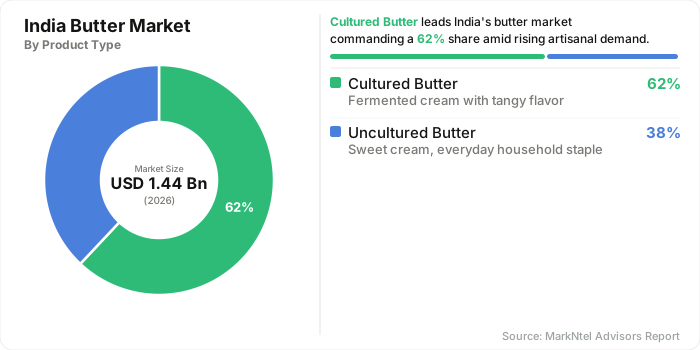
- By product type, cultured butter holds a significant share of about 62% in 2026.
- By source, animal-based butter seized a significant share of about 95% in 2026.
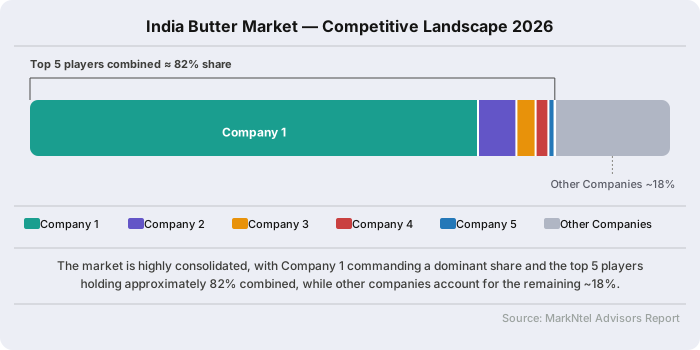
- The industry is moderately consolidated. However, the top five players collectively account for nearly 52% share.
India Butter Market Size and Outlook
India butter market size was valued at USD 1.22 billion in 2025 and is projected to grow from USD 1.44 billion in 2026 to USD 2.98 billion by 2032. Along with this, the market is estimated to grow at a CAGR of around 12.89% during the forecast period, i.e., 2026-32.
India’s butter industry is supported by the country’s expanding dairy supply, rising milk availability and increasing opportunities for organized processing. Per-capita milk availability increased from 427 grams per person per day in 2020–21 to 485 grams in 2024–25, representing growth of approximately 13.6%, while national milk production rose from 210.0 million tonnes to 247.87 million tonnes during the same period.
This expanding raw-material base supports the production of value-added dairy products, including butter. However, milk production remains geographically concentrated, with Uttar Pradesh, Rajasthan, Madhya Pradesh, Gujarat and Maharashtra collectively accounting for approximately 54.1% of national milk production in 2024–25. This concentration influences the location of dairy-processing facilities, milk-procurement networks, cold-chain infrastructure and distribution routes.
These developments create opportunities for dairy companies to strengthen regional procurement, expand processing capacity near major milk-producing areas and improve cold-chain distribution. Furthermore, reliable supply can become an important competitive advantage for brands serving bakeries, restaurants, hotels and other commercial users. As organized dairy processing expands, packaged and branded butter can gain wider availability across urban, semi-urban and regional markets.
Consequently, India’s butter industry is positioned for continued development, supported by a growing milk supply base, expanding value-added dairy processing and rising demand for dependable packaged products, although cost volatility and regional supply disruptions will remain important factors influencing market performance.
India Butter Market Key Indicators
- India’s butter production is forecast to reach approximately 7.44 million metric tons in 2026, representing around 3% growth over 2025. This large production base reflects the scale of India’s dairy industry and the availability of milk for processing into butter and other value-added products. Rising milk output, improved dairy processing, and expansion of organized dairy companies are supporting supply. The production outlook also indicates that India remains largely self-sufficient in butter, reducing dependence on imports and supporting domestic availability.
- India’s butter consumption is forecast to reach approximately 7.36 million metric tons in 2026, increasing by 3% over 2025. According to the USDA Foreign Agricultural Service, this growth is supported by demographic and economic expansion, rising disposable incomes, improved supply chains, and changing consumer lifestyles and habits. These factors are expanding demand for butter across India’s large and increasingly formalized dairy-consumption base.
- India exported approximately 57.65 million kg of butter and other milk-derived fats in 2024, valued at around USD 317.7 million. Saudi Arabia, the United Arab Emirates and Bahrain were among the largest destinations, with exports to these three markets collectively exceeding 30 million kg. The United States and Egypt were also important markets. These figures demonstrate that Indian dairy processors have established international demand, particularly in Gulf and neighboring markets.
India Butter Market Scope
| Category | Segments |
|---|---|
| By Product Type | Cultured Butter, Uncultured Butter |
| By Source | Animal-Based Butter, Plant-Based Butter Alternatives |
| By Salt Content | Salted Butter, Unsalted Butter |
| By Packaging | Blocks and Cubes, Plastic Boxes / Tubs, Sheets and Slabs, Others |
| By End User | Household Consumption, Bakery and Confectionery, Food Processing, Hotels, Restaurants and Cafés (HoReCa), Foodservice and Quick-Service Restaurants |
| By Distribution Channel | Supermarkets and Hypermarkets, Convenience and Grocery Stores, Specialty Stores, Online Retail / E-commerce, Others |
India Butter Market Growth Drivers
India’s Expanding Milk Pool Powers the Next Wave of Butter Market Growth
Rising milk production is a fundamental driver of India’s butter industry because it expands the supply of milk fat available for butter manufacturing. According to the Government of India, milk production increased from 239.30 million tonnes in 2023–24 to 247.87 million tonnes in 2024–25, registering 3.58% growth. Per-capita milk availability also reached 485 grams per day in 2024–25, strengthening the country’s dairy supply base.
The expanding milk pool enables dairy cooperatives and private processors to allocate more raw material to value-added products such as butter. Furthermore, the Government’s National Programme for Dairy Development (NPDD) is designed to strengthen organized milk procurement, milk testing, chilling and dairy-processing infrastructure through 2025–26, supporting the availability and quality of raw material for butter manufacturers.
Moreover, White Revolution 2.0, implemented during 2024–25 to 2028–29, targets a rise in cooperative milk procurement to 1,007 lakh kg per day by 2028–29 and the formation of 75,000 new dairy cooperative societies. These initiatives are expected to expand organized milk collection and processing capacity. Consequently, a larger and more reliable raw-material base will support butter production, improve supply stability and drive long-term growth in India’s butter market.
Recent Trends
Organized Dairy Processing Gains Momentum in India
The Indian butter market is gradually shifting toward organized dairy processing as cooperatives and private dairy companies expand procurement, processing and distribution networks. India produced 239.3 million tonnes of milk in 2023–24, including approximately 150 million tonnes of marketable surplus. However, only 32% of this surplus, or around 47 million tonnes, was handled by the organized sector, while approximately 102 million tonnes remained in the unorganized sector. This highlights significant formalization potential in India’s dairy value chain.
A strong example is Gujarat Cooperative Milk Marketing Federation (GCMMF), which markets products under the Amul brand. The cooperative network comprises 3.64 million milk producer members, 18,600 village milk cooperative societies and 18 member unions. During 2024–25, GCMMF recorded average daily milk collection of 32 million liters, supported by total milk-handling capacity of 50 million liters per day. Its large-scale procurement and processing network supports the production and distribution of value-added dairy products, including butter.
The expansion of organized dairy networks is strengthening formal milk procurement, processing scale, and distribution efficiency. As more milk moves through organized channels, dairy companies can improve product standardization, packaging and supply consistency. This creates a stronger foundation for the wider availability of branded and packaged butter across regional markets while increasing competition between cooperatives and private dairy processors.
India Butter Market Opportunities and Challenges
Adulteration Concerns Drive India’s Shift Toward Traceable Butter
Milk adulteration and inconsistent quality remain major challenges for India’s dairy value chain, creating risks for the safety, authenticity, and consistency of butter produced from milk and cream. A July 2026 assessment reported that more than 65–70% of sampled milk failed to meet food-safety standards, with adulteration involving substances such as water, starch, glucose, detergents, urea, hydrogen peroxide and formalin. The challenge is amplified because nearly two-thirds of India’s milk flows through the unorganized sector, where monitoring and traceability are more difficult.
This challenge is creating an opportunity for quality-assured and traceable butter production. A GS1 India initiative with Mother Dairy, the Department of Animal Husbandry and Dairying, and other partners tracks the supply chain from livestock health and milk sourcing through butter and ghee production. By April 2025, the system had traced 10 million liters of cow milk and 200,000 kilograms of cow butter. Using GS1 identifiers, batch-level data and QR-enabled digital traceability, companies can provide information on sourcing, processing and packaging. Such systems can strengthen consumer trust, differentiate organized butter brands from informal alternatives and support premium positioning.
Milk adulteration and quality concerns are creating a clear opportunity for organized butter manufacturers to compete through verified sourcing, advanced testing and digital traceability. As consumer demand for safe and authentic dairy products increases, transparent quality assurance can strengthen brand trust and support premium positioning. Consequently, investment in traceable supply chains can accelerate the shift from informal to organized butter production in India.
Segmentation Insights
Cultured Butter Commands a 62% Share as Premium Demand Expands
Cultured butter is estimated to account for nearly 62% of India’s butter industry revenue, making it the leading product type. Its strong position is supported by broad usage across household consumption, bakery and confectionery manufacturing, foodservice and processed-food applications. Produced by fermenting cream with selected bacterial cultures, cultured butter develops a distinctive flavor and aroma that differentiates it from conventional alternatives.
The segment also benefits from the expansion of organized dairy processing and branded product portfolios, which has improved the availability of packaged butter across supermarkets, modern retail outlets and online channels. Furthermore, rising consumer interest in premium dairy products and differentiated taste experiences is supporting demand for cultured butter, particularly in urban markets. Its use across multiple consumption occasions, including cooking, baking, breakfast and food preparation, further strengthens its revenue contribution.
As organized dairy companies continue expanding value-added product portfolios and consumers increasingly seek higher-quality and differentiated dairy products, cultured butter is expected to maintain its leading position in India’s butter industry. Based on product type, the scope has been segmented into
- Cultured Butter
- Uncultured Butter
Animal-Based Butter Commands a 95% Share as India’s Dairy Base Expands
Animal-based butter holds the dominant position in India’s butter industry, accounting for an estimated 95% share, supported by the country’s extensive dairy production base and deeply established consumer preference for milk-derived products. India produced approximately 247.87 million tonnes of milk in 2024–25, while per-capita milk availability reached 485 grams per person per day, providing a substantial raw-material base for dairy products, including butter. Cow and buffalo milk are the primary sources used in the dairy industry, with buffalo milk particularly valuable for butter production because of its relatively high milk-fat content.
Established cooperatives and dairy companies, including Amul, Mother Dairy and regional dairy brands, further strengthen the availability of packaged animal-based butter through extensive procurement, processing and distribution networks. In contrast, plant-based butter remains an emerging alternative with limited penetration. Its smaller market presence reflects lower consumer familiarity, narrower product availability and the continued cultural importance of traditional dairy products in India. Consequently, animal-based butter is expected to remain the leading source category in the Indian market. Based on source, the market is categorized into
- Animal-Based Butter
- Plant-Based Butter
India Butter Market Geographical Outlook
North India is projected to account for around 39% of the India butter market in 2026, supported by its strong milk production base, well-established dairy processing infrastructure, and high consumption of dairy products. The region benefits from the presence of India's leading milk-producing states, with Uttar Pradesh contributing 15.66% and Rajasthan 14.82% of the country's total milk production in 2024–25, ensuring abundant raw material for butter manufacturing. In addition, Punjab and Haryana are among the country's major dairy-producing states, supported by high milk yields and organized procurement systems.
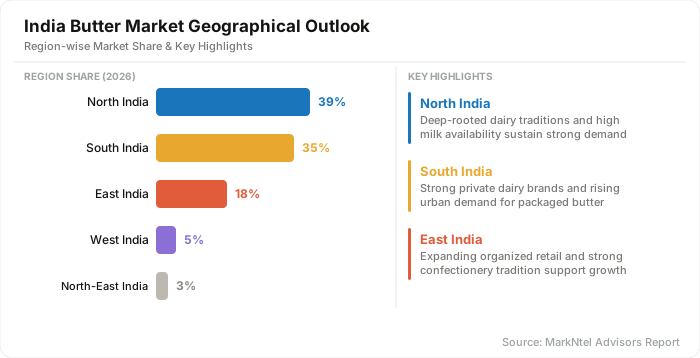
As an industry example, Mother Dairy, headquartered in New Delhi, has developed an extensive procurement, processing, and distribution network across Delhi-NCR and neighboring northern states, while Amul has expanded its milk procurement operations into Punjab, strengthening butter production and supply in the region. Rising urban demand from cities such as Delhi, Lucknow, Jaipur, and Chandigarh, together with growing bakery, hospitality, and food-service industries, continues to reinforce North India's dominant position in the Indian butter market.
India Butter Market Competitive Analysis
The India Butter industry is moderately consolidated. The top five players collectively account for approximately 52% of India’s branded butter market, led by Amul, Mother Dairy, Britannia, Nandini and Parag Milk Foods.
Major Companies in India Butter Industry
- Gujarat Cooperative Milk Marketing Federation (Amul)
- Britannia Industries Ltd.
- Mother Dairy Fruit & Vegetable Pvt. Ltd.
- Parag Milk Foods Ltd.
- Hatsun Agro Product Ltd.
- Karnataka Co-operative Milk Producers' Federation (Nandini)
- Milky Mist Dairy Food Pvt. Ltd.
- Patanjali Ayurved Ltd.
- Punjab State Cooperative Milk Producers' Federation (Verka)
- Lactalis India (President)
- Others
India Butter Industry News and Recent Developments
2026: Milky Mist Announces ₹1,130 Crore Dairy Processing Plant with Butter Production
Milky Mist signed an agreement to invest ₹1,130 crore (approximately USD 132 million) in a new dairy processing facility in Maharashtra. The planned plant will initially process 1 million litres of milk per day, with capacity expandable to 2.5 million litres per day, and will manufacture value-added products including butter, paneer, mozzarella, yoghurt, ghee and ice cream. This expansion is expected to strengthen butter-processing capacity and widen the company’s presence beyond southern India.
Impact Analysis: Milky Mist’s planned ₹1,130 crore investment in a Maharashtra dairy processing plant could significantly strengthen India’s organised butter-processing ecosystem. The facility’s initial capacity of 1 million litres of milk per day, expandable to 2.5 million litres, will support the production of multiple value-added dairy products, including butter. The investment can improve regional processing capacity, reduce dependence on southern markets and enable the company to expand its branded dairy distribution across western and northern India.
2025: Amul Introduces Garlic & Herbs Buttery Spread
Amul expanded its value-added butter portfolio with a Garlic & Herbs Buttery Spread, combining butter with garlic flakes and oregano. The product contains a minimum 77% milk fat and is distributed through retail stores, modern-format outlets and Amul parlours across India. The launch reflects increasing product differentiation within the butter and spread segment
Impact Analysis: Amul’s launch of its Garlic & Herbs Buttery Spread, containing a minimum of 77% milk fat, demonstrates the increasing diversification of India’s butter and spread segment. By combining butter with garlic flakes and oregano, the product targets consumers seeking convenient and flavoured alternatives to conventional butter. The launch could support premiumisation, increase consumption occasions and encourage further innovation in value-added butter products as organised dairy brands compete through differentiated offerings.
- Market Segmentation
- Introduction
- Product Definition
- Research Process
- Assumptions
- Executive Summary
- India Butter Market Policies, Regulations, and Product Standards
- India Butter Market Supply Chain Analysis
- India Butter Market Production Trend 2022-2032
- India Butter Market Production Trend By Type of Product
- Cultured Butter
- Uncultured Butter
- Company Wise Production Plants and Statistics
- Installed Production Capacity
- Actual Production
- Planned Production Target
- India Butter Market Production Trend By Type of Product
- India Butter Market Pricing Analysis 2022-2032
- India Butter Market Pricing Trend (USD/Tons) 2022-2032
- India Butter Market Pricing Trend (USD/Tons) By Regions 2022-2032
- North India
- South India
- East India
- West India
- Central India
- India Butter Market Pricing Trend (USD/Tons) By Product Type 2022-2032
- Cultured Butter
- Uncultured Butter
- India Butter Market Trends & Developments
- India Butter Market Dynamics
- Growth Factors
- Challenges
- India Butter Market Hotspot & Opportunities
- India Butter Market Outlook, 2022-2032
- Market Size & Outlook
- By Revenues (USD Million)
- By Quantity Sold (Thousand Tons)
- Market Segmentation & Outlook
- By Product Type- Market Size & Forecast 2022-2032, USD Million & Thousand Tons
- Cultured Butter
- Uncultured Butter
- By Source- Market Size & Forecast 2022-2032, USD Million & Thousand Tons
- Animal-Based Butter
- Cow Milk Butter
- Buffalo Milk Butter
- Goat and Sheep Milk Butter
- Others
- Plant-Based Butter Alternatives
- Animal-Based Butter
- By Salt Content- Market Size & Forecast 2022-2032, USD Million & Thousand Tons
- Salted Butter
- Unsalted Butter
- By Packaging- Market Size & Forecast 2022-2032, USD Million & Thousand Tons
- Blocks and Cubes
- Plastic Boxes / Tubs
- Sheets and Slabs
- Others
- By End User- Market Size & Forecast 2022-2032, USD Million & Thousand Tons
- Household Consumption
- Bakery and Confectionery
- Food Processing
- Hotels, Restaurants and Cafés (HoReCa)
- Foodservice and Quick-Service Restaurants
- By Distribution Channel- Market Size & Forecast 2022-2032, USD Million & Thousand Tons
- Supermarkets and Hypermarkets
- Convenience and Grocery Stores
- Specialty Stores
- Online Retail / E-commerce
- Others
- By Region- Market Size & Forecast 2022-2032, USD Million & Thousand Tons
- North India
- South India
- West India
- East India
- Central India
- By Company
- Competition Characteristics
- Market Share & Analysis
- By Product Type- Market Size & Forecast 2022-2032, USD Million & Thousand Tons
- Market Size & Outlook
- India Cultured Butter Market Outlook, 2022-2032
- Market Size & Outlook
- By Revenues (USD Million)
- By Quantity Sold (Thousand Tons)
- Market Segmentation & Outlook
- By Source- Market Size & Forecast 2022-2032, USD Million & Thousand Tons
- By Salt Content- Market Size & Forecast 2022-2032, USD Million & Thousand Tons
- By Packaging- Market Size & Forecast 2022-2032, USD Million & Thousand Tons
- By End User- Market Size & Forecast 2022-2032, USD Million & Thousand Tons
- By Distribution Channel- Market Size & Forecast 2022-2032, USD Million & Thousand Tons
- By Region- Market Size & Forecast 2022-2032, USD Million & Thousand Tons
- Market Size & Outlook
- India Uncultured Butter Market Outlook, 2022-2032
- Market Size & Outlook
- By Revenues (USD Million)
- By Quantity Sold (Thousand Tons)
- Market Segmentation & Outlook
- By Source- Market Size & Forecast 2022-2032, USD Million & Thousand Tons
- By Salt Content- Market Size & Forecast 2022-2032, USD Million & Thousand Tons
- By Packaging- Market Size & Forecast 2022-2032, USD Million & Thousand Tons
- By End User- Market Size & Forecast 2022-2032, USD Million & Thousand Tons
- By Distribution Channel- Market Size & Forecast 2022-2032, USD Million & Thousand Tons
- By Region- Market Size & Forecast 2022-2032, USD Million & Thousand Tons
- Market Size & Outlook
- India Butter Market Key Strategic Imperatives for Success & Growth
- Competitive Outlook
- Company Profiles
- Gujarat Cooperative Milk Marketing Federation (Amul)
- Business Description
- Product Portfolio
- Collaborations & Alliances
- Recent Developments
- Financial Details
- Others
- Britannia Industries Ltd.
- Business Description
- Product Portfolio
- Collaborations & Alliances
- Recent Developments
- Financial Details
- Others
- Mother Dairy Fruit & Vegetable Pvt. Ltd.
- Business Description
- Product Portfolio
- Collaborations & Alliances
- Recent Developments
- Financial Details
- Others
- Parag Milk Foods Ltd.
- Business Description
- Product Portfolio
- Collaborations & Alliances
- Recent Developments
- Financial Details
- Others
- Hatsun Agro Product Ltd.
- Business Description
- Product Portfolio
- Collaborations & Alliances
- Recent Developments
- Financial Details
- Others
- Karnataka Co-operative Milk Producers' Federation (Nandini)
- Business Description
- Product Portfolio
- Collaborations & Alliances
- Recent Developments
- Financial Details
- Others
- Milky Mist Dairy Food Pvt. Ltd.
- Business Description
- Product Portfolio
- Collaborations & Alliances
- Recent Developments
- Financial Details
- Others
- Patanjali Ayurved Ltd.
- Business Description
- Product Portfolio
- Collaborations & Alliances
- Recent Developments
- Financial Details
- Others
- Punjab State Cooperative Milk Producers' Federation (Verka)
- Business Description
- Product Portfolio
- Collaborations & Alliances
- Recent Developments
- Financial Details
- Others
- Lactalis India (President)
- Business Description
- Product Portfolio
- Collaborations & Alliances
- Recent Developments
- Financial Details
- Others
- Others
- Gujarat Cooperative Milk Marketing Federation (Amul)
- Company Profiles
- Disclaimer

MarkNtel Advisors follows a robust and iterative research methodology designed to ensure maximum accuracy and minimize deviation in market estimates and forecasts. Our approach combines both bottom-up and top-down techniques to effectively segment and quantify various aspects of the market. A consistent feature across all our research reports is data triangulation, which examines the market from three distinct perspectives to validate findings. Key components of our research process include:
1. Scope & Research Design At the outset, MarkNtel Advisors define the research objectives and formulate pertinent questions. This phase involves determining the type of research—qualitative or quantitative—and designing a methodology that outlines data collection methods, target demographics, and analytical tools. They also establish timelines and budgets to ensure the research aligns with client goals.
2. Sample Selection and Data Collection In this stage, the firm identifies the target audience and determines the appropriate sample size to ensure representativeness. They employ various sampling methods, such as random or stratified sampling, based on the research objectives. Data collection is carried out using tools like surveys, interviews, and observations, ensuring the gathered data is reliable and relevant.
3. Data Analysis and Validation Once data is collected, MarkNtel Advisors undertake a rigorous analysis process. This includes cleaning the data to remove inconsistencies, employing statistical software for quantitative analysis, and thematic analysis for qualitative data. Validation steps are taken to ensure the accuracy and reliability of the findings, minimizing biases and errors.

4. Data Forecast and FinalizationThe final phase involves forecasting future market trends based on the analyzed data. MarkNtel Advisors utilize predictive modeling and time series analysis to anticipate market behaviors. The insights are then compiled into comprehensive reports, featuring visual aids like charts and graphs, and include strategic recommendations to inform client decision-making
FILL THE FORM TO INQUIRE BEFORE BUYING THIS REPORT
We offer flexible licensing options to cater to varying organizational needs. Choose the pricing pack that best suits your requirements:
Buy Now Talk to our Consultant
 Request Customization