

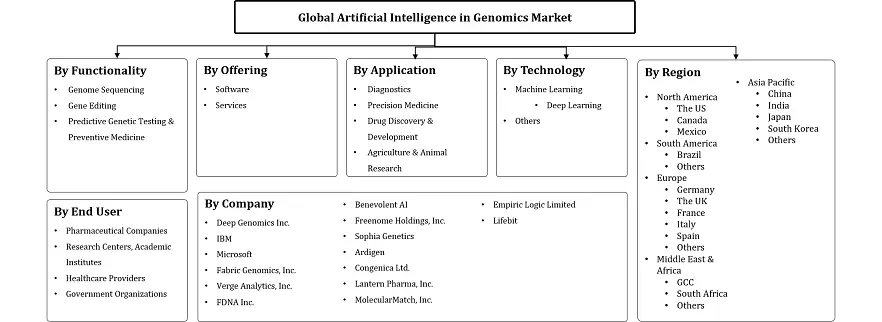
By Offering (Software, Services), By Technology (Machine Learning (Deep Learning, Supervised Learning, Reinforcement Learning, Unsupervised Learning), Others), By Functionality (Ge......nome Sequencing, Gene Editing, Predictive Genetic Testing & Preventive Medicine), By Application (Diagnostics, Drug Discovery & Development, Precision Medicine, Agriculture & Animal Research, Other Applications), By End-User (Pharmaceutical & Biotech Companies, Healthcare Providers, Research Centers, Academic Institutes, Government Organizations, Other End Users), By Region (North America, South America, Europe, Asia-Pacific, Middle East and Africa), By Country (U.S, Canada, Brazil, Mexico, Germany, France, The U.K, Spain, Italy, China, India, Japan, Australia, Saudi Arabia, South Africa), By Competitors (Deep Genomics Inc., IBM, Microsoft Corporation, Fabric Genomics, Inc., Verge Analytics, Inc., FDNA Inc., Benevolent AI, Freenome Holdings, Inc., SOPHIA GENETICS, Ardigen, Congenica Ltd., Lantern Pharma, Inc., MolecularMatch, Inc., Empiric Logic Limited, Lifebit) Read more
- Healthcare
- May 2023
- 210
- PDF, Excel, PPT
Market Definition
Genomes are a complete set of DNA, including all the genes of a particular individual. The study of genomes of an organism focusing on its evolution, structure, and functioning is known as genomics, and the role of AI (Artificial Intelligence) in it is to aid in the development of drugs for curing rare diseases.
Market Insights
The Global Artificial Intelligence in Genomics Market is poised to grow at a CAGR of around 53% during the forecast period, i.e., 2023-28. The growth of the market is projected to be propelled mainly by the rapidly growing genomic data volume, ever-increasing adoption of precision medicine, significant advancements in AI Technologies, and the integration of multi-omics data, which includes genomic, transcriptomic, proteomic, & epigenomic data. Besides, the mounting demand for efficient drug discovery & development, various partnerships between academic institutes, bio-pharma companies, and technology firms, and the growing supportive regulatory environment are other prominent aspects projected enhance the Global Artificial Intelligence in Genomics Market size in the future.
| Report Coverage | Details |
|---|---|
| Study Period | Historical Data: 2018-21 |
| Base Year: 2022 | |
| Forecast Period: 2023-28 | |
| CAGR | 53% |
| Regions Covered | North America: USA, Canada, Mexico |
| Europe: Germany, The UK, France, Spain, Italy, and Others | |
| Asia-Pacific: China, India, Japan, South Korea and Others | |
| South America: Brazil, and others | |
| Middle East & Africa: GCC, South Africa and Others | |
| Key Companies Profiled | Deep Genomics Inc., IBM, Microsoft Corporation, Fabric Genomics, Inc., Verge Analytics, Inc., FDNA Inc., Benevolent AI, Freenome Holdings, Inc., SOPHIA GENETICS, Ardigen, Congenica Ltd., Lantern Pharma, Inc., MolecularMatch, Inc., Empiric Logic Limited, Lifebit |
| Unit Denominations | USD Million/Billion |
Genomics is a rapidly evolving field that is becoming increasingly reliant on AI, as it can identify patterns & connections in genetic data that is otherwise difficult for humans to detect. Consequently, it is leading to remarkable improvements in developing new therapeutics for diseases, as well as more accurate diagnoses and personalized patient care, thus becoming a trend in the market. Additionally, the extensively growing use of AI to create digital models of the human body in order to assess the safety & effectiveness of potential new drugs is another notable contributor to the market growth.
As the traditional drug discovery & development process is time-consuming, costly, and often faces high failure rates, AI-driven genomics approaches are gaining traction as they have the potential to expedite the drug discovery process by leveraging genomic data analysis, target identification, along with the prediction of drug efficacy. Using AI in genomics allows for the efficient identification of drug targets, repositioning of existing drugs, and optimization of clinical trial design. Furthermore, favorable regulations and appropriate data privacy & security measures are also expected to amplify the adoption of AI in genomics research, clinical applications, & commercialization, and, in turn, drive the Global Artificial Intelligence in Genomics Market over the coming years.
Market Dynamics
Key Drivers: Immense Potential of AI to Transform Genomics Research & Healthcare
Genomics research generates massive & complex datasets, which include DNA sequences, gene expression profiles, and epigenetic data, which AI algorithms can handle & analyze at an unprecedented scale & speed by identifying patterns, detecting genomic variants, predicting gene functions, and uncovering hidden relationships within the data in order to provide valuable insights for researchers & clinicians. Moreover, AI algorithms can also analyze genomic variants identified through sequencing to understand their potential impact on health & disease. By classifying variants, predicting their functional consequences, and prioritizing them for further investigation, AI can help identify disease-causing mutations and enable more accurate diagnoses as well as personalized treatment decisions. Hence, in this manner, AI holds enormous potential to transform genomics research and the entire healthcare industry and, consequently, drive the Global Artificial Intelligence in Genomics Market during 2023-28.
Growth Restraint: Lack of Standardization and Data Privacy & Security Concerns
Since genomic data contain sensitive & personal information, its security & privacy are significant concerns. The use of AI in genomics relies on large-scale genomic datasets, which is why ensuring their privacy & security is critical. Currently, concerns regarding data breaches, unauthorized access, & misuse of genomic data are impacting the adoption of AI-based genomics solutions, particularly in healthcare settings where patient data protection is of utmost importance. Moreover, as the field of AI in genomics is still evolving, there is a lack of standardized approaches & methodologies, which are essential to ensure interoperability, comparability, & reproducibility of results across different AI-based genomics tools & platforms, which otherwise could lead to variations in data analysis & interpretation. Hence, these aspects are projected to hamper the Global Artificial Intelligence in Genomics Market through 2028.
- Introduction
- Product Definition
- Research Process
- Assumptions
- Market Segmentation
- Preface
- Executive Summary
- Impact of COVID-19 on Global Artificial Intelligence in Genomics Market
- Global Artificial Intelligence in Genomics Market Trends & Insights
- Global Artificial Intelligence in Genomics Market Dynamics
- Drivers
- Challenges
- Impact Analysis
- Global Artificial Intelligence in Genomics Market Hotspots & Opportunities
- Global Artificial Intelligence in Genomics Market Value Chain Analysis
- Global Artificial Intelligence in Genomics Market Regulations & Policy
- Global Artificial Intelligence in Genomics Market Start-up Ecosystem, 2018-2028
- Entrepreneurial Activity
- Year On Year Funding Received
- Funding Received by Top Companies
- Key Investors Active in the Market
- Series Wise Funding Received
- Seed Funding
- Angel Investing
- Venture Capitalists (VC) Funding
- Others
- Global Artificial Intelligence in Genomics Market Outlook, 2018-2028F
- Market Size & Analysis
- By Revenues
- Market Share & Analysis
- By Offering
- Softwares
- Services
- By Technology
- Machine Learning
- Deep Learning
- Other Technologies
- Machine Learning
- By Functionality
- Gene Editing
- Genome Sequencing
- Predictive Genetic Testing & Preventive Medicine
- By Application
- Diagnostics
- Precision Medicine
- Drug Discovery & Development
- Agriculture & Animal Research
- By End User
- Pharmaceutical Companies
- Research Centers, Academic Institutes
- Healthcare Providers
- Government Organizations
- By Region
- North America
- South America
- Europe
- Middle East & Africa
- Asia Pacific
- By Competitors
- Competition Characteristics
- Market Share & Analysis
- Competitive Matrix
- By Offering
- Market Size & Analysis
- North America Artificial Intelligence in Genomics Market Outlook, 2018-2028F
- Market Size & Analysis
- By Revenue
- Market Share & Analysis
- By Offering
- By Technology
- By Functionality
- By Application
- By End User
- By Country
- The US
- Canada
- Mexico
- The US Artificial Intelligence in Genomics Market Outlook, 2018-2028F
- Market Size & Analysis
- By Revenue
- Market Share & Analysis
- By Offering
- By Technology
- Market Size & Analysis
- Canada Artificial Intelligence in Genomics Market Outlook, 2018-2028F
- Market Size & Analysis
- By Revenue
- Market Share & Analysis
- By Offering
- By Technology
- Market Size & Analysis
- Mexico Artificial Intelligence in Genomics Market Outlook, 2018-2028F
- Market Size & Analysis
- By Revenue
- Market Share & Analysis
- By Offering
- By Technology
- Market Size & Analysis
- Market Size & Analysis
- South America Artificial Intelligence in Genomics Market Outlook, 2018-2028F
- Market Size & Analysis
- By Revenue
- Market Share & Analysis
- By Offering
- By Technology
- By Functionality
- By Application
- By End User
- By Country
- Brazil
- Others
- Brazil Artificial Intelligence in Genomics Market Outlook, 2018-2028F
- Market Size & Analysis
- By Revenue
- Market Share & Analysis
- By Offering
- By Technology
- Market Size & Analysis
- Market Size & Analysis
- Europe Artificial Intelligence in Genomics Market Outlook, 2018-2028F
- Market Size & Analysis
- By Revenue
- Market Share & Analysis
- By Offering
- By Technology
- By Functionality
- By Application
- By End User
- By Country
- Germany
- The UK
- France
- Spain
- Italy
- Others
- Germany Artificial Intelligence in Genomics Market Outlook, 2018-2028F
- Market Size & Analysis
- By Revenue
- Market Share & Analysis
- By Offering
- By Technology
- Market Size & Analysis
- The UK Artificial Intelligence in Genomics Market Outlook, 2018-2028F
- Market Size & Analysis
- By Revenue
- Market Share & Analysis
- By Offering
- By Technology
- Market Size & Analysis
- France Artificial Intelligence in Genomics Market Outlook, 2018-2028F
- Market Size & Analysis
- By Revenue
- Market Share & Analysis
- By Offering
- By Technology
- Market Size & Analysis
- Spain Artificial Intelligence in Genomics Market Outlook, 2018-2028F
- Market Size & Analysis
- By Revenue
- Market Share & Analysis
- By Offering
- By Technology
- Market Size & Analysis
- Italy Artificial Intelligence in Genomics Market Outlook, 2018-2028F
- Market Size & Analysis
- By Revenue
- Market Share & Analysis
- By Offering
- By Technology
- Market Size & Analysis
- Market Size & Analysis
- Middle East & Africa Artificial Intelligence in Genomics Market Outlook, 2018-2028F
- Market Size & Analysis
- By Revenue
- Market Share & Analysis
- By Offering
- By Technology
- By Functionality
- By Application
- By End User
- By Country
- GCC
- South Africa
- Others
- GCC Artificial Intelligence in Genomics Market Outlook, 2018-2028F
- Market Size & Analysis
- By Revenue
- Market Share & Analysis
- By Offering
- By Technology
- Market Size & Analysis
- South Africa Artificial Intelligence in Genomics Market Outlook, 2018-2028F
- Market Size & Analysis
- By Revenue
- Market Share & Analysis
- By Offering
- By Technology
- Market Size & Analysis
- Market Size & Analysis
- Asia Pacific Artificial Intelligence in Genomics Market Outlook, 2018-2028F
- Market Size & Analysis
- By Revenue
- Market Share & Analysis
- By Offering
- By Technology
- By Functionality
- By Application
- By End User
- By Country
- China
- India
- Japan
- South Korea
- Others
- China Artificial Intelligence in Genomics Market Outlook, 2018-2028F
- Market Size & Analysis
- By Revenue
- Market Share & Analysis
- By Offering
- By Technology
- Market Size & Analysis
- India Artificial Intelligence in Genomics Market Outlook, 2018-2028F
- Market Size & Analysis
- By Revenue
- Market Share & Analysis
- By Offering
- By Technology
- Market Size & Analysis
- Japan Artificial Intelligence in Genomics Market Outlook, 2018-2028F
- Market Size & Analysis
- By Revenue
- Market Share & Analysis
- By Offering
- By Technology
- Market Size & Analysis
- South Korea Artificial Intelligence in Genomics Market Outlook, 2018-2028F
- Market Size & Analysis
- By Revenue
- Market Share & Analysis
- By Offering
- By Technology
- Market Size & Analysis
- Market Size & Analysis
- Key Strategic Imperatives for Success and Growth
- Competition Outlook
- Competition Matrix
- Product Portfolio
- Target Markets
- Target End Users
- Research & Development
- Strategic Alliances
- Strategic Initiatives
- Company Profiles
- Deep Genomics Inc.
- IBM
- Microsoft Corporation
- Fabric Genomics, Inc.
- Verge Analytics, Inc.
- FDNA Inc.
- Benevolent AI
- Freenome Holdings, Inc.
- SOPHIA GENETICS
- Ardigen
- Congenica Ltd.
- Lantern Pharma, Inc.
- MolecularMatch, Inc.
- Empiric Logic Limited
- Lifebit
- Competition Matrix
- Disclaimer
MarkNtel Advisors follows a robust and iterative research methodology designed to ensure maximum accuracy and minimize deviation in market estimates and forecasts. Our approach combines both bottom-up and top-down techniques to effectively segment and quantify various aspects of the market. A consistent feature across all our research reports is data triangulation, which examines the market from three distinct perspectives to validate findings. Key components of our research process include:
1. Scope & Research Design At the outset, MarkNtel Advisors define the research objectives and formulate pertinent questions. This phase involves determining the type of research—qualitative or quantitative—and designing a methodology that outlines data collection methods, target demographics, and analytical tools. They also establish timelines and budgets to ensure the research aligns with client goals.
2. Sample Selection and Data Collection In this stage, the firm identifies the target audience and determines the appropriate sample size to ensure representativeness. They employ various sampling methods, such as random or stratified sampling, based on the research objectives. Data collection is carried out using tools like surveys, interviews, and observations, ensuring the gathered data is reliable and relevant.
3. Data Analysis and Validation Once data is collected, MarkNtel Advisors undertake a rigorous analysis process. This includes cleaning the data to remove inconsistencies, employing statistical software for quantitative analysis, and thematic analysis for qualitative data. Validation steps are taken to ensure the accuracy and reliability of the findings, minimizing biases and errors.

4. Data Forecast and FinalizationThe final phase involves forecasting future market trends based on the analyzed data. MarkNtel Advisors utilize predictive modeling and time series analysis to anticipate market behaviors. The insights are then compiled into comprehensive reports, featuring visual aids like charts and graphs, and include strategic recommendations to inform client decision-making
FILL THE FORM TO INQUIRE BEFORE BUYING THIS REPORT
We offer flexible licensing options to cater to varying organizational needs. Choose the pricing pack that best suits your requirements:
Buy Now Talk to our Consultant
 Request Customization