

By Insulation & Cooling Method (Oil-Filled Transformer, Dry-Type Transformer), By Phase (Single-Phase Transformer, Three-Phase Transformer), By Voltage Rating (Power Transformer (1......–50 MVA, 50.1–160 MVA, 160.1–350 MVA, Above 350 MVA), Distribution Transformer (Up to 100 KVA, 100.1–315 KVA, 315.1 KVA–5 MVA)), and others Read more
- Energy
- Sep 2026
- 295
- PDF, Excel, PPT
GCC Power and Distribution Transformer Market Key Takeaways
- The GCC power & distribution transformer market is valued at USD 0.72 billion in 2025, to USD 0.73 billion in 2026 and is projected to reach USD 1.23 billion by 2032.
- The industry is projected to witness steady growth at a 9.8% CAGR during the forecast period of 2026-32.
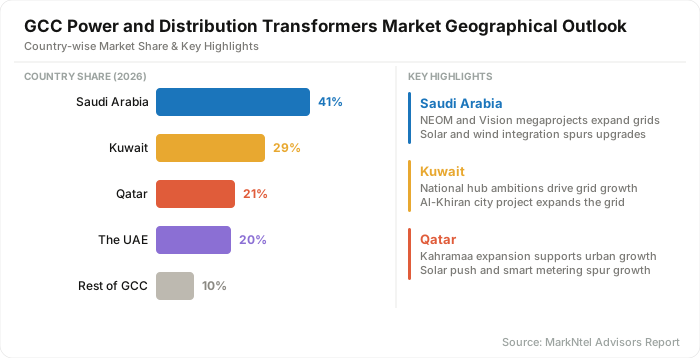
- Saudi Arabia accounts for approximately 41% of the GCC market in 2026, representing the largest national market in the region.
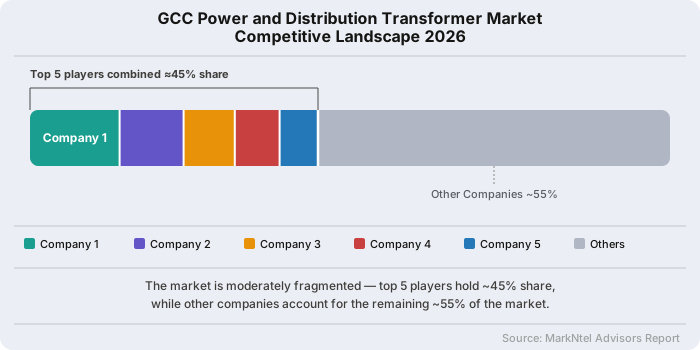
- The market is moderately fragmented, with the top five players collectively accounting for approximately 45% of the total market in 2026.
- Three-phase transformers account for approximately 77% of the market in 2026, making them the leading product type.
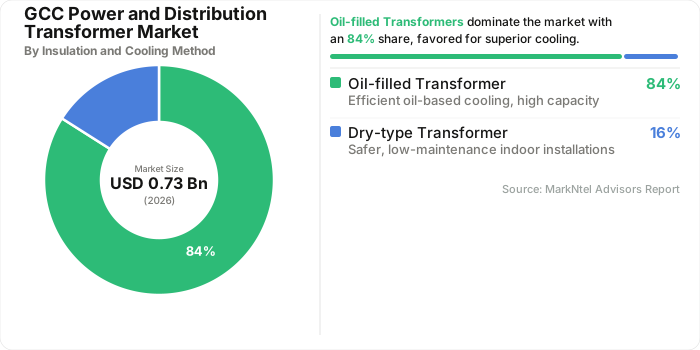
- Oil-filled transformers account for approximately 84% of the market in 2026, representing the dominant transformer type.
GCC Power and Distribution Transformer Market Size and Outlook
The GCC power & distribution transformer market was valued at USD 0.72 billion in 2025, to 0.73 billion in 2026 and is projected to reach USD 1.23 billion by 2030, expanding at a 9.8% CAGR during the forecast period of 2026-32.
The outlook is supported by rising electricity requirements and continued investment in power infrastructure. GCC electricity demand is projected to increase by a further 50% by 2035, driven by population growth, urbanization, extreme heat, cooling, data centers, and desalination. Electricity-sector investment is expected to exceed USD 66 billion by 2035, with nearly 40% directed toward transmission modernization and regional interconnections. These developments are expected to increase the need for substations and power and distribution transformers.
Transmission and distribution expansion remains a major source of transformer demand. Saudi Electricity Company invested USD 15.9 billion in 2024, up 44% year-on-year, for infrastructure expansion, smart-grid improvements and reliability upgrades. By end-2025, its distribution network exceeded 859,000 circuit-km, while its transmission network exceeded 104,600 circuit-km. SEC also reported 12.3 GW of renewable capacity connected to the grid. Such expansion requires transmission transformers for new generation and grid connections, while distribution-network expansion requires additional distribution transformers and substation capacity.
Desalination provides another GCC-specific demand channel. GCC desalinated-water production reached 4.8%. New desalination plants create concentrated electricity loads and consequently require electrical connections, substations and transformers. Saudi Arabia's pipeline includes Jubail 5 with 600,000 m³/day capacity, along with additional projects at Jubail and Ras Al Khair.
Construction, industrial development and renewable energy projects further increase transformer requirements. GCC contract awards reached approximately USD 213.2 billion in 2025, while Saudi Arabia had more than USD 90 billion of power projects under execution. These developments require power transformers for generation and grid connection and distribution transformers for new residential, commercial, tourism and industrial loads.
Overall, the market is expected to experience infrastructure-led growth through 2030. Rising electricity demand, T&D investment, desalination, construction, renewable energy expansion and network modernization will collectively support transformer demand. Saudi Arabia represents the strongest expansion-and-modernization opportunity, while the UAE remains focused on capacity, reliability and new-load requirements.
GCC Power and Distribution Transformer Market Key Indicators
- The UAE is targeting USD 54 billion in renewable investment by 2030, anchored by the 2 GW Al Dhafra plant and the 5 GW Mohammed bin Rashid Al Maktoum Solar Park. These projects are large solar plants that connect straight into the 400-kV high-voltage grid. Therefore, OEMs need the right product capability, EPCs need a locked-in supplier relationship to bid competitively, and utilities are the gatekeepers who decide who's even allowed to compete so market entry strategy differs completely depending upon end-user category.
- Qatar's power grid is running very close to its limit. In 2024, peak summer demand hit 10,220 MW, while total power plant capacity was only 10,573 MW a safety margin of just 353 MW, or about 3.3%. With over 26,450 distribution substations already in place, Kahramaa now has little room to just add new capacity. Instead, it will likely need to upgrade and replace existing transformers to handle more load. For suppliers, this means the near-term opportunity is less about winning new substation projects and more about replacement and upgrade orders on the existing network.
- Abu Dhabi approved 75 million square meters of gross floor area in 2025 across 11,000+ permits, up 15% year-on-year — averaging roughly 6,800 square meters per project. This mid-scale, broad-based permit mix, rather than concentration in mega-developments, signals volume-driven distribution-transformer demand across dispersed connection points, favoring suppliers with wide servicing reach over single large-capacity contracts.
- GCC countries have invested over USD 42.5 billion to develop nearly 62.1 GW of renewable energy projects, but only 19.3 GW had been connected to the grid as of July 2025 — a small fraction of the region's 165 GW 2030 target. That gap between developed and grid-connected capacity means a large share of committed renewable projects still needs their step-up and collector transformers installed, representing near-term backlog demand rather than future pipeline.
Geopolitical & Critical-Grid Security Impact on GCC Power & Distribution Transformers
Conflict Created a New Critical-Infrastructure Security Shock
The June 2025 Iran–Israel conflict was mainly concentrated on Iran and Israel, although Iran also targeted the U.S. military base at Al Udeid, Qatar, on 23 June 2025. In contrast, the 2026 conflict created much broader exposure across GCC civilian infrastructure. Between 28 February and 30 July 2026, ACLED recorded 172 attacks on non-military infrastructure across the six GCC countries.
Energy, oil and gas facilities accounted for 83 attacks (48%), while 47 targeted airports/ports. The UAE recorded 49 attacks, Kuwait 43, Bahrain 34, Saudi Arabia 27, Qatar 11, and Oman 8. More importantly, 122 of these events involved material damage and/or casualties, showing that the risk moved from regional tension to actual physical exposure of critical infrastructure.
The 2026 conflict changes the GCC transformer opportunity from a purely capacity-expansion story to a dual-demand model, grid expansion plus infrastructure resilience. With energy facilities accounting for 48% of recorded non-military attacks and 122 events involving material damage and/or casualties, utilities face a stronger need to protect critical power assets, maintain redundancy and restore service rapidly. This is likely to support incremental demand for HV/EHV transformers, spare units and resilient substations, particularly in the most exposed markets. However, the opportunity should be viewed as a targeted resilience premium rather than a uniform increase in GCC transformer demand.
GCC Power and Distribution Transformer Market Scope
| Category | Segments |
|---|---|
| By Insulation & Cooling Method | Oil-Filled Transformer, Dry-Type Transformer |
| By Phase | Single-Phase Transformer, Three-Phase Transformer |
| By Voltage Rating | Power Transformer (1–50 MVA, 50.1–160 MVA, 160.1–350 MVA, Above 350 MVA), Distribution Transformer (Up to 100 KVA, 100.1–315 KVA, 315.1 KVA–5 MVA |
GCC Power and Distribution Transformer Market Growth Drivers
Cooling-Intensive Electricity Demand Driving Sustained Transformer Deployment Across the GCC
The GCC’s extreme climate, with summer temperatures regularly exceeding 40°C, makes air conditioning a major component of regional electricity consumption. According to the IEA’s 2026 MENA power sector assessment, cooling accounts for nearly half of peak electricity demand and approximately one-quarter of annual electricity demand, with GCC countries recording particularly high air conditioner ownership. This heavy concentration of electricity consumption around cooling, particularly during summer peaks, increases loading across transmission and distribution networks and drives requirements for additional transformation capacity.
The impact is already evident in 2025 power-system data. Saudi Electricity Company delivered a record 160.5 TWh of electricity in H1 2025, up 10% year over year, while DEWA recorded a peak demand of 11.39 GW, an increase of 5.83%. Kuwait reached a 17,610 MW summer peak at temperatures of 51°C, Qatar’s Kahramaa recorded a 10,220 MW summer load, and Bahrain’s EWA registered a record 4,017 MW peak, with air conditioning accounting for approximately 60% of national electricity consumption.
The IEA projects that cooling and desalination will account for nearly 40% of MENA electricity-demand growth through 2035. In response to rising system requirements, Oman’s OETC plans to add 21,800 MVA of transformer capacity and 20 grid stations by 2029, while DEWA invested AED 11.72 billion in transmission expansion in 2025. As cooling-driven electricity demand continues to rise, GCC utilities will require ongoing grid reinforcement, substation expansion and transformer capacity additions, sustaining demand for both power and distribution transformers across the region.
Recent Trends
Retrofitting Legacy Transformers with IoT-Based Monitoring Systems
GCC utilities are increasingly shifting from calendar-based transformer replacement toward condition-based lifecycle management, particularly as installed transformer fleets expand and replacement becomes costlier and time-consuming.
Driven by the expanding installed base and longer replacement cycles. Saudi Electricity Company reported 940,000 transformer stations in 2024, up from 697,068 previously, while survey conducted in 2025 recorded power-transformer lead times of 128 weeks, making large-scale replacement slow and capital-intensive. The shift is also evident in the region’s technical focus, with the CIGRE GCC Power 2025 conference addressing operation beyond design life and refurbishment strategies.
This is creating a market for retrofit monitoring systems that upgrade existing transformers without complete replacement. Hitachi Energy showcased its TXpert ecosystem at Middle East Energy 2025 in Dubai, ABB commercialized the TRAFCOM sensor for transformers across different ages and manufacturers, and Schneider Electric offers EcoStruxure Transformer Expert in Saudi Arabia. These solutions enable continuous monitoring of temperature, moisture, loading and dissolved-gas-related conditions, allowing utilities to identify deterioration earlier and base maintenance or replacement on actual asset condition.
With GCC utilities expanding grid automation and managing increasingly large transformer fleets, retrofit monitoring is emerging as a commercially attractive lifecycle-services opportunity. The addressable market extends beyond new transformer sales into sensors, analytics, diagnostics, maintenance, refurbishment and asset-life optimization, creating recurring revenue opportunities for OEMs and specialized service providers.
GCC Power and Distribution Transformer Market Opportunities and Challenges
Stringent Utility and EPC Vendor-Qualification Requirements Making Localization and Partnerships Critical for GCC Market Access
Major GCC transformer contracts are accessed through utility and EPC procurement systems requiring technical qualification, approved-vendor status, project references and local-value participation. Saudi Electricity Company’s March 2025 qualified-manufacturer list included only seven established transformer suppliers, while its USD 126 billion six-year CAPEX programme through 2030 includes 1,316 power transformers, 168 new 380 kV substations and 292 high-voltage transmission substations. This makes vendor qualification a direct determinant of accessible transformer demand. Saudi Arabia’s localization requirements further raise the barrier, with Saudi Aramco’s iktva programme reaching 70% local content in 2026 and targeting 75% by 2030.
The same model extends across other major GCC markets. In the UAE, the In-Country Value programme channelled AED 65.7 billion (USD 17.9 billion) to nearly 400 local suppliers in H1 2025, while ADNOC has committed AED 551 billion (USD 150 billion) in CAPEX for 2026–2030, increasing the importance of ICV positioning. In Qatar, Tawteen added 12 accredited ICV-certification entities in 2025, taking the total to 23, strengthening local-value evaluation for energy-sector tenders.
For 2026–2032, these requirements make direct cross-border entry less attractive, while qualified local partnerships, JVs, local assembly and EPC alliances offer a faster route to tender access, references and recurring transformer contracts.
Segmentation Insights
Oil-Filled Transformers Hold 84% Share as GCC Utilities Remain Locked into Mineral-Oil Technology
Driven by the region’s Oil-filled transformers account for 84% share, supported by GCC-specific operating conditions and the region's concentration of large utility and industrial loads. Saudi Electricity Company specifies transformer operation at ambient temperatures of up to 55°C, while Qatar's Kahramaa specifications account for 52°C maximum ambient temperature, 84°C solar-radiation temperature, 100% humidity, salt-laden atmosphere and sandstorms. These conditions favour established oil-insulated and liquid-cooled designs for continuous operation under severe thermal and environmental exposure.
The UAE continues to procure equipment built around mineral-oil technology, with local transformer offerings covering 300 kVA–5 MVA, up to 72 kV, using ONAN/ONAF cooling and mineral oil. This overlaps directly with the medium-voltage distribution applications that constitute a major part of GCC utility procurement
Qatar's utility base further demonstrates the scale of installed large-transformer assets: Kahramaa's 2026 procurement includes investigation and repair of 220/132-kV, 315-MVA transformers at Ras Laffan and Doha South, creating an established maintenance and replacement ecosystem around large utility transformers.
This installed-base and specification effect reduces technology-switching requirements for utilities, allowing existing maintenance practices, approved suppliers and technical standards to continue supporting oil-filled procurement. Consequently, new distribution additions and replacement/upgrading of existing utility assets reinforce the segment’s 84% dominance, while dry-type transformers remain concentrated in more specialized indoor applications. By insulation and cooling method, the market is further segmented into the following sub-categories:
- Oil-Filled Transformer
- Dry-Type Transformer
Three-Phase Transformers Dominate the GCC Market by Phase with 77% Share
Reflected by the region's predominantly three-phase utility and industrial electrical infrastructure. Large electricity loads are connected through three-phase systems, making three-phase transformation the standard configuration for generation, transmission, distribution and industrial applications. In Saudi Arabia, GE Vernova completed a turnkey substation for the Rabigh-3 desalination plant, supplying electrical infrastructure for one of the world's largest seawater reverse-osmosis facilities. The project demonstrates how GCC's electricity-intensive desalination infrastructure translates into three-phase transformer requirements.
Qatar provides another demand signal, Kahramaa awarded approximately USD 604 million for western-region electricity-network expansion in 2026, including grid infrastructure associated with the Dukhan solar project. Such utility-scale generation and grid connections require three-phase transformation at multiple voltage levels, while single-phase transformers remain concentrated in smaller residential, rural and specialized applications. Consequently, the GCC's concentration of large utility loads, desalination, industrial facilities and multi-MW renewable projects structurally favours three-phase transformers and sustains their approximately 77% share. By phase the market is further segmented into the following sub-categories:
- Single-Phase Transformer
- Three-Phase Transformer
GCC Power and Distribution Transformer Market Geographical Analysis
Saudi Arabia accounts for approximately 47% of the GCC power and distribution transformer industry, supported by the Kingdom's large-scale generation and grid expansion under Vision 2030. The demand opportunity is increasingly tied to new generation and transmission infrastructure, requiring transformer capacity to be installed alongside newly developed renewable plants and associated grid connections rather than relying primarily on replacement demand.
On 14 July 2025, PIF-backed ACWA Power, Badeel and SAPCO committed approximately USD 8.3 billion to develop 15,000 MW of renewable capacity, comprising 12,000 MW of solar and 3,000 MW of wind across seven projects in Asir, Madinah, Makkah and Riyadh. These projects create requirements for collector, step-up and grid-interface transformers across multiple generation sites.
The grid expansion is developing alongside generation capacity. In February 2025, Hyundai Engineering & Construction secured a USD 389 million Saudi Electricity Company contract for two 380-kV transmission networks covering 491 km, connecting new solar generation to the Medina and Mecca grids. The projects therefore create direct demand for high-voltage grid transformers alongside renewable-generation transformation equipment, reinforcing Saudi Arabia's position as the GCC's largest and most project-driven transformer market.
GCC Power and Distribution Transformer Market Competitive Landscape
The GCC market is moderately fragmented, with global OEMs dominating high-voltage and utility projects, while local manufacturers compete strongly in distribution transformers. With the top players Siemens Energy, GE Vernova, Schneider Electric, Saudi Transformers and Alfanar collectively hold approximately 40%.
Major players in the GCC Power and Distribution Transformer Market
- Hitachi Energy
- Siemens Energy
- GE Vernova
- Schneider Electric
- ABB
- Mitsubishi Electric
- Hyundai Electric
- CG Power and Industrial Solutions
- Elsewedy Electric
- Nissin Electric
- SGB-SMIT Group
- Toshiba Energy Systems & Solutions
GCC Power and Distribution Transformer Market News and Recent Developments
2025: Schneider Electric Expands Saudi Transformer Service Partnership with UTEC
Schneider Electric formalized a collaboration with Saudi transformer manufacturer UTEC at its Riyadh Innovation Summit, expanding UTEC's role into certified transformer services.
Impact analysis: The partnership strengthens Schneider's localized maintenance and after-sales capabilities in Saudi Arabia, improving service responsiveness for utility and industrial customers and reinforcing its competitive position as local-content requirements increasingly influence transformer procurement.
April 2026: Hitachi Energy and Samsung C&T Expand HVAC Grid Collaboration
Hitachi Energy and Samsung C&T signed an MoU to jointly pursue high-voltage AC grid infrastructure opportunities, building on their previous collaboration in the UAE and Australia.
Impact analysis: The agreement combines Hitachi Energy's grid and transformer technology with Samsung C&T's EPC capabilities and establishes a joint opportunity pipeline, positioning the partners to compete for complex transmission and cross-border grid projects across the GCC and other markets.
- Market Segmentation
- Introduction
- Product Definition
- Research Process
- Assumptions
- Executive Summary
- GCC Power and Distribution Transformer Market Policies, Regulations, and Product Standards
- GCC Power and Distribution Transformer Market Trends & Developments
- GCC Power and Distribution Transformer Market Dynamics
- Growth Factors
- Challenges
- GCC Power and Distribution Transformer Market Hotspot & Opportunities
- GCC Power and Distribution Transformer Market Outlook, 2022-2032
- Market Size & Outlook
- By Revenues (USD Million)
- Market Share & Analysis
- By Insulation & Cooling Method- Market Size & Forecast 2022-2032, USD Million
- Oil-Filled Transformer
- Dry-Type Transformer
- By Phase- Market Size & Forecast 2022-2032, USD Million
- Single-Phase Transformer
- Three-Phase Transformer
- By Voltage Rating- Market Size & Forecast 2022-2032, USD Million
- Power Transformer
- 1–50 MVA
- 50.1–160 MVA
- 160.1–350 MVA
- Above 350 MVA
- Distribution Transformer
- Up to 100 KVA
- 100.1–315 KVA
- 315.1 KVA–5 MVA
- Power Transformer
- By Country
- Saudi Arabia
- UAE
- Qatar
- Oman
- Kuwait
- Bahrain
- By Company
- Competition Characteristics
- Market Share & Analysis
- By Insulation & Cooling Method- Market Size & Forecast 2022-2032, USD Million
- Market Size & Outlook
- Saudi Arabia Power and Distribution Transformer Market Outlook, 2022-2032
- Market Size & Outlook
- By Revenues (USD Million)
- Market Share & Analysis
- By Insulation & Cooling Method- Market Size & Forecast 2022-2032, USD Million
- By Phase- Market Size & Forecast 2022-2032, USD Million
- By Voltage Rating- Market Size & Forecast 2022-2032, USD Million
- Market Size & Outlook
- UAE Power and Distribution Transformer Market Outlook, 2022-2032
- Market Size & Outlook
- By Revenues (USD Million)
- Market Share & Analysis
- By Insulation & Cooling Method- Market Size & Forecast 2022-2032, USD Million
- By Phase- Market Size & Forecast 2022-2032, USD Million
- By Voltage Rating- Market Size & Forecast 2022-2032, USD Million
- Market Size & Outlook
- Qatar Power and Distribution Transformer Market Outlook, 2022-2032
- Market Size & Outlook
- By Revenues (USD Million)
- Market Share & Analysis
- By Insulation & Cooling Method- Market Size & Forecast 2022-2032, USD Million
- By Phase- Market Size & Forecast 2022-2032, USD Million
- By Voltage Rating- Market Size & Forecast 2022-2032, USD Million
- Market Size & Outlook
- Oman Power and Distribution Transformer Market Outlook, 2022-2032
- Market Size & Outlook
- By Revenues (USD Million)
- Market Share & Analysis
- By Insulation & Cooling Method- Market Size & Forecast 2022-2032, USD Million
- By Phase- Market Size & Forecast 2022-2032, USD Million
- By Voltage Rating- Market Size & Forecast 2022-2032, USD Million
- Market Size & Outlook
- Kuwait Power and Distribution Transformer Market Outlook, 2022-2032
- Market Size & Outlook
- By Revenues (USD Million)
- Market Share & Analysis
- By Insulation & Cooling Method- Market Size & Forecast 2022-2032, USD Million
- By Phase- Market Size & Forecast 2022-2032, USD Million
- By Voltage Rating- Market Size & Forecast 2022-2032, USD Million
- Market Size & Outlook
- Bahrain Power and Distribution Transformer Market Outlook, 2022-2032
- Market Size & Outlook
- By Revenues (USD Million)
- Market Share & Analysis
- By Insulation & Cooling Method- Market Size & Forecast 2022-2032, USD Million
- By Phase- Market Size & Forecast 2022-2032, USD Million
- By Voltage Rating- Market Size & Forecast 2022-2032, USD Million
- Market Size & Outlook
- GCC Power and Distribution Transformer Market Key Strategic Imperatives for Success & Growth
- Competitive Outlook
- Company Profiles
- Hitachi Energy
- Business Description
- Product Portfolio
- Collaborations & Alliances
- Recent Developments
- Financial Details
- Others
- Siemens Energy
- Business Description
- Product Portfolio
- Collaborations & Alliances
- Recent Developments
- Financial Details
- Others
- GE Vernova
- Business Description
- Product Portfolio
- Collaborations & Alliances
- Recent Developments
- Financial Details
- Others
- Schneider Electric
- Business Description
- Product Portfolio
- Collaborations & Alliances
- Recent Developments
- Financial Details
- Others
- ABB
- Business Description
- Product Portfolio
- Collaborations & Alliances
- Recent Developments
- Financial Details
- Others
- Mitsubishi Electric
- Business Description
- Product Portfolio
- Collaborations & Alliances
- Recent Developments
- Financial Details
- Others
- Hyundai Electric
- Business Description
- Product Portfolio
- Collaborations & Alliances
- Recent Developments
- Financial Details
- Others
- CG Power and Industrial Solutions
- Business Description
- Product Portfolio
- Collaborations & Alliances
- Recent Developments
- Financial Details
- Others
- Elsewedy Electric
- Business Description
- Product Portfolio
- Collaborations & Alliances
- Recent Developments
- Financial Details
- Others
- Nissin Electric
- Business Description
- Product Portfolio
- Collaborations & Alliances
- Recent Developments
- Financial Details
- Others
- SGB-SMIT Group
- Business Description
- Product Portfolio
- Collaborations & Alliances
- Recent Developments
- Financial Details
- Others
- Toshiba Energy Systems & Solutions
- Business Description
- Product Portfolio
- Collaborations & Alliances
- Recent Developments
- Financial Details
- Others
- Hitachi Energy
- Company Profiles
- Disclaimer

MarkNtel Advisors follows a robust and iterative research methodology designed to ensure maximum accuracy and minimize deviation in market estimates and forecasts. Our approach combines both bottom-up and top-down techniques to effectively segment and quantify various aspects of the market. A consistent feature across all our research reports is data triangulation, which examines the market from three distinct perspectives to validate findings. Key components of our research process include:
1. Scope & Research Design At the outset, MarkNtel Advisors define the research objectives and formulate pertinent questions. This phase involves determining the type of research—qualitative or quantitative—and designing a methodology that outlines data collection methods, target demographics, and analytical tools. They also establish timelines and budgets to ensure the research aligns with client goals.
2. Sample Selection and Data Collection In this stage, the firm identifies the target audience and determines the appropriate sample size to ensure representativeness. They employ various sampling methods, such as random or stratified sampling, based on the research objectives. Data collection is carried out using tools like surveys, interviews, and observations, ensuring the gathered data is reliable and relevant.
3. Data Analysis and Validation Once data is collected, MarkNtel Advisors undertake a rigorous analysis process. This includes cleaning the data to remove inconsistencies, employing statistical software for quantitative analysis, and thematic analysis for qualitative data. Validation steps are taken to ensure the accuracy and reliability of the findings, minimizing biases and errors.

4. Data Forecast and FinalizationThe final phase involves forecasting future market trends based on the analyzed data. MarkNtel Advisors utilize predictive modeling and time series analysis to anticipate market behaviors. The insights are then compiled into comprehensive reports, featuring visual aids like charts and graphs, and include strategic recommendations to inform client decision-making
FILL THE FORM TO INQUIRE BEFORE BUYING THIS REPORT
We offer flexible licensing options to cater to varying organizational needs. Choose the pricing pack that best suits your requirements:
Buy Now Talk to our Consultant
 Request Customization