

Footwear Market and Global Industry Analysis - By Product Type (Athletic, Non-Athletic) By Material (Leather, Non-Leather (Rubber, Plastic, Fabric, Others)), By End-User (Men, Wome......n, Children) By Sales Channel (Online, Offline) and others Read more
- FMCG
- Jun 2025
- 178
- PDF, Excel, PPT
Market Definition
In today’s world, footwear is not just a necessary item but it also shows the fashion choice of a person. They can be manufactured using wood, rubber, leather, etc., with either machine or by hand. As the season or occasion changes, footwear also changes accordingly. Nowadays, the demand for footwear that is comfortable along with stylish, is increasing. Leading companies in this field are providing their customers with customized products to fulfill their demands.
Market Insights & Analysis: Global Footwear Market (2025-30):
The Global Footwear Market size was valued at around USD 428 billion in 2024 and is projected to reach USD 564.44 billion by 2030. Along with this, the market is estimated to grow at a CAGR of around 4.72% during the forecast period, i.e., 2025-30. Various factors like the increasing popularity of online shopping and social media play a big role in driving the growth & expansion of the Global Footwear Market. It is now much easier and accessible to buy different footwear due to the presence of online platforms and social media keeps everyone updated with trends leading to more purchases.
| Report Coverage | Details |
|---|---|
| Historical Years | 2020–23 |
| Base Years | 2024 |
| Forecast Years | 2025–30 |
| Market Value in 2024 | USD 428 Billion |
| Market Value by 2030 | USD 564.44 Billion |
| CAGR (2025–30) | 4.72% |
| Leading Region | Asia-Pacific |
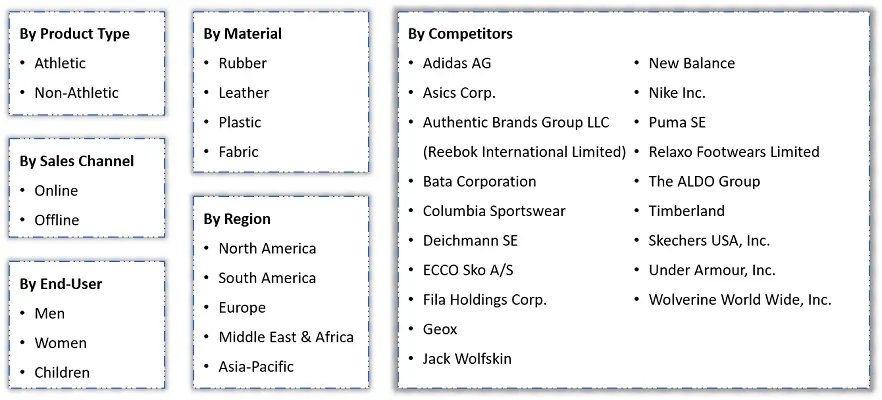
| Top Key Players | Adidas AG, Asics Corp. Authentic Brands Group LLC (Reebok International Limited), Bata Corporation, Columbia Sportswear, Deichmann SE, ECCO Sko A/S, Fila Holdings Corp., Geox, Jack Wolfskin, New Balance, Nike Inc., Puma SE, Relaxo Footwears Limited, Skechers USA, Inc., The ALDO Group, Timberland, Under Armour, Inc., Wolverine World Wide, Inc. and others |
| Segmentation | By Product Type (Athletic, Non-Athletic) By Material (Leather, Non-Leather (Rubber, Plastic, Fabric, Others)), By End-User (Men, Women, Children) By Sales Channel (Online, Offline) and others |
| Key Report Highlights |
|
*Boost strategic growth with in-depth market analysis - Get a free sample preview today!
As people become more conscious about the impact of products on the environment & sustainability, lucrative growth opportunities are developing in the market for the top manufacturers. Due to this people are now buying products made from recyclable materials. Even the big brands like Adidas and Nike are producing various products using recycled materials and this is not exclusive to only major brands because some small brands are also benefiting from the same by providing similar products. The aim of this trend is not only to satisfy customers but also to contribute to the country’s sustainable goals set by the government. Despite a positive market outlook, one of the major challenges for the global footwear industry is the counterfeiting of products. This not only ruins the big brand’s reputation, but it also ruins the trust of the customers who bought the counterfeit item unknowingly at the price of the original one.
Moreover, personalization and customization are some of the major market trends in the footwear market. Everyone nowadays seeks a more unique and personalized product. Even major brands like Nike and Adidas are providing customization tools on their website that help a person choose different colors, patterns, and materials. This market trend is changing market dynamics and is anticipated to pave the path for future growth & development during the forecast period.
Global Footwear Market Driver:
Growing Popularity of Online Shopping – Due to an increase in the popularity of online shopping platforms and social media, the process of buying footwear has become easy and more accessible. Using social media, people can see what is trending and are more likely to align with current fashion trends, which results in more people buying footwear that is trending. People can now even customize and personalize their products on online shopping platforms which results in a much more unique product and customer satisfaction. This helps people to choose their style based on their preference which makes every product more personalized. Due to online platforms being so popular, various fashion influencers also use them to buy footwear, which makes the trend keep on changing and evolving and then resulting in many more purchases of similar products. Moreover, some brands like Adidas are integrating with Augmented Reality (AR), using which a person can virtually try the product.
- Introduction
- Product Definition
- Research Process
- Assumptions
- Market Segmentation
- Preface
- Executive Summary
- Global Footwear Market Trends & Insights
- Global Footwear Market Dynamics
- Growth Drivers
- Challenges
- Global Footwear Market Hotspot & Opportunities
- Global Footwear Market Outlook, 2020-2030F
- Market Size & Analysis
- Market Revenues
- Market Share & Analysis
- By Product Type
- Athletic
- Non-Athletic
- By Material
- Leather
- Non-Leather
- Rubber
- Plastic
- Fabric
- Others
- By End-User
- Men
- Women
- Children
- By Sales Channel
- Online
- Offline
- By Region
- North America
- South America
- Europe
- Middle East & Africa
- Asia-Pacific
- By Competitors
- Competition Characteristics
- Market Share & Analysis
- Competitive Metrix
- By Product Type
- Market Size & Analysis
- North America Footwear Market Outlook, 2020-2030F
- Market Size & Analysis
- By Revenues (USD Billion)
- Market Share & Analysis
- By Product Type
- By Material
- By End-user
- By Sales Channel
- By Country
- The US
- Canada
- Mexico
- Market Size & Analysis
- South America Footwear Market Outlook, 2020-2030F
- Market Size & Analysis
- By Revenues (USD Billion)
- Market Share & Analysis
- By Product Type
- By Material
- By End-user
- By Sales Channel
- By Country
- Brazil
- Argentina
- Rest of South America
- Market Size & Analysis
- Europe Footwear Market Outlook, 2020-2030F
- Market Size & Analysis
- By Revenues (USD Billion)
- Market Share & Analysis
- By Product Type
- By Material
- By End-user
- By Sales Channel
- By Country
- The UK
- France
- Germany
- Italy
- Spain
- Russia
- Rest of Europe
- Market Size & Analysis
- Middle East & Africa Footwear Market Outlook, 2020-2030F
- Market Size & Analysis
- By Revenues (USD Billion)
- Market Share & Analysis
- By Product Type
- By Material
- By End-user
- By Sales Channel
- By Country
- UAE
- South Africa
- Rest of Middle East & Africa
- Market Size & Analysis
- Asia-Pacific Footwear Market Outlook, 2020-2030F
- Market Size & Analysis
- By Revenues (USD Billion)
- Market Share & Analysis
- By Product Type
- By Material
- By End-user
- By Sales Channel
- By Country
- China
- India
- Japan
- Australia
- South Korea
- Rest of Asia-Pacific
- Market Size & Analysis
- Global Footwear Market Key Strategic Imperatives for Success & Growth
- Competition Outlook
- Competition Matrix
- Target Markets
- Research & Development
- Collaborations & Strategic Alliances
- Key Business Expansion Initiatives
- Business Restructuring- Mergers, Acquisitions, JVs
- Strategic Initiatives
- Company Profiles (Business Description, Product Segments, Business Segments, Financials, Strategic Alliances/ Partnerships, Future Plans)
- Adidas AG
- Asics Corp.
- Authentic Brands Group LLC (Reebok International Limited)
- Bata Corporation
- Columbia Sportswear
- Deichmann SE
- ECCO Sko A/S
- Fila Holdings Corp.
- Geox
- Jack Wolfskin
- New Balance
- Nike Inc.
- Puma SE
- Relaxo Footwears Limited
- Skechers USA, Inc.
- The ALDO Group
- Timberland
- Under Armour, Inc.
- Wolverine World Wide, Inc.
- Others
- Competition Matrix
- Disclaimer
MarkNtel Advisors follows a robust and iterative research methodology designed to ensure maximum accuracy and minimize deviation in market estimates and forecasts. Our approach combines both bottom-up and top-down techniques to effectively segment and quantify various aspects of the market. A consistent feature across all our research reports is data triangulation, which examines the market from three distinct perspectives to validate findings. Key components of our research process include:
1. Scope & Research Design At the outset, MarkNtel Advisors define the research objectives and formulate pertinent questions. This phase involves determining the type of research—qualitative or quantitative—and designing a methodology that outlines data collection methods, target demographics, and analytical tools. They also establish timelines and budgets to ensure the research aligns with client goals.
2. Sample Selection and Data Collection In this stage, the firm identifies the target audience and determines the appropriate sample size to ensure representativeness. They employ various sampling methods, such as random or stratified sampling, based on the research objectives. Data collection is carried out using tools like surveys, interviews, and observations, ensuring the gathered data is reliable and relevant.
3. Data Analysis and Validation Once data is collected, MarkNtel Advisors undertake a rigorous analysis process. This includes cleaning the data to remove inconsistencies, employing statistical software for quantitative analysis, and thematic analysis for qualitative data. Validation steps are taken to ensure the accuracy and reliability of the findings, minimizing biases and errors.

4. Data Forecast and FinalizationThe final phase involves forecasting future market trends based on the analyzed data. MarkNtel Advisors utilize predictive modeling and time series analysis to anticipate market behaviors. The insights are then compiled into comprehensive reports, featuring visual aids like charts and graphs, and include strategic recommendations to inform client decision-making
FILL THE FORM TO INQUIRE BEFORE BUYING THIS REPORT
We offer flexible licensing options to cater to varying organizational needs. Choose the pricing pack that best suits your requirements:
Buy Now Talk to our Consultant
 Request Customization