

By Membrane Material (Polymeric Membranes, Polyvinylidene Fluoride, Polyethersulfone, Polysulfone, Polyacrylonitrile, Polyvinyl Chloride, Others, Ceramic Membranes), By Module Type...... (Hollow Fiber, Tubular, Plate & Frame, Spiral Wound, Others), By System Type (Pressurized Ultrafiltration Systems, Submerged Ultrafiltration Systems), By Application (Municipal Water Treatment, Municipal Wastewater Treatment, Industrial Process Water Treatment, Wastewater Reuse & Recycling, Desalination Pre-treatment, Food & Beverage Processing, Biopharmaceutical & Pharmaceutical Processing, Chemical & Petrochemical Processing, Others), By End-Use Industry (Municipal, Food & Beverage, Pharmaceutical & Biotechnology, Chemical & Petrochemical, Power Generation, Oil & Gas, Electronics & Semiconductor, Pulp & Paper, Textile, Others), By Sales Channel (Online (Company Websites, E-Commerce Marketplaces, Online Distributor Portals, Online RFQ/Quotation Platforms), Offline (Authorized Distributors, Dealers & Retail Stores, System Integrators, Direct Sales)), and others Read more
- Environment
- Jun 2026
- 300
- PDF, Excel, PPT
Europe Ultrafiltration Market Key Takeaways
- The Europe Ultrafiltration Market was valued at USD 0.780 billion in 2025 and is projected to reach USD 0.825 billion in 2026, expanding at a CAGR of 4.91% through 2032.
- By 2032, the market is forecast to reach USD 1.100 billion, driven by expanding regulatory compliance obligations across municipal water treatment, industrial wastewater end-user segments continent-wide.
- Polymeric membranes command approximately 85% of the Market, led by their cost efficiency, established supply chains, and validated compatibility across municipal, pharmaceutical, and food and beverage processing applications.
- Pressurized ultrafiltration systems account for approximately 65% of the industry, underpinned by their operational precision and seamless integration into cross-flow filtration and reverse osmosis pretreatment trains across industrial end-uses.
- Germany holds approximately 25% of the industry, supported by Europe's largest quantified municipal water infrastructure investment gap of USD 915 billion by 2045 and acute groundwater stress across half its districts.
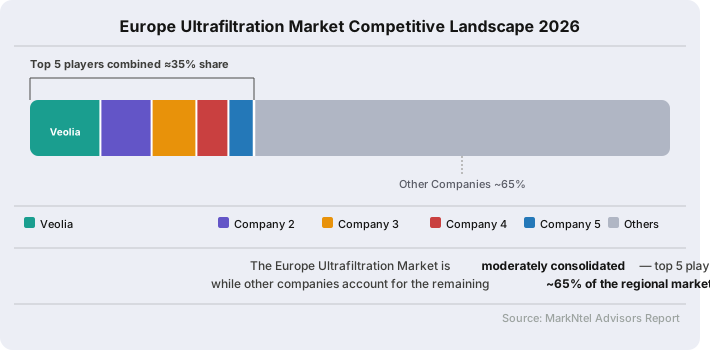
- The market is moderately consolidated, with the top five players collectively accounting for approximately 35% of total market revenue, with competitive differentiation increasingly driven by proprietary membrane IP and PFAS-compliant product portfolios.
Europe Ultrafiltration Market Size and Outlook
The Europe Ultrafiltration Market was valued at USD 0.780 billion in 2025 and is projected to grow from USD 0.825 Billion in 2026 to USD 1.100 Billion by 2032, registering a CAGR of 4.91% during the forecast period. This growth is anchored in the convergence of stringent EU water regulations, accelerating biopharmaceutical manufacturing, and the continent's deep industrial base across food and beverage processing, chemicals, and municipal water treatment infrastructure.
Ultrafiltration membranes operating at 0.01–0.1micron pore sizes as a pressure-driven membrane process deliver high-efficiency pathogen and suspended solids removal at lower energy inputs than competing technologies, making them the preferred upgrade pathway as water quality compliance thresholds tighten across all end-use verticals.
The revised Urban Wastewater Treatment Directive (EU) 2024/3019, which entered into force on 1 January 2025, is one of the most consequential regulatory catalysts for Europe membrane filtration market demand. The European Commission has confirmed that the directive's financial benefits are estimated at approximately USD 7.5 billion per year by 2040, reflecting the scale of water treatment infrastructure upgrade obligations imposed on member states .
Member states must phase in quaternary treatment which advanced water treatment membrane systems directly support for plants handling loads of 150,000 population equivalents and above by 2045, with tertiary treatment mandates by 2039. Water utilities and municipal corporations across Germany, France, and the Netherlands are actively evaluating membrane-based purification upgrades to comply with this timeline, directly expanding the Europe membrane water treatment market.
Additionally, the growing adoption of ultrafiltration technologies within Europe’s pharmaceutical sector is creating demand from a distinct industrial perspective. The region’s pharmaceutical and biotechnology industries continue to expand significantly, driving the need for advanced filtration and purification solutions.
According to the European Federation of Pharmaceutical Industries and Associations (EFPIA), the European biopharmaceutical sector invested approximately €55 billion in research and development activities in 2024 and supports around 2.6 million jobs across the region. This sustained growth in pharmaceutical manufacturing and innovation is expected to strengthen the demand for ultrafiltration systems used in drug production, bioprocessing, and quality assurance applications.
Additionally, the biologics now account for roughly 41% of all prescription drug spending in Europe, with EU countries spending an estimated USD 108 billion on biologics in 2024 alone. Pharmaceutical purification and biotechnology separation workflows, including protein concentration, viral clearance, and sterile drug production, rely directly on ultrafiltration membranes, making this sector a structurally growing demand channel for the European ultrafiltration market.
Europe Ultrafiltration Industry Key Indicators
- The EEA's State of Europe's Waters 2024 report confirmed that only 29% of EU surface water bodies achieved good chemical status, with groundwater supplying two-thirds of the EU's drinking water. The widespread chemical and microbiological contamination of source waters forces municipal water treatment operators and water utilities to deploy pretreatment technology and membrane-based purification ahead of conventional treatment steps, making Europe’s UF technology market solutions indispensable in drinking water supply chains.
- FoodDrinkEurope's Data & Trends 2026 report confirmed that the EU food and drink industry, the largest manufacturing sector in the EU, employs 4.8 million people and generates a turnover of USD 1.7 trillion, with exports outside the EU reaching USD 217 billion. At this industrial scale, dairy processing filtration, food and beverage ultrafiltration for juice clarification, protein concentration, and brewery applications, and process water treatment for cleaning-in-place cycles represent a structurally large and growing demand channel for ultrafiltration membranes across European food manufacturing facilities.
- Water Europe's Annual Report 2024–2025 identified a USD 291 billion investment gap required for European utilities to meet EU water standards. This structural underfunding creates sustained institutional procurement pressure for cost-effective, high-performance membrane filtration technology, including hollow fiber membranes and polymeric ultrafiltration membranes that deliver regulatory compliance at scale across water treatment plants.
Europe Ultrafiltration Market Scope
| Category | Segments |
|---|---|
| By Membrane Material | Polymeric Membranes, Polyvinylidene Fluoride, Polyethersulfone, Polysulfone, Polyacrylonitrile, Polyvinyl Chloride, Others, Ceramic Membranes |
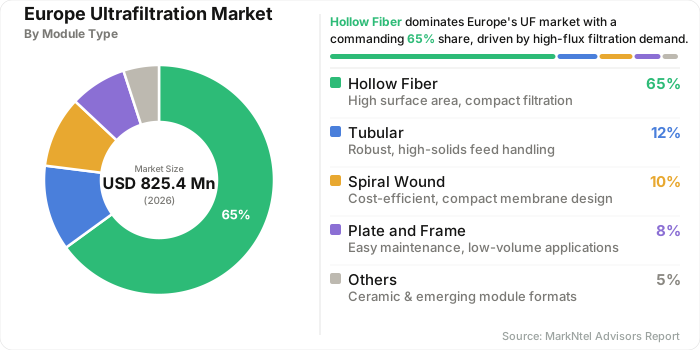
| By Module Type | Hollow Fiber, Tubular, Plate & Frame, Spiral Wound, Others |
| By System Type | Pressurized Ultrafiltration Systems, Submerged Ultrafiltration Systems |
| By Application | Municipal Water Treatment, Municipal Wastewater Treatment, Industrial Process Water Treatment, Wastewater Reuse & Recycling, Desalination Pre-treatment, Food & Beverage Processing, Biopharmaceutical & Pharmaceutical Processing, Chemical & Petrochemical Processing, Others |
| By End-Use Industry | Municipal, Food & Beverage, Pharmaceutical & Biotechnology, Chemical & Petrochemical, Power Generation, Oil & Gas, Electronics & Semiconductor, Pulp & Paper, Textile, Others |
| By Sales Channel | Online (Company Websites, E-Commerce Marketplaces, Online Distributor Portals, Online RFQ/Quotation Platforms), Offline (Authorized Distributors, Dealers & Retail Stores, System Integrators, Direct Sales |
Europe Ultrafiltration Market Growth Drivers
Escalating Industrial and Municipal Demand for Circular Water Reuse Across Europe
Only 2.4% of wastewater is currently reused within the EU, against a technically recoverable potential six times the current volume a gap the European Commission's Water Resilience Strategy, adopted on 4 June 2025, directly targets by embedding a "Water Efficiency First" principle and setting a binding-trajectory goal to improve water efficiency by at least 10% across the EU by 2030 Closing this gap requires industries and municipal water treatment operators to upgrade effluent quality to levels safe for industrial wastewater treatment reuse a standard that conventional secondary treatment cannot meet alone, and that cross-flow filtration and hollow fiber membranes achieve reliably.
The Joint Research Centre confirms that treated wastewater could replace up to 40% of industrial freshwater demand in Europe. As manufacturing facilities across chemicals, food processing, and power generation adopt water recycling systems to meet the Water Resilience Strategy's compliance timeline, demand for European industrial ultrafiltration systems as the core pretreatment technology in closed-loop reuse circuits is rising structurally, not cyclically, across the continent.
Recent Trends
Integration of Digital-First Design Platforms, Transforming Ultrafiltration System Specification Across Europe
Tightening effluent standards under the recast Urban Wastewater Treatment Directive, combined with operator pressure to reduce chemical dosing and lifecycle costs, have made conventional static-capacity system design unworkable for European water treatment plants, accelerating a structural shift toward digitally-driven ultrafiltration systems specification since 2025.
This is directly restructuring the supplier-to-operator value chain. Equipment manufacturers are moving beyond hardware sales toward integrated design and performance platforms that embed technical advisory into procurement. DuPont Water Solutions launched WAVE PRO in March 2025, a cloud-based modelling tool enabling precise simulation of drinking water filtration, industrial wastewater treatment, and desalination pretreatment configurations before installation.
By March 2026, DuPont expanded WAVE PRO to integrate reverse osmosis (RO) and nanofiltration (NF) alongside ultrafiltration into a single design environment. In April 2026, DuPont further launched Inge™ UF modules with integrated pre-filter combining pretreatment technology and membrane-based purification into a single compact unit, reducing plant footprint and installation complexity.
This trend will persist because the European Investment Bank has committed USD 17.46 billion through its Water Resilience Programme between 2025 and 2027 to modernize European water infrastructure, a long-dated capital pipeline that mandates performance- optimized, digitally-specified Europe UF technology market solutions as the procurement baseline across water utilities, municipalities, and industrial manufacturing operators continent-wide.
Europe Ultrafiltration Market Opportunities and Challenges
PVDF Membrane PFAS Classification Leading to Accelerated Demand for Ceramic and Low-Fouling Ultrafiltration Alternatives
Membrane fouling is the primary operational constraint across the European ultrafiltration market, reducing system flux, intensifying chemical cleaning cycles, and compressing membrane lifespan, directly raising lifecycle costs for water utilities and industrial manufacturing operators. This challenge became structurally acute in 2025, when the European Chemicals Agency (ECHA) published its updated PFAS restriction proposal under EU REACH, placing polyvinylidene fluoride (PVDF) the polymer behind membrane bioreactors (MBR) globally within the restriction scope, with ECHA's scientific assessment scheduled to conclude by end of 2026.
Simultaneously, the recast EU Drinking Water Directive made PFAS monitoring legally binding from January 2026, enforcing parametric limits of 0.10 µg/L for the sum of 20 PFAS substances in drinking water, constraining polymeric membranes from meeting compliance requirements in PFAS-affected catchments across Germany, the Netherlands, and Belgium .
The same regulatory pressure creates a defined commercial opening for ceramic ultrafiltration membranes and low-fouling membranes that carry no PFAS classification risk. The European Commission has confirmed that proactive deployment of advanced membrane filtration technologies to address PFAS at source could save USD125.4 billion relative to treating polluted water alone, making investment in certified, PFAS-compliant sustainable filtration technologies financially rational for both public and industrial procurement cycles across the European membrane filtration market.
Segmentation Insights
Pressurized Ultrafiltration Systems Lead as the Dominant System Configuration
Pressurized Ultrafiltration Systems hold approximately 65% of the Europe ultrafiltration market by module type. Their dominance stems from operational precision enclosed pressure housings enable controlled transmembrane pressure management, consistent permeate quality across variable feed waters, and seamless integration into cross-flow filtration and reverse osmosis (RO) pretreatment trains capabilities that industrial manufacturing, chemical processing, power generation, and desalination pretreatment operators require and that submerged configurations cannot replicate.
Netherlands-based Pentair X-Flow, a leading Europe UF membrane market supplier, confirmed its 2026 participation at IFAT Munich the world's largest environmental technology trade fair to showcase pressurized hollow fiber membrane modules for industrial process water treatment and wastewater reuse.
Similarly, Toray's pressurized UF rack systems engineered for high surface area and high-flux operation with minimal footprint are actively deployed across European water treatment plants for groundwater purification and surface water treatment. As water utilities and industrial manufacturing operators across Germany, France, and the Netherlands scale up membrane separation technology procurement under the EU's recast regulatory framework, pressurized system configurations will sustain their lead share through 2032. By the system type the market is further divided into the following sub-categories:
- Pressurized Ultrafiltration Systems
- Submerged Ultrafiltration Systems
Polymeric Membranes Lead the Europe Ultrafiltration Market as the Dominant Membrane Material
Polymeric membranes hold approximately 85% share of the Europe ultrafiltration market by membrane material, driven by cost-to-performance advantages, established supply chains, and validated compatibility across municipal water treatment, pharmaceutical purification, and food and beverage ultrafiltration end-uses. PVDF and polyethersulfone (PES) dominate within this category. PVDF for its chemical and oxidation resistance in aggressive industrial wastewater treatment environments, and PES for high-flux, low-fouling performance in sterile bioprocessing.
For instance, Sartorius invested USD 469.45 million in 2024 in its global research and membrane and filter production infrastructure including expansion at its headquarters in Göttingen, Germany directly scaling polymeric ultrafiltration membrane capacity for biologics manufacturing across Europe while Toray unveiled its F-HFUG Series high-removal PVDF ultrafiltration membrane module in February 2025 reducing biopolymer transmission to one-third of conventional levels and cutting RO cleaning frequency with global rollout confirmed for IFAT Munich 2026. The breadth of active capital deployment across biotechnology ultrafiltration, dairy processing filtration, and water recycling systems confirms polymeric membranes will retain their structural dominance through 2032. By membrane material the market is divided in to the following sub-categories
- Polymeric Membranes
- Polyvinylidene Fluoride
- Polyethersulfone
- Polysulfone
- Polyacrylonitrile
- Polyvinyl Chloride
- Others
- Ceramic Membranes
Europe Ultrafiltration Industry Geographical Analysis
Germany holds approximately 25% share of the Europe Ultrafiltration Market, the largest country position on the continent, underpinned by its simultaneous role as Europe's largest industrial economy and most densely networked municipal water treatment infrastructure base. Germany's chemical sector generated a turnover of USD 723.9 Billion in 2024, sustaining intensive industrial process water and industrial wastewater treatment demand across chemical clusters in Nort h Rhine-Westphalia, Bavaria, and Rhineland-Palatinate, where cross-flow filtration and ultrafiltration membranes operate as embedded baseline separation technology.

The structural demand case deepened in June 2025, when an ISOE study commissioned by BUND confirmed that 201 out of 401 German districts are experiencing acute o r structural groundwater stress, compelling water utilities and municipal corporations to accelerate advanced water treatment and water reuse solutions deployment.
Looking ahead, a November 2025 BBH Group study quantified €800 billion in water infrastructure investment required across Germany's municipal water industry by 2045 the largest single-country water infrastructure gap published in Europe creating a structurally locked multi-decade procurement pipeline for Europe UF membrane market solutions across water treatment plants and membrane bioreactor (MBR) installations nationwide.
Europe Ultrafiltration Industry Competitive Landscape
The Europe Ultrafiltration Market is moderately consolidated, with a combination of large multinational water treatment companies and specialized membrane manufacturers competing across municipal, industrial, and wastewater treatment applications. The leading companies in the Ultrafiltration industry include Veolia Water Technologies, SUEZ Water Technologies & Solutions, Pentair X-Flow, Alfa Laval, and NX Filtration. These companies hold a significant share 35% of the market.
Major Ultrafiltration Companies in Europe
- NX Filtration
- Pentair X-Flow
- Berghof Membranes
- Polymem
- MANN+HUMMEL Water & Fluid Solutions
- OSMO Membrane Systems GmbH
- SANI Membranes
- Alfa Laval
- Veolia Water Technologies
- SUEZ Water Technologies & Solutions
- Fluytec Filtration Technologies
- MFT Membran-Filtrations-Technik GmbH
- Pall Corporation
- Toray Industries
Europe Ultrafiltration Industry News and Recent Developments
2025: Veolia Acquires Full Ownership of Water Technologies and Solutions to Strengthen Global Ultrafiltration Supply Positioning
In May 2025, Veolia completed the acquisition of CDPQ's remaining 30% stake in Veolia Water Technologies and Solutions (WTS) for USD 1.75 billion representing an 11x EV/post-synergies 2025 EBITDA multiple bringing WTS to full ownership. WTS serves over 8,000 clients across 44 countries, operating 38 technology sites and 11 dedicated R&I laboratories globally, and generated €4.97 billion in Water Technologies segment revenue in 2024. The acquisition followed Veolia's announcement of USD 750 million in new Q1 2025 flagship contracts including a USD 550 million, 16-year semiconductor water treatment contract in the US Midwest deploying ZeeWeed™ hollow fiber ultrafiltration membranes capable of recycling 8,000 m³ of water per day, and three energy-sector contracts totalling USD 170 million deploying ZeeWeed™ UF and SWSR nanofiltration membranes for offshore FPSO operations in Brazil and the UAE.
Impact analysis: Full WTS ownership consolidates Veolia's proprietary membrane separation technology portfolio spanning ultrafiltration, nanofiltration, and reverse osmosis (RO) — under a single integrated R&I and supply structure, raising entry barriers for competitors without equivalent membrane IP. For the Europe Ultrafiltration Market, this deepens Veolia's competitive positioning across municipal water treatment, industrial process water, and electronics manufacturing end-uses, while the USD 750 million contract pipeline signals accelerating global demand for ZeeWeed™ hollow fiber membrane systems that directly strengthens Veolia's European pricing leverage and supply-chain scale.
2025: SUEZ and CNRS Sign Five-Year Strategic Partnership to Advance PFAS Membrane Treatment Across European Water Infrastructure
On 10 April 2025, SUEZ and France's Centre National de la Recherche Scientifique (CNRS) Europe's largest public research organisation with an annual budget exceeding USD 3.89 billion signed a five-year strategic research partnership at SUEZ Innovation Day in Paris. The agreement assigns CNRS scientific teams to collaborate with SUEZ experts across five priority research areas: PFAS reduction via membrane-based purification, micropollutant treatment, advanced water treatment decarbonisation, sewage sludge management, and AI-driven circular resource use frameworks.
Impact Analysis: The SUEZ-CNRS partnership directly targets the compliance gap created by the EU Drinking Water Directive's January 2026 PFAS parametric limits of 0.10 µg/L — the single largest near-term procurement catalyst across the European membrane filtration market. By anchoring membrane R&D within Europe's premier public science institution, SUEZ strengthens its competitive positioning against operators still relying on conventional activated carbon approaches, accelerating commercialisation of PFAS-compliant advanced membrane filtration technologies across water utilities in France, Germany, and Belgium. This raises the innovation barrier for smaller Europe membrane filtration market participants without equivalent research partnerships.
2025: Merck Opens USD 171.75 million Climate-Neutral Filtration Facility in Ireland to Scale Pharmaceutical Ultrafiltration Capacity Across EMEA
On 18 September 2025, Merck officially opened its €150 million climate-neutral filter and membrane manufacturing facility at Blarney Business Park, Cork, Ireland its first facility designed for full climate-neutral operations, powered by 100% renewable electricity with a heat recovery system estimated to avoid 61 metric tonnes of CO₂ equivalents annually. The 3,000 sq m cleanroom will produce aseptic processing devices, tangential-flow filtration modules, and virus filtration cassettes for monoclonal antibodies, vaccines, and cell and gene therapy manufacturing creating over 200 jobs by 2028.
Impact Analysis: Merck's Blarney facility expands in-region supply of pharmaceutical ultrafiltration modules and polymeric membrane filtration devices for EMEA biomanufacturers reducing cross-border supply dependencies that constrained European biologics producers during 2021–2023. For the Europe Ultrafiltration Market, this investment raises available regional capacity for high-specification biotechnology ultrafiltration and pharmaceutical purification applications, directly supporting accelerating biologics manufacturing across Ireland, Germany, and Switzerland. The facility's climate-neutral design also responds to tightening ESG compliance procurement criteria among European pharmaceutical industry and biotechnology industry buyers, establishing Merck's sustainability positioning as a competitive differentiator in EMEA filtration supply contracts.
- Market Segmentation
- Introduction
- Product Definition
- Research Process
- Assumptions
- Executive Summary
- Europe Ultrafiltration Market Policies, Regulations, and Product Standards
- Europe Ultrafiltration Market Trends & Developments
- Europe Ultrafiltration Market Dynamics
- Growth Factors
- Challenges
- Europe Ultrafiltration Market Hotspot & Opportunities
- Europe Ultrafiltration Market Outlook, 2022-2032F
- Market Size & Outlook
- By Revenues (USD Million)
- Market Share & Analysis
- By Membrane Material- Market Size & Forecast 2022-2032, USD Million
- Polymeric Membranes
- Polyvinylidene Fluoride
- Polyethersulfone
- Polysulfone
- Polyacrylonitrile
- Polyvinyl Chloride
- Others
- Ceramic Membranes
- By Module Type- Market Size & Forecast 2022-2032, USD Million
- Hollow Fiber
- Tubular
- Plate & Frame
- Spiral Wound
- Others
- By System Type- Market Size & Forecast 2022-2032, USD Million
- Pressurized Ultrafiltration Systems
- Submerged Ultrafiltration Systems
- By Application- Market Size & Forecast 2022-2032, USD Million
- Municipal Water Treatment
- Municipal Wastewater Treatment
- Industrial Process Water Treatment
- Wastewater Reuse & Recycling
- Desalination Pre-treatment
- Food & Beverage Processing
- Biopharmaceutical & Pharmaceutical Processing
- Chemical & Petrochemical Processing
- Others
- By End-Use Industry- Market Size & Forecast 2022-2032, USD Million
- Municipal
- Food & Beverage
- Pharmaceutical & Biotechnology
- Chemical & Petrochemical
- Power Generation
- Oil & Gas
- Electronics & Semiconductor
- Pulp & Paper
- Textile
- Others
- By Sales Channel- Market Size & Forecast 2022-2032, USD Million
- Online
- Company Websites
- E-Commerce Marketplaces
- Online Distributor Portals
- Online RFQ/Quotation Platforms
- Offline
- Authorized Distributors
- Dealers & Retail Stores
- System Integrators
- Direct Sales
- Online
- By Country
- Germany
- United Kingdom
- France
- Italy
- Spain
- Rest of Europe
- By Company
- Competition Characteristics
- Market Share & Analysis
- By Membrane Material- Market Size & Forecast 2022-2032, USD Million
- Market Size & Outlook
- Germany Ultrafiltration Market Outlook, 2022-2032F
- Market Size & Outlook
- By Revenues (USD Million)
- Market Share & Analysis
- By Membrane Material- Market Size & Forecast 2022-2032, USD Million
- By Module Type- Market Size & Forecast 2022-2032, USD Million
- By System Type- Market Size & Forecast 2022-2032, USD Million
- By Application- Market Size & Forecast 2022-2032, USD Million
- By End-Use Industry- Market Size & Forecast 2022-2032, USD Million
- By Sales Channel- Market Size & Forecast 2022-2032, USD Million
- Market Size & Outlook
- United Kingdom Ultrafiltration Market Outlook, 2022-2032F
- Market Size & Outlook
- By Revenues (USD Million)
- Market Share & Analysis
- By Membrane Material- Market Size & Forecast 2022-2032, USD Million
- By Module Type- Market Size & Forecast 2022-2032, USD Million
- By System Type- Market Size & Forecast 2022-2032, USD Million
- By Application- Market Size & Forecast 2022-2032, USD Million
- By End-Use Industry- Market Size & Forecast 2022-2032, USD Million
- By Sales Channel- Market Size & Forecast 2022-2032, USD Million
- Market Size & Outlook
- France Ultrafiltration Market Outlook, 2022-2032F
- Market Size & Outlook
- By Revenues (USD Million)
- Market Share & Analysis
- By Membrane Material- Market Size & Forecast 2022-2032, USD Million
- By Module Type- Market Size & Forecast 2022-2032, USD Million
- By System Type- Market Size & Forecast 2022-2032, USD Million
- By Application- Market Size & Forecast 2022-2032, USD Million
- By End-Use Industry- Market Size & Forecast 2022-2032, USD Million
- By Sales Channel- Market Size & Forecast 2022-2032, USD Million
- Market Size & Outlook
- Italy Ultrafiltration Market Outlook, 2022-2032F
- Market Size & Outlook
- By Revenues (USD Million)
- Market Share & Analysis
- By Membrane Material- Market Size & Forecast 2022-2032, USD Million
- By Module Type- Market Size & Forecast 2022-2032, USD Million
- By System Type- Market Size & Forecast 2022-2032, USD Million
- By Application- Market Size & Forecast 2022-2032, USD Million
- By End-Use Industry- Market Size & Forecast 2022-2032, USD Million
- By Sales Channel- Market Size & Forecast 2022-2032, USD Million
- Market Size & Outlook
- Spain Ultrafiltration Market Outlook, 2022-2032F
- Market Size & Outlook
- By Revenues (USD Million)
- Market Share & Analysis
- By Membrane Material- Market Size & Forecast 2022-2032, USD Million
- By Module Type- Market Size & Forecast 2022-2032, USD Million
- By System Type- Market Size & Forecast 2022-2032, USD Million
- By Application- Market Size & Forecast 2022-2032, USD Million
- By End-Use Industry- Market Size & Forecast 2022-2032, USD Million
- By Sales Channel- Market Size & Forecast 2022-2032, USD Million
- Market Size & Outlook
- Europe Ultrafiltration Market Key Strategic Imperatives for Success & Growth
- Competitive Outlook
- Company Profiles
- NX Filtration
- Business Description
- Product Portfolio
- Collaborations & Alliances
- Recent Developments
- Financial Details
- Others
- Pentair X-Flow
- Business Description
- Product Portfolio
- Collaborations & Alliances
- Recent Developments
- Financial Details
- Others
- Berghof Membranes
- Business Description
- Product Portfolio
- Collaborations & Alliances
- Recent Developments
- Financial Details
- Others
- Polymem
- Business Description
- Product Portfolio
- Collaborations & Alliances
- Recent Developments
- Financial Details
- Others
- MANN+HUMMEL Water & Fluid Solutions
- Business Description
- Product Portfolio
- Collaborations & Alliances
- Recent Developments
- Financial Details
- Others
- OSMO Membrane Systems GmbH
- Business Description
- Product Portfolio
- Collaborations & Alliances
- Recent Developments
- Financial Details
- Others
- SANI Membranes
- Business Description
- Product Portfolio
- Collaborations & Alliances
- Recent Developments
- Financial Details
- Others
- Alfa Laval
- Business Description
- Product Portfolio
- Collaborations & Alliances
- Recent Developments
- Financial Details
- Others
- Veolia Water Technologies
- Business Description
- Product Portfolio
- Collaborations & Alliances
- Recent Developments
- Financial Details
- Others
- SUEZ Water Technologies & Solutions
- Business Description
- Product Portfolio
- Collaborations & Alliances
- Recent Developments
- Financial Details
- Others
- Fluytec Filtration Technologies
- Business Description
- Product Portfolio
- Collaborations & Alliances
- Recent Developments
- Financial Details
- Others
- MFT Membran-Filtrations-Technik GmbH
- Business Description
- Product Portfolio
- Collaborations & Alliances
- Recent Developments
- Financial Details
- Others
- Pall Corporation
- Business Description
- Product Portfolio
- Collaborations & Alliances
- Recent Developments
- Financial Details
- Others
- Toray Industries
- Business Description
- Product Portfolio
- Collaborations & Alliances
- Recent Developments
- Financial Details
- Others
- NX Filtration
- Company Profiles
- Disclaimer

MarkNtel Advisors follows a robust and iterative research methodology designed to ensure maximum accuracy and minimize deviation in market estimates and forecasts. Our approach combines both bottom-up and top-down techniques to effectively segment and quantify various aspects of the market. A consistent feature across all our research reports is data triangulation, which examines the market from three distinct perspectives to validate findings. Key components of our research process include:
1. Scope & Research Design At the outset, MarkNtel Advisors define the research objectives and formulate pertinent questions. This phase involves determining the type of research—qualitative or quantitative—and designing a methodology that outlines data collection methods, target demographics, and analytical tools. They also establish timelines and budgets to ensure the research aligns with client goals.
2. Sample Selection and Data Collection In this stage, the firm identifies the target audience and determines the appropriate sample size to ensure representativeness. They employ various sampling methods, such as random or stratified sampling, based on the research objectives. Data collection is carried out using tools like surveys, interviews, and observations, ensuring the gathered data is reliable and relevant.
3. Data Analysis and Validation Once data is collected, MarkNtel Advisors undertake a rigorous analysis process. This includes cleaning the data to remove inconsistencies, employing statistical software for quantitative analysis, and thematic analysis for qualitative data. Validation steps are taken to ensure the accuracy and reliability of the findings, minimizing biases and errors.

4. Data Forecast and FinalizationThe final phase involves forecasting future market trends based on the analyzed data. MarkNtel Advisors utilize predictive modeling and time series analysis to anticipate market behaviors. The insights are then compiled into comprehensive reports, featuring visual aids like charts and graphs, and include strategic recommendations to inform client decision-making
FILL THE FORM TO INQUIRE BEFORE BUYING THIS REPORT
We offer flexible licensing options to cater to varying organizational needs. Choose the pricing pack that best suits your requirements:
Buy Now Talk to our Consultant
 Request Customization