

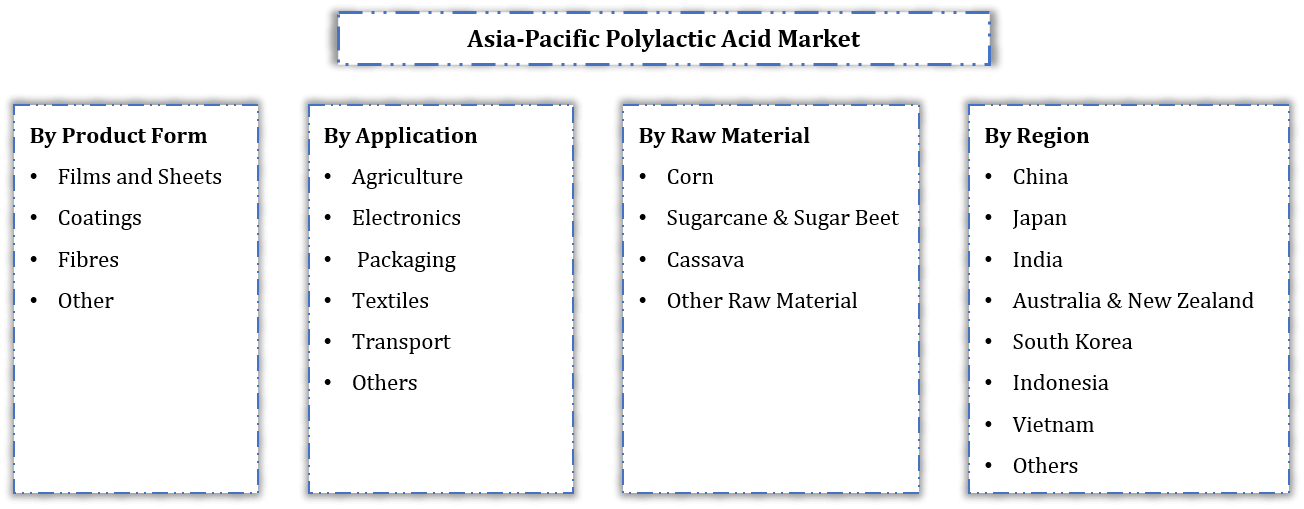
By Product Form (Films and Sheets, Coatings, Fibers, Other), By Application (Agriculture, Electronics, Packaging, Textiles, Transport, Others), By Raw-Material (Corn, Sugarcane & S......ugar Beet, Cassava, Other Raw Material), By Country (China, India, Japan, South Korea, Australia & New Zealand, Indonesia, Vietnam), By Competitors (Natureworks Llc., BASF, Mitsubishi Chemical Holding Corporation, Zhejiang Hisun Biomaterials Co Ltd, Futerro Sa, BEWiSynbra, Teijin Limited, Thyssenkrupp Ag, Green Dot Bioplastics, Good Natured Products Inc, Total Corbion Pla) Read more
- Chemicals
- Jan 2022
- 196
- PDF, Excel, PPT
Market Definition
Owing to the rising environmental concerns, scarcity of natural resources, and volatility in fossil fuel prices, governments & companies across Asia-Pacific are taking several initiatives to find & adopt substitutes of oil-based products. Bio-based products have great potential to minimize the consumption of petroleum-derived materials, which can further help reduce the adverse impact of increasing carbon footprints on the environment.
Polylactic acid, a bio-based product, is a thermoplastic aliphatic polyester formed using renewable resources like corn, sugarcane, beetroot, cassava, plant feed, etc. It is used for making various sustainable plastic-based products like poly bags, films, fiber cables, etc. Across Asia-Pacific, it is utilized extensively to minimize pollution levels & the dependency on petroleum-based plastic products.
Market insights
The Asia-Pacific Polylactic Acid Market is anticipated to grow at a CAGR of around 16% during the forecast period, i.e., 2021-26. The major factors attributing to the polylactic acid market growth are rising adoption of biodegradable products and surging price competitiveness compared to petrochemical-based plastic. In addition, polylactic acid is lightweight & extensively used in manufacturing a wide range of additives that can be blended with other materials, which, in turn, propels the overall market growth.
Polylactic acid is derived using corn, plant feed, sugarcane, etc. Since Asia-Pacific has a huge potential to grow sugarcane & corn, it further supports the growth of the polylactic acid market in the region. Moreover, the extensive manufacturing capabilities of China and surging investments in developing new polylactic acid production plants in Thailand are also projected to boost the market. Asia-Pacific Polylactic Acid Market growth. According to the Chinese government's Jilin Provincial Commercial Information Center, the country's PLA demand stood at around 160,000-180,000 tons in 2019, which is expected to rise by 15% to 25% in the upcoming years.
| Report Coverage | Details |
|---|---|
| Study Period | Historical Data: 2016-19 |
| Base Year: 2020 | |
| Forecast Period: 2021-26 | |
| CAGR (2021-2026) | 16% |
| Countries Covered | China, India, Japan, South Korea, Australia & New Zealand, Indonesia, Vietnam |
| Key Companies Profiled | Natureworks Llc., BASF, Mitsubishi Chemical Holding Corporation, Zhejiang Hisun Biomaterials Co Ltd, Futerro Sa, BEWiSynbra, Teijin Limited, Thyssenkrupp Ag, Green Dot Bioplastics, Good Natured Products Inc, Total Corbion Pla |
| Unit Denominations | USD Million/Billion |
Moreover, the biodegradable property of polylactic acid makes it an eco-friendly material. Thus, rising awareness regarding the need to reduce environmental pollution is encouraging the adoption of polylactic acid across Asia-Pacific. It has a wide range of applications across several fields, including plastic household products, packaging materials, internal fixation of bone fracture, surgical sutures, textile fabrics, carpets, and household decorations.
Impact of the Covid-19 on the Asia-Pacific Polylactic Acid Market
- The Covid-19 pandemic in 2020 led to macroeconomic uncertainty and affected several business activities. China, the epicenter of the outbreak, adversely impacted the economic activities across the Asia-Pacific region.
- The government of countries like India, China, Japan, South Korea, etc., imposed nationwide lockdowns, including stringent restrictions in social gatherings & travel.
- However, amidst the pandemic, the demand for personal protective equipment registered an increased momentum, which, in turn, propelled the need for polylactic acid-based products.
- Additionally, the increasing demand for face protection masks & shields also led to the surging usage of polylactic acid.
- Due to the lockdown measures & movement restrictions, the food packaging services and online food deliveries witnessed astronomical growth, which accelerated the demand for polylactic acid.
- With an environment-friendly & bio-degradable nature, Polylactic Acid-based material witnessed increased adoption.
- One of the key players in the Polylactic Acid Market, ‘Corbion,’ experienced significant growth opportunities amidst the pandemic. The company’s growth in 2020 was beyond expectations than initially forecasted.
- The prime reason behind this was a reduction in transportation/travel costs. Along with this, the leader reported a 6.2% organic increase in net sales of Lactic Acid & Specialties in 2020.
- Introduction
- Product Definition
- Research Process
- Assumptions
- Market Definition
- Preface
- Executive Summary
- Impact of COVID-19 on Asia-Pacific Polylactic Acid Market
- Asia-Pacific Polylactic Acid Market Outlook 2016-2026F
- Market Size & Analysis
- By Revenues
- Market Share & Analysis
- By Product Form
- Films and Sheets
- Coatings
- Fibers
- Other Product Forms
- By Application
- Agriculture
- Electronics
- Packaging
- Textiles
- Transport
- Others
- By Raw-Material
- Corn
- Sugarcane & Sugar Beet
- Cassava
- Other Raw Material
- By Country
- China
- Japan
- India
- South Korea
- Australia & New Zealand
- Indonesia
- Vietnam
- Others
- By Company
- Revenue Shares
- Strategic Factorial Indexing
- Competitor Placement in MarkNtel Quadrant
- By Product Form
- Market Size & Analysis
- China Polylactic Acid Market Outlook 2016-2026F
- Market Size & Analysis
- By Revenues
- Market Share & Analysis
- By Product Form
- By Application
- By Raw Material
- Market Size & Analysis
- Japan Polylactic Acid Market Outlook 2016-2026F
- Market Size & Analysis
- By Revenues
- Market Share & Analysis
- By Product Form
- By Application
- By Raw Material
- Market Size & Analysis
- India Polylactic Acid Market Outlook 2016-2026F
- Market Size & Analysis
- By Revenues
- Market Share & Analysis
- By Product Form
- By Application
- By Raw Material
- Market Size & Analysis
- South Korea Polylactic Acid Market Outlook 2016-2026F
- Market Size & Analysis
- By Revenues
- Market Share & Analysis
- By Product Form
- By Application
- By Raw Material
- Market Size & Analysis
- Australia & New Zealand Polylactic Acid Market Outlook 2016-2026F
- Market Size & Analysis
- By Revenues
- Market Share & Analysis
- By Product Form
- By Application
- By Raw Material
- Market Size & Analysis
- Indonesia Polylactic Acid Market Outlook 2016-2026F
- Market Size & Analysis
- By Revenues
- Market Share & Analysis
- By Product Form
- By Application
- By Raw Material
- Market Size & Analysis
- Vietnam Polylactic Acid Market Outlook 2016-2026F
- Market Size & Analysis
- By Revenues
- Market Share & Analysis
- By Product Form
- By Application
- By Raw Material
- Market Size & Analysis
- Asia-Pacific Polylactic Acid Market Regulations
- Asia-Pacific Polylactic Acid Market Trends & Insights
- Asia-Pacific Polylactic Acid Market Dynamics
- Growth Drivers
- Challenges
- Impact Analysis
- Asia-Pacific Polylactic Acid Market Hotspot and Opportunities
- Asia-Pacific Polylactic Acid Market Key Strategic Imperatives for Success and Growth
- Competition Outlook
- Competition Matrix
- Target Markets
- Target End Users
- Research & Development
- Strategic Alliances
- Strategic Initiatives
- Company Profiles (Business Description, Product Segments, Business Segments, Financials, Strategic Alliances/ Partnerships, Future Plans)
- Natureworks Llc
- BASF
- Mitsubishi Chemical Holding Corporation
- Futerro Sa
- Green Dot Bioplastics
- Total Corbion Pla
- Competition Matrix
- Disclaimer
MarkNtel Advisors follows a robust and iterative research methodology designed to ensure maximum accuracy and minimize deviation in market estimates and forecasts. Our approach combines both bottom-up and top-down techniques to effectively segment and quantify various aspects of the market. A consistent feature across all our research reports is data triangulation, which examines the market from three distinct perspectives to validate findings. Key components of our research process include:
1. Scope & Research Design At the outset, MarkNtel Advisors define the research objectives and formulate pertinent questions. This phase involves determining the type of research—qualitative or quantitative—and designing a methodology that outlines data collection methods, target demographics, and analytical tools. They also establish timelines and budgets to ensure the research aligns with client goals.
2. Sample Selection and Data Collection In this stage, the firm identifies the target audience and determines the appropriate sample size to ensure representativeness. They employ various sampling methods, such as random or stratified sampling, based on the research objectives. Data collection is carried out using tools like surveys, interviews, and observations, ensuring the gathered data is reliable and relevant.
3. Data Analysis and Validation Once data is collected, MarkNtel Advisors undertake a rigorous analysis process. This includes cleaning the data to remove inconsistencies, employing statistical software for quantitative analysis, and thematic analysis for qualitative data. Validation steps are taken to ensure the accuracy and reliability of the findings, minimizing biases and errors.

4. Data Forecast and FinalizationThe final phase involves forecasting future market trends based on the analyzed data. MarkNtel Advisors utilize predictive modeling and time series analysis to anticipate market behaviors. The insights are then compiled into comprehensive reports, featuring visual aids like charts and graphs, and include strategic recommendations to inform client decision-making
FILL THE FORM TO INQUIRE BEFORE BUYING THIS REPORT
We offer flexible licensing options to cater to varying organizational needs. Choose the pricing pack that best suits your requirements:
Buy Now Talk to our Consultant
 Request Customization