

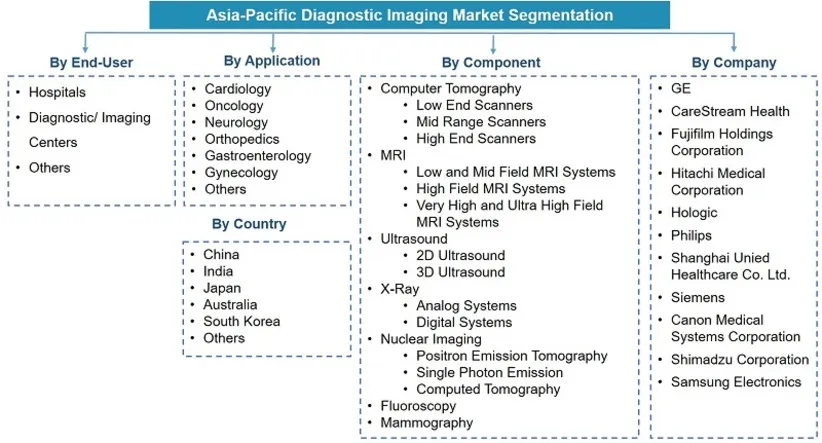
By End-User (Hospitals, Diagnostic/ Imaging Centers, Others), By Application (Cardiology, Oncology, Neurology, Orthopedics, Gastroenterology, Gynecology, Others), By Component (Com......puter Tomography, MRI, Ultrasound, X-Ray, Nuclear Imaging, Fluoroscopy, Mammography), By Country (China, India, Japan, Australia, New Zealand, South Korea and Rest of Asia, Pacific), By Company Read more
- Healthcare
- Apr 2020
- 143
- PDF, Excel, PPT
Asia-Pacific Diagnostic Imaging Market Analysis, 2020 market research report provides exhaustive market analysis and statistics of Asia-Pacific diagnostic imaging market which consists of regional and country-wise market size, market forecast, CAGR market segmentation, market shares of diverse regions and countries, market share of various end users, applications, product type, technologies, competitive benchmarking, etc. The report also takes into consideration the short term and long-term business impact of COVID-19 on the Asia- Pacific Diagnostic Imaging Market.
Continuous improving medical healthcare facilities and rising healthcare expenditure in countries such as China, India, and Japan are driving the growth of the Diagnostic Imaging market. Growing awareness for early detection of chronic diseases such as cancer is inducing the demand for diagnostic imaging. Moreover, the governments are conducting programs for early detection of chronic diseases to combat these diseases. The need for early diagnosis is leading to an emergence of the need for diagnostic imaging systems in the region. According to MarkNtel Advisors’ research report titled “Asia-Pacific Diagnostic Imaging Market Analysis, 2020”, the Asia-Pacific Diagnostic Imaging market is anticipated to grow at a CAGR of around 7.5% during 2020-25. During 2019-20, COVID-19 breakdown in the region has resulted in massive lockdowns and curfews, eventually disrupting the market value chain. The overall process of procurement, payments, and the entire logistics witnessed a slowdown. The slowdown in the market is expected to persist during 2020-21. However, the growth is set to pick in the 2nd half of 2021.
Hospitals Segment Accounted for the Largest Market Share
Hospitals are providing training and teachings for advanced technology which is expected to propel the growth of diagnostic imaging systems. Southeast Asian countries such as Thailand and other Asian countries such as South Korea and India have seen an uptick in the installation of 3.5T MRI systems. Moreover, escalating foreign direct investment (FDI) policies, and rising awareness about different technologies is fuelling the demand for diagnostic imaging systems as stated in the MarkNtel Advisors’ research report “Asia-Pacific Diagnostic Imaging Market Analysis, 2020”.
Escalating Growth of the X-Ray Segment in Asia-Pacific
MRI Segment acquired the largest market share in 2019, owing to the rising chronic disorder cases in the region. MRI helps in early diagnosis of the disease which is making it more popular in emerging countries. However, the X-Ray segment also accounted for the largest market share owing to the catalyzing number of hospitals, emerging demand for mobile X-rays and retrofitting upgrade kits. Also, the growing aging population in countries is resulting in the amplified growth of the X-ray system. The x-ray segment is anticipated to further witness steady growth during the forecast period.
- Introduction
- Product Definition
- Research Process
- Glossary
- Market Segmentation
- Executive Summary
- Expert Verbatim- Interview Excerpts of 10 industry experts
- Asia-Pacific Diagnostic Imaging Market Outlook, 2015-2025F
- Market Size & Analysis
- By Revenues (USD Million)
- Market Share & Analysis
- By End-User
- Hospitals
- Diagnostic/ Imaging Centers
- Others
- By Application
- Cardiology
- Oncology
- Neurology
- Orthopedics
- Gastroenterology
- Gynecology
- Others
- By Component
- Computer Tomography
- Low End Scanners
- Mid-Range Scanners
- High End Scanners
- MRI
- Low and Mid Field MRI Systems
- High Field MRI Systems
- Very High and Ultra High Field MRI Systems
- Ultrasound
- 2D Ultrasound
- 3D Ultrasound
- X-Ray
- Analog Systems
- Digital Systems
- Nuclear Imaging
- Positron Emission Tomography
- Single Photon Emission
- Computed Tomography
- Fluoroscopy
- Mammography
- Computer Tomography
- By Country
- China
- India
- Japan
- Australia
- South Korea
- Rest of Asia-Pacific
- By Company
- Revenue Shares
- Strategic Factorial Indexing
- Competitor Placement in MarkNtel Quadrant
- By End-User
- China Diagnostic Imaging Market Outlook, 2015-2025F
- Market Size & Analysis
- By Revenues (USD Million)
- Market Share & Analysis
- By Component
- Market Size & Analysis
- India Diagnostic Imaging Market Outlook, 2015-2025F
- Market Size & Analysis
- By Revenues (USD Million)
- Market Share & Analysis
- By Component
- Market Size & Analysis
- Japan Diagnostic Imaging Market Outlook, 2015-2025F
- Market Size & Analysis
- By Revenues (USD Million)
- Market Share & Analysis
- By Component
- Market Size & Analysis
- Australia Diagnostic Imaging Market Outlook, 2015-2025F
- Market Size & Analysis
- By Revenues (USD Million)
- Market Share & Analysis
- By Component
- Market Size & Analysis
- South Korea Diagnostic Imaging Market Outlook, 2015-2025F
- Market Size & Analysis
- By Revenues (USD Million)
- Market Share & Analysis
- By Component
- Market Size & Analysis
- Rest of Asia-Pacific Diagnostic Imaging Market Outlook, 2015-2025F
- Market Size & Analysis
- By Revenues (USD Million)
- Market Share & Analysis
- By Component
- Market Size & Analysis
- Market Size & Analysis
- Asia-Pacific Diagnostic Imaging Dynamics
- Drivers
- Challenges
- Impact Analysis
- Asia-Pacific Diagnostic Imaging Regulations, Product Standards
- Asia-Pacific Diagnostic Imaging Value Chain Analysis
- Asia-Pacific Diagnostic Imaging Intellectual Property Rights Analysis
- Asia-Pacific Diagnostic Imaging Hotspots & Opportunities
- Competition Outlook
- Competitor Wise Growth Strategies
- Product Portfolio
- Brand Specialization
- Target Markets
- Research & Development
- Strategic Alliances & Initiatives
- Company Profiles
- GE
- CareStream Health
- Fujifilm Holdings Corporation
- Hitachi Medical Corporation
- Hologic
- Philips
- Shanghai Unied Healthcare Co. Ltd.
- Siemens
- Canon Medical Systems Corporation
- Shimadzu Corporation
- Samsung Electronics
- Competitor Wise Growth Strategies
- Disclaimer
MarkNtel Advisors follows a robust and iterative research methodology designed to ensure maximum accuracy and minimize deviation in market estimates and forecasts. Our approach combines both bottom-up and top-down techniques to effectively segment and quantify various aspects of the market. A consistent feature across all our research reports is data triangulation, which examines the market from three distinct perspectives to validate findings. Key components of our research process include:
1. Scope & Research Design At the outset, MarkNtel Advisors define the research objectives and formulate pertinent questions. This phase involves determining the type of research—qualitative or quantitative—and designing a methodology that outlines data collection methods, target demographics, and analytical tools. They also establish timelines and budgets to ensure the research aligns with client goals.
2. Sample Selection and Data Collection In this stage, the firm identifies the target audience and determines the appropriate sample size to ensure representativeness. They employ various sampling methods, such as random or stratified sampling, based on the research objectives. Data collection is carried out using tools like surveys, interviews, and observations, ensuring the gathered data is reliable and relevant.
3. Data Analysis and Validation Once data is collected, MarkNtel Advisors undertake a rigorous analysis process. This includes cleaning the data to remove inconsistencies, employing statistical software for quantitative analysis, and thematic analysis for qualitative data. Validation steps are taken to ensure the accuracy and reliability of the findings, minimizing biases and errors.

4. Data Forecast and FinalizationThe final phase involves forecasting future market trends based on the analyzed data. MarkNtel Advisors utilize predictive modeling and time series analysis to anticipate market behaviors. The insights are then compiled into comprehensive reports, featuring visual aids like charts and graphs, and include strategic recommendations to inform client decision-making
FILL THE FORM TO INQUIRE BEFORE BUYING THIS REPORT
We offer flexible licensing options to cater to varying organizational needs. Choose the pricing pack that best suits your requirements:
Buy Now Talk to our Consultant
 Request Customization