

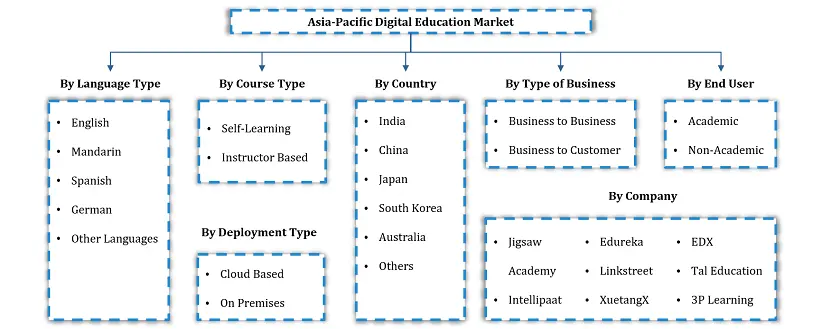
By Language Type (English, Mandarin, Spanish, German), By Course Type (Self-Learning, Instructor-Based), By Deployment Type (Cloud, On-Premise), By Type of Business (Business-to-Bu......siness, Business-to-Customer), By End-User (Academic, Non-Academic), By Country (India, China, Japan, South Korea, Australia), By Company (Jigsaw Academy, Intellipaat, Edureka, Linkstreet, XuetangX, EDX, Tal Education, 3P Learning, Think & Learn) Read more
- ICT & Electronics
- Jun 2022
- 132
- PDF, Excel, PPT
Market Definition
Digital education involves using various technologies, tools, & applications during teaching & learning, i.e., beneficial for both students & educators. It is an advanced form of teaching students, wherein teachers can make learning flexible & an overall fun experience. On the other hand, students can attend sessions anywhere & anytime as per their preferences, which, in turn, boosts their productivity.
With digital education being implemented increasingly among schools & colleges, classes or lectures are well-carried out through various seamless video conferencing applications. The growth prospects for digital education solution providers in the nearer future are lucrative as more and more educational institutes are implementing these advanced e-learning solutions.
Market Insights
The Asia-Pacific Digital Education Market is projected to grow at a CAGR of around 16.20% during the forecast period, i.e., 2022-27. The growth of the market would be driven primarily by the exponentially rising population with a majority of youth prioritizing education, coupled with the mounting government focus on expanding the educational infrastructure and the rapid digital transformation across different industries operating in Asia-Pacific.
| Report Coverage | Details |
|---|---|
| Study Period | Historical Data: 2017-20 |
| Base Year: 2021 | |
| Forecast Period: 2022-27 | |
| CAGR (2022-2027) | 16.20% |
| Country Covered | India, China, Japan, South Korea, Australia |
| Key Companies Profiled | Jigsaw Academy, Intellipaat, Edureka, Linkstreet, XuetangX, EDX, Tal Education, 3P Learning, Think & Learn |
| Unit Denominations | USD Million/Billion |
Besides, with the mounting adoption of smart devices like mobile phones, laptops, desktops, & tablets, among others, and the surging internet penetration, more and more learners are inclining toward digital platforms for educational purposes. Additionally, the growing public awareness about the convenience & ease of learning new subjects & courses through online mediums, i.e., encouraging digital education solution providers to introduce an extensive range of e-learning tools & applications, further projects remunerative opportunities for the market over the coming years.
Moreover, more & more universities & institutions are rapidly making digital transformations to expand their student base & provide next-level education. As a result, numerous courses, mentors, & teachers are easily available & accessible from across different countries.
Furthermore, the integration of cutting-edge technologies like Augmented Reality (AR) into various e-learning tools to provide better sound effects & graphics for students to attain better learning & maximize their capabilities is another prominent aspect projected to drive the Asia-Pacific Digital Education Market over the forecast years.
Impact of Covid-19 on the Asia-Pacific Digital Education Market
While the advent of Covid-19 in 2020 catastrophically impacted most businesses, the Asia-Pacific Digital Education Market witnessed lucrative growth prospects amidst the crisis. With the imposition of lockdowns & stringent movement restrictions and the suspension of public gatherings, most schools, colleges, & other educational institutions made a paradigm shift to digital platforms in order to continue providing learning to students, which, as a result, introduced various e-learning platforms across Asia-Pacific.
Besides, as the durations for lockdowns were uncertain, many students showcased a keen interest in learning new courses and developing skills through these digital education platforms, which resulted in a swift expansion of the digital education market amidst the crisis. Furthermore, while the pandemic situation has improved since 2021 and enabled the governments to uplift the restrictions, digital education solutions are still gaining significant traction, and the same trend is expected in the future, which indicates a pool of growth opportunities for the market through 2027.
- Introduction
- Research Process
- Assumptions
- Market Definitions
- Market Segmentation
- Executive Summary
- Asia-Pacific Digital Education Startups Ecosystem
- Asia-Pacific Digital Education Market Landscape
- Impact of covid-19 on Asia-Pacific Digital Education Market
- Asia-Pacific Digital Education Market Outlook, 2017-2027
- Market Revenues & Forecast
- Market Revenues
- Market Share & Forecast
- By Language Type
- English
- Mandarin
- Spanish
- German
- Other Languages
- By Course Type
- Self-Learning
- Instructor Based
- By Deployment Type
- Cloud Based
- On Premise
- By Type of Business
- Business to Business
- Business to Customer
- By End User
- Academic
- Non-Academic
- By Country
- India
- China
- Japan
- South Korea
- Australia
- Others
- By Company
- Revenue Shares
- Strategic Factorial Indexing
- Competitor Placement in MarkNtel Quadrant
- By Language Type
- Market Attractiveness Index
- By Language Type
- By Course Type
- By Deployment Type
- By Type of Business
- By End User
- By Country
- Market Revenues & Forecast
- India Digital Education Market Outlook, 2017-2027
- Market Revenues & Forecast
- Market Revenues
- Market Share & Forecast
- By Language Type
- By Deployment
- By Type of Business
- Market Revenues & Forecast
- China Digital Education Market Outlook, 2017-2027
- Market Revenues & Forecast
- Market Revenues
- Market Share & Forecast
- By Language Type
- By Deployment
- By Type of Business
- Market Revenues & Forecast
- Japan Digital Education Market Outlook, 2017-2027
- Market Revenues & Forecast
- Market Revenues
- Market Share & Forecast
- By Language Type
- By Deployment
- By Type of Business
- Market Revenues & Forecast
- South Korea Digital Education Market Outlook, 2017-2027
- Market Revenues & Forecast
- Market Revenues
- Market Share & Forecast
- By Language Type
- By Deployment
- By Type of Business
- Market Revenues & Forecast
- Australia Digital Education Market Outlook, 2017-2027
- Market Revenues & Forecast
- Market Revenues
- Market Share & Forecast
- By Language Type
- By Deployment
- By Type of Business
- Market Revenues & Forecast
- Asia-Pacific Digital Education Market Dynamics
- Growth Drivers
- Challenges
- Impact Analysis
- Asia-Pacific Digital Education Market Policies, Regulations, Product Standards
- Asia-Pacific Digital Education Market Trends & Insights
- Asia-Pacific Digital Education Market Hotspot & Opportunities
- Consumer Behavior Analysis
- Consumer Trends and Preferences
- Factors Affecting Consumer Decision
- Asia-Pacific Digital Education Market Key Strategic Imperatives for Success & Growth
- Competition Outlook
- Competition Matrix
- Course Type
- Target Markets
- Target End Users
- Strategic Alliances
- Strategic Initiatives
- Company Profiles of top companies (Business Description, Product Segments, Business Segments, Financials, Strategic Alliances/ Partnerships, Future Plans)
- Jigsaw Academy
- Intellipaat
- Edureka
- Linkstreet
- XuetangX
- EDX
- Tal Education
- 3P Learning
- Think & Learn
- Competition Matrix
- Disclaimer
MarkNtel Advisors follows a robust and iterative research methodology designed to ensure maximum accuracy and minimize deviation in market estimates and forecasts. Our approach combines both bottom-up and top-down techniques to effectively segment and quantify various aspects of the market. A consistent feature across all our research reports is data triangulation, which examines the market from three distinct perspectives to validate findings. Key components of our research process include:
1. Scope & Research Design At the outset, MarkNtel Advisors define the research objectives and formulate pertinent questions. This phase involves determining the type of research—qualitative or quantitative—and designing a methodology that outlines data collection methods, target demographics, and analytical tools. They also establish timelines and budgets to ensure the research aligns with client goals.
2. Sample Selection and Data Collection In this stage, the firm identifies the target audience and determines the appropriate sample size to ensure representativeness. They employ various sampling methods, such as random or stratified sampling, based on the research objectives. Data collection is carried out using tools like surveys, interviews, and observations, ensuring the gathered data is reliable and relevant.
3. Data Analysis and Validation Once data is collected, MarkNtel Advisors undertake a rigorous analysis process. This includes cleaning the data to remove inconsistencies, employing statistical software for quantitative analysis, and thematic analysis for qualitative data. Validation steps are taken to ensure the accuracy and reliability of the findings, minimizing biases and errors.

4. Data Forecast and FinalizationThe final phase involves forecasting future market trends based on the analyzed data. MarkNtel Advisors utilize predictive modeling and time series analysis to anticipate market behaviors. The insights are then compiled into comprehensive reports, featuring visual aids like charts and graphs, and include strategic recommendations to inform client decision-making
FILL THE FORM TO INQUIRE BEFORE BUYING THIS REPORT
We offer flexible licensing options to cater to varying organizational needs. Choose the pricing pack that best suits your requirements:
Buy Now Talk to our Consultant
 Request Customization