

By Installation type (Point-of-Entry (POE), Point-of-Use, Others), By Technology Type (Ion Exchange, Template-Assisted Crystallization (TAC), Reverse Osmosis (RO)-Based, Hybrid Technologies), By Produ... ... hnologies), By Product Type (Salt-Based Water Softeners, Salt-Free Water Softeners, Magnetic Water Softeners), By Capacity (Low Capacity (Below 1,000 LPH), Medium Capacity (1,001- 10,000 LPH), High Capacity (Above 10,000 LPH)), By Operation Mode (Manual, Semi-Automatic, Fully Automatic), By Distribution Channel (Direct Sales, Distributors/Dealers, Online), By End user (Residential, Commercial, Industrial, Institutional), and others Read more
- Environment
- Jun 2026
- 170
- PDF, Excel, PPT
India Water Softeners Market Key Takeaways
- The India Water Softeners Market was valued at USD 128 million in 2025, reached USD 146 million in 2026, and is projected to attain USD 225 million by 2032.
- The industry is projected to witness steady growth at a CAGR of 7.47% during 2026–2032.
- Ion exchange technology dominates with approximately 85% share by technology type in 2026.
- Fully automatic water softeners lead operation mode segmentation at approximately 60% share in 2026.
- North India commands approximately 35% market share in 2026.
- The market is moderately fragmented; Kent RO Systems, Eureka Forbes, Ion Exchange India, 3M India, and A.O. Smith India collectively hold approximately 50% share nationally.
India Water Softeners Market Size and Outlook
The India water softeners market was valued at USD 128 million in 2025 and is projected to grow from USD 146 million in 2026 to USD 225 million by 2032, registering a CAGR of 7.47% during the forecast period, i.e., 2026-32.
This growth is largely driven by India's widespread hard water challenge, which continues to increase demand for water conditioning and treatment solutions. According to the Central Ground Water Board's Annual Groundwater Quality Report 2025, based on nearly 15,000 groundwater samples collected in 2024, Punjab, Rajasthan, and Haryana remain the most over-exploited aquifer states, with groundwater extraction rates reaching 156.36%, 147.11%, and 136.75% of annual recharge, respectively.
The arid geological conditions prevalent in these regions contribute to elevated concentrations of calcium and magnesium in groundwater, often exceeding the Bureau of Indian Standards (BIS IS 10500:2012) permissible limit of 300 mg/L for total hardness. As hard water can cause scaling, reduce appliance efficiency, and increase maintenance requirements, its widespread prevalence across residential, commercial, and institutional sectors is significantly driving the adoption of water conditioning systems throughout India.
Government infrastructure programs are amplifying the addressable install base considerably. The Jal Jeevan Mission, backed by a central outlay of USD 22.0 billion, had connected over 15.72 crore rural households to functional tap connections as of October 2025, representing more than 81% of India's rural households. Piped supply reaching previously unconnected households increases consumer exposure to groundwater-sourced distribution networks where hardness exceedances are common, expanding the water purification and softening market base beyond urban centres.
Industrial and commercial demand continues to strengthen the India water softener market. The country's pharmaceutical industry, valued at USD 53.29 billion in 2025, requires water softening through ion exchange technology to meet CDSCO standards for purified water and water-for-injection used in sterile manufacturing.
Meanwhile, the hospitality sector is emerging as a key demand contributor, with listed hotel operators projected to add more than 70,000 room keys by 2030, according to CBRE. Water softeners are increasingly deployed to prevent limescale buildup in boilers, plumbing systems, and laundry equipment, supporting operational efficiency and driving sustained market growth across India.
India Water Softeners Market Key Indicators
- The Ministry of Jal Shakti's Jal Jeevan Mission deployed 2,843 water testing laboratories across India to test 3.878 million samples in 2025–26, confirming widespread monitoring of hardness, TDS, and chemical parameters at the village level. This rising community awareness of water contamination directly accelerates demand for hard water removal systems at the household level.
- The Ministry of Food Processing Industries received a budget allocation of USD 522.6 million in the Union Budget 2025–26, supporting expansion of food and beverage processing infrastructure. Food and beverage processing is acutely sensitive to source-water hardness, as calcium and magnesium deposits contaminate product batches and damage heat exchangers, making commercial water softening systems a process-critical requirement for approved facilities.
India Water Softeners Market Scope
| Category | Segments |
|---|---|
| By Installation type | Point-of-Entry (POE), Point-of-Use, Others |
| By Technology Type | Ion Exchange, Template-Assisted Crystallization (TAC), Reverse Osmosis (RO)-Based, Hybrid Technologies |
| By Product Type | Salt-Based Water Softeners, Salt-Free Water Softeners, Magnetic Water Softeners |
| By Capacity | Low Capacity (Below 1,000 LPH), Medium Capacity (1,001- 10,000 LPH), High Capacity (Above 10,000 LPH |
| By Operation Mode | Manual, Semi-Automatic, Fully Automatic |
| By Distribution Channel | Direct Sales, Distributors/Dealers, Online |
| By End user | Residential, Commercial, Industrial, Institutional |
India Water Softeners Market Growth Drivers
Rising Water Hardness Levels and Growing Demand for Water Quality Solutions in Indian Households
Groundwater deterioration across India's most populous states is the primary structural force driving adoption of residential and commercial hard water treatment solutions. As aquifer levels fall under sustained extraction pressure, water drawn from deeper formations carries progressively higher concentrations of dissolved calcium, magnesium, and total dissolved solids mineral loads that inflict scale damage on plumbing, geysers, and appliances, compelling households to act.
The Central Ground Water Board's Annual Ground Water Quality Report 2025, based on approximately 15,000 samples collected across 2024 pre- and post-monsoon periods, found that over 28% of samples exceeded permissible limits for one or more quality parameters, signaling a measurable and widening water quality deficit that household ion exchange technology-based softeners are positioned to address.
The scale of this problem is reinforced by extraction data. The CGWB's Dynamic Ground Water Resource of India 2024 estimates national groundwater extraction at 60.4% of annual recharge, with India consuming 87% of extracted groundwater for agriculture and 11% for domestic use , a distribution that concentrates increasing water hardness levels in domestic supply networks drawing from over-stressed, mineral-rich formations.
As water softener demand in India grows in direct proportion to this deteriorating baseline quality, manufacturers offering compact residential and whole-house calcium and magnesium removal systems gain a structurally expanding customer base through 2032.
Recent Trends
Growing Adoption of Smart, Automated, and Sustainable Water Softening Solutions
The India Water Softeners Market is witnessing a strong shift toward smart, automated, and eco-friendly water treatment technologies. Consumers are increasingly seeking low-maintenance systems equipped with automatic regeneration, digital monitoring, and water-saving capabilities to improve convenience and reduce operating costs. Manufacturers are responding by introducing advanced solutions designed for modern urban households, residential complexes, and commercial facilities. For instance, in 2026, Boon launched its intelligent under-counter water treatment system, reflecting the growing industry focus on smart and connected water management technologies.
Another emerging trend is the increasing popularity of salt-free and maintenance-free water conditioning systems that reduce water wastage and eliminate the need for frequent servicing. Companies such as Ethix and 3G Aqua are actively promoting sustainable hard-water treatment solutions featuring low-maintenance and zero-electricity operation . Additionally, this trend is expected to persist throughout the forecast period due to increasing water hardness levels, rapid urbanization, growing disposable incomes, and expanding smart home adoption. Furthermore, continuous product innovation and rising emphasis on water-efficient technologies are likely to sustain demand for intelligent and sustainable water softening solutions across India.
India Water Softeners Market Opportunities and Challenges
Stricter Brine Discharge Enforcement Leading to Demand for Zero-Brine Water Conditioning Systems
Conventional ion-exchange softeners regenerate by flushing resin beds with concentrated sodium chloride solution, producing high-TDS brine that industrial facilities discharge as effluent, a practice directly in conflict with India's tightening real-time surveillance framework. In August 2025, the Central Pollution Control Board issued its Online Automated Alerts Generation Protocol for OCEMS, transmitting effluent data to CPCB servers every 15 minutes and requiring industries to cease all discharge immediately upon a Red-level alert.
Similarly, in November 2025, the National Green Tribunal directed CPCB and State Pollution Control Boards across Uttar Pradesh, Haryana, Delhi, and Bihar to enforce OCEMS compliance against over 1,700 Grossly Polluting Industries discharging untreated effluents into the Ganga and Yamuna systems. Pharmaceutical, textile, and chemical facilities running salt-based water softeners face direct operational risk, as brine discharge spikes elevate TDS readings transmitted continuously to regulatory servers.
This enforcement pressure is actively converting into commercial demand for zero-brine sustainable water treatment technologies. For instance, Ion Exchange (India) Limited deploys ZLD-integrated softening systems for industrial clients across pharmaceutical, textile, and chemical sectors, eliminating brine discharge while meeting treated water reuse compliance thresholds. As Consent to Operate renewals increasingly require discharge-free documentation, industrial operators procuring water quality improvement systems compatible with zero-liquid-discharge mandates will drive sustained demand for next-generation brine-free softening architectures through 2032.
Segmentation Insights
Ion Exchange Technology Leads as the Dominant Water Softening Technology in India
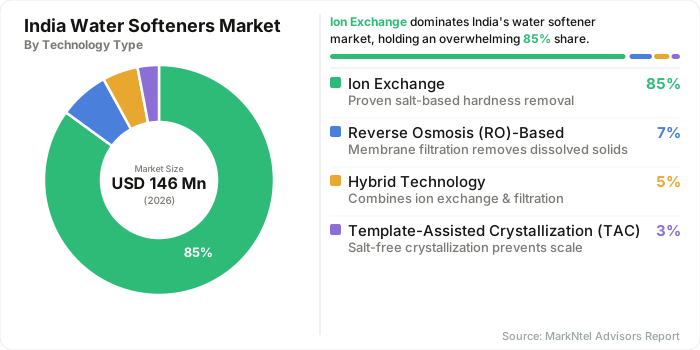
Ion exchange technology holds approximately 85% of the India water softeners market by technology type, driven by its proven performance across the full hardness range found in Indian groundwater from municipal supplies at 150 mg/L to borewell sources exceeding 1,000 mg/L across northern and western states.
The process requires no electricity during the softening stage; it uses only sodium chloride for regeneration and reliably delivers residual hardness levels that protect boilers, heat exchangers, and plumbing infrastructure.
The Strong acid cation resins in Na⁺ form exchange Ca²⁺ and Mg²⁺ ions with sodium, producing scale-free output water that is the standard specification for boiler feedwater across power, refinery, and pharmaceutical manufacturing.
Leading domestic manufacturers such as Thermax Limited play a crucial role in supporting the India water softener market through the supply of Tulsion® T-42 Na and T-52 Na strong acid cation exchange resins. Produced at the company's fully automated manufacturing facility in Dahej, Gujarat, these resins serve both industrial water softening system manufacturers and residential unit assemblers across the country.
The availability of locally produced, cost-competitive ion exchange resins helps reduce supply chain dependence on imports and reinforces the cost advantage of ion exchange technology over membrane-based and Template Assisted Crystallization (TAC) alternatives. As boiler feedwater standards tighten and pharmaceutical purified water compliance expands, ion exchange systems will retain their dominant position through 2032. By technology type, the market is further sub-segmented into the following sub-categories:
- Ion Exchange
- Template-Assisted Crystallization (TAC)
- Reverse Osmosis (RO)-Based
- Hybrid Technology
Fully Automatic Operation Mode Emerges as the Leading Segment in the India Water Softeners Market
Fully automatic water softeners account for approximately 60% of the India water softeners market by operation mode, primarily driven by rising consumer preference for low-maintenance appliances and the need for uninterrupted soft water supply across residential, commercial, and industrial applications. Urban households increasingly favor fully automatic systems as they eliminate the need for manual intervention while ensuring consistent performance despite fluctuations in water quality.
To address varying hardness levels commonly found in Indian borewell and municipal water supplies, manufacturers are introducing advanced automatic regeneration technologies. For instance, 3M India's fully automatic softener range, including the IAWTS-28L and IAWTS-57L whole-house models, features demand-responsive regeneration controls that automatically adjust to changing inlet water conditions without requiring manual recalibration.
Similarly, KENT RO Systems has expanded its portfolio with the Automatic Water Softener 100L, a high-capacity whole-house solution equipped with a microprocessor-controlled 5-step regeneration process comprising Normal, Backwash, Recharging, Flushing, and Brine Refill cycles. The system is specifically designed for large homes, villas, and bungalows where a continuous supply of soft water is essential.
As smart water softeners with connectivity and remote monitoring features gain wider acceptance, and consumer preference for convenience-oriented appliances continues to strengthen, fully automatic systems are expected to further increase their market share over semi-automatic and manual alternatives through 2032. By operation mode, the market is further segmented into the following sub-categories:
- Manual
- Semi-Automatic
- Fully Automatic
India Water Softeners Market Geographical Analysis
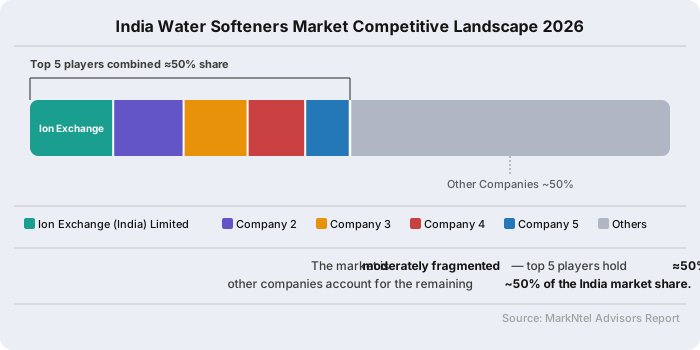
North India holds the largest share of the India Water Softeners Market, accounting for approximately 35% of total revenue, primarily due to the widespread prevalence of hard groundwater across states such as Delhi, Haryana, Punjab, Rajasthan, and Uttar Pradesh. The region's heavy dependence on groundwater and borewell water has resulted in elevated concentrations of calcium and magnesium, creating persistent scaling issues in residential, commercial, and industrial applications. According to recent assessments, Northern India generally experiences very hard water conditions ranging between 200–400 mg/L CaCO₃ equivalent, significantly higher than several other regions of the country.
Industrial demand continues to strengthen North India's leadership in the water softeners market, supported by increasing investments in water treatment and regulatory compliance initiatives. A notable example is the Ludhiana Water Conclave held in June 2025, organized by the Chamber of Industrial and Commercial Undertakings, which brought together technology providers and industry stakeholders to address Zero Liquid Discharge (ZLD) compliance and water infrastructure modernization across Punjab's textile and electroplating industries. The event highlighted growing industrial adoption of commercial water softening and water treatment solutions throughout the region's manufacturing base.
At the same time, ongoing aquifer depletion is increasing groundwater mineral concentrations across several northern states, further intensifying the need for water softening systems. Coupled with rapid residential development across the Delhi-NCR region, particularly in areas characterized by high water hardness, these factors are expected to sustain strong demand and reinforce North India's dominant position in the market through 2032.
India Water Softeners Market Competitive Landscape
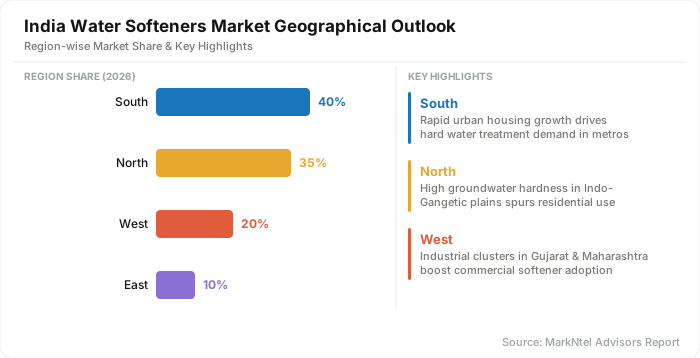
The India Water Softeners Market is characterized by a moderately fragmented competitive landscape, comprising a mix of multinational corporations, established domestic water treatment companies, and regional solution providers catering to residential, commercial, and industrial customers. The top five players Ion Exchange (India) Limited, Eureka Forbes Limited, Kent RO Systems Limited, A. O. Smith India Water Products Private Limited, and Livpure Private Limited collectively account for approximately 50% of the market share.
Major Companies in the India Water Softeners Market
- Ion Exchange (India) Limited
- Eureka Forbes Limited
- Kent RO Systems Limited
- O. Smith India Water Products Private Limited
- Livpure Private Limited
- Pentair plc
- 3M India Limited
- Thermax Limited
- Aquionics Development India Pvt. Ltd.
- Pure N Safe Water Technologies Pvt. Ltd.
India Water Softeners Market News and Recent Developments
2025: Ion Exchange India Secures USD 24.6 million Orders from Rayzon Energy and INOX Solar for Ultrapure Water and ZLD Systems
In December 2025, Ion Exchange India received orders totalling USD 24.6 million from Rayzon Energy for an Ultrapure Water system, ETP, and ZLD facility at its 5.1 GW solar project in Surat, and USD 13.2 million from INOX Solar for ultrapure water generation and zero liquid discharge systems. Both projects are to be completed within nine to ten months.
Impact analysis: Both contracts embed ion exchange resin-based softening as a mandatory pre-treatment stage ahead of ultrapure water generation, establishing a structural demand pattern for industrial water softening systems as an embedded process input across India's expanding high-purity manufacturing sectors.
2026: Thermax Limited and HPCL Sign Strategic MoU at India Energy Week 2026 to Advance Sustainable Industrial Solutions
On January 30, 2026, Thermax Limited and Hindustan Petroleum Corporation Limited signed a Memorandum of Understanding at India Energy Week 2026 in Goa, combining Thermax's engineering expertise with HPCL's R&D and refinery operational scale. The partnership targets collaborative development across green hydrogen, CO₂ capture, and bio-pyrolysis oil processing — all processes requiring high-purity process water for which pre-treatment softening and demineralisation are mandatory first-stage inputs.
Impact Analysis: As HPCL and Thermax jointly scale green hydrogen and carbon capture infrastructure, both process-water-intensive technologies, the partnership expands Thermax's industrial water treatment project pipeline, where its Tulsion® ion exchange resin platform and softening systems serve as embedded pre-treatment inputs, reinforcing structural demand for industrial water softening systems across India's emerging clean energy manufacturing base through 2032.
- Market Segmentation
- Introduction
- Product Definition
- Research Process
- Assumptions
- Executive Summary
- India Water Softeners Market Policies, Regulations, and Product Standards
- India Water Softeners Market Trends & Developments
- India Water Softeners Market Dynamics
- Growth Factors
- Challenges
- India Water Softeners Market Hotspot & Opportunities
- India Water Softeners Market Outlook, 2022-2032F
- Market Size & Outlook
- By Revenues (USD Million)
- Market Share & Analysis
- By Installation type- Market Size & Forecast 2022-2032, USD Million
- Point-of-Entry (POE)
- Point-of-Use
- Others
- By Technology Type- Market Size & Forecast 2022-2032, USD Million
- Ion Exchange
- Template-Assisted Crystallization (TAC)
- Reverse Osmosis (RO)-Based
- Hybrid Technologies
- By Product Type- Market Size & Forecast 2022-2032, USD Million
- Salt-Based Water Softeners
- Salt-Free Water Softeners
- Magnetic Water Softeners
- By Capacity- Market Size & Forecast 2022-2032, USD Million
- Low Capacity (Below 1,000 LPH)
- Medium Capacity (1,001- 10,000 LPH)
- High Capacity (Above 10,000 LPH)
- By Operation Mode- Market Size & Forecast 2022-2032, USD Million
- Manual
- Semi-Automatic
- Fully Automatic
- By Distribution Channel- Market Size & Forecast 2022-2032, USD Million
- Direct Sales
- Distributors/Dealers
- Online
- By End user- Market Size & Forecast 2022-2032, USD Million
- Residential
- Commercial
- Industrial
- Institutional
- By Region- Market Size & Forecast 2022-2032, USD Million
- North
- National Capital Region (Delhi NCR)
- Uttar Pradesh
- Punjab
- Rajasthan
- others
- South
- Karnataka
- Tamil Nadu
- Kerala
- others
- East
- West Bengal
- Odisha
- others
- West
- Maharashtra
- Gujarat
- Madhya Pradesh
- others
- North
- By Company
- Competition Characteristics
- Market Share & Analysis
- By Installation type- Market Size & Forecast 2022-2032, USD Million
- Market Size & Outlook
- India Salt-Based Water Softeners Market Outlook, 2022-2032
- Market Size & Outlook
- By Revenues (USD Million)
- Market Share & Outlook
- By Capacity- Market Size & Forecast 2022-2032, USD Million
- By Operation Mode- Market Size & Forecast 2022-2032, USD Million
- By Distribution Channel- Market Size & Forecast 2022-2032, USD Million
- By End user- Market Size & Forecast 2022-2032, USD Million
- By Region- Market Size & Forecast 2022-2032, USD Million
- Market Size & Outlook
- India Salt-Free Water Softeners Market Outlook, 2022-2032
- Market Size & Outlook
- By Revenues (USD Million)
- Market Share & Outlook
- By Capacity- Market Size & Forecast 2022-2032, USD Million
- By Operation Mode- Market Size & Forecast 2022-2032, USD Million
- By Distribution Channel- Market Size & Forecast 2022-2032, USD Million
- By End user- Market Size & Forecast 2022-2032, USD Million
- By Region- Market Size & Forecast 2022-2032, USD Million
- Market Size & Outlook
- India Magnetic Water Softeners Market Outlook, 2022-2032
- Market Size & Outlook
- By Revenues (USD Million)
- Market Share & Outlook
- By Capacity- Market Size & Forecast 2022-2032, USD Million
- By Operation Mode- Market Size & Forecast 2022-2032, USD Million
- By Distribution Channel- Market Size & Forecast 2022-2032, USD Million
- By End user- Market Size & Forecast 2022-2032, USD Million
- By Region- Market Size & Forecast 2022-2032, USD Million
- Market Size & Outlook
- India Water Softeners Market Key Strategic Imperatives for Success & Growth
- Competitive Outlook
- Company Profiles
- Ion Exchange (India) Limited
- Business Description
- Product Portfolio
- Collaborations & Alliances
- Recent Developments
- Financial Details
- Others
- Eureka Forbes Limited
- Business Description
- Product Portfolio
- Collaborations & Alliances
- Recent Developments
- Financial Details
- Others
- Kent RO Systems Limited
- Business Description
- Product Portfolio
- Collaborations & Alliances
- Recent Developments
- Financial Details
- Others
- A. O. Smith India Water Products Private Limited
- Business Description
- Product Portfolio
- Collaborations & Alliances
- Recent Developments
- Financial Details
- Others
- Livpure Private Limited
- Business Description
- Product Portfolio
- Collaborations & Alliances
- Recent Developments
- Financial Details
- Others
- Pentair plc
- Business Description
- Product Portfolio
- Collaborations & Alliances
- Recent Developments
- Financial Details
- Others
- 3M India Limited
- Business Description
- Product Portfolio
- Collaborations & Alliances
- Recent Developments
- Financial Details
- Others
- Thermax Limited
- Business Description
- Product Portfolio
- Collaborations & Alliances
- Recent Developments
- Financial Details
- Others
- Aquionics Development India Pvt. Ltd.
- Business Description
- Product Portfolio
- Collaborations & Alliances
- Recent Developments
- Financial Details
- Others
- Pure N Safe Water Technologies Pvt. Ltd.
- Business Description
- Product Portfolio
- Collaborations & Alliances
- Recent Developments
- Financial Details
- Others
- Ion Exchange (India) Limited
- Company Profiles
- Disclaimer

MarkNtel Advisors follows a robust and iterative research methodology designed to ensure maximum accuracy and minimize deviation in market estimates and forecasts. Our approach combines both bottom-up and top-down techniques to effectively segment and quantify various aspects of the market. A consistent feature across all our research reports is data triangulation, which examines the market from three distinct perspectives to validate findings. Key components of our research process include:
1. Scope & Research Design At the outset, MarkNtel Advisors define the research objectives and formulate pertinent questions. This phase involves determining the type of research—qualitative or quantitative—and designing a methodology that outlines data collection methods, target demographics, and analytical tools. They also establish timelines and budgets to ensure the research aligns with client goals.
2. Sample Selection and Data Collection In this stage, the firm identifies the target audience and determines the appropriate sample size to ensure representativeness. They employ various sampling methods, such as random or stratified sampling, based on the research objectives. Data collection is carried out using tools like surveys, interviews, and observations, ensuring the gathered data is reliable and relevant.
3. Data Analysis and Validation Once data is collected, MarkNtel Advisors undertake a rigorous analysis process. This includes cleaning the data to remove inconsistencies, employing statistical software for quantitative analysis, and thematic analysis for qualitative data. Validation steps are taken to ensure the accuracy and reliability of the findings, minimizing biases and errors.

4. Data Forecast and FinalizationThe final phase involves forecasting future market trends based on the analyzed data. MarkNtel Advisors utilize predictive modeling and time series analysis to anticipate market behaviors. The insights are then compiled into comprehensive reports, featuring visual aids like charts and graphs, and include strategic recommendations to inform client decision-making
We’d love to understand what matters most to you.