GCC Wires and Cables Market Research Report: Forecast (2026-2032)
By Type (Power Cables, Communication & Data Cables, Control & Instrumentation Cables, Fire-Resistant & Safety Cables), By Voltage Level (Low Voltage (≤1kV), Medium Voltage (1–33kV) ... , High Voltage (33–220kV), Extra High Voltage (>220kV)), By Installation (Overhead, Underground, Submarine), By Material (Copper, Aluminium, glass), By End User (Aerospace & Defense, Construction, IT & Telecommunication, Power Transmission & Distribution, Oil & Gas, Consumer Electronics, Manufacturing, Automotive, Others), and others Read more
- Energy
- Jun 2026
- Pages 220
- Report Format: PDF, Excel, PPT
GCC Wires and Cables Market
Projected 7.10% CAGR from 2026 to 2032
Study Period
2026-2032
Market Size (2026)
USD 4.68 Billion
Market Size (2032)
USD 8.76 Billion
Base Year
2025
Projected CAGR
7.10%
Leading Segments
By Type: Power Cables
GCC Wires and Cables Market Key Takeaways
- The GCC Wires and Cables market size was valued at USD 3.78 billion in 2025 and is projected to grow from USD 4.68 billion in 2026 to USD 8.76 billion by 2032
- The industry is projected to witness steady growth at a CAGR of 7.10% during 2026-2032.
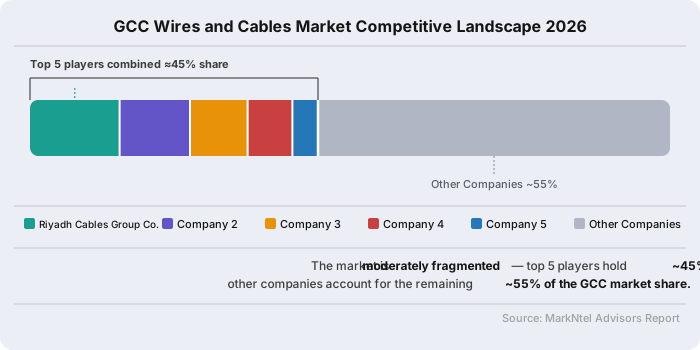
- In 2026, Saudi Arabia dominated the market with approximately 40% share.
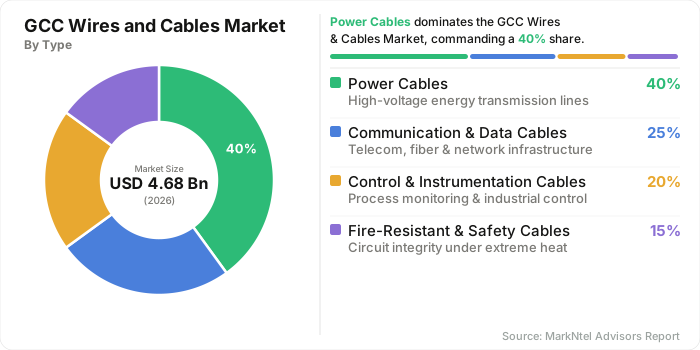
- By Product Type, Power Cables dominated the market with approximately 40% share in 2026.
- By End User, Power Transmission and Distribution accounted for approximately 73% of the market share in 2026.
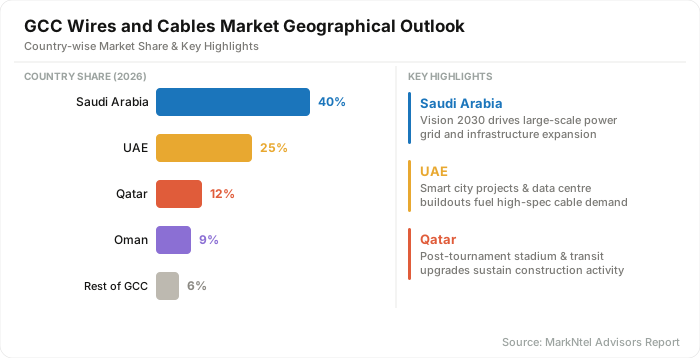
- The industry is moderately consolidated, with a mix of strong regional giants and localized providers competing across the Gulf. However, the top five players collectively account for approximately 45% market share.
GCC Wires and Cables Market Size and Outlook
The GCC Wires and Cables market size was valued at USD 3.78 billion in 2025 and is projected to grow from USD 4.68 billion in 2026 to USD 8.76 billion by 2032. Along with this, the market is estimated to grow at a CAGR of around 7.10% during the forecast period, i.e., 2026-32. The GCC wires and cables market outlook is increasingly supported by a broad set of government-led infrastructure and utility development programs that extend beyond conventional power transmission and renewable energy investments.
A primary growth enabler is the ongoing expansion and reinforcement of electricity transmission and distribution infrastructure in Saudi Arabia under national utility modernization initiatives. The Saudi Electricity Company continues to allocate significant capital toward upgrading substations, expanding transmission corridors, and enhancing grid resilience across the Kingdom. These initiatives are directly translating into consistent procurement requirements for high-voltage and medium-voltage cable systems essential for national grid stability and capacity expansion.
In the UAE, energy and infrastructure development strategies led by the Ministry of Energy and Infrastructure are advancing smart grid deployment, digitalization of utility networks, and integration of distributed energy resources. These programs are accelerating the adoption of advanced cable solutions, including fire-resistant systems, high-efficiency insulated conductors, and digitally enabled transmission infrastructure across urban and industrial ecosystems.
Furthermore, industrial development initiatives under Saudi Arabia’s MODON are expanding industrial cities, logistics hubs, and manufacturing clusters. This is significantly increasing demand for medium-voltage distribution systems and industrial-grade automation cabling used across production facilities and heavy industrial operations
GCC Wires and Cables Market Key Indicators
- According to the International Energy Agency, global electricity demand increased by approximately 4.3% in 2024, driven by rising electrification, industrial expansion, and cooling demand. Growing electricity consumption requires continuous investments in transmission and distribution (T&D) networks, substations, and grid modernization, thereby increasing the deployment of power cables and supporting the growth of the GCC wires and cables market.
- The GCC construction sector continues to expand, with the total value of active construction projects exceeding USD 2.7 trillion across the region, led by Saudi Arabia and the UAE. Large-scale residential, commercial, industrial, and infrastructure developments require extensive installation of low-, medium-, and high-voltage cables for power distribution, lighting, fire safety, and communication systems, thereby driving demand for wires and cables.
- According to the International Renewable Energy Agency, the Middle East added approximately 5.1 GW of renewable energy capacity in 2024, with utility-scale solar projects accounting for the majority of new installations. Renewable energy projects require significant volumes of DC, AC, underground, and grid-connection cables for power evacuation and transmission, thereby positively influencing the GCC wires and cables market.
- According to the International Energy Agency, the Middle East accounted for approximately 31% of global crude oil production in 2024, highlighting the region's dominant position in upstream and downstream energy activities. Expansion of refineries, petrochemical facilities, offshore platforms, and pipeline infrastructure requires specialized industrial and instrumentation cables, thereby supporting demand across the GCC wires and cables industry.
- According to the Global System for Mobile Communications Association, 5G connections in the Middle East and North Africa are projected to exceed 150 million by 2030, with Gulf countries among the region's early adopters. The rollout of 5G networks requires extensive deployment of fiber-optic and communication cables for base stations, backhaul infrastructure, and data transmission, thereby driving growth in the telecommunications cable segment.
- The UAE has set a target of installing more than 70,000 EV charging points by 2030 through the collaboration between ADNOC Distribution and TAQA, while Saudi Arabia aims to deploy over 5,000 fast chargers and around 1,000 charging hubs by 2030 under the Electric Vehicle Infrastructure Company (EVIQ). The rapid expansion of EV charging infrastructure requires extensive deployment of low- and medium-voltage power cables, control cables, and communication cables for grid connectivity, thereby supporting demand in the GCC wires and cables market.
GCC Wires and Cables Market Scope
| Category | Segments |
|---|---|
| By Type | Power Cables, Communication & Data Cables, Control & Instrumentation Cables, Fire-Resistant & Safety Cables |
| By Voltage Level | Low Voltage (≤1kV), Medium Voltage (1–33kV), High Voltage (33–220kV), Extra High Voltage (>220kV |
| By Installation | Overhead, Underground, Submarine |
| By Material | Copper, Aluminium, glass |
| By End User | Aerospace & Defense, Construction, IT & Telecommunication, Power Transmission & Distribution, Oil & Gas, Consumer Electronics, Manufacturing, Automotive, Others |
GCC Wires and Cables Market Growth Drivers
Cross-Border Power Grid Interconnection Driving GCC Wires & Cables Demand
The GCC Interconnection Authority is playing a central role in strengthening regional electricity trade and enhancing grid reliability through the continuous expansion of cross-border transmission infrastructure. The UAE–Saudi interconnection upgrade is a key milestone, increasing electricity transfer capacity from 2,400 MW to 3,500 MW, significantly improving the ability of member states to balance peak demand and share reserve power across borders. This development is supported by large-scale investments in high-capacity substations and transmission corridors designed to reinforce the stability of the GCC unified power grid.
Such interconnection projects require extensive deployment of extra-high-voltage (EHV) and high-voltage (HV) cable systems, including underground and overhead transmission lines capable of handling long-distance, high-load electricity flow. The GCCIA’s ongoing expansion plans, including additional interconnection enhancements across Oman, Saudi Arabia, and the UAE, are further strengthening regional grid integration and reducing dependence on isolated national systems.
By improving cross-border power exchange efficiency, these initiatives are directly increasing demand for advanced insulated conductors, copper and aluminum transmission cables, and grid control systems. As a result, grid interconnection remains a structural growth driver for the wires and cables market, supported by government-backed infrastructure investments aimed at long-term energy security and regional integration.
Recent Trends
Renewable Energy Expansion Driving Wires & Cables Demand in GCC
The GCC wires and cables market is experiencing strong structural growth driven by large-scale renewable energy expansion led by government-backed national energy programs. In 2025, Saudi Arabia’s Power Procurement Company, under the Ministry of Energy, signed agreements for seven renewable energy projects with a combined capacity of 15,000 MW and a total investment of approximately USD 8.3 billion, according to the Saudi Press Agency. These projects form part of the National Renewable Energy Program aimed at diversifying the electricity generation mix and strengthening grid infrastructure across the Kingdom.
Such large-scale capacity additions require extensive deployment of high-voltage, extra-high-voltage, and medium-voltage cable systems for transmitting electricity from remote solar and wind sites to major consumption hubs. In parallel, GCC governments are strengthening regional interconnection networks through the GCC Interconnection Authority to enhance cross-border power exchange and grid stability.
Together, these initiatives are accelerating demand for advanced copper, aluminum, and fiber-integrated cable systems, positioning renewable integration and grid expansion as the core growth engine of the GCC wires and cables industry.
GCC Wires and Cables Market Opportunities and Challenges
Supply Chain Constraints Driving Industrial Localization and Cable Manufacturing Innovation in the GCC
The GCC wires and cables industry faces persistent pressure from volatile raw material prices, particularly copper and aluminum, which significantly influence production costs and project execution timelines. According to the International Energy Agency (IEA), global critical mineral markets continue to experience supply tightness driven by accelerating electrification and infrastructure expansion, intensifying cost uncertainty for cable manufacturers and utilities. This volatility often disrupts procurement planning for large-scale grid and construction projects across the region.
However, this challenge is directly catalyzing a shift toward localized manufacturing and supply chain diversification within the GCC. Governments under Saudi Vision 2030 and the UAE industrial strategies are actively promoting domestic production of high-voltage and specialty cables to reduce import dependency and stabilize input costs. This has created strong momentum for regional capacity expansion in medium and high-voltage cable manufacturing.
A key example reinforcing this transition is Ducab’s development of 400 kV extra-high-voltage (EHV) cable systems, engineered for regional grid interconnection and certified for extreme operational conditions. This advancement enhances local capability to deliver high-specification transmission infrastructure previously reliant on European suppliers.
Collectively, rising input cost pressures and supply-chain constraints are accelerating industrial localization, technological upgrading, and high-performance cable innovation, positioning them as structural growth enablers for the GCC wires and cables market.
Segmentation Insights
Power Cables Remain the Cornerstone of GCC Energy Infrastructure Development
Power cables account for the largest share of the GCC wires and cables market, estimated at 40% of total demand, driven by continuous government investment in electricity generation, transmission, and distribution infrastructure across the region. Across the GCC, national governments are expanding grid capacity to support rising electricity demand from urbanization, industrial growth, and renewable energy integration. The GCC Interconnection Authority is strengthening cross-border transmission systems to improve regional electricity exchange and grid stability.
The UAE Ministry of Energy and Infrastructure is also advancing initiatives focused on smart grid modernization and integration of clean energy into national electricity systems, further increasing demand for high-capacity transmission infrastructure.
Compared with other cable types, power cables benefit from long-term utility investments, high-capital transmission projects, and continuous expansion of national electricity networks. As GCC governments accelerate energy transition and infrastructure development, this segment is expected to maintain its dominance through 2032. Based on type, the market is further segmented into:
- Power Cables
- Communication & Data Cables
- Control & Instrumentation Cables
- Fire-Resistant & Safety Cables
National Grid Expansion Sustains the Dominance of the Power Transmission & Distribution Segment
Energy & Utilities accounted for an estimated 73% share of the GCC wires and cables market in 2026, driven by extensive investments in power generation, transmission, distribution, and grid modernization projects across the region. GCC governments continue to prioritize energy infrastructure expansion to meet rising electricity demand from urbanization, industrialization, and large-scale economic diversification programs.
Saudi Arabia is leading regional investments through transmission network expansion, renewable energy integration projects, and electricity infrastructure upgrades under Vision 2030. Large-scale solar and wind developments require extensive deployment of high-voltage, extra-high-voltage, and medium-voltage cable systems to connect generation assets with national power grids. Similarly, the UAE is strengthening its electricity infrastructure through smart grid initiatives, clean energy integration, and utility modernization programs that increase demand for advanced power transmission and distribution cables.
Furthermore, growing investments in utility-scale desalination plants, substations, and electricity distribution networks are creating additional demand for specialized cable solutions capable of operating in harsh environmental conditions. The critical role of reliable power infrastructure in supporting industrial growth, smart cities, transportation networks, and economic diversification initiatives continues to reinforce the dominance of the Energy & Utilities segment across the GCC. Based on the end user, the scope has been divided into:
- Aerospace & Defense
- Construction
- IT & Telecommunication
- Power Transmission & Distribution
- Oil & Gas
- Consumer Electronics
- Manufacturing
- Automotive
- Others
GCC Wires and Cables Market Geographical Outlook
Saudi Arabia is projected to account for approximately 40% of the GCC wires and cables market revenue in 2026, maintaining its leadership position through sustained investments in power infrastructure, industrial development, and giga-projects under Vision 2030. The Kingdom is advancing more than USD 1 trillion worth of infrastructure and real estate developments, including NEOM, The Red Sea Project, Qiddiya, Diriyah Gate, and ROSHN, all of which require extensive deployment of power, communication, fiber-optic, and industrial cables.
The country's power sector continues to be a major demand driver. According to the Saudi Ministry of Energy, the Kingdom aims to generate 50% of its electricity from renewable sources by 2030, supported by a target of 130 GW of renewable energy capacity. Achieving this objective requires substantial investments in transmission networks, substations, and grid modernization, significantly increasing demand for high-voltage and extra-high-voltage power cables.
Saudi Arabia also benefits from a well-established domestic cable manufacturing base, led by companies such as Riyadh Cables Group and Bahra Advanced Cable Manufacturing, enabling efficient local supply for infrastructure, utility, and industrial projects. Furthermore, industrial expansion under the Saudi Authority for Industrial Cities and Technology Zones has resulted in the development of 39 industrial cities, accommodating more than 6,800 industrial and logistics facilities.
The continued expansion of manufacturing clusters, logistics parks, and utility infrastructure is expected to sustain strong demand for medium-voltage, control, instrumentation, and specialty cables, reinforcing Saudi Arabia's dominance in the GCC wires and cables market through the forecast period.
GCC Wires and Cables Market Competitive Analysis
The GCC Wires and Cables Market is moderately consolidated, featuring prominent regional manufacturers alongside specialized infrastructure suppliers. The top five companies, including Riyadh Cables, Al Fanar, Dubai Cable, Bahra Cable, and Oman Cables Industry, collectively account for approximately 45% of the market. Competitive positioning is driven by manufacturing capacity, utility contract wins, and high-voltage product innovation.
Key Companies in GCC Wires and Cables Market
- Riyadh Cable
- Al Fanar Electrical Systems
- Jeddah Cable
- Bahra Cable
- National Cable Industry
- Dubai Cable (Ducab)
- Power Plus Cables
- Oman Cables Industry (OCI)
- Doha Cables
- QICC Cables (Qatar International Cable Company)
GCC Wires and Cables Industry News and Recent Developments
2026: Ducab Advances 400 kV Extra-High-Voltage Cable System Qualification for Regional Grid Expansion
Ducab completed Extended Pre-Qualification (EPQ) testing for a 400 kV EHV cable system rated up to 105°C emergency operation, developed with Brugg Cables and independently certified by DEKRA. The system is engineered for long-distance, high-capacity transmission corridors used in UAE–Saudi interconnection and regional grid reinforcement programs. The qualification confirms compliance with IEC high-voltage standards and validates suitability for extreme thermal and load conditions in GCC environments.
Impact Analysis: This development elevates GCC manufacturing capability into the global EHV certification tier, reducing dependency on European imports for 400 kV systems. It enables localization of strategic transmission infrastructure and strengthens GCC participation in cross-border power interconnection projects, which are becoming central to regional energy security and renewable integration strategies.
2026: Ducab Expands Smart Cable Portfolio with High-Voltage Fiber Optic (HVFO) Integrated Systems
Ducab continues scaling its High-Voltage Fiber Optic (HVFO) cable systems, which integrate optical fiber sensing within power transmission cables. These systems enable real-time monitoring of temperature, mechanical stress, and load fluctuations across transmission networks. The product combines energy transmission and digital monitoring into a single infrastructure layer, designed for smart grid applications and renewable energy corridors.
Impact Analysis: This product shift transforms GCC cable infrastructure from passive transmission systems into digitally enabled grid intelligence platforms. It supports predictive maintenance, reduces outage risks, and aligns directly with smart city initiatives in the UAE and Saudi Arabia, where grid digitalization is becoming a core infrastructure priority.
Frequently Asked Questions
- Market Segmentation
- Introduction
- Product Definition
- Research Process
- Assumptions
- Executive Summary
- GCC Wires and Cables Market Supply Chain Analysis
- GCC Wires and Cables Market Production (Thousand Tons) Trend 2022-2032
- GCC Wires and Cables Production (Thousand Tons) Trend by Type 2022-2032
- Power Cables
- Communication & Data Cables
- Control & Instrumentation Cables
- Fire-Resistant & Safety Cables
- Company-Wise Production Plants and Statistics
- Installed Production Capacity
- Actual Production
- Planned Production Target
- GCC Wires and Cables Production (Thousand Tons) Trend by Type 2022-2032
- GCC Wires and Cables Market Pricing Analysis 2022-2032
- GCC Wires and Cables Pricing Trend (USD/Tons) 2022-2032
- GCC Wires and Cables Pricing Trend (USD/Tons) By Country 2022-2032
- Saudi Arabia
- UAE
- Qatar
- Kuwait
- Oman
- Bahrain
- GCC Wires and Cables Pricing Trend (USD/Tons) By Country 2022-2032
- GCC Wires and Cables Pricing Trend (USD/Tons Trend by Type 2022-2032
- Power Cables
- Communication & Data Cables
- Control & Instrumentation Cables
- Fire-Resistant & Safety Cables
- GCC Wires and Cables Pricing Trend (USD/Tons) 2022-2032
- GCC Wires and Cables Market Policies, Regulations, and Product Standards
- GCC Wires and Cables Market Trends & Developments
- GCC Wires and Cables Market Dynamics
- Growth Factors
- Challenges
- GCC Wires and Cables Market Hotspot & Opportunities
- GCC Wires and Cables Market Outlook, 2022-2032F
- Market Size & Outlook
- By Revenues (USD Million)
- By Units Sold (Thousand Tons)
- Market Segmentation and Outlook
- By Type- Market Size & Forecast 2022-2032, USD Million
- Power Cables
- Communication & Data Cables
- Control & Instrumentation Cables
- Fire-Resistant & Safety Cables
- By Voltage Level- Market Size & Forecast 2022-2032, USD Million
- Low Voltage (≤1kV)
- Medium Voltage (1–33kV)
- High Voltage (33–220kV)
- Extra High Voltage (>220kV)
- By Installation- Market Size & Forecast 2022-2032, USD Million
- Overhead
- Underground
- Submarine
- By Material- Market Size & Forecast 2022-2032, USD Million
- Copper
- Aluminium
- glass
- By End User- Market Size & Forecast 2022-2032, USD Million
- Aerospace & Defense
- Construction
- IT & Telecommunication
- Power Transmission & Distribution
- Oil & Gas
- Consumer Electronics
- Manufacturing
- Automotive
- Others
- By Country
- Saudi Arabia
- UAE
- Qatar
- Kuwait
- Oman
- Bahrain
- By Company
- Competition Characteristics
- Market Segmentation and Outlook
- By Type- Market Size & Forecast 2022-2032, USD Million
- Market Size & Outlook
- Saudi Arabia Wires and Cables Market Outlook, 2022-2032F
- Market Size & Outlook
- By Revenues (USD Million)
- By Units Sold (Thousand Tons)
- Market Segmentation and Outlook
- By Type- Market Size & Forecast 2022-2032, USD Million
- By Voltage Level- Market Size & Forecast 2022-2032, USD Million
- By Installation- Market Size & Forecast 2022-2032, USD Million
- By Material- Market Size & Forecast 2022-2032, USD Million
- By End User- Market Size & Forecast 2022-2032, USD Million
- Market Size & Outlook
- UAE Wires and Cables Market Outlook, 2022-2032F
- Market Size & Outlook
- By Revenues (USD Million)
- By Units Sold (Thousand Tons)
- Market Segmentation and Outlook
- By Type- Market Size & Forecast 2022-2032, USD Million
- By Voltage Level- Market Size & Forecast 2022-2032, USD Million
- By Installation- Market Size & Forecast 2022-2032, USD Million
- By Material- Market Size & Forecast 2022-2032, USD Million
- By End User- Market Size & Forecast 2022-2032, USD Million
- Market Size & Outlook
- Qatar Wires and Cables Market Outlook, 2022-2032F
- Market Size & Outlook
- By Revenues (USD Million)
- By Units Sold (Thousand Tons)
- Market Segmentation and Outlook
- By Type- Market Size & Forecast 2022-2032, USD Million
- By Voltage Level- Market Size & Forecast 2022-2032, USD Million
- By Installation- Market Size & Forecast 2022-2032, USD Million
- By Material- Market Size & Forecast 2022-2032, USD Million
- By End User- Market Size & Forecast 2022-2032, USD Million
- Market Size & Outlook
- Kuwait Wires and Cables Market Outlook, 2022-2032F
- Market Size & Outlook
- By Revenues (USD Million)
- By Units Sold (Thousand Tons)
- Market Segmentation and Outlook
- By Type- Market Size & Forecast 2022-2032, USD Million
- By Voltage Level- Market Size & Forecast 2022-2032, USD Million
- By Installation- Market Size & Forecast 2022-2032, USD Million
- By Material- Market Size & Forecast 2022-2032, USD Million
- By End User- Market Size & Forecast 2022-2032, USD Million
- Market Size & Outlook
- Oman Wires and Cables Market Outlook, 2022-2032F
- Market Size & Outlook
- By Revenues (USD Million)
- By Units Sold (Thousand Tons)
- Market Segmentation and Outlook
- By Type- Market Size & Forecast 2022-2032, USD Million
- By Voltage Level- Market Size & Forecast 2022-2032, USD Million
- By Installation- Market Size & Forecast 2022-2032, USD Million
- By Material- Market Size & Forecast 2022-2032, USD Million
- By End User- Market Size & Forecast 2022-2032, USD Million
- Market Size & Outlook
- Bahrain Wires and Cables Market Outlook, 2022-2032F
- Market Size & Outlook
- By Revenues (USD Million)
- By Units Sold (Thousand Tons)
- Market Segmentation and Outlook
- By Type- Market Size & Forecast 2022-2032, USD Million
- By Voltage Level- Market Size & Forecast 2022-2032, USD Million
- By Installation- Market Size & Forecast 2022-2032, USD Million
- By Material- Market Size & Forecast 2022-2032, USD Million
- By End User- Market Size & Forecast 2022-2032, USD Million
- Market Size & Outlook
- GCC Wires and Cables Market Key Strategic Imperatives for Success & Growth
- Competitive Outlook
- Company Profiles
- Riyadh Cable
- Business Description
- Product Portfolio
- Collaborations & Alliances
- Recent Developments
- Financial Details
- Others
- Al Fanar Electrical Systems
- Business Description
- Product Portfolio
- Collaborations & Alliances
- Recent Developments
- Financial Details
- Others
- Jeddah Cable
- Business Description
- Product Portfolio
- Collaborations & Alliances
- Recent Developments
- Financial Details
- Others
- Bahra Cable
- Business Description
- Product Portfolio
- Collaborations & Alliances
- Recent Developments
- Financial Details
- Others
- National Cable Industry
- Business Description
- Product Portfolio
- Collaborations & Alliances
- Recent Developments
- Financial Details
- Others
- Dubai Cable
- Business Description
- Product Portfolio
- Collaborations & Alliances
- Recent Developments
- Financial Details
- Others
- Power Plus Cables
- Business Description
- Product Portfolio
- Collaborations & Alliances
- Recent Developments
- Financial Details
- Others
- Oman Cables Industry (OCI)
- Business Description
- Product Portfolio
- Collaborations & Alliances
- Recent Developments
- Financial Details
- Others
- Doha Cables
- Business Description
- Product Portfolio
- Collaborations & Alliances
- Recent Developments
- Financial Details
- Others
- QICC Cables (Qatar International Cable Company)
- Business Description
- Product Portfolio
- Collaborations & Alliances
- Recent Developments
- Financial Details
- Others
- Others
- Riyadh Cable
- Company Profiles
- Disclaimer
MarkNtel Advisors follows a robust and iterative research methodology designed to ensure maximum accuracy and minimize deviation in market estimates and forecasts. Our approach combines both bottom-up and top-down techniques to effectively segment and quantify various aspects of the market. A consistent feature across all our research reports is data triangulation, which examines the market from three distinct perspectives to validate findings. Key components of our research process include:
1. Scope & Research Design At the outset, MarkNtel Advisors define the research objectives and formulate pertinent questions. This phase involves determining the type of research—qualitative or quantitative—and designing a methodology that outlines data collection methods, target demographics, and analytical tools. They also establish timelines and budgets to ensure the research aligns with client goals.
2. Sample Selection and Data Collection In this stage, the firm identifies the target audience and determines the appropriate sample size to ensure representativeness. They employ various sampling methods, such as random or stratified sampling, based on the research objectives. Data collection is carried out using tools like surveys, interviews, and observations, ensuring the gathered data is reliable and relevant.
3. Data Analysis and Validation Once data is collected, MarkNtel Advisors undertake a rigorous analysis process. This includes cleaning the data to remove inconsistencies, employing statistical software for quantitative analysis, and thematic analysis for qualitative data. Validation steps are taken to ensure the accuracy and reliability of the findings, minimizing biases and errors.

4. Data Forecast and FinalizationThe final phase involves forecasting future market trends based on the analyzed data. MarkNtel Advisors utilize predictive modeling and time series analysis to anticipate market behaviors. The insights are then compiled into comprehensive reports, featuring visual aids like charts and graphs, and include strategic recommendations to inform client decision-making
We offer flexible licensing options to cater to varying organizational needs. Choose the pricing pack that best suits your requirements:
Buy Now Inquire Before Buying
 Request Customization
 Talk to our Consultant